QUICK ANSWER
Should you choose Shopify or Squarespace?
Choose Shopify when catalog, inventory, orders, fulfillment, multiple sales channels, and international storefront operations are the center of the business. Choose Squarespace when the primary job is a polished content or service website with an integrated store. Test the same products, content, checkout, refund, stock change, in-person sale, regional path, and export before committing.
Shopify and Squarespace can both publish a branded website, manage products, accept payments, track orders, and support in-person selling. Their center of gravity is different. Shopify starts with a commerce operating system and adds a theme-based online store and content. Squarespace starts with a visual website system and adds an integrated commerce layer.
This dated bilateral owner covers both “Shopify vs Squarespace” and the reversed “Squarespace vs Shopify” query. It does not replace either platform’s cost guide or Shopify-alternatives research, and it does not declare a universal winner. The comparison uses current first-party documentation checked September 5, 2026; we did not run a controlled hands-on build, checkout, POS, performance, support, or migration benchmark.
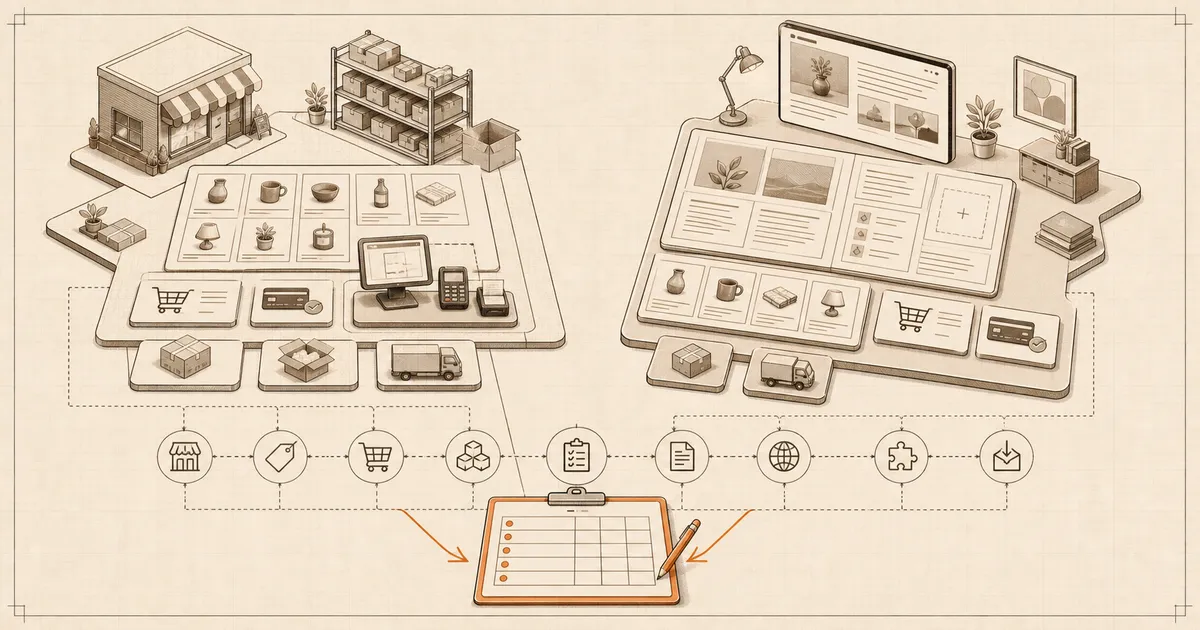
Use One Commerce Scenario in Both Platforms
A same-scenario worksheet prevents a polished demo or headline price from deciding the purchase. Use the same products, team, markets, transactions, content, and exit exercise in both systems.
Freeze the representative business
Define one fictional but realistic launch: 120 products with variants, two stock locations, an online store, occasional in-person sales, a blog, five campaign pages, three staff roles, domestic shipping, one secondary market, and two required extensions. Record which requirements are essential rather than aspirational.
Sources: [shopify-online-store], [shopify-products], [shopify-inventory], [shopify-pos], [squarespace-selling-plans], [squarespace-inventory], [squarespace-pos]
Build the same customer journey
Create the same homepage, collection, product detail, editorial article, and campaign page. Import a bounded catalog, configure the intended processor, then test cart, discount, checkout, receipt, cancellation, refund, and customer-account behavior with test data.
Sources: [shopify-themes], [shopify-sections-blocks], [shopify-products], [shopify-orders-fulfillment], [squarespace-fluid-engine], [squarespace-selling-plans], [squarespace-fees], [squarespace-commerce-overview]
Operate one difficult week
Receive stock at both locations, sell online and in person, fulfill a split order, issue a partial refund, handle an out-of-stock item, and reconcile the inventory and order records. Document every manual handoff, external dashboard, permission, and provider dependency.
Sources: [shopify-inventory], [shopify-orders-fulfillment], [shopify-pos], [squarespace-inventory], [squarespace-pos], [squarespace-commerce-overview]
Model the full production meter
Price the live site or store for the correct country and billing cycle. Include plan, processor and platform fees, theme, apps or extensions, email, domain, POS software and hardware, shipping services, and implementation or maintenance help. Use the dedicated cost guides for volatile figures.
Sources: [shopify-pricing-plans], [shopify-managing-apps], [shopify-pos], [squarespace-selling-plans], [squarespace-fees], [squarespace-extensions], [squarespace-pos]
Test the regional and exit boundaries
Configure the same secondary market, then export every supported data class and rehearse a non-production ownership transfer. Keep a separate ledger for domains, payment accounts, customer and order data, products, inventory, media, apps, themes, redirects, analytics, and external subscriptions.
Sources: [shopify-international-domains], [shopify-product-export], [shopify-ownership-transfer], [squarespace-countries-currencies], [squarespace-site-export], [squarespace-product-export], [squarespace-site-owner]
What This Bilateral Comparison Includes
This page answers direct Shopify-versus-Squarespace selection intent. For current vendor budgeting, use the Shopify website cost guide and the Squarespace website cost guide. For a broader replacement shortlist, use Shopify alternatives.
Included
- Current first-party storefront, catalog, checkout, inventory, order, fulfillment, POS, international, extension, ownership, and export documentation
- Both Shopify vs Squarespace and Squarespace vs Shopify platform-selection wording
- A same-scenario worksheet that tests customer experience and back-office operation
- The production meter and exit boundary behind the subscription plan
Not included
- A universal winner, score, rating, support conclusion, uptime comparison, speed benchmark, conversion claim, or generated-site quality judgment
- A complete regional price table, processor quote, tax calculation, shipping-carrier quote, enterprise negotiation, or implementation bid
- Shopify replacement, Squarespace replacement, generic best ecommerce platform, or generic website-builder intent
- A claim that transferring a site or store also transfers every domain, payment account, app, customer record, tax setup, or external subscription
- A claim that a CSV or partial website export reproduces the original theme, design, checkout, order history, app behavior, or hosted implementation
Nine Operating Boundaries to Compare
Score neither platform in the abstract. Record whether each boundary fits the same business scenario, who owns it, and what must happen when the business grows or moves.
Storefront authoring
Tests how the same homepage, collection, product page, editorial page, and campaign page are created and maintained.
Catalog and checkout
Connects product types, variants, cart, discounts, payment processing, transaction fees, and the customer account path.
Inventory, orders, and fulfillment
Shows how stock, locations, order states, refunds, shipping, and fulfillment are operated after the storefront launches.
In-person and multichannel selling
Checks whether online and in-person sales share products, inventory, orders, staff controls, payments, and hardware boundaries.
International selling
Separates translated content, regional URLs, currencies, processors, local pricing, tax setup, shipping, and market operations.
Content and website model
Tests whether commerce is the center of the site or one capability inside a broader editorial, service, membership, or portfolio website.
Extensions and customization
Distinguishes built-in behavior, themes, official integrations, third-party apps, extensions, APIs, custom code, support, and data ownership.
Production meter
Captures the paid site or store plan, transaction and processor fees, themes, apps, extensions, domains, email, POS, and outside help.
Ownership, export, and migration
Treats the site, theme, domain, payment accounts, products, customers, orders, media, apps, and operating procedures as separate handoff assets.
Shopify and Squarespace Operating Matrix
The matrix reports documented behavior as of the evidence date. It does not claim observed ease, reliability, support quality, performance, or sales outcomes.
Shopify
Best for: Commerce-led businesses that want products, inventory, orders, fulfillment, in-person sales, and regional storefront operations to share one commerce administration model.
Shopify organizes the business around a product catalog and commerce administration, then publishes an online store through themes, templates, sections, blocks, pages, and blogs. Its operating model extends across online and in-person channels, inventory locations, orders, fulfillment, markets, and apps. The exact plan, fees, hardware, apps, and regional availability still require account-level verification.
| Criterion | Finding |
|---|---|
| Storefront authoring | Shopify’s online store uses responsive themes. Templates organize product, collection, page, blog, cart, search, and other page types; sections and blocks control reusable layout and can connect to product or other custom data. Theme availability, licensing, features, and support vary by theme. Sources: [shopify-themes], [shopify-sections-blocks], [shopify-online-store] |
| Catalog and checkout | The Shopify admin centers the catalog on products, variants, prices, media, inventory, tags, metafields, and collections. The online store provides product discovery, cart, and accelerated checkout paths. The eligible plan, processor, region, and third-party transaction-fee path must be checked at purchase time. Sources: [shopify-products], [shopify-online-store], [shopify-pricing-plans] |
| Inventory, orders, and fulfillment | Shopify tracks inventory quantities and adjustment history and supports inventory by location. Its order and fulfillment documentation covers payment capture, order edits, cancellations, refunds, shipping configuration, routing, labels, tracking, and fulfillment through the merchant, an app, or a service. Sources: [shopify-inventory], [shopify-orders-fulfillment] |
| In-person and multichannel selling | Shopify POS runs on iOS or Android and syncs orders and inventory with the Shopify admin across retail locations, the online store, and active sales channels. The operation still needs a Shopify store, supported device, processor and country path, staff setup, locations, and any required hardware or POS subscription. Sources: [shopify-pos], [shopify-pricing-plans] |
| International selling | Shopify Markets can assign country- or region-specific domains, subdomains, or subfolders, plus languages and local currencies where supported. International domains require Basic or higher, and currency behavior depends on Shopify Payments and the configured market. Shipping, tax, entity, payment, and catalog rules still need regional review. Sources: [shopify-international-domains] |
| Content and website model | The Shopify online store supports custom pages, menus, search, blogs, and theme templates alongside product and collection pages. The content system is part of a commerce-led store model: products and collections live in the admin and themes render them into the storefront. Sources: [shopify-online-store], [shopify-themes] |
| Extensions and customization | Shopify apps can add sales channels, admin features, storefront extensions, automation, and integrations. The app details surface exposes permissions, privacy, billing and usage charges, extensions, functions, pixels, compatibility, history, and support. Uninstalling can leave theme code, external charges, data, inventory, or workflow cleanup behind. Sources: [shopify-managing-apps], [shopify-uninstalling-apps] |
| Production meter | The production meter starts with the Shopify plan, then can add payment and third-party transaction fees, a paid theme, apps with recurring or usage charges, POS software and hardware, domains, email, shipping services, and outside implementation. Model the actual country, plan, channel, and app stack. Sources: [shopify-pricing-plans], [shopify-managing-apps], [shopify-pos] |
| Ownership, export, and migration | Shopify documents ownership transfer, but the checklist separately calls out contact details, domains, billing, payouts, tax details, and third-party payment accounts. Product CSV exports support catalog movement, while product images depend on public source URLs during import. Inventory, orders, customers, theme, apps, and procedures need separate exit checks. Sources: [shopify-product-export], [shopify-ownership-transfer] |
Tradeoffs
- The commerce-centered model can reduce assembly across catalog, orders, inventory, fulfillment, POS, and regional storefronts while asking content and custom workflows to fit Shopify themes, apps, APIs, or custom storefront paths.
- A broad app ecosystem can extend the operation while adding app-specific permissions, support, data, billing, uninstall, and migration dependencies.
- Product CSV and theme download paths are useful assets, but neither alone is a complete portable copy of the live store and every connected service.
Squarespace
Best for: Content, service, portfolio, or brand-led websites that want commerce inside a cohesive visual site system and do not need the broader commerce operations model to define the whole website.
Squarespace combines a visual website system with store pages, products, checkout, customer accounts, inventory, orders, shipping, subscriptions, digital products, and point of sale. Current Basic, Core, Plus, and Advanced plan documentation mixes website and selling features, while commerce, digital-product, processor, extension, and regional boundaries still require direct verification.
| Criterion | Finding |
|---|---|
| Storefront authoring | Squarespace uses its visual website system for regular pages and store pages. On version 7.1, Fluid Engine is the primary drag-and-drop editor for block sections in all page types, portfolio projects, and the site footer, inside supported section and block behavior. Sources: [squarespace-fluid-engine], [squarespace-selling-plans] |
| Catalog and checkout | Current Squarespace plans can sell physical, digital, service, subscription, course, and membership products. A connected payment solution is required. Payment-processing rates apply to purchases, while Squarespace commerce and digital-product transaction fees depend on the plan and product type. Sources: [squarespace-selling-plans], [squarespace-fees], [squarespace-commerce-overview] |
| Inventory, orders, and fulfillment | Squarespace’s Products panel manages product visibility, SKUs, prices, variants, and stock. It supports quantity limits, cart reservations, bulk changes, low-stock alerts, waitlists, product import and export, order fulfillment, and extensions for inventory sync, with extension support remaining provider-specific. Sources: [squarespace-inventory], [squarespace-commerce-overview] |
| In-person and multichannel selling | Squarespace POS uses the Squarespace app for in-person sales in the United Kingdom and United States. Current documentation distinguishes Squarespace Payments, Stripe, and Square processor paths, Tap to Pay on iPhone or Android, Pay Links, US-only Square Reader support, and the link back to store inventory and order refunds. Sources: [squarespace-pos], [squarespace-fees] |
| International selling | Squarespace Commerce availability depends on the connected processor and bank-account location. A store accepts one currency at a time, even when multiple currencies are available to the account, and processor conversion fees can apply. Shipping can be international where the carrier supports it. Sources: [squarespace-countries-currencies] |
| Content and website model | Squarespace’s plan model starts with the website and adds selling, memberships, courses, invoices, customer accounts, analytics, code features, and other business tools by plan. Commerce sits inside the same visual site rather than defining every page around the catalog. Sources: [squarespace-selling-plans], [squarespace-fluid-engine] |
| Extensions and customization | Squarespace documents official integrations, third-party Extensions, code-based customizations, and public APIs. Some official integrations or external services need separate subscriptions; Extensions are built and supported by their providers and can carry their own price, permissions, data, and exit boundary. Sources: [squarespace-integrations], [squarespace-extensions] |
| Production meter | The production meter begins with one website plan and can add payment-processing and transaction fees, domains, email campaigns, scheduling or digital-product services, extensions, POS processor and hardware, and implementation help. New plan rollouts and country availability make account-level verification necessary. Sources: [squarespace-selling-plans], [squarespace-fees], [squarespace-extensions], [squarespace-pos] |
| Ownership, export, and migration | Squarespace can transfer site ownership to an accepted contributor, with separate follow-up for billing, connected domains, payment accounts, and prior-owner access. Site export uses WordPress XML for selected content and excludes many page, style, store, draft, and media elements; products use a separate CSV path. Sources: [squarespace-site-owner], [squarespace-site-export], [squarespace-product-export] |
Tradeoffs
- The website-first system can keep content, design, services, memberships, and a store in one coherent surface while deeper commerce operations may depend on the chosen plan, processor, extensions, APIs, or outside systems.
- Squarespace supports inventory and point of sale, but international selling uses one store currency at a time and in-person processor, device, and country constraints are explicit.
- Website and product exports cover selected content and catalog data rather than a complete copy of every design, store, media, payment, service, and operational record.
Decision Rules That Survive Launch
Choose the operating model that removes the largest recurring risk in the representative scenario. Re-run the comparison when catalog, channels, team, markets, or content strategy change.
Catalog, inventory, orders, fulfillment, in-person sales, and multiple regional storefronts are the core operating system.
Choose: Prototype in Shopify and verify the exact plan, processor, POS, location, market, theme, app, and export stack.
Tradeoff: The commerce-first model can consolidate more retail operations while increasing dependence on Shopify-specific themes, apps, permissions, and data boundaries.
The primary asset is a content, portfolio, service, membership, or brand website, and commerce is one supporting capability.
Choose: Prototype in Squarespace and verify the store, plan, processor, fee, inventory, POS, extension, and export boundaries against the same journey.
Tradeoff: The website-first model can keep design and content coherent while deeper commerce workflows may require another service, extension, or operating workaround.
The business needs one localized storefront URL and currency strategy per market, plus shared inventory and retail channels.
Choose: Test Shopify Markets and POS against the exact entities, processors, currencies, domains, catalogs, locations, taxes, and shipping rules.
Tradeoff: More built-in market structure can reduce custom assembly while increasing setup and governance across markets and entities.
The business sells in one main currency and prioritizes editorial presentation over complex multichannel operations.
Choose: Test Squarespace with the intended processor, store currency, shipping, inventory, and content workflow before adding extensions.
Tradeoff: A focused website-and-store system may be easier to operate, but it offers a narrower default path for market-specific storefronts and complex retail operations.
Neither platform can express the required custom workflow, record model, portal, dashboard, or business rule.
Choose: Treat the gap as a custom software job rather than forcing it into a theme or app stack. Keep the payment, tax, shipping, inventory, and fulfillment providers explicit.
Tradeoff: Custom software gives the workflow more room but creates responsibility for requirements, testing, integrations, security, operations, and maintenance.
The current Shopify or Squarespace setup already works and the move has no measured business or operational outcome.
Choose: Stay, document ownership and exports, and improve the existing storefront before starting a migration.
Tradeoff: Staying preserves a known operating system; moving adds catalog, order, redirect, checkout, data, domain, and staff-change risk.
Need custom software behind the storefront?
Describe the commerce workflow the template cannot hold.
Playcode can build a custom website, portal, dashboard, or app when the provider APIs and credentials exist. It is not a turnkey Shopify or Squarespace replacement, and your team still owns payments, catalog data, tax, shipping, fulfillment, policies, and operations.
Start BuildingNo credit card required. AI credits included to start.
Compare the broader Shopify replacement shortlistUse the shortlist only when replacement intent is real and the exit inventory is complete.
What This Comparison Does Not Prove
First-party documentation establishes current platform boundaries. It does not prove the result of a particular store, team, processor, app stack, or migration.
- No controlled storefront build, checkout, accessibility, Core Web Vitals, conversion, uptime, support, POS, fulfillment, or migration benchmark was performed.
- Plans, promotions, plan names, fees, processor support, POS hardware, market features, tax behavior, and app or extension pricing can change by country, billing cycle, account, and rollout.
- Official documentation does not prove that a theme, third-party app, extension, custom code path, processor, carrier, or tax service will fit a specific operation.
- Store or site ownership does not automatically settle ownership of domains, payment accounts, customer data, media rights, tax records, apps, themes, or external subscriptions.
- CSV, XML, and theme exports do not prove a complete, lossless, or automatically importable migration of the full hosted operation.
- Playcode is not presented as a turnkey commerce platform. A custom build still needs explicit provider integration, credentials, security, reconciliation, tax, shipping, fulfillment, policy, and maintenance ownership.
Current First-Party Evidence
Every product finding maps to the official source IDs below. Pages without a revision date were accessed and checked on September 5, 2026.
[shopify-online-store] Shopify Help Center:Online Store
Checked September 5, 2026. Supports: Online-store pages, blog, responsive themes, navigation, search, custom domains, checkout buttons, and the custom-storefront boundary.
[shopify-themes] Shopify Help Center:Shopify Themes
Checked September 5, 2026. Supports: Theme-based storefront design, theme selection, customization, support, licensing, publishing, and management.
[shopify-sections-blocks] Shopify Help Center:Sections and Blocks
Checked September 5, 2026. Supports: Theme section and block layout, settings, rearrangement, dynamic sources, and the theme-code fallback boundary.
[shopify-products] Shopify Help Center:Products
Checked September 5, 2026. Supports: Catalog fields, variants, media, inventory, tags, metafields, collections, and bulk-management boundaries.
[shopify-inventory] Shopify Help Center:Managing Inventory
Checked September 5, 2026. Supports: Inventory tracking, quantities, adjustments, reports, locations, transfers, purchase orders, and alert-app boundaries.
[shopify-orders-fulfillment] Shopify Help Center:Order Management and Fulfillment
Checked September 5, 2026. Supports: Orders, payment capture, edits, refunds, cancellations, shipping configuration, labels, tracking, and fulfillment paths.
[shopify-pos] Shopify Help Center:Selling in Person With Shopify POS
Checked September 5, 2026. Supports: iOS and Android POS, order and inventory sync, retail locations, payment methods, hardware, staff, refunds, and country boundaries.
[shopify-international-domains] Shopify Help Center:International Domains
Checked September 5, 2026. Supports: Market-specific domains, subdomains, subfolders, languages, currencies, Basic-plan requirement, and regional URL setup.
[shopify-pricing-plans] Shopify Help Center:Pricing Plans
Checked September 5, 2026. Supports: Plan selection, upgrades, POS consideration, local pricing, and the current-account verification boundary.
[shopify-managing-apps] Shopify Help Center:Managing Apps
Checked September 5, 2026. Supports: App billing and usage charges, permissions, privacy, extensions, functions, pixels, compatibility, history, and support.
[shopify-uninstalling-apps] Shopify Help Center:Uninstalling Apps
Checked September 5, 2026. Supports: Theme-code cleanup, external billing, customer-data requests, inventory location handling, and app-dependent workflow checks after uninstall.
[shopify-product-export] Shopify Help Center:Exporting Products
Checked September 5, 2026. Supports: Product CSV export, backup and migration uses, variant handling, image URL dependence, and inventory-assignment boundaries.
[shopify-ownership-transfer] Shopify Help Center:Change or Transfer Ownership
Checked September 5, 2026. Supports: Store ownership transfer and the separate contact, domain, billing, payout, tax, payment-provider, and permission checklist.
[squarespace-fluid-engine] Squarespace Help Center:Edit Your Site With Fluid Engine
Checked September 5, 2026. Supports: Version 7.1 block-section drag-and-drop editing, grid-based block placement, classic-editor section upgrades, and supported section boundaries.
[squarespace-selling-plans] Squarespace Help Center:Selling on Basic, Core, Plus, and Advanced Plans
Checked September 5, 2026. Supports: Current plan rollout, website and commerce features, products, memberships, subscriptions, contributors, code, analytics, POS, and fees.
[squarespace-fees] Squarespace Help Center:Transaction Fees and Payment Processing Rates
Checked September 5, 2026. Supports: Payment processing and Squarespace transaction fees by plan, country, processor, product type, invoice, Pay Link, and Scheduling path.
[squarespace-inventory] Squarespace Help Center:Managing Inventory
Checked September 5, 2026. Supports: Products panel, store pages, SKUs, stock, variants, quantity limits, cart reservations, bulk edits, alerts, and extension sync.
[squarespace-commerce-overview] Squarespace Help Center:Sell on Squarespace
Checked September 5, 2026. Supports: Commerce availability by plan, product types, processors, subscriptions, quantity limits, cart reservations, order fulfillment, international shipping boundaries, extensions, and regional availability.
[squarespace-pos] Squarespace Help Center:Selling in Person With Squarespace
Checked September 5, 2026. Supports: Squarespace app POS, supported countries and processors, device and hardware boundaries, inventory connection, cash sales, and refunds.
[squarespace-countries-currencies] Squarespace Help Center:Supported Countries and Currencies for Commerce
Checked September 5, 2026. Supports: Processor and country availability, bank-account and store currency, one-currency-at-a-time operation, conversion fees, and international shipping.
[squarespace-integrations] Squarespace Help Center:Squarespace Integrations
Checked September 5, 2026. Supports: Official integrations, included and separately paid services, setup support, and custom-code or extension alternatives.
[squarespace-extensions] Squarespace Help Center:Squarespace Extensions
Checked September 5, 2026. Supports: Third-party extension roles, pricing, permissions, provider support, commerce APIs, and inventory or order synchronization paths.
[squarespace-site-owner] Squarespace Help Center:Change the Site Owner
Checked September 5, 2026. Supports: Site ownership transfer, contributor prerequisite, attached subscriptions, payment-account follow-up, and prior-owner access review.
[squarespace-site-export] Squarespace Help Center:Exporting Your Site
Checked September 5, 2026. Supports: WordPress XML export and the excluded page, product, style, custom-code, draft, and media classes.
[squarespace-product-export] Squarespace Help Center:Exporting Products to a CSV
Checked September 5, 2026. Supports: Separate product CSV export and its distinction from the partial WordPress XML website export.
Shopify vs Squarespace FAQ
Is Shopify or Squarespace better for a small online store?
Start with the operating model, not store size. Shopify is commerce-first and connects catalog, inventory, orders, fulfillment, sales channels, POS, and markets in one administration model. Squarespace is website-first and can add products, checkout, inventory, orders, subscriptions, and POS to a visual site. Run the same launch and difficult-week worksheet before choosing.
Is Shopify or Squarespace cheaper?
There is no stable universal answer. Price the same country, billing cycle, products, processor, sales channels, staff, theme, apps or extensions, email, domain, POS, shipping services, and outside help. Shopify and Squarespace have different plan, transaction-fee, processor, app, extension, and hardware paths. Use the dedicated vendor cost guides for current figures.
Which is better for inventory and order management?
Shopify documents a broader commerce operations model across inventory locations, orders, fulfillment, online channels, and Shopify POS. Squarespace also manages SKUs, variants, stock, cart reservations, orders, refunds, shipping, and extensions. The practical test is one difficult week: receive stock, sell online and in person, split fulfillment, refund an item, and reconcile every record.
Can Squarespace handle ecommerce?
Yes. Current Squarespace plans support selling products and services, and the platform documents checkout, payment processors, inventory, orders, shipping, subscriptions, digital products, customer accounts, transaction fees, and point of sale. Fit still depends on the plan, country, processor, store currency, product type, extensions, and how much commerce operations depth the business needs.
Which is better for content and design?
Squarespace centers the workflow on a visual website system, which can fit content, portfolio, service, membership, and brand-led sites with commerce attached. Shopify supports responsive themes, templates, sections, blocks, pages, menus, search, and a built-in blog, but its center of gravity remains the product catalog and commerce administration. Build the same editorial and campaign pages in both.
Which is better for selling internationally?
Shopify documents market-specific domains, subdomains or subfolders, languages, and supported local currencies through Markets. Squarespace Commerce can sell internationally where the processor and bank-account path works, but a store uses one currency at a time. Verify entities, processors, currencies, domains, tax, catalogs, shipping, and translation needs for every intended country.
Can I move from Shopify to Squarespace or Squarespace to Shopify?
Plan a controlled migration, not a one-click copy. Both platforms provide product CSV paths, and Squarespace provides a partial WordPress XML site export. Those files do not reproduce every design, theme, checkout, order, customer, inventory, app, extension, payment, or media record. Keep the old site running until routes, redirects, catalog, checkout, analytics, email, and DNS pass.
Is Playcode a Shopify or Squarespace replacement?
Not as a turnkey commerce platform. Playcode is useful when the job is a custom website, portal, dashboard, or app and the required providers expose APIs that the team can connect with its own credentials. The team still owns payment accounts, product and customer data, security, reconciliation, tax, shipping, fulfillment, policies, monitoring, and ongoing maintenance.
Build the workflow the store needs
Keep commerce providers explicit. Make the software fit.
Describe the website, portal, dashboard, or custom app you need. Playcode builds a working project you can review and keep changing, while payments and commerce services remain explicit provider integrations.
Start BuildingNo credit card required. AI credits included to start.