QUICK ANSWER
How much does a Shopify website cost in 2026?
On September 6, 2026, Shopify’s official US annual pricing listed Basic at USD 29 per month, Grow at USD 79, and Advanced at USD 299, or USD 348, USD 948, and USD 3,588 prepaid yearly. That is only the fixed plan: add actual payment processing, third-party transaction fees where applicable, apps, theme, domain, fulfillment, returns, content, support, tax, and labor.
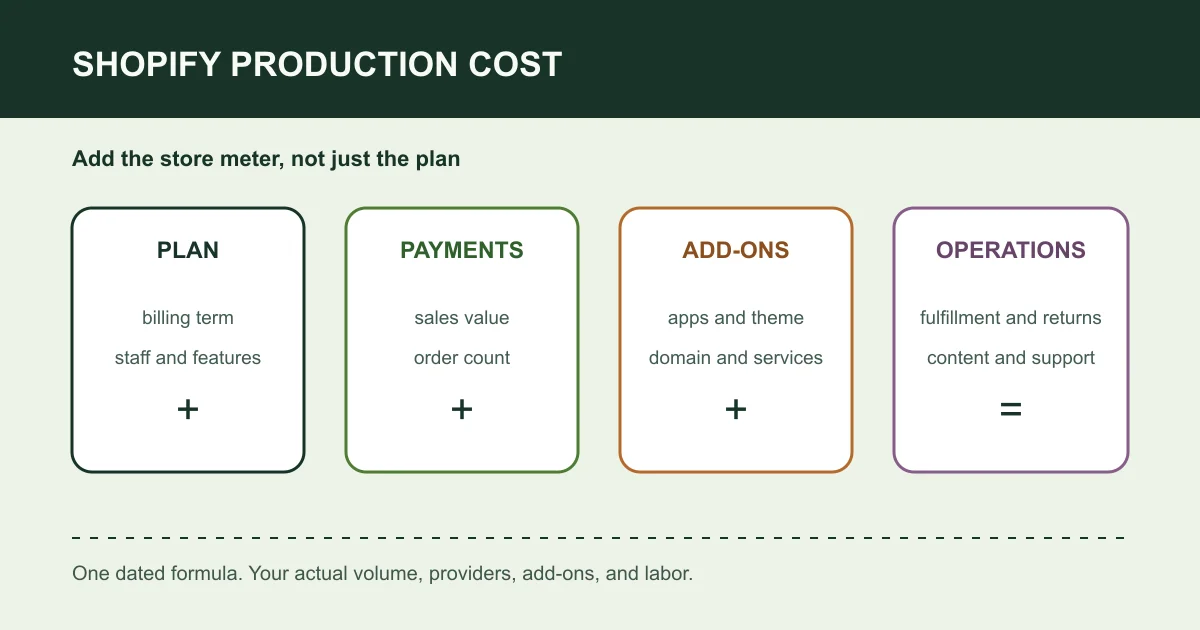
A Shopify store costs more than its subscription. The production meter also depends on sales value, transaction count, payment method, apps, theme, domain, shipping and fulfillment services, returns, content, tax responsibilities, support, and the people operating the store.
This guide owns Shopify-specific production cost. The broader website cost guide compares build methods, while the separate ecommerce cost owner covers provider-neutral catalog, payment, fulfillment, return, and operating scope.
Assumptions behind the fixed and variable examples
The visible arithmetic is deliberately narrow. Replace the example volume and every optional row with the store’s actual current inputs.
| Assumption | Value used | Why it changes the estimate |
|---|---|---|
| Market and currency | United States, USD, before tax | Plan and payment rates vary by location, payment-provider eligibility, card or method, and settlement conditions. |
| Plan billing | Basic, Grow, or Advanced annual plan, paid for the year | The displayed monthly equivalent is multiplied by 12. Monthly terms and promotions are not substituted. |
| Controlled payment example | USD 60,000 eligible online card sales across 1,200 transactions | This is arithmetic for comparing plan and starting-rate inputs, not a forecast or typical Shopify store. |
| Payment path | Shopify Payments or a third-party provider modeled separately | The third-party path needs both Shopify’s applicable transaction fee and the provider’s own current charges. |
| Optional and operating costs | Actual selected theme, apps, domain, services, setup, and monthly labor | No universal range is inserted for supplier-priced or workload-specific rows. |
DATED PRODUCTION METER
Put plan and payment volume in the same worksheet
These US annual-plan and online card-rate inputs were checked September 6, 2026. They are planning comparisons, not quotes, guarantees, or workload recommendations. Recheck region, eligibility, rates, and checkout by September 20, 2026.
| Plan | Annual charge | Online card rate | Third-party Shopify fee |
|---|---|---|---|
| Basic | USD 348 | 2.9000000000000004% + USD 0.3 | 2% of eligible sales |
| Grow | USD 948 | 2.7% + USD 0.3 | 1% of eligible sales |
| Advanced | USD 3,588 | 2.5% + USD 0.3 | 0.6% of eligible sales |
Source: [shopify-pricing]
A controlled example, not a universal store total
The next table isolates USD 60,000 of eligible US online card sales across 1,200 transactions. It excludes tax, apps, theme, domain, shipping, returns, provider eligibility, disputes, international or currency additions, and human work.
| Plan | Annual plan charge | Processing | Known subtotal | Third-party Shopify fee only |
|---|---|---|---|---|
| Basic | USD 348 | USD 2,100 | USD 2,448 | USD 1,200 + provider charges |
| Grow | USD 948 | USD 1,980 | USD 2,928 | USD 600 + provider charges |
| Advanced | USD 3,588 | USD 1,860 | USD 5,448 | USD 360 + provider charges |
Complete the production ledger
- Shopify subscription: Current plan charge for the selected billing term and location
- Payment processing: Eligible sales x method rate + transaction count x fixed fee
- Third-party payment fee: Eligible sales x current Shopify plan rate + the provider own charges
- Apps, theme, and domain: Every selected subscription, usage meter, one-time purchase, and renewal
- Store operations: Actual setup and monthly content, fulfillment, return, support, and review hours
How this Shopify production-cost model works
Start with the fixed annual plan, calculate payment costs from actual volume, then add every selected service and operating responsibility on its own row.
Select the minimum plan from the required store job
Use staff access, reporting, market, shipping, payment, and operational requirements to choose a candidate plan. Shopify’s own plan guide says the useful break point varies by region and payment path; a lower processing rate alone is not proof that a higher plan fits.
Sources: [shopify-pricing], [shopify-plan-selection]
Normalize the plan billing term
The checked US figures are annual-plan monthly equivalents. Multiply each by 12, record that the year is paid in advance, and keep the monthly plan option, promotions, tax, and nonrefundable-term boundary separate.
Sources: [shopify-pricing], [shopify-billing-overview]
Calculate payments from sales value and order count
For Shopify Payments, multiply eligible sales by the current method rate and add the fixed amount for each transaction. For a third-party provider, add Shopify’s plan-specific transaction fee to the provider’s own current charges. Model refunds, international cards, currency, disputes, store credit, and gift cards separately when they apply.
Sources: [shopify-pricing], [shopify-billing-overview]
Add selected apps, theme, domain, and services
List recurring, usage-based, and one-time app charges; one-time theme purchases; annual domain renewal; email hosting; and every selected fulfillment, shipping, tax, support, or marketing service. Each can have a different billing cycle and cancellation path.
Sources: [shopify-app-charges], [shopify-app-management], [shopify-theme-store], [shopify-domains], [shopify-bill-types]
Price the operating workflow
Record actual setup and monthly time for catalog, merchandising, content, inventory, fulfillment, returns, customer support, reconciliation, access review, analytics, and changes. A platform subscription does not perform or own every business operation.
Sources: [shopify-bill-types], [shopify-app-management]
What this Shopify cost guide covers
The article explains the Shopify-specific fixed plan, transaction, extension, supplier, and operating cost structure. If the job is choosing a different ecommerce platform rather than pricing Shopify, use the Shopify alternatives comparison. This guide does not claim one average store price.
Included
- Current US annual-plan arithmetic for Basic, Grow, and Advanced
- Starting US online Shopify Payments and third-party transaction-fee formulas
- Apps, themes, domain, setup, fulfillment, returns, content, support, tax-tool, and owner-time rows
- A deterministic sales-and-transaction example with explicit exclusions
Not included
- A universal cost for every country, payment method, currency, tax, app, theme, domain, shipment, return, or employee
- The provider-neutral cost of building any ecommerce system or website
- A Shopify alternative comparison, migration promise, or universal price-winner claim about Playcode
- Promises about conversion, revenue, profit, payment approval, tax compliance, shipping performance, or business outcomes
Shopify cost by plan and production meter
Each scenario starts with a dated US annual plan and shows one controlled Shopify Payments example. Feature fit and every excluded row still need review.
Basic annual plan
A solo operator whose required store workflow fits Basic and who does not need the higher-plan staff, reporting, market, or shipping features.
- One-time
- USD 348 annual plan: USD 29 monthly equivalent x 12, paid for the year before tax.
- Recurring
- In the controlled USD 60,000 and 1,200-order Shopify Payments example, processing is USD 2,100 and plan plus processing is USD 2,448 before every excluded row.
Includes
- The checked Basic annual plan charge
- 2.9% x USD 60,000 + USD 0.30 x 1,200 payment arithmetic
Excludes
- Apps, theme, domain, tax, international or currency additions, disputes, refunds, shipping, returns, and labor
Uncertainty: Feature needs, location, eligibility, payment mix, average order value, and actual transaction volume can change both fit and cost.
Sources: [shopify-pricing], [shopify-billing-overview]
Grow annual plan
A small team that needs the checked Grow staff or reporting scope and has tested whether the full plan difference is justified.
- One-time
- USD 948 annual plan: USD 79 monthly equivalent x 12, paid for the year before tax.
- Recurring
- In the controlled USD 60,000 and 1,200-order Shopify Payments example, processing is USD 1,980 and plan plus processing is USD 2,928 before every excluded row.
Includes
- The checked Grow annual plan charge
- 2.7% x USD 60,000 + USD 0.30 x 1,200 payment arithmetic
Excludes
- A claim that the lower rate alone saves money after plan, feature, provider, app, and operating differences
Uncertainty: Shopify’s official selection guidance says useful break points vary with location and whether Shopify Payments is used.
Sources: [shopify-pricing], [shopify-plan-selection]
Advanced annual plan
A higher-volume or international operation that can document a need for the checked Advanced market, staff, reporting, or shipping capabilities.
- One-time
- USD 3,588 annual plan: USD 299 monthly equivalent x 12, paid for the year before tax.
- Recurring
- In the controlled USD 60,000 and 1,200-order Shopify Payments example, processing is USD 1,860 and plan plus processing is USD 5,448 before every excluded row.
Includes
- The checked Advanced annual plan charge
- 2.5% x USD 60,000 + USD 0.30 x 1,200 payment arithmetic
Excludes
- A presumption that a lower payment rate makes Advanced suitable for every store
Uncertainty: The higher fixed plan row must be justified by actual sales, payment, staff, reporting, market, shipping, and operating requirements.
Sources: [shopify-pricing], [shopify-plan-selection]
Third-party payment provider path
A store where Shopify Payments is unavailable or another provider is selected after reviewing eligibility and operating needs.
- One-time
- Use the selected Shopify plan charge and the provider’s actual setup, verification, migration, and hardware inputs.
- Recurring
- At USD 60,000 eligible sales, the checked Shopify fee alone is USD 1,200 Basic, USD 600 Grow, or USD 360 Advanced, before the provider’s own charges.
Includes
- The plan-specific Shopify third-party transaction-fee arithmetic
Excludes
- The provider’s processing, fixed, refund, dispute, currency, payout, and service charges
Uncertainty: Payment availability, provider rates, transaction eligibility, store-credit treatment, country, currency, refunds, and disputes can move the total.
Sources: [shopify-pricing], [shopify-billing-overview]
The complete Shopify production ledger
Give fixed, variable, one-time, supplier, and human-work rows separate owners and billing cadences so one plan headline does not hide the operating system.
| Category | One-time | Recurring | Main drivers |
|---|---|---|---|
| Shopify subscription The fixed platform charge for the selected plan, billing period, store, location, and current feature set. Sources: [shopify-pricing], [shopify-billing-overview] | Checked annual charges are USD 348 Basic, USD 948 Grow, or USD 3,588 Advanced before tax. | The account’s current renewal for its plan, term, location, and tax treatment. | plan; billing term; location; tax; promotion; store count |
| Payment processing and Shopify transaction fees Card or payment processing and Shopify’s third-party transaction fee are distinct charges with plan, method, and location boundaries. Sources: [shopify-pricing], [shopify-billing-overview] | Provider setup, verification, migration, testing, and launch work from actual inputs. | Eligible sales x percentage + transaction count x fixed fee, plus applicable international, currency, refund, dispute, gift-card, store-credit, and third-party charges. | sales; orders; method; provider; country; currency; refunds |
| Apps Apps can use recurring, usage-based, one-time, or externally billed charges and a billing cycle different from the Shopify plan. Sources: [shopify-app-charges], [shopify-app-management], [shopify-bill-types] | Every selected one-time app purchase, migration service, and configuration input. | Every active recurring or usage charge, including externally billed products. | app count; plan; usage; spending limit; billing cycle; external billing |
| Theme and storefront work Free and paid themes exist, while setup, customization, content, accessibility, and later changes remain project work. Sources: [shopify-theme-store], [shopify-bill-types] | Selected Theme Store purchase plus actual setup and customization hours. | Only supplier support, service, or operating work that actually recurs. | theme; catalog; templates; customization; review; support |
| Domain, email, and adjacent services A Shopify-managed domain renews annually and separately from the plan; email hosting comes from a third party. Sources: [shopify-domains], [shopify-bill-types] | Current registration for the selected extension and actual mailbox setup. | Annual domain renewal plus each active mailbox or external service. | extension; registrar; mailboxes; renewal; privacy; provider |
| Fulfillment, returns, content, and operations Inventory, shipping, labels, fulfillment, returns, support, merchandising, analytics, tax work, and access review remain business operations. Sources: [shopify-bill-types], [shopify-app-management] | Actual catalog, migration, process setup, policy, training, and launch work. | Actual service charges and monthly owner or specialist hours. | orders; SKUs; locations; shipping; returns; support; change rate |
What can change the Shopify estimate
The fixed plan is easy to reproduce. The larger uncertainty is the store’s actual payment mix, extension stack, supplier services, catalog and fulfillment workflow, returns, support load, and owner time.
What moves the estimate
- Country, currency, tax, plan term, promotion, payment eligibility, and checkout changes
- Sales value, transaction count, average order value, payment method, international cards, currency, refunds, and disputes
- App subscriptions, usage meters, external billing, theme, domain, email, and service providers
- Catalog size, inventory locations, fulfillment, shipping, labels, returns, customer support, and tax responsibilities
- Content, migration, merchandising, access review, reconciliation, analytics, and human operating time
Re-estimate when
- The plan, billing term, payment provider, country, settlement currency, or card mix changes
- Sales value, order count, refunds, disputes, store credit, or gift-card use changes materially
- An app trial, theme purchase, domain, promotion, or external service approaches renewal
- The store adds markets, staff, locations, channels, subscriptions, wholesale, new shipping paths, or tax responsibilities
- The operator starts spending recurring time on catalog, returns, support, reconciliation, or manual workarounds
Shopify costs after launch
Record each charge on its real billing and usage cycle. Shopify plan, app, domain, payment, shipping, and external-service charges do not all arrive on one schedule.
| Cost | Cadence | Planning range | Boundary |
|---|---|---|---|
| Shopify plan renewal Sources: [shopify-pricing], [shopify-billing-overview] | 30-day plan cycle or annual billing term | Current renewal for the selected plan, store, location, tax, and billing term. | Annual billing lowers the displayed effective monthly rate but charges the year in advance. |
| Payment and transaction charges Sources: [shopify-pricing], [shopify-billing-overview] | Per eligible transaction and billing statement | Actual sales x current percentage + transactions x fixed amount + applicable event charges. | A third-party provider can add its charges alongside Shopify’s applicable plan-specific fee. |
| App subscriptions and usage Sources: [shopify-app-charges], [shopify-app-management] | Independent 30-day, usage, one-time, or external supplier cycle | The sum of active app subscriptions, usage, one-time purchases, and external charges. | Uninstall and external cancellation rules differ; review the next bill and the app supplier together. |
| Domain and external services Sources: [shopify-domains], [shopify-bill-types] | Annual domain and supplier-specific subscription | Current extension renewal plus every active email, fulfillment, shipping, support, or other service. | Shopify-managed domains renew separately from the plan and Shopify does not provide email hosting. |
| Store operating work Sources: [shopify-bill-types], [shopify-app-management] | Monthly hours and per-order work | Actual owner and specialist hours x their economic rates, plus selected supplier services. | Include catalog, merchandising, fulfillment, returns, support, reconciliation, access review, analytics, and changes. |
Choose from the complete production meter
These rules prevent a lower percentage or promotional headline from substituting for feature fit and store operations.
The store is choosing among Basic, Grow, and Advanced.
Choose: Compare annual plan difference, required features, staff, markets, reporting, shipping, and the exact payment path together.
Tradeoff: A higher plan can lower selected transaction rates while raising the fixed subscription and adding features the store may not need.
Shopify Payments is available and selected.
Choose: Model every relevant method from expected sales and transaction count, then include international, currency, refund, dispute, and credit cases separately.
Tradeoff: Integrated payment administration simplifies one boundary, but method and event-specific fees still affect the production meter.
A third-party payment provider is required.
Choose: Add Shopify’s plan-specific applicable fee and the provider’s complete current pricing and eligibility terms.
Tradeoff: The provider can satisfy a market or workflow need while adding another contract, reconciliation path, fee schedule, and failure boundary.
An app or premium theme is proposed.
Choose: Record the job, supplier, permissions, data path, charge type, usage limit, support, renewal, cancellation, and replacement plan.
Tradeoff: An extension can reduce custom work while adding cost, permissions, compatibility, supplier, data, and migration dependencies.
The desired store also needs custom portal, dashboard, or operational workflows.
Choose: Compare the complete extension and operating stack with a guided custom build-and-run path before committing.
Tradeoff: A custom path offers different workflow flexibility but requires its own payment, ecommerce, operations, and provider boundaries.
Need a custom workflow behind the storefront?
Describe the site and the software behind it
Playcode can build and run a website, portal, dashboard, or app. Model payment-provider requirements, data, operations, and current plan limits before choosing.
Start BuildingNo credit card required. AI credits included under current terms.
Review current Playcode pricing and plan limitsThis article does not copy a Playcode price into the Shopify model.
Limits of this Shopify cost guide
This is a dated planning model, not a Shopify checkout, payment-provider agreement, app contract, fulfillment plan, tax review, or supplier proposal.
- Plan, payment, transaction, currency, country, promotion, eligibility, and tax terms can change before the review date.
- Starting card rates do not describe every payment method, international card, currency conversion, refund, dispute, store-credit, or gift-card case.
- No universal app, theme, domain, fulfillment, shipping, return, support, content, tax, migration, or labor range is inserted.
- Theme Store and App Store availability do not prove that a product fits, remains supported, protects data, or has no external charges.
- The controlled USD 60,000 and 1,200-transaction example is arithmetic, not a forecast, recommendation, or typical-store claim.
- The guide does not promise that Shopify or Playcode will be cheaper, easier, more profitable, compliant, or better for every store.
Official sources checked for this guide
These first-party Shopify pages support the visible facts. Checked dates record access, not a claim that every page exposes a revision date.
[shopify-pricing] Shopify:Shopify pricing
Checked September 6, 2026. Supports: US annual prices for Basic, Grow, and Advanced; starting online card rates; third-party transaction-fee rates; and current plan feature comparison.
[shopify-billing-overview] Shopify Help Center:Pricing plans and billing overview
Checked September 6, 2026. Supports: Plan billing, annual discount boundary, payment processing, third-party transaction fees, refunds, store credit and gift-card rules, and separate provider charges.
[shopify-plan-selection] Shopify Help Center:Choosing the right Shopify plan
Checked September 6, 2026. Supports: Plan audience guidance and official region- and payment-path-dependent break-even examples, including the warning that actual break points vary.
[shopify-app-charges] Shopify Help Center:App charges on Shopify bills
Checked September 6, 2026. Supports: Recurring, usage-based, one-time, and external app charges; independent 30-day cycles; spending limits; uninstall timing; and pending-charge boundaries.
[shopify-app-management] Shopify Help Center:Managing Shopify apps
Checked September 6, 2026. Supports: Where to review app subscription, billing cycle, usage charges, spending limit, permissions, privacy, and compatibility details.
[shopify-theme-store] Shopify:Shopify Theme Store
Checked September 6, 2026. Supports: Free and paid themes coexist and current paid theme prices are product-specific rather than one universal theme amount.
[shopify-bill-types] Shopify Help Center:Types of charges on Shopify bills
Checked September 6, 2026. Supports: Plan, app, shipping, transaction, domain, theme, one-time, recurring, and per-use charges can appear on different bill types.
[shopify-domains] Shopify Help Center:Buying a domain through Shopify
Checked September 6, 2026. Supports: Domain price depends on extension, registration is one year, renewal is annual and separate from the plan, and email hosting is third-party.
Shopify website cost questions
How much was Shopify annual billing in the US on September 6, 2026?
The official US page listed Basic at USD 29 per month billed yearly, Grow at USD 79, and Advanced at USD 299. That is USD 348, USD 948, or USD 3,588 prepaid for the year before tax. Recheck checkout.
Is the Shopify plan the complete store cost?
No. Add payment processing, applicable third-party transaction fees, apps, theme, domain, email, shipping, fulfillment, returns, content, support, tax responsibilities, migration, setup, and operator time when they apply.
How do I calculate Shopify Payments cost?
For each eligible method, multiply sales value by its current percentage and add transaction count times the fixed amount. Keep country, plan, method, international cards, currency, refunds, disputes, store credit, and gift cards separate.
What happens with a third-party payment provider?
Shopify can charge a plan-specific third-party transaction fee, and the provider charges its own rates separately. Model both contracts, eligibility, fixed and percentage fees, refunds, disputes, currency, payouts, and reconciliation.
How much do Shopify apps cost?
There is no universal amount. Apps can be free, recurring, usage-based, one-time, or billed outside Shopify. Review each app’s current charge type, billing cycle, usage limit, permissions, data handling, support, renewal, and cancellation.
Do I need to pay for a Shopify theme and domain?
Free and paid themes exist. A Shopify-managed domain is purchased and renewed separately, with price depending on the extension. Email hosting is third-party. Use the actual selected products instead of a generic allowance.
When should I recalculate Shopify cost?
Recalculate before purchase and renewal and when plan, country, payment provider, sales, orders, card mix, apps, theme, domain, staff, markets, shipping, returns, support, tax responsibilities, or owner time changes.
Build and run in one guided path
Start with the website, then add the workflow
Describe what the site and business workflow must do. Playcode builds and runs websites and apps under current plan and provider limits.
Build My WebsiteNo credit card required. AI credits included under current terms.