QUICK ANSWER
How much does a WordPress website cost in 2026?
On September 5, 2026, WordPress.com displayed US annual-plan equivalents of USD 4, USD 8, USD 25, and USD 45 per month, or USD 48-540 for the prepaid year. Self-hosted WordPress has no software licensing fee, but there is no sourced universal total: add actual hosting, domain, theme, plugin, setup, maintenance, security, backup, and migration inputs.
A WordPress website does not have one universal price. WordPress.com bundles software and hosting into a plan, while self-hosted WordPress starts with a USD 0 software license and leaves hosting, domain, extensions, maintenance, backup, recovery, and labor to the owner and chosen suppliers.
This guide owns the WordPress-specific cost decision. For a provider-neutral project budget, use the complete website cost guide. For hosting architecture and provider meters, use the website hosting cost guide.
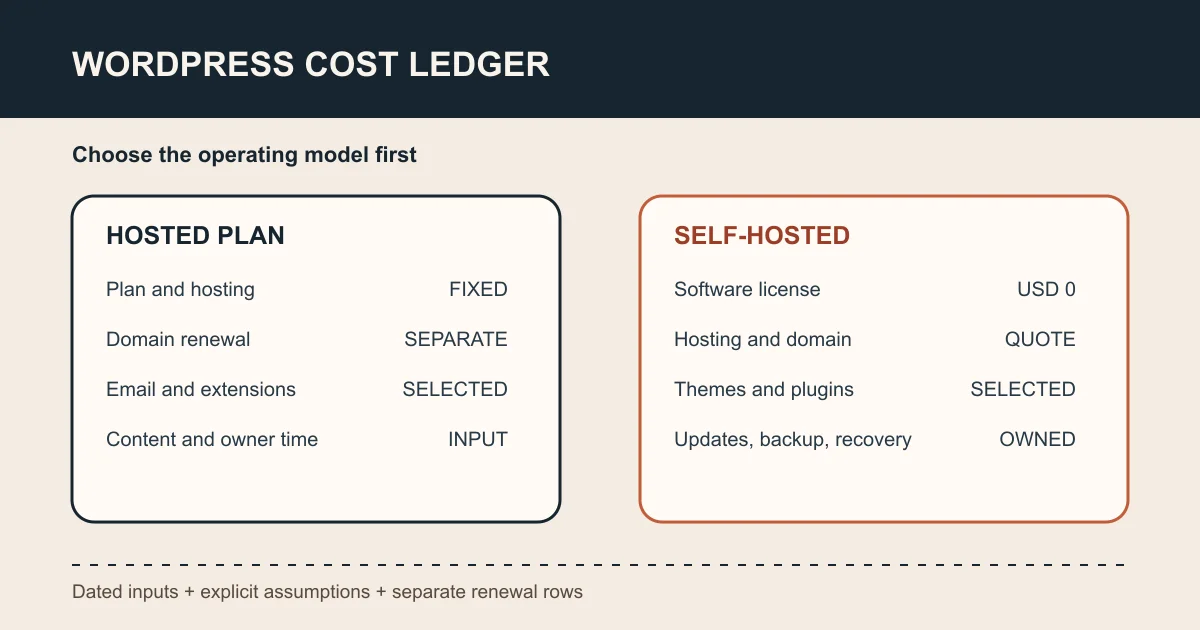
Assumptions behind the displayed numbers
The WordPress.com arithmetic uses a narrow dated checkout model. The self-hosted formula intentionally requires real supplier and labor inputs.
| Assumption | Value used | Why it changes the estimate |
|---|---|---|
| Market and currency | United States display, USD, before tax | WordPress.com says plan costs can change with country and currency, so another account or billing address can show different terms. |
| WordPress.com billing term | One annual plan for one website, paid for the year | The effective monthly amount is multiplied by 12. Multi-year equivalents are not substituted for the one-year term. |
| Self-hosted license | USD 0 WordPress software licensing fee | This does not set hosting, domain, extension, operations, security, backup, support, or labor to zero. |
| Supplier inputs | Actual host, registrar, theme, plugin, backup, security, and support terms | No universal range is inserted. A missing supplier value stays an unresolved budget row. |
| Human work | Setup hours and monthly operating hours at the owner’s actual economic rate | A low cash subscription can still carry material content, update, testing, incident, and recovery work. |
DATED COST WORKSHEET
Separate the license from the operating model
These WordPress.com US annual-billing inputs were checked September 5, 2026. They are planning comparisons, not quotes, guarantees, or a claim that the same checkout applies in every country. Recheck the selected plan by September 19, 2026.
| WordPress.com plan | Checked monthly equivalent | Visible annual arithmetic |
|---|---|---|
| Personal | USD 4 | USD 4 x 12 = USD 48 |
| Premium | USD 8 | USD 8 x 12 = USD 96 |
| Business | USD 25 | USD 25 x 12 = USD 300 |
| Commerce | USD 45 | USD 45 x 12 = USD 540 |
Source: [wordpress-com-pricing]
Use different rows for hosted and self-hosted WordPress
| Budget row | WordPress.com | Self-hosted WordPress |
|---|---|---|
| Software or hosted plan | Selected WordPress.com charge for one site and billing term | USD 0 WordPress software license plus the selected host |
| Domain and email | First-year domain eligibility and later renewal are separate; email can be separate | Registrar and mailbox charges from the selected providers |
| Themes and plugins | Plan allowance plus every selected extension subscription | Free directory items or supplier-priced products, each with its own support terms |
| Maintenance and recovery | Managed platform features under the selected plan | Named owner for updates, compatibility, backups, restores, monitoring, and incidents |
Self-hosted first year = hosting + domain + selected theme and plugin charges + setup hours + 12 x monthly operating hours. Use actual provider checkouts and your team's actual economic rate.
How this WordPress cost model works
Choose the operating model first, then put fixed subscriptions, selected supplier charges, variable usage, and human ownership on separate dated rows.
Choose WordPress.com or self-hosted WordPress
WordPress.com includes hosting in its platform plans. Self-hosted WordPress uses the open-source software on a host the owner selects and must meet the current PHP, database, and HTTPS requirements. Do not combine these responsibility models into one headline price.
Sources: [wordpress-com-plans], [wordpress-org-features], [wordpress-org-requirements]
Normalize the billing term
For the checked WordPress.com annual display, multiply the monthly equivalent by 12 and record that the year is prepaid. Keep monthly, two-year, and three-year terms separate instead of treating the lowest multi-year equivalent as a one-year charge.
Sources: [wordpress-com-pricing]
Add separate domain, email, theme, and plugin rows
A first-year domain benefit does not remove later renewal, and email is a separate service. Free directory themes and plugins exist, but selected commercial products, supplier support, or renewals require their own current terms.
Sources: [wordpress-com-domains], [wordpress-com-email], [wordpress-org-plugins], [wordpress-org-themes]
Price ownership and change risk
Record who installs updates, checks compatibility, monitors the site, tests backups, restores data, handles incidents, and migrates the site. Automatic updates can reduce routine work, but they do not prove compatibility, recovery, or a complete operating process.
Sources: [wordpress-org-updates], [wordpress-org-requirements]
What this WordPress price guide covers
The article compares the cost structure and ownership boundary of WordPress.com and self-hosted WordPress. It does not claim one average market price.
Included
- Current WordPress.com US annual-plan arithmetic for Personal, Premium, Business, and Commerce
- Self-hosted software, hosting, domain, theme, plugin, maintenance, backup, recovery, labor, and migration rows
- First-year versus renewal treatment and a formula driven by actual supplier inputs
- Decisions about management responsibility, extension count, compatibility, and change cadence
Not included
- A generic average for every website, host, domain extension, developer, agency, plugin, or theme
- A provider ranking or universal price-winner claim about WordPress.com, self-hosting, or Playcode
- Promises about uptime, security, compatibility, rankings, sales, migration success, or maintenance outcomes
- Cross-vendor AI builder subscription comparison, which stays on its existing pricing owner
WordPress cost by operating model
These scenarios show dated plan arithmetic and input formulas. They do not assert that every site needs the named tier or supplier scope.
WordPress.com Personal
A simple site whose required domain, storage, design, plugin, and support needs fit the checked Personal plan.
- One-time
- USD 48 for the checked annual plan: USD 4 monthly equivalent x 12, paid for the year before tax.
- Recurring
- Recheck the selected plan renewal, domain after any eligible first-year benefit, email, extensions, and owner work.
Includes
- Hosting and the current Personal plan feature set for one site
Excludes
- Tax, later domain renewal, email, supplier work, and any selected paid extension
Uncertainty: Country, currency, tax, term, eligibility, plan features, and checkout can change the amount or fit.
Sources: [wordpress-com-pricing], [wordpress-com-plans], [wordpress-com-domains]
WordPress.com Premium
A site that needs the checked Premium feature set and can document why Personal is insufficient.
- One-time
- USD 96 for the checked annual plan: USD 8 monthly equivalent x 12, paid for the year before tax.
- Recurring
- Recheck the plan, domain, mailbox, extension, content, and operating rows at renewal.
Includes
- Hosting and the current Premium plan feature set for one site
Excludes
- A claim that accepting payments removes provider fees, tax, policies, or operating work
Uncertainty: The useful difference from Personal depends on the site’s real design, analytics, payment, and growth requirements.
Sources: [wordpress-com-pricing], [wordpress-com-plans], [wordpress-com-email]
WordPress.com Business
A site that needs the checked Business development, staging, backup, or administration capabilities.
- One-time
- USD 300 for the checked annual plan: USD 25 monthly equivalent x 12, paid for the year before tax.
- Recurring
- Recheck the plan and every separate domain, email, extension, service, and human-work row.
Includes
- Hosting and the current Business plan feature set for one site
Excludes
- A guarantee that plugins, custom code, backups, or staging eliminate compatibility and recovery work
Uncertainty: The site should prove it needs the higher operational features rather than choosing from the plan name alone.
Sources: [wordpress-com-pricing], [wordpress-com-plans]
WordPress.com Commerce
A store that needs the checked Commerce plan bundle and has separately modeled payments and operations.
- One-time
- USD 540 for the checked annual plan: USD 45 monthly equivalent x 12, paid for the year before tax.
- Recurring
- Add the current plan, domain, email, extension, payment-provider, content, catalog, support, and operating costs.
Includes
- Hosting and the current Commerce plan feature set for one site
Excludes
- Payment processing, tax, shipping, returns, catalog work, legal review, and any sales outcome claim
Uncertainty: Store complexity, payment method, extensions, catalog, fulfillment, support, and regulations can dominate the plan row.
Sources: [wordpress-com-pricing], [wordpress-com-plans]
Self-hosted WordPress
An owner who wants to select the host and extension stack and can assign maintenance and recovery responsibilities.
- One-time
- USD 0 software license plus actual theme and plugin purchases and setup hours at the responsible person’s rate.
- Recurring
- Actual annual hosting, domain, theme, plugin, backup, security, support, and 12 x monthly operating-hour inputs.
Includes
- The WordPress software license and a transparent formula for selected suppliers and labor
Excludes
- An invented universal hosting, extension, security, maintenance, or professional-service amount
Uncertainty: Supplier terms, workload, extension count, compatibility, update cadence, incidents, recovery needs, and labor move the total.
Sources: [wordpress-org-features], [wordpress-org-requirements], [wordpress-org-plugins], [wordpress-org-themes], [wordpress-org-updates]
The complete WordPress cost ledger
Give every row an owner, source, billing cadence, renewal date, and verification check. A bundled plan and a free software license hide different things.
| Category | One-time | Recurring | Main drivers |
|---|---|---|---|
| Hosted plan or self-hosted server The fixed WordPress.com subscription or the selected self-hosted provider and workload allowance. Sources: [wordpress-com-pricing], [wordpress-com-plans], [wordpress-org-requirements] | Checked WordPress.com annual charges are USD 48, USD 96, USD 300, or USD 540; self-hosted setup uses the selected host terms. | Current renewal for the selected plan or host, plus any capacity or support charges. | operating model; billing term; region; workload; support |
| Domain and email The site address and mailbox are separate subscriptions even when an eligible first year is included. Sources: [wordpress-com-domains], [wordpress-com-email] | Apply only the benefit shown for the selected plan and eligible domain. | Use the current domain renewal and mailbox price for every active address. | extension; eligibility; mailbox count; provider; renewal date |
| Themes and design work A directory theme, commercial theme, custom design, and later design support have different supplier and ownership terms. Sources: [wordpress-org-themes], [wordpress-com-plans] | Selected theme purchase and actual setup or customization hours. | Theme renewal or support only when the selected supplier charges it. | theme; support; customization; templates; review rounds |
| Plugins and service dependencies Each plugin adds a feature, supplier, permissions surface, compatibility boundary, and possible renewal. Sources: [wordpress-org-plugins], [wordpress-org-updates] | Selected plugin purchase, configuration, data migration, and acceptance testing. | Every active paid renewal, usage meter, external service, and support plan. | plugin count; licensing; usage; compatibility; support |
| Maintenance, security, backup, and recovery Updates, monitoring, backups, restore tests, access review, incidents, and compatibility checks need a named owner. Sources: [wordpress-org-updates], [wordpress-org-requirements], [wordpress-com-plans] | Initial hardening, backup, monitoring, and restore-test setup at actual supplier or labor inputs. | Current service charges plus monthly operating hours at the responsible person’s rate. | change cadence; extension stack; risk; backup retention; incident rate |
| Content, migration, and owner time Pages, media, SEO, accessibility, policies, analytics, data movement, review, and ongoing publishing remain project work. Sources: [wordpress-com-plans], [wordpress-org-updates] | Actual inventory, migration, setup, review, and launch hours. | Actual monthly publishing, QA, reporting, support, and improvement hours. | page count; data volume; languages; integrations; change rate |
What can change the WordPress estimate
The largest uncertainty is not the software license. It is the selected responsibility model, supplier stack, extension count, content inventory, and amount of work required to keep the site safe and useful.
What moves the estimate
- Country, currency, tax, checkout, billing term, plan eligibility, and renewal changes
- Host capacity, backups, support, traffic, storage, database, and recovery requirements
- Theme and plugin purchases, renewals, service dependencies, and compatibility work
- Content volume, migration complexity, custom behavior, integrations, and review rounds
- Update cadence, security exposure, incidents, monitoring, restoration, and owner time
Re-estimate when
- A promotion or first-year domain benefit approaches renewal
- The site adds ecommerce, memberships, bookings, user accounts, languages, or new integrations
- A plugin, theme, host, PHP version, database version, or WordPress release changes compatibility
- Traffic, storage, support, backup, or recovery requirements move beyond the selected service
- The owner starts spending recurring time on publishing, updates, incidents, or manual recovery
WordPress costs after launch
Keep subscriptions and human work on their real schedules. A one-year benefit or one-time setup cost must not be carried into every later year.
| Cost | Cadence | Planning range | Boundary |
|---|---|---|---|
| WordPress.com plan or hosting renewal Sources: [wordpress-com-pricing], [wordpress-org-requirements] | Monthly, annual, or selected multi-year term | Checked WordPress.com annual charges of USD 48, USD 96, USD 300, or USD 540, or the selected self-hosted provider renewal. | Recheck country, tax, billing term, plan fit, resource allowance, and renewal before payment. |
| Domain and email renewal Sources: [wordpress-com-domains], [wordpress-com-email] | Annual domain and provider-specific mailbox billing | Current renewal for the chosen extension and each selected mailbox. | The first-year domain benefit and an email offer are not permanent zero-cost rows. |
| Theme, plugin, and external-service renewals Sources: [wordpress-org-plugins], [wordpress-org-themes] | Supplier-specific subscription or usage period | The sum of current charges for only the selected and active products. | Record supplier, site count, features, usage, update access, support, renewal, and cancellation. |
| Maintenance and recovery services Sources: [wordpress-org-updates], [wordpress-com-plans] | Monthly or annual by provider | Actual monitoring, backup, security, support, and recovery-service charges. | A backup subscription is incomplete without retention, restore ownership, and a tested recovery procedure. |
| Owner or specialist work Sources: [wordpress-org-updates], [wordpress-org-requirements] | Monthly hours | Actual monthly hours x the responsible person’s economic rate. | Include content, updates, compatibility, access review, analytics, support, incidents, and improvements. |
Choose the responsibility model before the plan
These rules keep the budget tied to the job and named owners rather than the lowest visible subscription.
No one owns server, update, backup, restore, and incident work.
Choose: Prefer a managed path or assign and price the operating role before choosing self-hosting.
Tradeoff: A managed subscription can cost more in cash while reducing supplier coordination and recurring technical work.
The required job fits a lower WordPress.com plan.
Choose: Use the minimum checked plan that satisfies the documented domain, storage, design, extension, and workflow needs.
Tradeoff: Starting smaller lowers the fixed row but can require an upgrade when the site adds operational requirements.
The self-hosted proposal starts with USD 0 software.
Choose: Require host, domain, extension, setup, maintenance, backup, recovery, and labor rows before comparing totals.
Tradeoff: Software freedom and supplier choice add responsibility for the assembled system.
A theme or plugin solves a required feature.
Choose: Record its supplier, current version, site allowance, renewal, data path, permissions, update policy, and fallback.
Tradeoff: Extensions reduce custom development but add compatibility, support, renewal, privacy, and migration boundaries.
The website needs to grow into a custom workflow or app.
Choose: Compare the complete ownership model with a guided build-and-run platform before committing to a large extension stack.
Tradeoff: A different platform changes flexibility, migration, runtime, and supplier assumptions; it does not erase content or operating work.
Need more than a website theme?
Describe the site and the workflow behind it
Playcode can build and run a website, portal, dashboard, or app. Compare the actual job, current plan limits, data ownership, and migration path before choosing.
Start BuildingNo credit card required. AI credits included under current terms.
Review current Playcode pricing and plan limitsThis article does not copy a Playcode price into the WordPress model.
Limits of this WordPress cost guide
This is a dated planning model, not a provider checkout, supplier proposal, workload test, security review, or migration plan.
- The WordPress.com display can vary by country, currency, tax, term, promotion, and account eligibility.
- No official WordPress source establishes one universal self-hosted hosting, theme, plugin, labor, maintenance, security, backup, or migration range.
- A directory listing does not prove that a theme or plugin fits the site, stays maintained, is secure, or has zero adjacent service cost.
- Automatic updates do not guarantee compatibility, availability, security, or successful recovery.
- The guide does not price regulated compliance, legal review, accessibility certification, custom development, or enterprise procurement.
- The guide does not promise that WordPress.com, self-hosted WordPress, or Playcode will be cheaper or produce better business results.
Official sources checked for this guide
These first-party pages support the visible facts. Checked dates record access, not a claim that every page exposes a revision date.
[wordpress-com-pricing] WordPress.com:WordPress.com pricing
Checked September 5, 2026. Supports: US plan display for Personal, Premium, Business, and Commerce across monthly, annual, two-year, and three-year terms, including the checked one-year annual equivalents.
[wordpress-com-plans] WordPress.com Support:Choose a WordPress.com plan
Checked September 5, 2026. Supports: Hosting inclusion, current plan names and feature boundaries, paid-plan plugin access, per-site plan requirement, and region/currency variability.
[wordpress-com-domains] WordPress.com Support:Domain pricing and available extensions
Checked September 5, 2026. Supports: First-year domain benefit for eligible annual or multi-year plans, extension-specific prices, and renewal variation boundaries.
[wordpress-com-email] WordPress.com Support:Custom email solutions
Checked September 5, 2026. Supports: Email is not included in the WordPress.com site plan and is selected and billed through a separate email path.
[wordpress-org-features] WordPress.org:WordPress features and software freedom
Checked September 5, 2026. Supports: WordPress code can be used and modified without a software licensing fee; this does not price the surrounding operating stack.
[wordpress-org-requirements] WordPress.org:WordPress hosting requirements
Checked September 5, 2026. Supports: Current recommended PHP, MariaDB or MySQL, HTTPS, and web-server requirements for a self-hosted installation.
[wordpress-org-plugins] WordPress.org:WordPress plugin directory
Checked September 5, 2026. Supports: A large free-plugin directory exists alongside commercial entries; selected products and adjacent services require item-level review.
[wordpress-org-themes] WordPress.org:WordPress theme directory
Checked September 5, 2026. Supports: A free official theme directory exists; it does not establish the cost or fit of commercial themes and customization work.
[wordpress-org-updates] WordPress.org Documentation:Configuring automatic background updates
Checked September 5, 2026. Supports: WordPress core, plugin, and theme automatic-update controls and the need to treat updates as an operating responsibility.
WordPress website cost questions
Is WordPress free?
The self-hosted WordPress software has no licensing fee. A working website can still need hosting, a domain, themes or plugins, backup, security, maintenance, support, migration, and owner or specialist time.
How much was WordPress.com on September 5, 2026?
The checked US annual display showed monthly equivalents of USD 4 Personal, USD 8 Premium, USD 25 Business, and USD 45 Commerce. That is USD 48, USD 96, USD 300, or USD 540 prepaid for one year before tax. Recheck checkout.
Does WordPress.com include hosting?
Yes, WordPress.com says hosting is included. The selected plan still has its own feature, storage, term, region, tax, and per-site boundaries, while domain renewal, email, and selected services can remain separate.
How should I estimate self-hosted WordPress?
Add actual annual hosting and domain charges, selected one-time and recurring theme or plugin costs, setup hours, and 12 times the monthly operating hours. Keep backup, security, support, migration, and recovery rows explicit.
Are WordPress plugins and themes always free?
No. Official free directories exist, but commercial products and adjacent services also exist. Even a no-license-cost extension can require setup, data handling, compatibility checks, updates, support, and a replacement path.
Which WordPress option is cheaper?
There is no universal winner. Compare the complete job and responsibility model. A hosted plan has a visible fixed subscription; self-hosting can offer more supplier choice while adding hosting and operating ownership.
When should I refresh this budget?
Refresh before purchase and renewal, when a plan or supplier changes, and when the site adds ecommerce, accounts, languages, integrations, traffic, storage, extensions, support, security, or recovery requirements.
Build and run in one guided path
Start with the website, then add the workflow
Describe what the site must do. Playcode builds and runs websites and apps, with current plan limits and a clear path from page to portal, dashboard, or internal tool.
Build My WebsiteNo credit card required. AI credits included under current terms.