QUICK ANSWER
Should you choose Webflow or WordPress?
Choose Webflow when a managed visual workflow, integrated CMS, hosting, HTTPS, and platform backups fit the site and its published limits. Choose self-hosted WordPress when open-source control, portable installation, and a broad theme and plugin ecosystem justify owning the host, updates, security, and recovery stack. Neither is the universal winner; test the actual content, traffic, extensions, and exit path.
Webflow and self-hosted WordPress can both run a polished content website, but the production responsibility lands in different places. Webflow combines a visual builder, CMS, hosting, HTTPS, apps, and backups inside a managed platform. WordPress.org supplies open-source CMS software that you install on a host and extend with themes and plugins.
This guide compares the same content-rich business-site job across price, publishing limits, code and content exit, maintenance, security, and recovery. It uses current first-party documentation and does not claim a hands-on benchmark, universal winner, or observed reliability result.
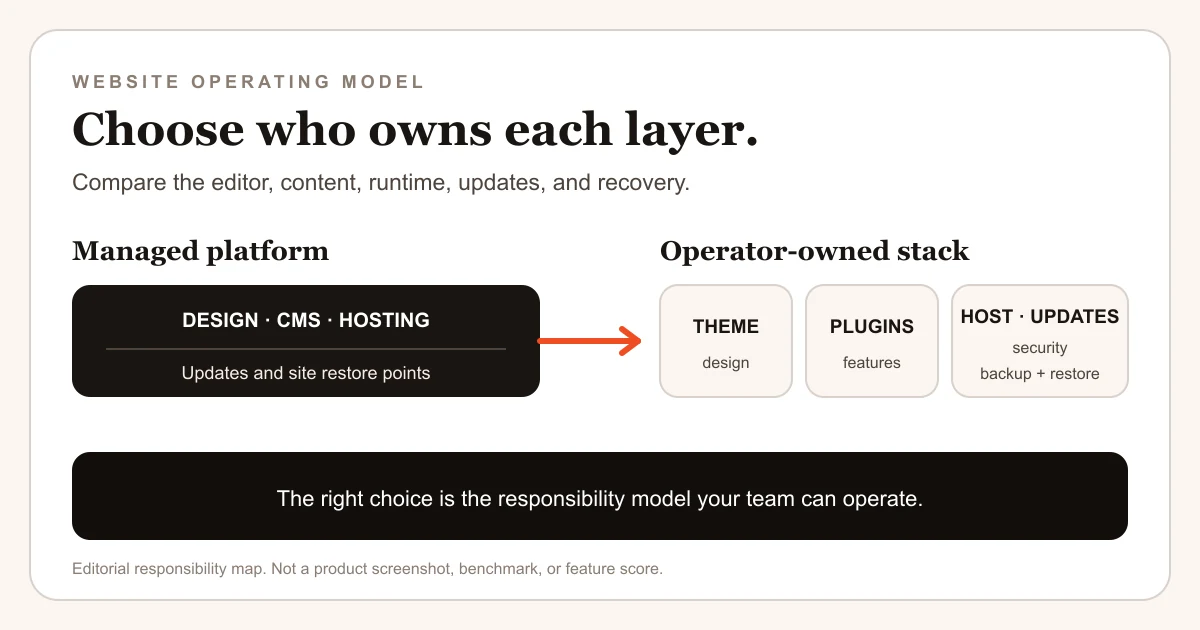
How this Webflow vs WordPress comparison works
The method holds one public, content-rich website constant and follows the responsibilities that remain after the homepage is designed.
Define the same production fixture
List the static pages, content types, item count, editors, custom domain, forms, expected bandwidth, integrations, and recovery target. A Webflow demo and a bare WordPress install are not comparable production scopes.
Sources: [webflow-site-plans], [webflow-cms], [wordpress-features], [wordpress-requirements]
Separate platform price from operating cost
For Webflow, record the Site plan, any Workspace plan or seat required for the workflow, add-ons, and current account transition. For WordPress, keep the USD 0 software license separate from hosting, domain, premium theme or plugin, support, maintenance, backup, and operator labor.
Sources: [webflow-pricing-update], [webflow-workspace-plans], [wordpress-license], [wordpress-requirements]
Measure the production constraint
Webflow publishes plan limits such as pages, CMS items, Collections, bandwidth, and Cloud requests. WordPress capacity follows the selected host, database, PHP runtime, cache, media, traffic, and extension stack, so the buyer must obtain and test those limits from the host rather than inventing one WordPress number.
Sources: [webflow-pricing-update], [webflow-cms-limits], [wordpress-requirements]
Rehearse export, restore, and supplier failure separately
Export Webflow static code and CMS data independently, then identify hosted functions that do not travel. For WordPress, preserve files and database together, test a restore, export content where useful, and prove the replacement host before canceling the original.
Sources: [webflow-code-export], [webflow-cms-export], [webflow-backups], [wordpress-content-export], [wordpress-backups]
Recheck every third-party dependency
Inventory Webflow Apps or WordPress plugins and themes by purpose, publisher, access, update state, data path, failure effect, replacement, and owner. Marketplace availability does not prove that an extension is suitable, secure, maintained, or portable for this site.
Sources: [webflow-apps], [wordpress-plugins], [wordpress-themes], [wordpress-security]
Comparison and owner boundary
This page owns Webflow vs WordPress and reverse wording WordPress vs Webflow as one bilateral product-selection decision.
Included
- Visual production workflow, CMS, hosting, visible prices, production meters, export, ownership, extensions, themes, updates, security, recovery, and exit
- Current Webflow and WordPress.org first-party sources checked on September 6, 2026
- A repeatable same-site evaluation that exposes the human and supplier work behind each choice
Not included
- Webflow replacement intent, which remains with /webflow-alternative
- WordPress-specific cost modeling, which remains with /blog/wordpress-website-cost
- AI website builder vs WordPress, which remains with /blog/ai-website-builder-vs-wordpress
- Webflow vs Framer, broader best website builder research, WordPress.com plan selection, agency services, and hosting-provider rankings
- A universal winner, score, uptime or performance benchmark, security audit, support-quality conclusion, or claim that either product was tested hands-on for this article
Twelve production boundaries to compare
Each row states the current official contract. Confirm it against the intended account, host, theme, extensions, content, traffic, and recovery objective.
Production workflow
A managed visual platform and an installed CMS assign design, publishing, and operating work to different people.
CMS model
Content structure, editorial scale, dynamic templates, and migration depend on what the CMS stores and how it is hosted.
Hosting boundary
The buyer must know who supplies the runtime, HTTPS, database, patches, and production support.
Visible price
Software price, site hosting, workspace access, extensions, and operator time are different cost lines.
Production meter
Page, CMS, bandwidth, request, server, storage, and extension constraints determine when the operating model changes.
Code and content export
An export is useful only when it names which code, content, behavior, credentials, and hosted services move.
Ownership and control
Software licensing, account ownership, hosting access, domains, content, and vendor services are separate control surfaces.
Apps and plugins
Third-party functionality adds capability while also adding permissions, compatibility, supplier, and maintenance risk.
Themes and design system
The design model affects visual control, reusable patterns, theme portability, and the skills needed for later changes.
Updates and maintenance
Managed software updates and operator-managed core, theme, plugin, and server updates create different recurring work.
Security boundary
Platform controls do not replace application configuration, extension review, account security, or an incident owner.
Recovery and exit
A design restore, CMS export, file backup, database restore, host move, and full-site recovery can preserve different state.
Webflow and WordPress across the website lifecycle
The matrix keeps managed-platform convenience and open-source control visible without pretending that the same person operates both stacks.
Webflow
Best for: Teams that want one managed visual platform for design, structured content, publishing, hosting, HTTPS, platform updates, and site backups.
Webflow combines a browser-based visual production environment, structured CMS, managed hosting, Apps, and site backups. Current Site plans set the publishing envelope, while Workspace plans cover staging, collaboration, AI credits, and code export. The buyer trades some infrastructure work for plan, hosted-feature, and export boundaries.
| Criterion | Finding |
|---|---|
| Production workflow | Webflow keeps visual design, reusable components, CMS binding, staging, publishing, and site settings in one hosted environment. Access depends on the Workspace and site role, and current Enterprise plans add a detailed Site Activity log. Sources: [webflow-intro], [webflow-workspace-plans] |
| CMS model | Webflow CMS stores structured content in Collections, fields, and Collection items, then renders Collection pages from one template and Collection lists on other pages. The current Premium transition lists 20,000 CMS items and 40 Collections. Sources: [webflow-cms], [webflow-pricing-update] |
| Hosting boundary | A paid Site plan hosts one custom-domain site through Webflow. Webflow describes the hosting path as managed, including platform patches, Cloudflare delivery, and automatic Webflow SSL provisioning while DNS remains correctly pointed. Sources: [webflow-site-plans], [webflow-hosting], [webflow-ssl] |
| Visible price | For new purchases in the May 2026 lineup, Basic is USD 15 per month billed yearly or USD 25 monthly; Premium is USD 25 per month billed yearly or USD 39 monthly. A qualifying Workspace can be separate: Core currently displays USD 19 per month billed yearly, Freelancer USD 16, and Agency USD 35. Taxes, seats, add-ons, Ecommerce, and transition timing can add cost. Sources: [webflow-pricing-update], [webflow-current-pricing], [webflow-workspace-plans] |
| Production meter | The new Basic plan lists 300 static pages. Premium lists 300 static pages, 20,000 CMS items, 40 Collections, 50 GB bandwidth, and 2 million Webflow Cloud requests per month. Workspace AI uses a separate pooled credit meter, while add-ons and legacy transitions can change the account total. Sources: [webflow-pricing-update], [webflow-ai-credits], [webflow-cms-limits] |
| Code and content export | Paid Workspace plans can export HTML, CSS, JavaScript, and assets. Webflow states that Site plans alone do not include code export and that CMS functionality, Ecommerce, User Accounts, forms, search, localized content, password protection, and code components do not continue in the exported static files. CMS items can be exported separately as CSV. Sources: [webflow-code-export], [webflow-cms-export] |
| Ownership and control | The Workspace and site accounts control Webflow design state, roles, plans, publishing, and transfers. Exported static code can be hosted without attribution, but hosted product behavior, billing, CMS, domains, credentials, Apps, and production data require their own handoff. Sources: [webflow-code-export], [webflow-site-transfer], [webflow-workspace-plans] |
| Apps and plugins | Webflow Apps are third-party applications authorized for selected sites or Workspaces and can extend Designer, forms, CMS, User Accounts, and Ecommerce behavior. Webflow reviews Marketplace Apps before listing, while the app publisher owns app-specific support and the site owner must review permissions and revocation. Sources: [webflow-apps], [webflow-marketplace] |
| Themes and design system | Webflow centers design on the canvas, components, variables, libraries, and site structure rather than an installable WordPress theme package. Duplicating or transferring a site preserves many design assets, but shared Libraries, settings, and localized publishing can require additional handling. Sources: [webflow-intro], [webflow-site-transfer] |
| Updates and maintenance | Webflow updates the hosted platform centrally and says users do not manually install platform updates or security patches. Site owners still own content, redirects, domains, Apps, account roles, publishing review, and any custom code or external service. Sources: [webflow-intro], [webflow-hosting], [webflow-apps] |
| Security boundary | Webflow manages the hosting platform and automatic SSL on its standard hosted path. The buyer still owns DNS correctness, account access, App permissions, form and content handling, custom code, third-party services, and application-specific review; Marketplace review is not a site security conclusion. Sources: [webflow-hosting], [webflow-ssl], [webflow-apps] |
| Recovery and exit | Webflow creates automatic and manual site restore points; paid Site plans have unlimited backups, while scheduled backups are not offered and automatic restore points occur every 50th auto-save. Restore effects and static-code or CMS exports must be rehearsed separately before exit. Sources: [webflow-backups], [webflow-code-export], [webflow-cms-export] |
Tradeoffs
- The integrated workflow reduces host and software-patch work, while Site plans, Workspace plans, add-ons, and account transitions can create several billing and permission layers.
- Static HTML, CSS, JavaScript, and assets can be exported from qualifying Workspaces, but CMS behavior, Ecommerce, User Accounts, forms, search, localized content, and other hosted features do not become a portable static site automatically.
- Platform backups simplify design and CMS recovery, yet a restore can change scheduled content, Ecommerce inventory handling, reCAPTCHA, bot protection, comments, locales, and older item identifiers.
WordPress
Best for: Teams that want open-source CMS control, portable installation, and a large theme and plugin ecosystem, with an accountable owner for hosting and maintenance.
WordPress.org provides GPL-licensed CMS software, structured content, users, APIs, themes, plugins, and export tools. The owner chooses the host and can inspect or modify the installation, but must define the server, database, HTTPS, updates, extension compatibility, security, backups, monitoring, and recovery contract directly or buy those services from a managed host.
| Criterion | Finding |
|---|---|
| Production workflow | WordPress separates content administration from the selected host, database, files, theme, plugins, and deployment practice. The block or classic theme and installed extensions determine much of the editing and publishing workflow. Sources: [wordpress-features], [wordpress-requirements], [wordpress-themes] |
| CMS model | WordPress core provides posts, pages, users, media, custom post types, taxonomies, metadata, databases, URL routing, and a REST API. Content structure can be extended in code or by plugins rather than being capped by one WordPress.org-hosted CMS plan. Sources: [wordpress-features], [wordpress-content-export] |
| Hosting boundary | WordPress.org is software, not the site host. The current recommended baseline asks the chosen host for PHP 8.3 or greater, MariaDB 10.11 or MySQL 8.0 or greater, and HTTPS; the host and site owner divide runtime, patching, support, monitoring, and recovery responsibilities. Sources: [wordpress-requirements] |
| Visible price | WordPress core is GPL-licensed and can be used or modified without a software licensing fee. The actual production price is the selected hosting, domain, premium theme or plugin, email or other providers, maintenance, backup, support, and labor. WordPress.org does not establish one universal monthly total. Sources: [wordpress-license], [wordpress-features], [wordpress-requirements] |
| Production meter | There is no single WordPress.org page, CMS-item, request, storage, or bandwidth allowance. The meter follows the host resources, database, PHP workers and version, storage, bandwidth, caching, media, theme, plugins, scheduled work, and traffic. Buyers must obtain limits from the selected suppliers and test the actual stack. Sources: [wordpress-requirements], [wordpress-security] |
| Code and content export | A self-hosted installation exposes its WordPress files, themes, plugins, uploads, configuration, and database through the owner-controlled host. The built-in WXR content export covers posts, pages, custom post types, comments, custom fields, categories, tags, custom taxonomies, and users, but it is not a full files-and-database backup. Sources: [wordpress-license], [wordpress-content-export], [wordpress-backups] |
| Ownership and control | The GPL permits running, studying, modifying, and redistributing WordPress. That software freedom is strongest when the buyer also controls the hosting account, domain, backups, database, files, suppliers, and credentials; plugin or theme licensing and external services still need separate review. Sources: [wordpress-license], [wordpress-features] |
| Apps and plugins | WordPress.org lists over 71,000 free plugins and describes plugins as separate software that extends core. Official documentation warns that directory plugins vary in quality and can become incompatible, so the operator must evaluate publisher, updates, access, data, failure impact, and replacement. Sources: [wordpress-plugins], [wordpress-plugin-directory] |
| Themes and design system | WordPress themes control front-end design and can be block, classic, hybrid, custom, free, or commercial. The official handbook distinguishes block themes built mainly with HTML and theme configuration from classic themes using PHP, JavaScript, and CSS, so migration and editor behavior depend on the chosen theme stack. Sources: [wordpress-themes], [wordpress-features] |
| Updates and maintenance | WordPress can apply minor and security core updates automatically, while administrators can opt plugins and themes into auto-updates. Official guidance still requires current core, plugin, and theme versions, compatibility checks, update monitoring, and a valid rollback path before relying on automation. Sources: [wordpress-updates], [wordpress-plugin-updates], [wordpress-security] |
| Security boundary | WordPress security spans the host environment, PHP and database versions, HTTPS, file permissions, accounts, core, themes, plugins, configuration, and backups. WordPress.org says old versions are not maintained with security updates and recommends actively maintained extensions; the operator or managed host owns that continuing work. Sources: [wordpress-requirements], [wordpress-security] |
| Recovery and exit | Official backup guidance requires both the WordPress database and site files. A WXR export can move content to another WordPress installation, but a production recovery or host exit also needs files, database, configuration, credentials, domain, provider state, and a tested restore. Sources: [wordpress-backups], [wordpress-content-export], [wordpress-updates] |
Tradeoffs
- Open-source control broadens customization and host choice while moving more supplier, patch, extension, and recovery decisions onto the operator.
- Thousands of themes and plugins can shorten implementation, but every active extension adds a publisher, compatibility, permission, update, security, data, and replacement boundary.
- The WordPress software has no license fee, but there is no universal production price or capacity because hosting, domain, premium extensions, support, labor, traffic, and backup contracts vary.
Decision rules for Webflow vs WordPress
Choose the responsibility model your team can operate during ordinary publishing, a supplier change, and a bad release.
The team wants managed visual production with one hosted CMS and site runtime
Choose: Evaluate Webflow first with the real page count, Collection schema, editors, bandwidth, Apps, code-export need, and recovery case.
Tradeoff: The managed platform reduces server and software-patch work, while plan limits, hosted features, account roles, add-ons, and export boundaries remain.
The team needs host choice, source-level control, or a specific WordPress theme or plugin
Choose: Evaluate self-hosted WordPress first and name the accountable owner for hosting, updates, security, backups, compatibility, and incident recovery.
Tradeoff: Open-source control and ecosystem breadth increase flexibility while adding more suppliers and recurring operational work.
A content team needs a bounded publishing system more than arbitrary extension depth
Choose: Prototype the exact content types and editorial roles in Webflow CMS, then check item, Collection, bandwidth, localization, and export limits before choosing the plan.
Tradeoff: A constrained managed model can be easier to govern, but future content structures or hosted features may outgrow the selected plan or export path.
A required workflow already depends on a mature WordPress plugin
Choose: Test that plugin with the intended theme, host, PHP version, data, updates, backup, and replacement plan before treating ecosystem size as proof.
Tradeoff: A plugin may avoid custom development while adding a vendor, update, compatibility, security, performance, and data-portability dependency.
Exit and disaster recovery are procurement requirements
Choose: Run a clean-room migration and restore: static code, CMS content, files, database, credentials, domain, hosted behavior, integrations, and the published smoke must each have an owner.
Tradeoff: The rehearsal adds time before purchase, but prevents a code download or content export from being mistaken for a recoverable website.
The current Webflow account may still be on legacy or transition pricing
Choose: Capture the live checkout, renewal date, Site plan, Workspace plan, seats, bandwidth history, add-ons, and November 2026 transition treatment before comparing totals.
Tradeoff: Account-specific verification slows the spreadsheet while avoiding a decision based on a price or allowance that has not reached that account.
PROVE THE WEBSITE PATH
Bring the content model, traffic, owner, and recovery case
Use Playcode to build one working website slice and make the publishing, data, provider, export, and recovery boundaries explicit before the scope expands.
Build the website sliceNo credit card required. AI credits are included to start; external providers and production plan limits still apply.
Use the WordPress cost guide for a dated hosted-versus-self-hosted budget model.
Evidence limits and current pricing transition
This is a first-party documentation review and decision model, not a product trial, contract, security review, performance test, or supplier quote.
- No identical website was designed, migrated, timed, load-tested, security-tested, restored, or operated in Webflow and WordPress for this article.
- Webflow Site-plan changes are account- and renewal-sensitive through 2026. Existing sites in Freelancer or Agency Workspaces and legacy pricing have a later November transition milestone.
- The Webflow Site plan and Workspace plan are separate for many workflows. Code export is a Workspace feature, not a feature granted by the Site plan alone.
- Webflow static code export excludes important hosted behavior, and CMS CSV export is separate. Neither should be described as a complete live-site migration without a replacement test.
- WordPress core has no software licensing fee, but WordPress.org does not provide one universal hosting, extension, support, maintenance, backup, or total-cost figure.
- WordPress theme and plugin directory presence does not establish suitability, maintenance quality, security, compatibility, support, or data portability for a particular site.
- Managed hosting, automatic SSL, platform backups, open-source licensing, and update controls do not prove that a configured website is secure, accessible, compliant, fast, reliable, or recoverable.
- Prices, taxes, limits, add-ons, AI credits, extension behavior, supplier terms, and documentation can change before the September 20 review date.
Official sources checked September 6, 2026
Every matrix finding cites first-party Webflow or WordPress.org material. Access dates record this review, not an invented revision date for undated pages.
[webflow-pricing-update] Webflow Help Center:Updated pricing and simplified plans for May 2026
Checked September 6, 2026. Supports: Basic and Premium Site-plan prices, pages, CMS items, Collections, bandwidth, Cloud requests, add-ons, and phased account transition dates.
[webflow-current-pricing] Webflow:Webflow plans and pricing
Checked September 6, 2026. Supports: Current public Site and Workspace plan display, annual-billing prices, staging, seats, code-export, and AI-credit plan rows.
[webflow-site-plans] Webflow Help Center:Choose a Site plan
Checked September 6, 2026. Supports: One paid Site plan per custom-domain hosted site and the separation between Site-plan hosting and Workspace billing.
[webflow-workspace-plans] Webflow Help Center:Choose a Workspace plan
Checked September 6, 2026. Supports: Workspace staging, seats, guests, collaboration, AI credits, code export, roles, billing, and separation from paid Site plans.
[webflow-intro] Webflow Help Center:Intro to Webflow
Checked September 6, 2026. Supports: Hosted visual production workflow, components, libraries, roles, publishing, site settings, and centrally delivered platform updates.
[webflow-cms] Webflow Help Center:Intro to the Webflow CMS
Checked September 6, 2026. Supports: Collections, fields, items, templates, dynamic pages, lists, bulk import, and the structured CMS model.
[webflow-cms-limits] Webflow Help Center:Dynamic content limits
Checked September 6, 2026. Supports: Per-page Collection-list, nested-list, and visible-item constraints that remain distinct from plan-level CMS totals.
[webflow-hosting] Webflow Help Center:Webflow hosting overview
Checked September 6, 2026. Supports: Managed hosting, platform patching, Cloudflare delivery, SSL, and the hosted Site-plan responsibility boundary.
[webflow-ssl] Webflow Help Center:SSL hosting
Checked September 6, 2026. Supports: Automatic Webflow SSL provisioning and renewal on the supported DNS path, plus custom-certificate and CAA boundaries.
[webflow-code-export] Webflow Help Center:How to export a Webflow site
Checked September 6, 2026. Supports: Paid-Workspace export gate, included static files, no-attribution external hosting, and excluded CMS, Ecommerce, User Accounts, forms, search, localization, password, and code-component behavior.
[webflow-cms-export] Webflow Help Center:Import and export Webflow CMS content
Checked September 6, 2026. Supports: CMS CSV import and export, locale scope, item matching, migration use, backup prompts, and item-limit dependence on Site plan.
[webflow-apps] Webflow Help Center:Webflow Apps overview
Checked September 6, 2026. Supports: Third-party Apps, Marketplace security review, authorization across sites or Workspaces, and Designer, CMS, form, User Account, and Ecommerce extensions.
[webflow-marketplace] Webflow Help Center:Webflow Marketplace overview
Checked September 6, 2026. Supports: Apps, Libraries, templates, publisher support responsibility, authorization review, and revocation behavior.
[webflow-backups] Webflow Help Center:Save and restore backups
Checked September 6, 2026. Supports: Automatic and manual restore points, paid-plan retention, the no-scheduled-backup boundary, every-50th-auto-save behavior, and restore side effects.
[webflow-site-transfer] Webflow Help Center:Transfer a site to another Workspace
Checked September 6, 2026. Supports: Transferred design, content, backup, Ecommerce, account, redirect, and site state plus reset billing, app authorization, fonts, comments, and localized-content boundaries.
[webflow-ai-credits] Webflow Help Center:Webflow AI credits
Checked September 6, 2026. Supports: Workspace-pooled credit allocations, reset and expiry rules, add-on prices, dynamic consumption, and features inside or outside the credit meter.
[wordpress-features] WordPress.org:WordPress features
Checked September 6, 2026. Supports: CMS features, custom content types, REST API, theme and plugin extensibility, software freedom, code modification, and data-control framing.
[wordpress-license] WordPress.org:WordPress GNU Public License
Checked September 6, 2026. Supports: WordPress GPLv2-or-later software license and its relationship to derivative plugin and theme code.
[wordpress-requirements] WordPress.org:WordPress hosting requirements
Checked September 6, 2026. Supports: Current recommended PHP, MariaDB or MySQL, HTTPS, server, legacy-version, host-selection, performance, and security baseline.
[wordpress-content-export] WordPress.org Documentation:WordPress Tools Export screen
Checked September 6, 2026. Supports: WXR export contents, filters, download flow, migration use, and the distinction between structured content export and full-site backup.
[wordpress-plugins] WordPress.org:WordPress Plugin Directory
Checked September 6, 2026. Supports: The current directory count, categories, publisher records, active installations, compatibility labels, updates, reviews, and free-plugin catalog.
[wordpress-plugin-directory] WordPress.org Documentation:Manage WordPress plugins
Checked September 6, 2026. Supports: Plugins as separate software, directory installation, varied quality, compatibility warnings, functionality categories, activation, and management.
[wordpress-themes] WordPress.org Theme Handbook:What is a WordPress theme?
Checked September 6, 2026. Supports: Theme responsibility for front-end design, free and third-party themes, custom themes, and block, classic, and hybrid theme models.
[wordpress-updates] WordPress.org Documentation:Updating WordPress
Checked September 6, 2026. Supports: Core update notifications, one-click and manual updates, minor and security background updates, backup-first guidance, and failed-update recovery.
[wordpress-plugin-updates] WordPress.org Documentation:Plugin and theme auto-updates
Checked September 6, 2026. Supports: Per-extension auto-update controls, twice-daily checks, owner notifications, backup recommendation, Cron dependency, and failure diagnostics.
[wordpress-security] WordPress.org Advanced Administration Handbook:Hardening WordPress
Checked September 6, 2026. Supports: Current-version requirement, host and application security responsibilities, HTTPS, file permissions, extension updates, backup practice, and older-version risk.
[wordpress-backups] WordPress.org Advanced Administration Handbook:WordPress backups
Checked September 6, 2026. Supports: Database and files backup scope, manual and automated options, restoration purpose, migration configuration, and full-site recovery boundary.
Webflow vs WordPress FAQ
Is Webflow or WordPress better for a business website?
Webflow fits teams that prefer a managed visual platform with integrated CMS, hosting, HTTPS, updates, and backups inside published plan limits. Self-hosted WordPress fits teams that value open-source control, host choice, and theme or plugin depth and can own or buy the required maintenance and recovery work.
Is Webflow cheaper than WordPress?
There is no universal answer. New Webflow Basic and Premium Site plans currently display USD 15 and USD 25 per month billed yearly, with separate Workspace or add-on costs for some workflows. WordPress core has no software licensing fee, but hosting, domain, premium extensions, support, maintenance, backups, and labor determine its actual total.
Can Webflow export a complete website?
A paid Webflow Workspace can export static HTML, CSS, JavaScript, and assets. Webflow states that CMS behavior, Ecommerce, User Accounts, forms, search, localized content, password protection, and code components do not continue in that static export. CMS items can be exported separately as CSV, so a complete migration still needs a replacement implementation and smoke test.
Does WordPress include hosting and security updates?
WordPress.org provides the CMS software, not the hosting service. Core supports automatic minor and security updates, and plugin or theme auto-updates can be enabled, but the operator or managed host still owns server versions, HTTPS, accounts, extension compatibility, backups, monitoring, failures, and application-specific security review.
Which has more plugins and themes, Webflow or WordPress?
WordPress.org currently lists over 71,000 free plugins and documents thousands of themes, while Webflow provides a Marketplace of Apps, Libraries, and templates. Catalog size is not a production verdict. Evaluate the exact extension for permissions, publisher, updates, compatibility, data, failure behavior, support, replacement, and exit.
Which is easier to back up and restore?
Webflow creates platform restore points and paid Site plans have unlimited backups, but restore side effects and exports still need review. WordPress requires database and files backups under the selected host or tool. The useful comparison is whether the team can restore the exact failure safely, not which product uses the word backup.
Does this page also own WordPress vs Webflow?
Yes. Webflow vs WordPress and WordPress vs Webflow are one bilateral owner. Webflow alternatives, WordPress website cost, AI website builder vs WordPress, Framer vs Webflow, and broader best website builder research remain separate search jobs and pages.
BUILD THE PROOF SLICE
Test the site, content, exit, and recovery before committing
Describe the public pages, content types, editors, forms, expected traffic, provider boundaries, export requirement, and one failure case. Playcode can build and run the smallest website slice that proves those decisions.
Start with PlaycodePlaycode AI builds the website or app. Playcode Cloud can run it under current plan limits. External providers keep their own accounts, credentials, terms, and review.