For over a decade, template builders like Squarespace, Wix, and Webflow defined how non-developers built websites. Pick a template. Drag and drop. Customize within the guardrails. It was a genuine revolution - suddenly anyone could have a professional-looking website without writing a line of code.
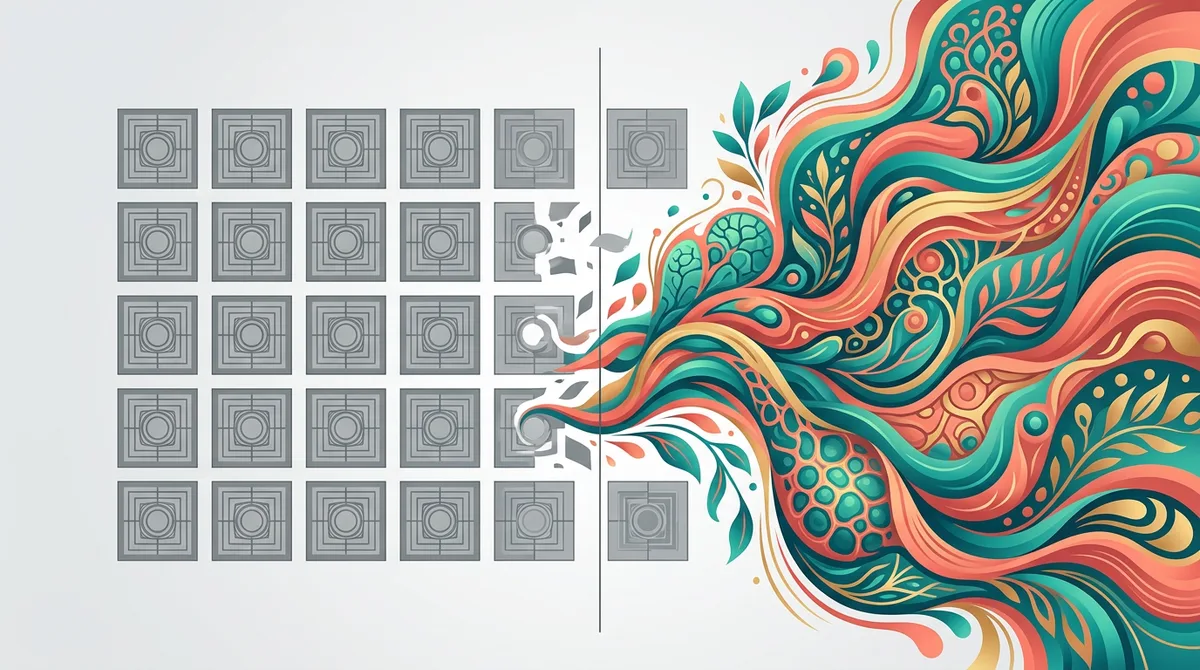
But a new revolution is here. AI website builders like Playcode skip the template entirely. You describe what you want, and AI generates a unique site from scratch - custom design, custom layout, custom everything. No template selection. No drag-and-drop constraints. Just results.
So which approach is actually better? The honest answer: it depends on what you need. This article breaks down both approaches across 10 criteria so you can make the right call for your project.
How Template Builders Work
Template builders follow a predictable workflow that has remained largely unchanged since the early 2010s:
- Choose a template. Browse a gallery of pre-designed layouts organized by industry or purpose - "restaurant," "portfolio," "online store." Most platforms offer 50-200 templates.
- Customize with drag-and-drop. Swap images, change colors, edit text, rearrange sections. Every edit happens within the visual editor. You see exactly what you get.
- Work within constraints. Each template defines a structure - header, hero, features, footer. You can customize within that structure, but breaking out of it requires workarounds or custom code (which most platforms discourage or make difficult).
- Publish on the platform. Your site lives on Squarespace, Wix, or whichever platform you chose. You can connect a custom domain, but the underlying infrastructure and code belong to the platform.
The big players - Squarespace, Wix, Webflow, Framer - each put their own spin on this model. Webflow gives more control. Framer focuses on animations. But the core loop is the same: start from a template, customize within limits.
How AI Builders Work
AI website builders take a fundamentally different approach. There is no template gallery. There is no drag-and-drop starting point. Instead:
- Describe what you want. Tell the AI about your business, your audience, and what the site should accomplish. "I need a landing page for my SaaS product that converts trial signups" or "Build me a portfolio site that showcases my architecture work."
- AI generates a unique site. The AI writes original HTML, CSS, and JavaScript from scratch. No template is selected behind the scenes - the design, layout, and structure are all generated specifically for your description.
- Refine through conversation. Instead of dragging elements around, you talk to the AI. "Make the hero section more bold." "Add a testimonials section after the pricing." "Change the color scheme to dark mode." The AI updates the code based on your feedback.
- Publish with one click. Deploy your site instantly on an included subdomain or connect your custom domain. No platform dependency - your site is truly yours.
The best AI builders, like Playcode, add an agency-style guidance layer on top. Instead of just executing whatever you type, Playcode asks clarifying questions, suggests improvements, and guides you toward production-ready results - the same process a $50,000 design agency would follow, but in minutes instead of months.
This distinction matters more than it appears. Many AI builders simply execute your prompt literally - you type "build a landing page" and get whatever the model produces on the first pass. Playcode treats your prompt as the start of a conversation. What is the page for? Who is the audience? What action should visitors take? The result is not just a website - it is the right website for your specific situation.
Head-to-Head Comparison: 10 Criteria
Here is how the two approaches stack up across every dimension that matters:
| Criteria | Template Builders | AI Builders | Winner |
|---|---|---|---|
| Speed to launch | Hours to days | Minutes | AI |
| Design uniqueness | Shared with thousands | One-of-a-kind | AI |
| Customization depth | Within template limits | Unlimited | AI |
| Learning curve | Low-medium | Very low | AI |
| Maintenance | Platform handles it | Depends on hosting | Tie |
| SEO capabilities | Good (built-in tools) | Excellent (clean code) | AI |
| Scalability | Platform limits apply | No limits | AI |
| Performance | Often bloated | Clean and fast | AI |
| Cost | $16-65/month | From $21/year | AI |
| Vendor lock-in | High (no export) | None (publish anywhere) | AI |
The numbers paint a clear picture: AI builders win on 9 of 10 criteria, with maintenance being a tie. But raw scorecard comparisons can be misleading - context matters. Let's dig into where each approach genuinely shines.
Where Template Builders Still Win
Template builders are a mature category. They have had 15+ years to build ecosystems, and that head start shows in a few areas:
Predictable, proven results
When you choose a Squarespace template, you know exactly what you are getting. The design has been tested by thousands of users. The layout works. The responsive breakpoints are dialed in. There are no surprises - what you see in the preview is what your visitors will see.
For people who find open-ended creative decisions stressful, this predictability is genuinely valuable. You do not have to describe what you want - you just point at what already exists.
Established ecosystems
Wix has 500+ apps in its marketplace. Squarespace has built-in e-commerce, scheduling, and email marketing. These platforms have spent years building integrations that "just work" - payment processors, analytics, CRM tools, booking systems.
If your project depends heavily on specific third-party integrations, template builders may offer a smoother setup experience today.
Visual editing comfort
Some people simply prefer drag-and-drop over conversation. Seeing all available sections in a sidebar, dragging them onto the page, and adjusting with sliders feels intuitive for visual thinkers. This is a real preference, not a limitation.
Webflow in particular has built a visual editor that gives near-pixel-perfect control over every element. For designers who think spatially and want to manipulate layouts by hand, this level of direct manipulation is hard to beat - even if it comes with a steep learning curve.
Mature documentation and community
Template builders have had years to build help centers, tutorial libraries, YouTube channels, and community forums. If you get stuck on Squarespace, there are thousands of articles and videos showing you exactly how to solve your problem. AI builders are newer, and while the tools themselves are often easier to use, the support ecosystem is still catching up.
Where AI Builders Win
AI builders have fundamental advantages that template builders cannot replicate, because the advantages come from the approach itself - not just features that could be added in an update.
Speed that templates cannot match
Building a website with a template builder takes hours at minimum. You browse templates (30 minutes), pick one (another 20 minutes of second-guessing), customize the content (2-4 hours), adjust the design (1-2 hours), and optimize for mobile (30-60 minutes). A realistic timeline for a polished template site is 1-3 days.
With an AI builder like Playcode, you describe your business and get a complete, polished site in minutes. Not a rough draft - a production-ready site with proper typography, spacing, responsive design, and real content structure. Refinements take another 10-20 minutes of conversation.
Every site is unique
This is the single biggest advantage AI has over templates. When AI generates your site, it creates original code from scratch. Your site does not share its DNA with thousands of other sites. Your layout, your design language, your structure - all unique to your business.
In a world where consumers are increasingly design-literate and can spot a Squarespace template or a Wix layout from a mile away, uniqueness is not vanity - it is credibility.
No ceiling on customization
Template builders give you a sandbox. You can play within it, but the walls are real. Want to add a custom interactive element? Want an unconventional layout that the template does not support? Want to integrate a niche API? You hit the walls fast.
AI builders have no walls. Anything that is possible on the web is possible in your site. Custom animations, complex interactions, unique data visualizations - just describe it. Click on any element to edit it visually, or let the AI handle it through conversation.
Agency-level guidance without the agency price
Playcode works like a premium design agency - it clarifies your idea, helps you think through the structure, creates wireframes, builds site maps, and guides you to a professional result. The difference? An agency costs $5,000-50,000. Playcode costs $21/year.
Template builders give you tools and leave you to figure it out. Playcode gives you a process. It asks the right questions, suggests improvements, and ensures you end up with a site that actually works for your business - not just a pretty page.
Consider what happens if Squarespace raises prices by 50% next year (they have raised prices before). With a template builder, you either pay the new price or lose your site. With Playcode, you can export your site and move on. That leverage changes the entire relationship between you and the platform.
Better performance out of the box
Template builders carry overhead. They load the platform's JavaScript framework, tracking scripts, and generic CSS that covers every template option - even the ones your site does not use. This bloat slows down page loads, hurts Core Web Vitals, and ultimately costs you search rankings and conversions.
AI-generated code is lean by nature. It includes only what your specific site needs - no framework overhead, no unused CSS, no third-party scripts you did not ask for. The result is faster load times, better Lighthouse scores, and a smoother experience for your visitors.
The "Template Fatigue" Problem
There is an elephant in the room that template builder marketing will never mention: template fatigue.
Every template platform has a popularity distribution problem. Out of 200 available templates, maybe 10-15 get used by the vast majority of customers. The "Bedford" template on Squarespace. The "Starter" template on Wix. You have seen them hundreds of times, even if you cannot name them.
This creates a paradox. Template builders promise professional-looking websites, but when thousands of businesses use the same handful of designs, the result is the opposite of professional - it is generic. Your coaching business looks like every other coaching business. Your restaurant site looks like every other restaurant site. Your portfolio looks like every other portfolio.
Visitors notice. They may not consciously think "this is a Squarespace template," but they register the familiarity. They have seen this exact layout, this exact scroll pattern, this exact section arrangement before. And familiarity breeds a subtle but powerful impression: this business did not invest in standing out.
The problem compounds over time. As more businesses adopt the same platform, template fatigue gets worse, not better. New templates are released, but the old popular ones keep dominating because they have the most reviews, the most tutorials, and the most familiarity. It is a self-reinforcing cycle of sameness.
AI builders eliminate this problem entirely. Every site is generated from scratch. There is no template gallery, so there is no popularity curve, so there is no fatigue. Your site looks like your site - not like a category.
For more on how AI builders approach website creation differently, see our guide on the best no-code website builders in 2026.
When to Use Each: A Decision Framework
Forget the hype on both sides. Here is a practical decision framework based on your actual situation:
Use a template builder if:
- You need a specific ecosystem integration - like Squarespace's native scheduling system or Wix's app marketplace for a specific niche tool.
- You prefer visual drag-and-drop - and the idea of describing what you want in words feels unnatural to you.
- You found the exact template you want - and it needs minimal customization beyond swapping content.
- Uniqueness does not matter - for internal sites, personal projects, or temporary pages where looking distinctive is irrelevant.
Use an AI builder if:
- You want speed - a complete site in minutes, not days.
- You want a unique design - not a template shared with thousands of other businesses.
- You want agency-level guidance - AI that clarifies your idea and guides you to the right result.
- You want unlimited customization - no template constraints, no sandbox walls.
- You are building a business - and need production-ready results that reflect your brand, not a platform's template library.
- You do not know exactly what you want yet - AI builders like Playcode guide you through clarifying your idea, just like an agency would.
Not sure where to start?Try Playcode - describe your idea, get guided through the process, and see production-ready results in minutes. No credit card required.
FAQ
Are AI website builders better than template builders?
For most new projects in 2026, yes. AI builders are faster, produce unique designs, offer agency-level guidance, and cost less. Template builders still have an edge in established ecosystems and for people who strongly prefer drag-and-drop editing. But the gap is closing fast - AI builders are adding integrations and visual editing features while template builders cannot replicate AI's core advantage of generating unique sites from scratch.
Can AI builders replace Squarespace and Wix?
For many use cases, they already have. If you need a landing page, business website, portfolio, or blog, an AI builder like Playcode delivers better results in less time at lower cost. Where Squarespace and Wix still lead is in specific ecosystem features - Squarespace's scheduling system, Wix's 500+ app marketplace. But for the core job of "build me a professional website," AI has overtaken templates.
Do AI website builders use templates behind the scenes?
Some low-quality ones do - they essentially auto-fill a template based on your input. But the best AI builders generate original code from scratch. Playcode writes unique HTML, CSS, and JavaScript for every project. There is no hidden template library. This is why AI-built sites look distinctive while template sites look like every other site on the same platform.
What is template fatigue and why does it matter?
Template fatigue happens when websites built on the same platform start looking identical because everyone gravitates toward the same popular templates. It matters because visitors - even non-technical ones - subconsciously recognize these patterns. A site that looks like every other Squarespace site signals "generic" instead of "professional." AI builders solve this completely by generating unique designs for every project.
Which is cheaper - AI builders or template builders?
AI builders are typically cheaper in both direct cost and time. Playcode starts at $21/year with AI credits included and an included subdomain. Squarespace costs $16-65/month ($192-780/year), and Wix costs $17-159/month ($204-1,908/year). Beyond pricing, the time savings are significant: template builders require hours of manual customization, while AI builders generate a complete site in minutes.
The Bottom Line
Template builders were a genuine revolution. They democratized website creation and gave millions of non-developers a way to get online. That matters, and it is worth respecting.
But AI builders are the next revolution. They solve the fundamental problems that template builders could never fix: every site looking the same, hitting customization walls, being locked into a platform, spending hours on what should take minutes.
If you are starting a new project today, the calculus is straightforward. Playcode gives you agency-level guidance, unique designs, visual editing, and production-ready results - at a fraction of the cost and time of template builders. Describe your idea, get guided through the process, and publish in minutes. No credit card required.
Templates had their era. AI is what comes next.