QUICK ANSWER
Should you choose Base44 or Bubble?
Choose Base44 when a prompt-led build loop, direct React code access, managed backend, and supported GitHub path match the way your team works. Choose Bubble when explicit visual control over data types, privacy rules, workflows, plugins, and branches matters more. Neither is a universal winner. Run the same stateful brief and verify source, records, access, recovery, and live usage in the intended plan.
Base44 and Bubble both combine AI assistance with visual app building, but the current products organize control differently. Base44 centers its AI chat, preview, dashboard, direct code, and managed backend in one prompt-led workspace. Bubble can generate a functional starting app with AI, then exposes interface design, data types, privacy rules, and event-action workflows through its visual editor.
This page owns both “Base44 vs Bubble” and “Bubble vs Base44”. It does not own Base44 vs Lovable, Bubble vs Lovable, a Base44 alternative search, a Bubble alternative search, or generic no-code and AI-builder category intent.
Disclosure: Playcode publishes this comparison and is an AI app builder that may appear in adjacent searches. Playcode has no affiliate relationship with Base44 or Bubble. We reviewed first-party sources but did not reproduce the same brief in either product; no hands-on output, speed, quality, security, reliability, or performance result is claimed.
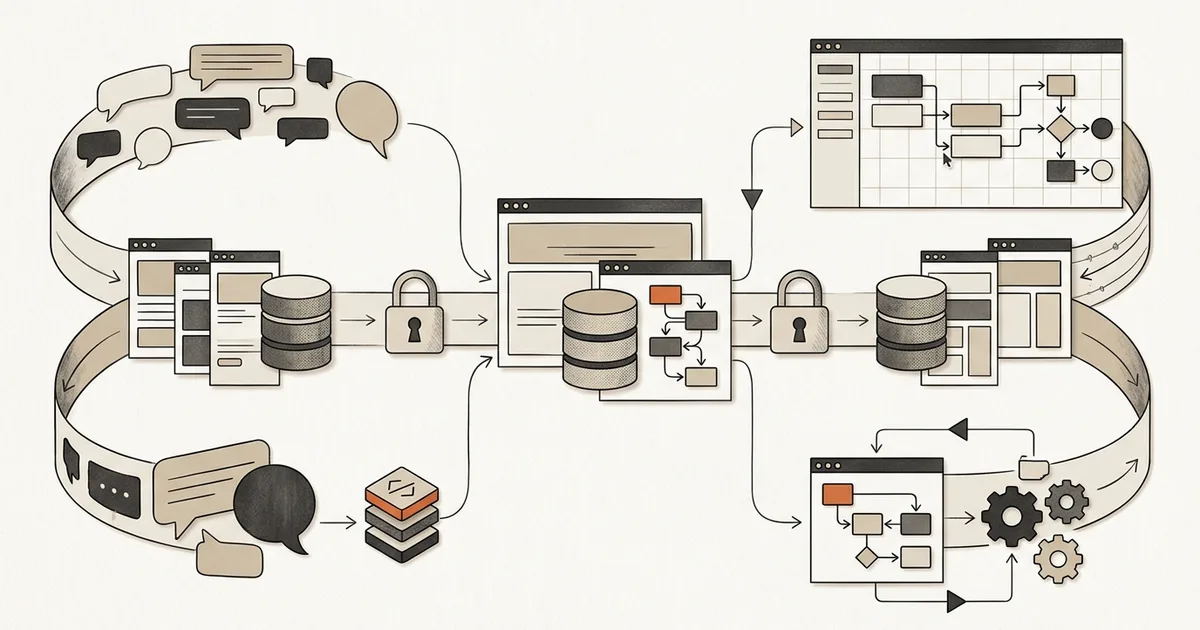
Use one equipment-booking app as the proof
The brief below is an editorial test plan, not an executed benchmark. No app, prompt transcript, screenshot set, runtime log, or artifact hash exists for either product.
Freeze the same stateful brief
Specify an equipment-booking portal with member sign-in, coordinator access, Asset, Reservation, MaintenanceWindow, and AuditEvent records, an availability view, a reservation request, and a coordinator approval or decline.
Sources: [base44-quick-start], [base44-backend-features], [bubble-intro], [bubble-data], [bubble-users]
Freeze authorization and failure checks
Require a member to be denied when marking an asset unavailable, reject an overlapping reservation, preserve an audit event, and show accessible loading, empty, validation, permission, and provider-error states.
Sources: [base44-backend-features], [base44-test-data], [bubble-privacy], [bubble-workflows], [bubble-debugger]
Freeze publishing and handoff evidence
Require a custom-domain answer, a named source or application-logic export, a data export, a production usage meter, and a written restore path for both app changes and live records. Treat each as a separate result.
Sources: [base44-github], [base44-pricing], [base44-credits], [bubble-ownership], [bubble-pricing], [bubble-version]
Record evidence without inventing a score
Save the exact account plan, prompts, visual edits, schema or data-type definitions, workflow rules, source revision, credits or workload units, errors, publish result, and recovery notes. Do not turn subjective preference into a quality ranking.
Sources: [base44-chat-modes], [base44-activity], [bubble-collaboration], [bubble-server-logs], [bubble-pricing]
What this comparison owns
This is the canonical bilateral buyer decision for Base44 and Bubble in either query direction. It compares current documented workflows and operating boundaries, not brand reputation or unverified output quality.
Included
- Base44 vs Bubble and the reverse Bubble vs Base44 query intent
- Prompt, AI-generated, visual-editor, frontend, backend, data, authentication, workflow, source, publishing, collaboration, integration, recovery, usage, and team-fit boundaries
- One neutral fictional app brief that a buyer can reproduce in both intended accounts
- Dated first-party findings with conflicts, unknowns, and not-evidenced states left visible
Not included
- A universal winner, score, ranking, performance benchmark, generated-code benchmark, security audit, or claim that either completed the brief
- Base44 vs Lovable and Bubble vs Lovable bilateral comparison intent
- Base44 alternative and Bubble alternative replacement intent
- Generic no-code app builder, AI app builder, and best-builder category intent
- Native mobile store packaging, enterprise procurement, negotiated contracts, tax analysis, or a legal opinion about ownership
Thirteen criteria for a current builder decision
Read every row as a workflow and operating boundary. Similar labels such as AI, database, export, or version control do not make the underlying models equivalent.
Starting workflow
Shows whether the first useful move is a prompt, an AI-generated starter, a visual canvas, or an explicit app model.
Generation and edit loop
Compares AI changes, planning, visual edits, direct code work, and the route from feedback to another build.
Same-brief proof boundary
Keeps one fictional app brief constant and prevents documented capability from becoming a fabricated result.
Frontend and interface control
Identifies how layouts, reusable components, responsive behavior, conditions, and generated source can be changed.
Backend, data, and authentication
Names the owner of records, user identity, authorization, files, server work, realtime behavior, and hosting.
Schema and workflow control
Tests whether the team can reason explicitly about record structure, events, actions, access rules, and state changes.
Source ownership and export
Separates legal ownership, code access, repository sync, data export, provider configuration, and self-hosting.
Deployment and domains
Identifies the live artifact, development environment, custom-domain path, runtime boundary, and release action.
Collaboration and versioning
Separates editor seats, workspace roles, simultaneous editing, branches, savepoints, and live-user permissions.
Integrations and plugins
Shows how external APIs, OAuth accounts, provider credentials, reusable connectors, and third-party extensions enter the app.
Debugging and recovery
Tests what can be inspected, replayed, reverted, restored, or exported when a change or live workflow fails.
Usage meter and current pricing
Compares the unit consumed while building with the resource or integration usage that can accumulate after launch.
Team fit and handoff
Turns the matrix into a conditional choice for the people who will build, review, operate, and eventually inherit the app.
Base44 and Bubble evidence matrix
The findings summarize current official documentation. They do not report observed generation speed, output quality, code quality, reliability, accessibility, security, support, or production performance.
Base44
Best for: Teams that want to begin in an AI-centered app editor, keep a managed backend close to the build, and retain direct frontend code and supported GitHub access when needed.
Base44 combines AI chat modes, visual editing, a live preview, a dashboard, React and Vite code access, a managed NoSQL backend, authentication, functions, integrations, hosting, GitHub sync, test data, and version history. Its current public model uses message credits for AI-assisted building and integration credits for many advanced or live-app actions.
| Criterion | Finding |
|---|---|
| Starting workflow | Base44 opens around AI chat, a live preview, and an app dashboard. A buyer can describe an app, watch changes appear, switch to Discuss for planning, or use Edit mode for targeted interface changes. Sources: [base44-quick-start], [base44-chat-modes] |
| Generation and edit loop | The documented loop combines AI changes, non-editing discussion, visual selection and adjustment, preview, direct code work, and version history. Manual visual edits do not consume message credits; AI changes can. Sources: [base44-chat-modes], [base44-developer-tools], [base44-credits] |
| Same-brief proof boundary | Official docs cover authentication, entities, access rules, backend functions, integrations, preview, testing data, and publishing, but this article did not run the equipment-booking brief. Completeness and authorization correctness are not established. Sources: [base44-backend-features], [base44-test-data] |
| Frontend and interface control | Current developer docs expose the generated React and Vite frontend in a code tab with file access and live preview, alongside visual edits and AI assistance. The frontend uses Tailwind and a folder of pre-built UI components in the documented app structure. Sources: [base44-developer-tools] |
| Backend, data, and authentication | The managed backend documents a NoSQL entity database, built-in authentication, row- and field-level access rules, realtime subscriptions, Deno-based functions, integrations, and hosting. The buyer remains responsible for proving the app-specific policy. Sources: [base44-backend-features], [base44-access] |
| Schema and workflow control | Entities describe document structure, but Base44 says schemas are not enforced and can change without migrations. Custom server logic lives in TypeScript functions, while access rules and integrations provide other workflow controls. That model should be tested against the team’s need for strict schema governance. Sources: [base44-backend-features], [base44-integrations] |
| Source ownership and export | Base44 states that customers own everything they build, including code, data, and users. Builder plans and above document GitHub integration, and Base44 documents export of frontend code and functions plus CSV export of database collections. Managed services, secrets, domains, and runtime configuration are separate from those exports. Sources: [base44-pricing], [base44-github], [base44-export] |
| Deployment and domains | Publishing can create a Base44-hosted app, and every paid plan from Starter up lists domain connection in the reviewed public plan model. Backend docs describe custom domains and automatic HTTPS for static or SPA builds, with an external frontend host as an option when the built-in hosting boundary does not fit. Sources: [base44-quick-start], [base44-pricing], [base44-backend-features] |
| Collaboration and versioning | The workspace model documents shared plan and credits, Owner, Editor, and Viewer roles on every plan, an Enterprise-only Admin role, and app-scoped collaborators managed separately. Apps attach to the workspace where they are created and can move to another workspace the account belongs to, so verify the actual account before planning a team handoff. Sources: [base44-workspaces] |
| Integrations and plugins | Base44 documents built-in integrations, OAuth connectors, reusable custom OpenAPI integrations, and per-app API calls through backend functions. Account-level MCP connections support the builder chat rather than the deployed app, while a published app can separately expose its own MCP server to AI assistants. Sources: [base44-integrations] |
| Debugging and recovery | Activity Monitor exposes preview requests, responses, status, and timing; separate test data protects production records in preview; Version History can preview, publish, or restore a prior app version. GitHub sync keeps a two-way external copy of the app code, and none of these facts alone proves production-record recovery. Sources: [base44-activity], [base44-test-data], [base44-chat-modes], [base44-github] |
| Usage meter and current pricing | The public annual pricing page reviewed September 5 lists Free, Starter at $16 per month, Builder at $40, Pro at $80, and Elite at $160, with monthly message and integration allowances. Credit use varies by action. Separate official docs describe workspace plans that bundle features with a fixed monthly credit allocation, so verify the intended account. Sources: [base44-pricing], [base44-credits], [base44-workspaces] |
| Team fit and handoff | The documented fit is strongest when a team values a prompt-led editor, a managed full-stack starting point, direct frontend code, and a supported repository path, and accepts the platform-specific backend and dual usage-meter boundaries after verification. Sources: [base44-quick-start], [base44-developer-tools], [base44-backend-features], [base44-credits] |
Tradeoffs
- The public site and support docs describe workspace plans that bundle features with fixed monthly credit allocations, and the intended account remains the final source for available plans, roles, and meters.
- The managed backend is portable differently from the frontend and functions: source, data collections, credentials, hosting, and provider configuration need separate handoff checks.
- Base44 site hosting currently documents SPA or static-export frontends rather than server-side rendering or server components.
Bubble
Best for: Teams that want an AI-generated starting app followed by explicit visual control over interface elements, data types, privacy rules, event-action workflows, plugins, and version branches.
Bubble combines an AI app generator with a visual editor, built-in database and user accounts, data types, privacy rules, frontend and backend workflows, plugins, APIs, hosting, development and live environments, debugging, server logs, collaboration, and version control. Live operation is priced through workload units at the project level.
| Criterion | Finding |
|---|---|
| Starting workflow | Bubble now documents an AI app generator that turns a prompt and confirmed feature list into a functional starting app with a built-in database and workflows. The team then customizes that result in the visual editor. Sources: [bubble-intro] |
| Generation and edit loop | The documented loop begins with AI generation where useful, then uses the visual editor for interface changes and the workflow editor for events, conditions, and actions. This is not accurately described as manual visual building only. Sources: [bubble-intro], [bubble-workflows] |
| Same-brief proof boundary | Official docs cover AI-generated apps, data types, users, privacy rules, workflows, plugins, debugging, and deployment, but this article did not run the equipment-booking brief. Generated completeness, access correctness, and maintainability are not established. Sources: [bubble-intro], [bubble-data], [bubble-privacy], [bubble-debugger] |
| Frontend and interface control | Bubble’s visual editor is the primary interface implementation surface after generation. Elements, dynamic expressions, conditions, and workflow-triggered UI behavior are configured in the platform rather than handed over as a conventional application source tree. Sources: [bubble-intro], [bubble-workflows], [bubble-ownership] |
| Backend, data, and authentication | Bubble provides a built-in database, a special User type, email-password and supported OAuth flows, server-side actions, API workflows, and privacy rules. Bubble warns that privacy rules are the primary data-security control and must be deliberately configured. Sources: [bubble-data], [bubble-users], [bubble-privacy], [bubble-workflows] |
| Schema and workflow control | The Data tab exposes named data types and fields, while workflows combine events with one or more actions and conditional expressions. Privacy rules are configured per type and can control search, field visibility, files, and modification paths. Sources: [bubble-data], [bubble-workflows], [bubble-privacy] |
| Source ownership and export | Bubble states that the customer owns app design, direct user content, data, and AI output, while Bubble retains the platform code. Data can be exported through CSV or APIs, and Bubble says it can help export the design, but the app cannot be exported as a conventional codebase or run outside Bubble without rebuilding. Sources: [bubble-ownership], [bubble-terms] |
| Deployment and domains | Bubble provides separate Development and Live environments with independent databases. Current paid Starter and above include a live web app and custom domain, while the app is hosted and run on Bubble’s cloud platform. Sources: [bubble-version], [bubble-domain], [bubble-pricing], [bubble-terms] |
| Collaboration and versioning | Higher-tier plans support additional app editors and granular collaborator access. Bubble documents simultaneous editing cues, Basic version control for Main and Live, and Premium custom branches, merging, savepoints, and conflict handling on higher plans. Sources: [bubble-collaboration], [bubble-version], [bubble-pricing] |
| Integrations and plugins | Bubble supports first- and third-party plugins, an API Connector for JSON REST APIs, incoming Data and Workflow APIs, an SQL Database Connector, and app-to-app connections. Paid plugins can add per-app one-time or recurring charges and third-party support dependencies. Sources: [bubble-integrations], [bubble-api-connector], [bubble-plugins] |
| Debugging and recovery | The development debugger can inspect elements and run workflows step by step, while server logs preserve past server-side actions for a plan-dependent window. Version control uses automatic and manual savepoints and can restore a branch. The reviewed sources do not establish the exact live-database recovery entitlement for every plan. Sources: [bubble-debugger], [bubble-server-logs], [bubble-version], [bubble-pricing] |
| Usage meter and current pricing | Current annual pricing reviewed September 5 lists Free with 50,000 workload units, Starter at $59 per month with 175,000, Growth at $209 with 250,000, and Team at $549 with 500,000. Workload aggregates server resources across the project; extra tiers, overages, storage, and plugin subscriptions can add cost. Sources: [bubble-pricing], [bubble-plugins] |
| Team fit and handoff | The documented fit is strongest when the team wants the Bubble visual language itself to be the long-term application model and values explicit control over data types, privacy, workflows, plugins, branches, and workload within one hosted platform. Sources: [bubble-intro], [bubble-data], [bubble-workflows], [bubble-version], [bubble-pricing] |
Tradeoffs
- Bubble owns the underlying platform code and states that a Bubble app has no traditional source codebase to export; moving away requires rebuilding application logic even though design and data can be exported.
- Explicit data and workflow control offers depth but requires the team to design and maintain privacy rules, conditions, actions, performance, and plugin behavior carefully.
- Workload units, overages, add-ons, plugin subscriptions, editor counts, branch limits, and log retention all affect the operating plan beyond a headline subscription price.
Choose the operating model your team can explain
A conditional rule is more useful than a score. Pair the apparent fit with the obligation it creates after the first app is generated.
Choose Base44 when the team wants prompt-led iteration, direct React code access, and a managed backend close to the same build workspace.
Choose: Run the brief with the intended plan, connect GitHub, exercise test data, publish to the intended domain, and measure both message and integration credits.
Tradeoff: The integrated path makes managed-backend portability, changing workspace terms, and the dual usage meter important operating dependencies.
Choose Bubble when the team wants explicit visual control over data types, privacy rules, workflows, plugins, and branches as the application’s long-term source of truth.
Choose: Model every type and access rule, inspect generated workflows, test them step by step, deploy through Development and Live, and measure workload under realistic traffic.
Tradeoff: The platform model is deep but not a conventional exportable codebase, so migration, Bubble skills, plugin ownership, and workload become long-term commitments.
Pause when “full stack,” “AI-generated,” or “no code” is still a marketing label rather than a saved same-brief result.
Choose: Execute the neutral brief in the intended accounts and retain prompts, schemas, workflows, source or logic exports, screenshots, usage records, errors, and restore notes.
Tradeoff: A controlled proof costs time and plan capacity, but it replaces generic feature claims with evidence the team can review.
Reopen the decision when source can move but production records, access policies, integrations, domains, or recovery cannot be handed over.
Choose: Inventory code or app logic, data, credentials, providers, domains, logs, usage, and recovery separately before growing the app.
Tradeoff: Ownership of content or frontend files is valuable, but it is not the same as a portable and recoverable production system.
Try a separate proof
Describe the same bounded app and inspect what actually runs.
Playcode is not scored in this comparison. Use it only as a separate proof: describe the roles, records, denied action, failure states, source handoff, and recovery boundary, then inspect the result before choosing a platform.
Start BuildingNo ranking claim. The same brief and your operating constraints decide the fit.
See current Playcode pricing and usage boundaries.Use current plan terms for any separate Playcode proof.
Evidence, pricing, and publisher limits
This is an editorial buyer guide from Playcode. It supports a buyer-run proof and does not replace hands-on evaluation, procurement, legal review, or application security work.
- Playcode is an AI app builder and may be an alternative in adjacent searches. Playcode has no affiliate relationship with Base44 or Bubble.
- We did not reproduce the equipment-booking portal in either product, so there is no output artifact, prompt pack, screenshot set, runtime log, or hash to publish.
- We make no claim about observed generation speed, visual quality, code quality, reliability, accessibility, security, support, scalability, or production performance.
- Base44 rolled out new workspace, role, plan, and credit behavior during 2026. Public pages and the intended account can differ, so verify the current upgrade and usage screens before purchase.
- Bubble prices shown here use the annual-billing view. Workload tiers, overages, storage, plugin subscriptions, taxes, mobile packaging, and negotiated terms can change the total.
- Base44 code or collection exports do not automatically transfer every managed service, secret, domain, credential, provider account, or restore procedure.
- Bubble’s ownership of the underlying platform and lack of a conventional app-code export are different from ownership of customer design, data, direct user content, and AI output.
- Platform access controls, privacy rules, scanners, and logs do not establish that a generated app has correct authorization, privacy behavior, or regulatory compliance.
Official sources checked September 5, 2026
Every product finding cites first-party documentation. Recheck volatile plans, credits, workload units, editor counts, branch limits, logs, integrations, and rollout state in the intended account.
[base44-quick-start] Base44 Support Documentation:Building an app
Checked September 5, 2026. Supports: AI chat, preview, dashboard, Edit mode, data controls, publishing, custom domains, sharing, and current plan unlocks.
[base44-chat-modes] Base44 Support Documentation:Using the AI Chat in Base44
Checked September 5, 2026. Supports: Build, Discuss, and Edit mode behavior, version history, prompt reverts, publishing an earlier version, and model selection.
[base44-developer-tools] Base44 Support Documentation:Base44 developer tools
Checked September 5, 2026. Supports: Direct code work, app structure, managed backend, integrations, local development, debugging tools, and hosting boundaries.
[base44-backend-features] Base44 Support Documentation:Base44 backend features
Checked September 5, 2026. Supports: NoSQL entities, schema behavior, access rules, authentication, functions, realtime, integrations, SPA hosting, custom domains, and HTTPS.
[base44-access] Base44 Support Documentation:Choosing who can access your app
Checked September 5, 2026. Supports: Live app visibility levels, Admin and User roles, group access, collaborator management, and acting as a user for permission testing.
[base44-pricing] Base44:Base44 plans and pricing
Checked September 5, 2026. Supports: Public annual plan prices, message and integration allowances, code edits, model selection, domain connection, GitHub, collaboration, and app ownership.
[base44-credits] Base44 Support Documentation:Credits
Checked September 5, 2026. Supports: Message and integration credit purposes, variable consumption, live integration examples, reset timing, and usage visibility.
[base44-workspaces] Base44 Support Documentation:Base44 plans, workspaces, and credits
Checked September 5, 2026. Supports: Workspace plans with fixed monthly credit allocations, shared credit pools, Owner, Editor, Viewer, and Enterprise Admin roles, and app-to-workspace attachment and moves.
[base44-github] Base44 Support Documentation:GitHub integration
Checked September 5, 2026. Supports: Repository connection, two-way sync, collaboration, local development, the main-branch sync rule, and disconnect behavior.
[base44-export] Base44 Support Documentation:Creating and using your app on mobile
Checked September 5, 2026. Supports: Builder-plan export of frontend and functions through GitHub or ZIP and database-collection export as CSV.
[base44-integrations] Base44 Support Documentation:Using integrations
Checked September 5, 2026. Supports: Built-in actions, OAuth connectors, custom OpenAPI integrations, backend-function APIs, secret handling, testing, and MCP boundary.
[base44-activity] Base44 Support Documentation:Activity Monitor
Checked September 5, 2026. Supports: Realtime preview request inspection, methods, status codes, timing, request details, responses, and error messages.
[base44-test-data] Base44 Support Documentation:Testing your app with test data
Checked September 5, 2026. Supports: Separate production and test databases, preview testing mode, and testing links that stay isolated from live records.
[bubble-intro] Bubble Docs:Bubble Manual introduction
Checked September 5, 2026. Supports: AI app generation, confirmed features, built-in database and workflows, visual refinement, plugins, APIs, and shared web or mobile backend.
[bubble-data] Bubble Docs:Data tab
Checked September 5, 2026. Supports: Data types, fields, privacy settings, app data, separate Development and Live databases, and data export controls.
[bubble-users] Bubble Docs:User accounts
Checked September 5, 2026. Supports: Built-in users, password handling, signup, login, OAuth, role use cases, temporary users, and shared web or mobile identity.
[bubble-privacy] Bubble Docs:Privacy rules
Checked September 5, 2026. Supports: Rule conditions, search and field permissions, API modification controls, and Bubble’s security warning about privacy rules.
[bubble-workflows] Bubble Docs:Workflows
Checked September 5, 2026. Supports: Event-action workflows, conditions, UI and database actions, external API calls, naming, and error handling.
[bubble-ownership] Bubble Docs:Application and data ownership
Checked September 5, 2026. Supports: Customer design and data ownership, Bubble platform-code ownership, CSV and API exports, design-export help, and no conventional code export.
[bubble-terms] Bubble:Bubble terms
Checked September 5, 2026. Supports: Platform and cloud model, direct user content, AI output, ownership, customer responsibility, and platform-code rights.
[bubble-pricing] Bubble:Bubble pricing and workload
Checked September 5, 2026. Supports: Current annual plan prices, workload units, live apps, domains, editors, branches, log retention, overages, tiers, and add-ons.
[bubble-version] Bubble Docs:Version control
Checked September 5, 2026. Supports: Development and Live environments, databases, Main and Live branches, custom branches, savepoints, merging, and restore behavior.
[bubble-domain] Bubble Docs:Custom domain and DNS
Checked September 5, 2026. Supports: Default Live and Development URLs, custom-domain setup, and one-domain-per-app boundary.
[bubble-collaboration] Bubble Docs:Collaborators
Checked September 5, 2026. Supports: App-scoped collaborators, permissions, simultaneous-editing cursors, plan boundary, and database or log access risk.
[bubble-integrations] Bubble Docs:Integrations
Checked September 5, 2026. Supports: Incoming and outgoing APIs, plugins, SQL databases, and Bubble app-to-app data and workflow connections.
[bubble-api-connector] Bubble Docs:The API Connector
Checked September 5, 2026. Supports: JSON REST API connections, actions and data sources, authentication, server routing, initialization, and secret handling.
[bubble-plugins] Bubble Docs:Installing and using plugins
Checked September 5, 2026. Supports: Plugin installation, configuration, keys, development and live settings, recurring billing, ownership, and page-weight caution.
[bubble-debugger] Bubble Docs:The debugger
Checked September 5, 2026. Supports: Normal, slow, and step-by-step workflow inspection, breakpoints, element inspection, conditions, and development-only behavior.
[bubble-server-logs] Bubble Docs:The server logs
Checked September 5, 2026. Supports: Historical server-side workflow searches, Development and Live separation, user and time filtering, and action-level detail.
Base44 vs Bubble FAQ
Is Base44 better than Bubble?
Not universally. Base44 has the clearer documented fit for a prompt-led workflow that stays close to React code, a managed backend, and GitHub. Bubble has the clearer documented fit for teams that want data types, privacy rules, workflows, plugins, and branches to remain explicit in a visual programming environment. This article did not test either product.
Is Bubble better than Base44?
The reverse query has the same conditional answer and belongs to this page. Bubble may fit teams that want long-term control in its visual application model. Base44 may fit teams that want an AI-centered build loop with direct frontend code. Run the same stateful brief before choosing.
Does Bubble use AI or only a visual editor?
Bubble now documents an AI app generator that can create a functional starting app with a database and workflows from a prompt. The generated result is then refined in Bubble’s visual editor. A current comparison should not describe Bubble as a manual-only builder.
Can Base44 export source code?
Base44 documents frontend and function export through ZIP or GitHub on Builder and higher, plus CSV export of database collections. That does not automatically move every managed backend service, live record, secret, domain, credential, integration, or restore process.
Can Bubble export source code?
Bubble says a Bubble app has no traditional codebase to export and runs on Bubble. Customers own their design, data, direct user content, and AI output; data can move by CSV or API, and Bubble says it can help export the design to assist migration. Rebuilding the application logic is still required to leave the runtime.
Which costs less, Base44 or Bubble?
A starting price cannot answer that. Base44 uses message and integration credits inside its workspace plan model. Bubble uses project-level workload units with optional tiers, overages, storage, and plugin costs. Model the intended build, live traffic, integrations, team access, logs, and branches in the current account screens.
Which is better for a team?
Base44 documents shared workspaces and credits with app-specific collaborators. Bubble documents app-scoped collaborators, multiple editors on higher plans, and premium branches on Growth and above. The better fit depends on who can edit, approve, deploy, inspect live data, pay for usage, and own the handoff.
Does this page also cover Bubble vs Base44?
Yes. The two word orders express one bilateral selection job, so one dated canonical page covers both directions. Alternatives, Lovable comparisons, generic no-code guides, and category rankings remain separate search intents.
Press play on the proof
Build one workflow that can fail, recover, and transfer.
Start with two roles, four records, one denied server action, an overlap conflict, explicit error states, a production publish, and a written source and data handoff.
Start BuildingKeep app ownership, code export, data export, and whole-system recovery as separate checks.