QUICK ANSWER
Should you choose Base44 or Replit?
Choose Base44 when a managed web-app path with built-in backend services, hosting, and a visual builder matches the job. Choose Replit when you want a broader browser workspace, Agent workflow, deployment choices, and Git-centered project control. Both currently price their paid entry plans at $20 monthly. Before deciding, test code and data exit, production usage, permissions, and recovery separately.
Base44 and Replit both present prompt-driven paths to working apps, yet their operating contracts are not interchangeable. The choice changes how your team handles direct code work, backend services, publishing, production usage, repository sync, data export, and recovery.
This buyer guide holds one app job constant and compares the boundaries that remain after a successful demo. It does not grade generated design or code quality, and it does not turn documentation into a reliability, security, or performance benchmark.
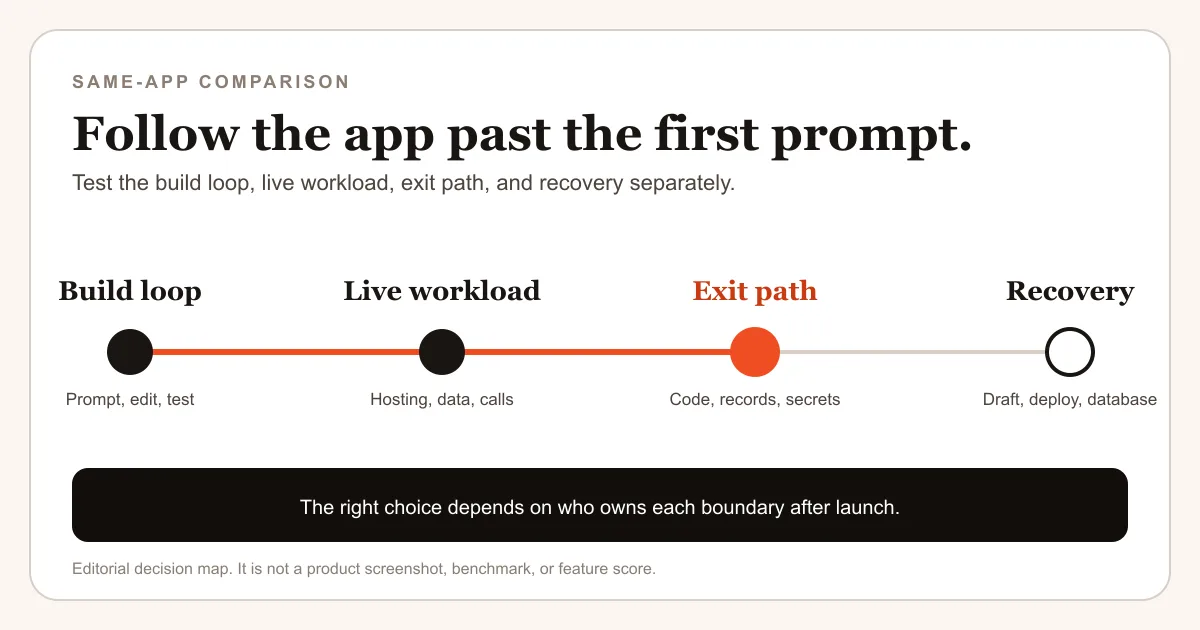
How this Base44 vs Replit comparison was built
The method compares one production-shaped web app, not two different showcase prompts.
Define one acceptance fixture
Use one actor, one durable record, one server-enforced permission, one external dependency, one published route, and one recovery case. Build the same scope before comparing polish, prompt count, or subscription headlines.
Sources: [base44-quick-start], [base44-backend], [replit-build]
Separate managed services from generated code
List which authentication, database, functions, files, email or AI calls, domains, and hosting behaviors are managed services. Then record which parts appear in source, data exports, or replacement infrastructure.
Sources: [base44-backend], [base44-mobile-export], [replit-import]
Run the publish and workload model
Publish a controlled route, record its runtime type, and estimate the actions that consume credits or usage. Base44 separates message and integration credits; Replit combines included credits with Agent and cloud-service usage plus deployment meters.
Sources: [base44-credits], [base44-new-plans], [replit-ai-billing], [replit-deployments]
Prove exit and recovery before lock-in
Exercise code export, Git sync, data export, secret recreation, an older draft, an older live version, and production-data recovery separately. Neither a repository nor an editor history proves the entire live app can move or be restored.
Sources: [base44-github], [base44-mobile-export], [base44-version-history], [replit-import], [replit-checkpoints]
Keep volatile plan facts scoped
Record the billing cadence, included credits, and plan gates shown by current public pages, then confirm the checkout screen. Base44 says a workspace plan determines its features and includes a monthly credit allocation; each public plan card lists fixed message and integration credit amounts. Its GitHub page now documents repository and account disconnect flows, so verify the current sync workflow instead of older permanence wording.
Sources: [base44-pricing], [base44-billing-plans], [base44-new-plans], [base44-github]
Owner and comparison boundary
This page owns Base44 vs Replit and reverse wording Replit vs Base44 as one bilateral product-selection job. If you are replacing Base44 rather than choosing between these two products, use the Base44 alternative guide.
Included
- Builder workflow, app output, backend, hosting, source and data exit, recovery, plan prices, credits, team controls, and migration burden
- First-party Base44 and Replit documentation reviewed on September 5, 2026
- A same-app decision method that buyers can repeat with their own records and workload
Not included
- Base44 vs Lovable, Replit vs Cursor, Replit vs Lovable, and broad best AI app builder intent
- Generated-design scoring, model-quality benchmarking, load testing, security auditing, or vendor reliability ranking
- Native app-store output, provider approval, compliance certification, or guaranteed production and business outcomes
Ten boundaries to verify with the same app
Each finding describes the current official surface. It still needs a trial against your records, policy, workload, and failure cases.
Builder workflow
The operator needs to know how prompts, direct edits, code review, test feedback, and collaboration fit together.
App shape and output
A hosted web app, PWA, API, scheduled job, and native store package are different outputs with different proof.
Backend and data
Authentication, functions, records, files, integrations, and access control determine whether the app can operate safely.
Publishing and hosting
The team must understand how drafts become live, what workload runs where, and who monitors the production path.
Code, data, and exit
Source code, backend functions, database records, secrets, domains, and managed services need separate exit checks.
Recovery scope
Restoring an editor version, publishing an older build, and restoring live data can affect different state.
Plan price
Subscription price, billing cadence, included credits, and overage exposure need to be compared before workload costs are modeled.
Production meter
Builder messages, integrations, Agent effort, app compute, requests, storage, and databases may be charged differently.
Team and change control
Workspace roles, repository permissions, budgets, and publish authority shape the operational risk.
Migration burden
A documented import or export path is only complete when the replacement app runs with records, secrets, and dependencies.
Base44 and Replit across price and the app lifecycle
The comparison keeps both products' strengths intact while separating code access from data, runtime, and recovery claims.
Base44
Best for: Teams that want a managed web-app builder with built-in backend services, hosting, and a visual path from prompt to live app.
Base44 documents an integrated web-app editor with authentication, database functionality, backend functions, managed hosting, custom domains, code views, ZIP export, and GitHub sync on Builder or higher. Its message and integration credit system also reaches some live app actions.
| Criterion | Finding |
|---|---|
| Builder workflow | Base44 centers AI chat, visual preview, direct code visibility, and live managed app behavior. The documented workflow can revert prompt changes, inspect files, and publish from the same editor surface. Sources: [base44-quick-start], [base44-version-history] |
| App shape and output | Base44 generates web apps that users can open in any mobile browser or add to their home screen. The editor now also documents App Store and Google Play preparation that scans store guidelines and generates IPA and AAB files for your own developer accounts, while third-party wrappers remain an external option and native-only features like push notifications require separate setup. Sources: [base44-mobile-export] |
| Backend and data | The managed backend includes data, authentication, backend functions, integrations, and hosting. Exact function access, capacity, connectors, and production policy vary by plan and credit level. Sources: [base44-backend], [base44-billing-plans], [base44-new-plans] |
| Publishing and hosting | Base44 says apps are hosted, live, and shareable through its managed path, with custom domains on qualifying plans. Its developer backend also documents frontend hosting with HTTPS and separate external-host options. Sources: [base44-quick-start], [base44-backend] |
| Code, data, and exit | The editor documents ZIP export, while GitHub sync and code export require Builder or higher. Mobile export guidance separates exported frontend code from app data and backend behavior, which makes code and runtime data separate handoffs. Sources: [base44-quick-start], [base44-github], [base44-mobile-export] |
| Recovery scope | Version History can preview, publish, or restore an earlier app version. The reviewed page does not establish that reverting a version also restores live database contents, so treat record recovery as a separate test. Sources: [base44-version-history] |
| Plan price | Base44 currently lists Free at $0. Its monthly prices are Starter $20, Builder $50, Pro $100, and Elite $200; annual billing displays $16, $40, $80, and $160 per month respectively. Each public plan card also lists a monthly message and integration credit allocation. Sources: [base44-pricing], [base44-billing-plans] |
| Production meter | Base44 separates message credits used while building from integration credits used by selected live services and actions. Each workspace uses its own plan and shared credit pool, and current plans include monthly allocations. Consumption still varies by action and selected model, so estimate both build and live usage. Sources: [base44-pricing], [base44-credits], [base44-new-plans] |
| Team and change control | All workspace plans include Owner, Editor, and Viewer roles; Enterprise adds Admin. Invited members use the workspace plan and shared credit pool on every plan including Free, and the current plan cards gate AI model selection and GitHub integration behind Builder or higher. Sources: [base44-new-plans], [base44-pricing] |
| Migration burden | GitHub and ZIP create a code path, and app data remains a separate handoff. The GitHub page now documents repository and account disconnect flows and requires syncing back through a branch named main; verify the current workflow in the UI before treating a connection or exit as reversible. Sources: [base44-github], [base44-mobile-export] |
Tradeoffs
- The managed path reduces initial infrastructure choices, while platform credits, managed services, and current plan rules remain part of the live operating contract.
- Source and function export do not automatically prove that every managed backend behavior, database record, secret, domain, or integration will run on a replacement stack.
- Public prices, credit allocations, and the GitHub sync contract have each been rewritten during 2026, so checkout and migration need separate confirmation against the current UI.
Replit
Best for: Teams that want a broad browser workspace, Agent, Git tools, cloud resources, and a choice of production deployment types.
Replit documents an idea-to-app Agent workflow, project editor, imports, Git-backed history, cloud services, and several deployment models. It offers more explicit runtime choices than one automatic hosting path, while that flexibility adds workload meters and deployment decisions.
| Criterion | Finding |
|---|---|
| Builder workflow | Replit supports idea-first work, existing repositories, ZIPs, designs, spreadsheets, and selected builder imports. Agent and the Project Editor share the build, run, secrets, Git, and preview workflow. Sources: [replit-build], [replit-import] |
| App shape and output | Replit documents web and mobile-oriented app building plus deployable web apps, APIs, static sites, and scheduled jobs. A product label alone still does not prove a native store binary or approval path. Sources: [replit-build], [replit-deployments] |
| Backend and data | The platform supports databases, storage, AI integrations, backend services, and deployment compute. Imported Base44 projects can bring source, backend logic, and schema, but existing data and secrets are excluded from that import. Sources: [replit-ai-billing], [replit-import] |
| Publishing and hosting | Replit separates the development workspace from Autoscale, Reserved VM, Scheduled, and static publishing choices. The operator selects a deployment type and monitors its request, compute, and related resource usage. Sources: [replit-deployments] |
| Code, data, and exit | Git and GitHub are first-class project paths, and Replit documents import from Base44 through a GitHub repository. Source movement does not include existing database values or secret values. Sources: [replit-import], [replit-checkpoints] |
| Recovery scope | Agent checkpoints can restore files, conversation context, configuration, and optionally the database contents captured at the checkpoint. Database restore is a selectable step during rollback, and the pricing page scopes database rollback retention by plan, so test how live app data is restored. Sources: [replit-checkpoints] |
| Plan price | Replit currently lists Starter as free, Core at $20 monthly or $17 per month billed annually, and Pro at $100 monthly or $95 per month billed annually; Enterprise is custom. Core lists $20 toward the most powerful models and Pro lists $100, on top of tiered free Agent usage, before workload usage is charged. Sources: [replit-pricing] |
| Production meter | Included credits can cover Agent and selected cloud services, while production deployments add request, compute, and resource usage. Core and Pro package different credit and collaboration levels, so model both build and live workload. Sources: [replit-pricing], [replit-ai-billing], [replit-deployments] |
| Team and change control | Current pricing distinguishes personal Core, professional Pro, and custom Enterprise controls. Collaborator and viewer limits, database rollback retention, seat limits, SSO, budgets, and advanced privacy controls vary by plan rather than following from every project. Sources: [replit-pricing], [replit-ai-billing] |
| Migration burden | The official Base44 import path begins with a GitHub export, then imports source, styles, assets, backend logic, and schema. Existing records and secrets are not migrated, so the replacement app needs data transfer, credentials, and smoke tests. Sources: [replit-import] |
Tradeoffs
- Deployment type, app compute, request traffic, storage, database, and Agent effort can all affect cost and operation.
- Imports can preserve code, backend logic, and database schema, but existing records and secrets need separate migration and configuration.
- Development checkpoints are broad, yet database restore is an optional selection during rollback, and rollback retention varies by plan.
Decision rules for Base44 vs Replit
Prefer the product whose production boundary is easiest for your operator to understand, verify, and recover.
The team wants a managed web-app path with few infrastructure choices
Choose: Evaluate Base44 first with one production-shaped workflow.
Tradeoff: The integrated backend and hosting reduce setup, while credits, plan gates, managed service boundaries, and migration still require review.
The app needs a broader coding workspace or several deployment models
Choose: Evaluate Replit first and choose the deployment type deliberately.
Tradeoff: The workspace and runtime choices add flexibility, but also increase the number of usage and operational decisions the team must own.
The app may leave the platform later
Choose: Require a clean-room exit test covering source, functions, current records, files, secrets, domains, scheduled work, and replacement-host operation.
Tradeoff: This is more work than checking for a GitHub button, but it prevents code access from being mistaken for application portability.
Live data recovery is a release requirement
Choose: Test editor undo, version publication, source history, record repair, and production database restore as separate controls.
Tradeoff: Multiple recovery exercises add time, while a single vague rollback promise can move the wrong state or fail to restore the data that matters.
Usage will come from both builders and app users
Choose: Track one monthly build fixture and one live workload fixture, then map every consumed credit and resource to its cause.
Tradeoff: A measured pilot delays the purchase decision, but avoids comparing Base44 message credits directly with Replit cloud and Agent credits as if they were equivalent units.
Current official pages conflict on a required plan or migration behavior
Choose: Treat the current billing screen and a recorded support confirmation as the decision input, with an expiry date.
Tradeoff: Waiting for confirmation can slow procurement, but choosing the favorable version of conflicting copy creates an unsupported production assumption.
PROVE THE OPERATING PATH
Bring the record, access rule, workload, and recovery case
Use Playcode to build one production-shaped slice with a real backend boundary, publishing path, code handoff, and recovery requirement before expanding the scope.
Build the app sliceNo credit card required. AI credits are included to start; production requirements and plan limits still apply.
Review the Playcode Cloud runtime, publishing, snapshot, and rollback boundaries.
Limits and source conflicts
The guide is a current first-party documentation review, not a hands-on product benchmark or contract.
- No identical application was generated, timed, load-tested, security-tested, migrated, or operated in both products for this article.
- Base44 says each workspace plan determines its features and includes a monthly credit allocation. Public plan cards currently list fixed message and integration credit amounts up to Elite, so confirm the exact allocation at checkout.
- Base44 GitHub documentation now includes repository and account disconnect instructions and no longer publishes permanent-sync wording. Do not base a migration rollback on documentation alone without testing the current UI.
- Replit imports from Base44 explicitly exclude existing database data and secret values; code and schema import is not a complete live migration.
- Prices, credits, included usage, resource limits, retention, exports, and plan gates can change before this guide's review date.
- Neither product name guarantees native store publication, accessibility, privacy, security, compliance, performance, reliability, scale, or business outcomes.
Official sources and review record
The matrix cites current first-party pages. Access dates show this review date, not an invented revision date for undated documentation.
[base44-quick-start] Base44 Support Documentation:Building an app
Checked September 5, 2026. Supports: Managed hosting, live sharing, code view, ZIP export, GitHub export boundary, app cloning, and the prompt-to-app editor workflow.
[base44-backend] Base44 Support Documentation:Backend service basics
Checked September 5, 2026. Supports: Managed data, authentication, backend functions, integrations, frontend hosting, HTTPS, custom domains, and external client options.
[base44-github] Base44 Support Documentation:GitHub integration
Checked September 5, 2026. Supports: Two-way sync setup, repository creation, Base44 CLI local development, main-branch-only sync back, collaborator invites, and the repository and account disconnect flows.
[base44-mobile-export] Base44 Support Documentation:Creating and using your app on mobile
Checked September 5, 2026. Supports: Web and home-screen output, in-editor App Store and Google Play preparation with IPA and AAB generation, external store wrappers, and Builder-level GitHub and ZIP code export.
[base44-version-history] Base44 Support Documentation:Using the AI Chat in Base44
Checked September 5, 2026. Supports: Prompt revert, editor version restore, previous-version publication, code inspection, and the absence of a stated live-database restore contract on that page.
[base44-credits] Base44 Support Documentation:Credits
Checked September 5, 2026. Supports: Message and integration credit definitions, variable consumption, resets, shared workspace pools, and selected live app actions that consume integration credits.
[base44-pricing] Base44:Base44 pricing
Checked September 5, 2026. Supports: Current Free, Starter, Builder, Pro, and Elite prices for monthly and annual billing, plus the message and integration credit allocations shown on each public plan card.
[base44-billing-plans] Base44 Support Documentation:Billing and plans
Checked September 5, 2026. Supports: Plan purchase and upgrade flows, the monthly and yearly billing cycle choice, invoices, cancellation, App Store subscriptions, and gift cards.
[base44-new-plans] Base44 Support Documentation:Base44 plans, workspaces, and credits
Checked September 5, 2026. Supports: Workspace-owned plans, plan-gated features, monthly credit allocations, separate workspace pools, Owner, Editor, Viewer, and Enterprise Admin roles, member collaboration, and app-workspace ownership.
[replit-build] Replit Docs:Build with Replit
Checked September 5, 2026. Supports: Idea-first guided journey from conversation to research, planning, design, and publishing, with web, Desktop App, and Mobile App entry points.
[replit-import] Replit Docs:Import from a provider
Checked September 5, 2026. Supports: Base44-to-Replit GitHub import, imported source, styles, assets, backend logic and schema, plus exclusions for existing database records and secret values.
[replit-deployments] Replit Docs:Publishing costs
Checked September 5, 2026. Supports: Autoscale, Reserved VM, Scheduled, and static deployments; request and compute meters; credits; budgets; and workload-specific publishing choices.
[replit-checkpoints] Replit Docs:Checkpoints and rollbacks
Checked September 5, 2026. Supports: Project and context checkpoints, optional database-contents restore during rollback, roll forward, and Git commits generated per checkpoint.
[replit-pricing] Replit:Replit pricing
Checked September 5, 2026. Supports: Current Starter, Core, Pro, and Enterprise plan framing, monthly and annual prices, model-credit headlines, free Agent usage tiers, collaborator and viewer limits, database rollback retention, and enterprise controls.
[replit-ai-billing] Replit Docs:Replit AI billing
Checked September 5, 2026. Supports: Usage-based Agent billing, included credits, Agent modes, checkpoints, credit use across AI and selected cloud services, alerts, and budget limits.
Base44 vs Replit FAQ
Is Base44 or Replit better for a non-technical founder?
Base44 documents a managed web-app builder with built-in backend services and hosting. Replit documents an integrated Agent and browser workspace with broader runtime choices. The better fit depends on the app's records, integrations, workload, code handoff, and who will operate failures after launch.
Do Base44 and Replit both include hosting?
Both document hosted application paths, but the models differ. Base44 presents built-in hosting in its managed builder. Replit offers distinct Autoscale, Reserved VM, Scheduled, and static deployments with usage meters. Verify domains, secrets, private access, capacity, monitoring, and recovery for the chosen plan.
Can I export a Base44 app to Replit?
Replit documents a Base44 import that starts with a Base44 GitHub export. It can import source, styles, assets, backend logic, and database schema. Existing database records and secret values are not migrated, so a real move also needs data transfer, credential recreation, and production smoke tests.
Does Base44 export all app data with the code?
Base44 documents code export to GitHub or ZIP on Builder or higher, and treats exported frontend code and app data as separate artifacts. Test files, relationships, identities, secrets, domains, scheduled work, provider configuration, and replacement-backend behavior rather than assuming a source ZIP is a complete running-app export.
Which has better version history and rollback?
Base44 documents prompt revert, older editor versions, and publishing a previous version. Replit checkpoints document broader development state with an optional database-contents restore, and rollback retention varies by plan. Compare the exact failure you need to recover, not the word rollback alone.
Which is cheaper, Base44 or Replit?
At the reviewed public rates, Base44 paid plans start with Starter at $20 monthly or $16 per month billed annually. Replit Core is $20 monthly or $17 per month billed annually. Those entry prices do not settle total cost: Base44 separates message and integration credits, while Replit credits can cover Agent and cloud services before deployment usage. Model the same monthly workload and confirm checkout.
Does this page also own Replit vs Base44?
Yes. Base44 vs Replit and Replit vs Base44 are one bilateral comparison owner. Base44 vs Lovable, Replit vs Cursor, Replit vs Lovable, and general best AI app builder research remain separate pages and search jobs.
BUILD THE SAME APP SLICE
Test the runtime and recovery, not only the first result
Describe one user, one durable record, one access rule, one live workload, one exit requirement, and one failure case. Playcode can build and run the smallest slice that proves those boundaries.
Start with PlaycodePlaycode AI builds the app. Playcode Cloud runs it. External providers still require their own accounts, credentials, limits, and review.