A useful inventory system is not an editable quantity beside a product name. It is a record of which SKU changed at which location, which stock event caused the change, who was allowed to do it, and how the team can prove the balance after retries, imports, concurrent requests, and recovery.
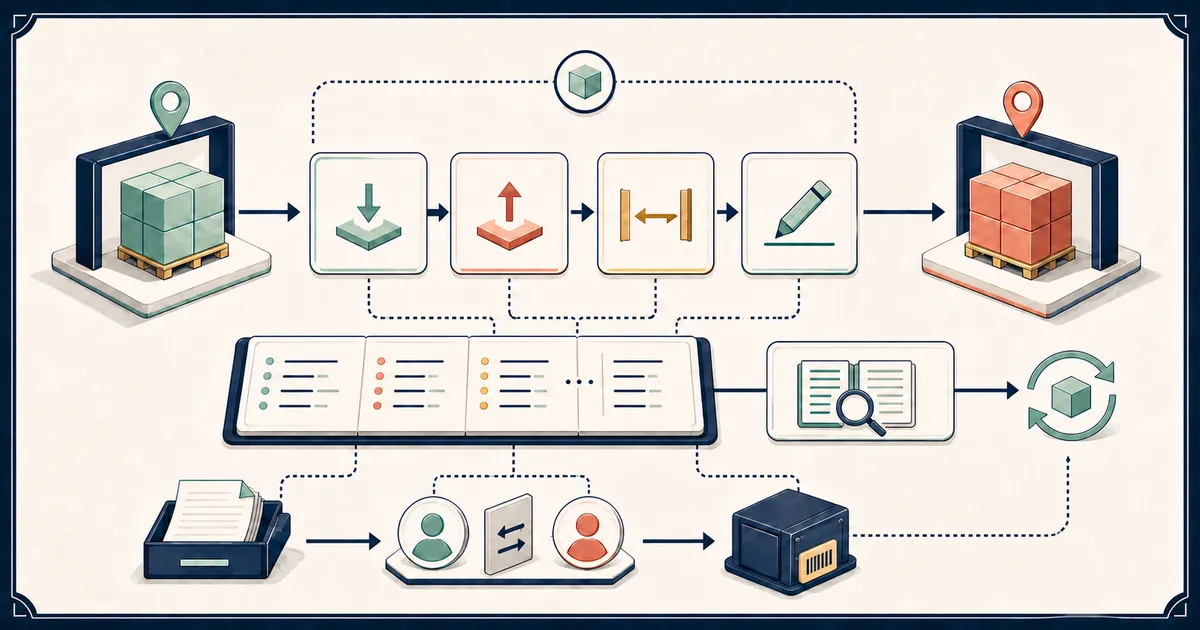
This guide creates the smallest complete stock workflow first. You will define a SKU/location ledger, implement receipts, issues, transfers, and adjustments, protect the last unit from a race, preview an opening import, reconcile materialized balances, and rehearse repair. A downloadable provider-neutral artifact exercises the same rules with fictional records.
QUICK ANSWER
How do you create an inventory management system?
Create an inventory management system by defining SKU, location, unit, role, and stock-movement records first; keeping receipt, issue, transfer, and adjustment entries durable; deriving each balance from those entries; and adding server authorization, retry identity, concurrent-decrement protection, import, export, reconciliation, tests, monitoring, repair, and recovery. Prove one fictional SKU across two locations before adding barcode, forecasting, or provider scope.
Write the stock contract before drawing inventory screens
Use one fictional SKU, two locations, and at least two ordinary user accounts. A single administrator and one editable total will hide the authorization, location, retry, and concurrency failures that this system needs to expose.
- A SKU, location, and unit dictionary: Give each stock item and location a stable ID. Define the unit for every SKU, whether quantities must be whole numbers, which locations may hold it, and whether negative inventory is forbidden. Names and labels can change without becoming record identity.
- A stock movement contract: Define receipt, issue, transfer, and adjustment separately. For each event, name the required source or destination, quantity direction, actor, reason, time, and validation. Decide which entries are immutable and which corrections require a new compensating event.
- A server-side role and action matrix: Write expected outcomes for signed-out visitors, viewers, operators, managers, and administrators across balance reads, stock movement, adjustment, import, export, reconciliation, audit, repair, and recovery. Hidden buttons are not authorization.
- A controlled opening file and hand-calculated baseline: Prepare fictional rows with stable source keys, unique SKU/location pairs, known units, valid and invalid quantities, and expected rejection reasons. Calculate the accepted opening balances by hand so the first reconciliation has an independent reference.
- Named owners for export, repair, and recovery: Decide who may export which fields, who may repair a materialized balance, how repair evidence is reviewed, which saved points exist, and who decides whether to restore the whole system. These operations have different blast radii and must remain separate.
Choose the authoritative inventory record
The central architecture decision is whether the current on-hand number is the business record or a fast projection of durable stock movements. That decision controls how well the team can explain a mismatch, recover from a retry, and rebuild state after a failure.
| Approach | Best for | Tradeoff |
|---|---|---|
| Mutable on-hand quantity | A short-lived prototype where one trusted person edits a simple count and no movement history, retry safety, audit, or recovery guarantee is needed. | It is easy to render, but a correction overwrites causality. Duplicate requests, concurrent changes, and recovery cannot be explained from the final number alone. |
| Authoritative transaction entries with a materialized balance | Operational systems that need receipt, issue, transfer, adjustment, roles, retries, audit, reconciliation, repair, and recoverable history. | It adds transactional writes, a reconciliation job, and an operator repair path, but every displayed balance can be checked against durable movement entries. |
| External inventory product as the source of truth | Teams whose workflow already fits a maintained system and only need a focused view or bounded automation around its supported records. | The application inherits that product's identity, permissions, API, rate limits, outages, export, and conflict behavior. Writes need a documented synchronization and reconciliation boundary. |
Recommended:For a custom operational system, keep immutable transaction entries authoritative and materialize each SKU/location balance for fast reads. Recalculate the expected balance from entries, compare it with the materialized value, and repair only after a reviewed mismatch. Choose an existing maintained product instead when its workflow already fits the job.
Create an inventory management system step by step
Define the stock contract, model the ledger, authorize transactions, protect retries and concurrent issues, preview imports, reconcile balances, test the artifact, publish, and operate recovery.
STEP 01
Define one complete stock lifecycle
Bound the first release around one SKU moving through two locations with explicit actors and reasons.
Write the path from opening state through receipt, issue, transfer, count adjustment, export, reconciliation, and bounded repair. Name the source and destination records, quantity direction, allowed role, required reason, and authoritative entry for each movement.
List the empty, loading, denied, invalid, retry, conflict, insufficient-stock, import-rejected, mismatch, recovery-locked, and repaired states. Leave purchasing, shipping, device input, prediction, and other adjacent workflows outside this first contract.
Expected result: The brief can explain every fictional quantity from durable events and can name which actor may perform each action without referring to a screen mockup.
Verify it: Walk one SKU from zero to receipt, issue, transfer, adjustment, reconciliation, and repair, then identify the record, rule, actor, result, and audit fact at every transition.
STEP 02
Model SKUs, locations, balances, and movements separately
Give durable business facts stable identities and keep the current balance as a projection of ledger entries.
Create SKU, location, stock transaction, transaction entry, materialized balance, request identity, import batch, reconciliation result, export record, and audit event records. Scope every private record to the owning workspace or account boundary.
A receipt adds one positive destination entry, an issue adds one negative source entry, a transfer adds balanced negative and positive entries, and an adjustment adds a reviewed delta. Do not rewrite a prior entry to make the current total look correct.
type StockEvent = 'receipt' | 'issue' | 'transfer' | 'adjustment'

type StockEntry = {
  transactionId: string
  skuId: string
  locationId: string
  quantityDelta: number
}

type StockBalance = {
  skuId: string
  locationId: string
  quantity: number
  version: number
}
Expected result: Every SKU/location quantity can be recalculated from entries, while imports, retries, exports, reconciliations, and repairs keep their own identities and outcomes.
Verify it: Receive 20 units at the source, issue 3, transfer 5 to the destination, adjust the destination by -1, and confirm the entry sum produces 12 at the source and 4 at the destination.
STEP 03
Authorize and validate every stock action on the server
Resolve identity and permissions at the request boundary before returning private records or changing stock.
Derive the current user, workspace membership, role, record scope, and requested action from the server session. Ignore browser-supplied role, workspace, permission, or owner claims. Apply the check to list, detail, movement, import, export, reconciliation, audit, repair, and recovery actions.
Validate bounded identifiers, units, positive quantities for receipt and issue, required adjustment reasons, different transfer locations, and no-negative-stock rules. Preflight both sides of a transfer before committing either side and its audit event.
Expected result: Signed-out, cross-workspace, viewer, malformed, unknown-record, same-location, and negative-result requests fail without a partial balance, transaction, export, or success event.
Verify it: Replay every action as two ordinary accounts and each role, then compare the raw result, transaction count, balance versions, and audit count before and after every denial.
STEP 04
Commit each stock transaction atomically
Write the transaction, all directional entries, materialized balances, and audit fact as one durable result.
Validate the complete movement first, then create its transaction header, directional entries, affected balance updates, and bounded audit event inside one database transaction. If any condition fails, commit none of them.
For a transfer, lock or condition both affected balances in a stable order so the source cannot decrement without the matching destination increment. Store previous and next versions so a later reconciliation or repair has precise evidence.
Expected result: A successful transfer changes two balances and one audit sequence together, while an interrupted or invalid transfer leaves both locations unchanged.
Verify it: Force a failure after the source preflight but before the destination write, then verify no transaction, entry, balance version, or success audit was committed.
STEP 05
Separate exact retries from concurrent stock claims
Use one mechanism for a repeated logical request and another for two actors competing for the same quantity.
Scope each retryable action to a request ID, actor, workspace, operation, and safe request fingerprint. Persist its durable result with the stock write, return that result for an exact retry, and reject the same ID when the fingerprint changes.
Protect concurrent issues and transfers with an expected version, conditional update, row lock, or equivalent transactional guard. Two operators requesting the final unit are different requests: one may succeed and the other must receive an explicit conflict or insufficient-stock result.
Expected result: A double-click or lost response applies once, changed request-ID reuse fails closed, and a final-unit race produces one winner without a negative balance.
Verify it: Repeat one receipt exactly, change its quantity under the same request ID, then launch two issue requests against a balance of one and compare request decisions, entries, versions, and final quantity.
STEP 06
Preview opening balances before applying an import
Make every source row, mapping, validation result, and apply decision reviewable before stock changes.
Give the import batch and each source row a stable identity. Validate known SKU and location IDs, units, whole-number rules, duplicate SKU/location pairs, nonnegative quantities, and whether the target record is eligible for an opening balance.
Show accepted and rejected rows with specific reasons before applying. Commit the accepted batch atomically, preserve row-level outcomes, return the prior result on an exact retry, and reject changed content under the same batch identity.
Expected result: The operator can account for every row, a bad later row cannot leave partial opening stock, and the same approved batch cannot be applied twice.
Verify it: Preview valid, duplicate, unknown, fractional, and negative fictional rows, compare totals with the hand calculation, apply once, retry exactly, and reuse the batch ID with changed content.
STEP 07
Export, reconcile, and repair as separate operations
Keep data access, mismatch detection, and bounded correction independent so each has its own owner and evidence.
Authorize export fields and scope on the server. Exclude credentials, access-control internals, unrelated workspaces, and private data outside the approved purpose. Treat a code export and a live inventory-record export as different artifacts.
Recalculate each expected SKU/location balance from transaction entries and compare it with the materialized value. If recovery or a controlled fault creates a mismatch, lock new writes for the affected scope, diagnose the entries, and repair the projection at an expected version rather than inventing a new unexplained total.
Expected result: An authorized role receives only the approved inventory fields, reconciliation reports exact expected-versus-actual values, and repair changes only the reviewed materialized projection.
Verify it: Run allowed and denied exports, alter one controlled materialized value, detect the mismatch, confirm the write lock, repair from authoritative entries, reconcile again, and inspect the audit trail.
STEP 08
Run the deterministic inventory ledger artifact
Exercise the documented ledger contract before connecting the workflow to real stock records.
Download the tested inventory ledger, extract it, and run npm test with a current Node.js release. The provider-neutral package has no runtime dependencies, network calls, credentials, or real inventory data.
Replace or extend the fictional fixtures with your actual SKU units, locations, roles, transaction rules, import mappings, export policy, and recovery choices. Assert stored entries and balance versions, not only interface messages.
Expected result: All 18 deterministic tests pass for movement, access, validation, retry, concurrency, import, export, reconciliation, repair, recovery, and archive integrity.
Verify it: Run the suite twice, confirm 18 passing tests each time, and compare the archive SHA-256 with the evidence note before treating the artifact as the reviewed baseline.
STEP 09
Publish and run a two-account stock smoke test
Verify the final HTTPS environment with fictional inventory before any real operational record enters it.
Publish the bounded system, sign in as an ordinary operator, receive stock, issue stock, transfer between two locations, and inspect history. Use a manager account for adjustment, import, export, reconciliation, and repair according to the written role matrix.
Repeat known list, detail, movement, import, export, audit, reconciliation, and repair requests signed out, in a private session, from another workspace, and as a viewer. Run the exact-retry and final-unit cases against the deployed database boundary.
Expected result: The intended roles complete one fictional lifecycle, every unauthorized context remains denied, exact retries stay single, and both locations reconcile in the published environment.
Verify it: Record bounded request, actor, workspace, transaction, batch, reconciliation, and repair IDs, compare stored entries with displayed balances, inspect logs for private data, then remove or retain fixtures under the written policy.
STEP 10
Monitor ledger integrity and rehearse recovery
Detect stuck or inconsistent stock without copying sensitive payloads into logs or restoring the whole system for one bad projection.
Monitor denied actions by safe reason, invalid movements, retry conflicts, final-unit conflicts, import totals, export activity, reconciliation mismatches, recovery locks, repair results, and audit continuity using stable bounded IDs.
Rehearse a controlled saved-point recovery. Compare restored materialized balances with authoritative entries before reopening writes, preserve request identities so old retries remain recognized, and choose bounded repair when one projection is wrong. A whole-app restore can move later legitimate transactions backward.
Use the PostgreSQL references for transaction isolation, database constraints, and row-level locks when choosing the concrete transaction boundary. Use the OWASP Authorization Cheat Sheet and Logging Cheat Sheet for access and event-recording review, and read RFC 9110 idempotent methods. These sources support design choices; they do not verify the deployed implementation. RFC 9110 defines HTTP method semantics and does not standardize an application Idempotency-Key contract.
Expected result: An authorized operator can find the authoritative entries, choose repair or whole-app recovery deliberately, and reopen stock writes only after reconciliation passes.
Verify it: Simulate one mismatch, one stuck import, one retry conflict, and one restore. Run the recovery lock, reconcile, repair if needed, replay an old request ID, and document the final decision and audit evidence.
Inventory tests that catch balance corruption
Use fictional stable IDs and assert transaction entries, materialized quantities, versions, request decisions, import rows, export scope, reconciliation results, repair events, and audit order after every request.
| Test | Scenario | Expected result |
|---|---|---|
| happy path | Receive 20 units, issue 3, transfer 5 to a second location, adjust that location by -1, export the authorized ledger, and reconcile both balances. | Four attributable transactions produce 12 units at the source and 4 at the destination, the approved export matches, and reconciliation reports no mismatch. |
| invalid input | Attempt a viewer write, cross-workspace read, unknown SKU, unknown location, fractional quantity, same-location transfer, missing adjustment reason, negative result, duplicate import row, and unauthorized export. | Every action fails closed with a specific result and no partial balance, entry, import, export, repair, or success-audit change. |
| retry | Repeat one exact receipt, reuse its request ID with changed quantity, retry one opening batch, and race two operators for the final unit. | Exact retries return prior results, changed reuse is rejected, the batch remains single, one decrement succeeds, one fails explicitly, and stock stops at zero. |
| production smoke | On the final HTTPS system, use private sessions for two fictional accounts to run read, receipt, issue, transfer, adjustment, import, export, audit, reconciliation, recovery lock, repair, and replay checks. | The intended roles complete only their allowed actions, another account stays isolated, balances reconcile, a recovered mismatch blocks writes, and repair preserves prior retry decisions. |
Diagnose inventory failures from the ledger
The visible quantity is only a projection. Compare identity, role, request decision, transaction entries, balance version, import row, reconciliation result, and audit fact before editing data or asking an operator to try again.
| Symptom | Likely cause | Check | Fix |
|---|---|---|---|
| The same receipt or issue appears twice after a slow response | The retry used a new request identity, or the server committed the stock transaction before persisting its key, fingerprint, and result. | Compare request IDs, safe fingerprints, actor, workspace, transaction IDs, entries, quantities, and response results without logging private payloads. | Reuse one request ID for the logical attempt and persist its fingerprint and result in the same durable boundary as the stock transaction. |
| Two operators both issued the final unit | Both requests read the previous balance before either conditional write or transaction guard committed. | Compare expected and final versions, transaction timing, lock or conditional-update results, accepted entries, and final materialized quantity. | Serialize the decrement or use a conditional version-and-quantity update so one request succeeds and the other receives an explicit conflict or insufficient-stock result. |
| A transfer lowered the source but did not raise the destination | The two directional entries and affected balance updates were written in separate commit boundaries. | Inspect the transaction header, source and destination entries, both balance versions, failure result, and audit order for the transfer ID. | Preflight both locations and commit the header, both entries, both balance updates, and the audit event atomically. |
| The import total does not match its source rows | Rows were applied before complete preview, duplicate pairs were accepted, or a later failure left a partial batch. | Compare the stable batch ID, row keys, mappings, accepted and rejected totals, apply result, retry decision, and final balance records. | Validate the complete batch first, show every row outcome, apply accepted opening rows atomically, and persist one durable result for exact retries. |
| The displayed balance differs from the transaction entries | A projection update was missed, a direct edit bypassed the ledger, or recovery restored balances and entries from inconsistent points. | Recalculate the SKU/location total from ordered entries, compare the materialized value and version, then inspect recovery and repair events. | Lock affected writes, repair the projection from reviewed authoritative entries at an expected version, audit the action, and reconcile before reopening. |
| A restored system accepts an old stock request again | Recovery restored inventory records but omitted request identities, fingerprints, results, versions, import outcomes, or audit order. | Compare pre-recovery and restored request decisions, batch rows, transaction IDs, balance versions, record counts, and audit sequence, then replay the old request. | Treat retry and import decisions as durable inventory state, include them in recovery, and run duplicate replay after every restore change. |
Publish and operate the stock ledger as a private system
Deploy
Publish over HTTPS and verify the final domain, authentication, session expiry, workspace scope, balance reads, four movement types, import preview and apply, authorized export, reconciliation, recovery lock, and repair with fictional accounts.
Keep development and production data separate. Before real stock records enter the system, review retention, export ownership, backup timing, saved-point scope, log redaction, and the exact operator who can reopen writes after a mismatch.
Monitor
Monitor authentication outcomes, denied actions by safe reason, invalid movements, request conflicts, concurrent decrement conflicts, import batch totals, export activity, reconciliation mismatch count, recovery locks, repairs, and audit continuity with stable IDs.
Do not log passwords, sessions, raw personal records, credentials, import files, export contents, free-text reasons, or complete request payloads. Prefer actor, workspace, request, transaction, SKU, location, version, result class, and bounded reason codes.
Recover
Support retrying one safe request response, rejecting changed key reuse, resolving one import row, exporting one approved scope, reconciling one SKU/location, and repairing one materialized balance as separate authorized operations.
Treat source-code export, inventory-record export, projection repair, external-system reconciliation, and whole-app restore separately. A saved-point restore returns code, files, and database to that point and can move later legitimate stock transactions backward.
Inventory system security and integrity checklist
Inventory records can expose locations, supply levels, and business activity. Collect only what the workflow needs, enforce every action at the server boundary, and make imports, exports, adjustments, repairs, and recovery rare, scoped, and reviewable.
- Derive identity, workspace membership, role, record scope, and allowed action on the server for every read, movement, import, export, reconciliation, audit, repair, and recovery request.
- Never trust browser-supplied role, workspace, owner, stock quantity, adjustment authority, import approval, export scope, reconciliation success, or hidden controls as authorization.
- Validate bounded stable identifiers, SKU units, positive integer quantities where required, different transfer locations, adjustment reasons, import sizes, and no-negative-stock constraints.
- Use idempotency keys plus safe fingerprints for exact retries and transactional version or quantity guards for concurrent stock claims. Do not treat the two mechanisms as interchangeable.
- Authorize export schemas explicitly and exclude credentials, access-control internals, unrelated workspaces, deleted or private data, and fields outside the approved operating purpose.
- Keep transaction entries immutable, record bounded actor and reason facts, and perform corrections through explicit adjustment or reviewed projection repair rather than direct quantity edits.
- Rate-limit sign-in, search, bulk import, export, stock movement, adjustment, reconciliation, and repair according to their abuse, privacy, and operational impact.
- Test signed out, private session, two ordinary workspaces, viewer, operator, manager, current and stale versions, exact and changed retries, final-unit race, recovery, and replay before production data.
- Obtain separate privacy, security, legal, retention, and operational review before collecting sensitive supplier, customer, device, financial, or regulated records.
Questions about creating an inventory management system
What is the minimum useful inventory management system?
Start with stable SKU and location records, receipt, issue, transfer, and adjustment entries, server-side roles, exact-retry handling, concurrent decrement protection, opening import preview, authorized export, reconciliation, bounded repair, audit, and recovery. Prove one SKU across two locations before adding scope.
Should the current stock quantity be authoritative?
Prefer durable transaction entries as the authoritative history and keep the current SKU/location balance as a materialized projection for fast reads. Recalculate it from the ledger, report mismatches, and repair only from reviewed entries. A mutable total alone cannot explain retries, concurrency, or recovery.
How do I prevent a stock transaction from running twice?
Give one logical request a scoped idempotency key and safe fingerprint, persist the decision with the durable stock write, return the original result for an exact retry, and reject changed content under the same identity. This solves retry duplication, not concurrent claims from different requests.
How do I stop two operators from issuing the last unit?
Use a database transaction, conditional quantity-and-version update, row lock, or equivalent guard. One current request may decrement the final unit. The competing request must receive an explicit version conflict or insufficient-stock result, and the stored quantity must never become negative.
How should opening inventory be imported?
Give the batch and each row a stable identity, map known SKU and location records, validate units and quantities, reject duplicate pairs, show every row result, and calculate totals before writing. Apply the accepted batch atomically and return its prior result on an exact retry.
What is inventory reconciliation?
Reconciliation recalculates the expected SKU/location balance from durable transaction entries and compares it with the materialized value. A mismatch should name the expected quantity, actual quantity, record version, and reviewed entries, then block or bound new writes until the projection is repaired and checked again.
Is Playcode a packaged inventory, ERP, or WMS product?
No. Playcode is an AI app builder that can create a bounded custom stock workflow as real code. This guide does not establish a packaged inventory catalog, ERP, WMS, native barcode or hardware path, forecasting model, ecommerce fulfillment system, purchasing suite, or shipping service.
Should I restore the whole inventory system to fix one balance?
Usually not. Lock the affected scope, reconcile the projection against authoritative entries, and use an authorized expected-version repair for a bounded mismatch. A whole-app restore returns code, files, and database to a saved point and may move later legitimate stock transactions backward.
Turn the stock contract into a working app
Build the Inventory Workflow Around Your Rules
Describe the SKUs, locations, movement types, roles, import rows, reconciliation checks, and recovery path. Playcode can build a custom browser workflow, server logic, and database-backed ledger for your team to test with fictional stock first.
Build the Inventory WorkflowThis informational article does not grant signup AI credits. The downloadable artifact is not a live app or provider proof. The commercial path builds a custom workflow; it is not a packaged inventory product.