QUICK ANSWER
Is Replit or Cursor the better fit?
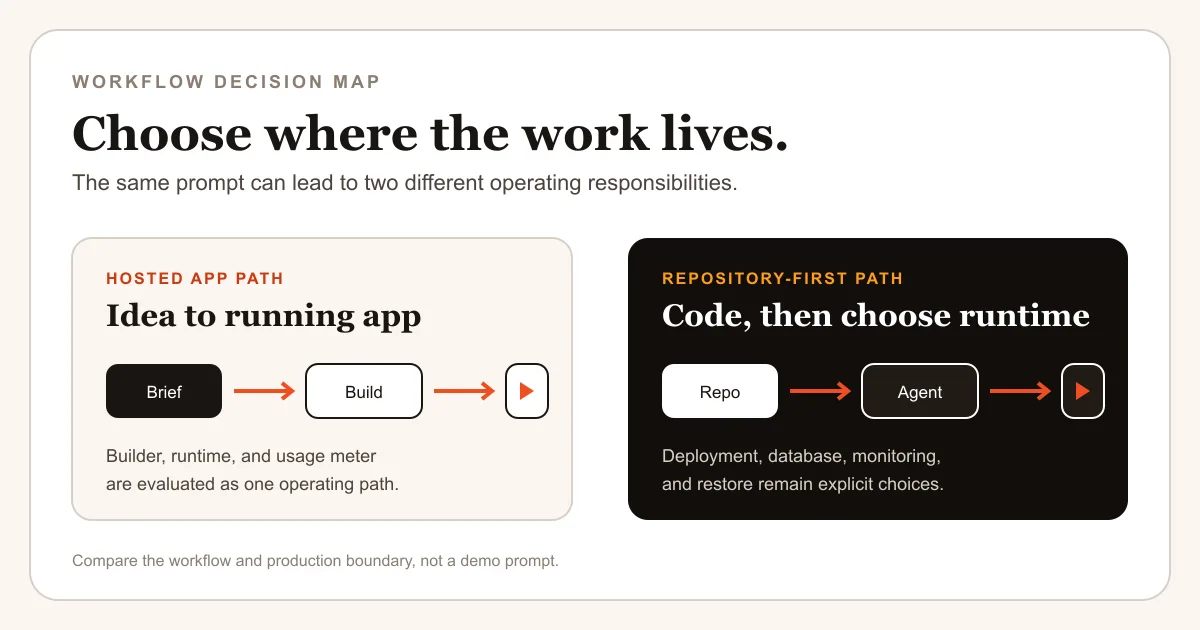
Choose Replit when you want the agent, workspace, cloud services, and publishing evaluated as one hosted app path. Choose Cursor when your repository and development toolchain are the center and your team will choose and operate the backend, host, and recovery plan. Test the same acceptance case before committing.
Replit and Cursor can both use AI to change software, but they start from different operating models. Replit joins an agent, browser workspace, cloud services, and publishing. Cursor centers an AI coding environment around a repository, with optional remote agents.
This comparison follows one app from brief to code, backend, deployment, export, and recovery. It does not score model quality or declare a universal winner. The useful question is which responsibilities your team wants the platform to absorb and which it is ready to own.
How this Replit vs Cursor comparison was built
The method follows one production-shaped app through the boundaries that survive after the first successful prompt.
Hold the job constant
Use the same existing or planned application, repository, acceptance cases, secret requirements, records, and traffic assumptions. Replit explicitly supports idea-first work and imports; Cursor Agent is documented as searching, editing, and running code in a codebase.
Sources: [replit-build], [replit-import], [cursor-agent-overview]
Separate coding from the runtime
Record where code runs during development and where the published application runs. Replit documents Autoscale, Reserved VM, Scheduled, and static deployments. Cursor documents local Agent tools and Cloud Agents in isolated remote development environments, not an included production runtime for the application.
Sources: [replit-deployments], [cursor-agent-overview], [cursor-cloud-agents]
Exercise the exit and recovery paths
Verify repository access, export, secret recreation, data handoff, agent-edit undo, and production recovery separately. Replit and Cursor both document checkpoints, but their captured state and production-data boundaries differ materially.
Sources: [replit-import], [replit-checkpoints], [cursor-agent-overview]
Price the meter that will actually move
Estimate agent use and production workload independently. Replit credits can cover Agent and cloud services, while publishing also has request, compute, and deployment-type meters. Cursor separates Cursor Models and Other Models usage pools, and charges Cloud Agents at the selected model API price; the application host remains a separate meter.
Sources: [replit-pricing], [replit-ai-billing], [replit-deployments], [cursor-pricing], [cursor-cloud-agents]
Review permissions before delegation
List repository access, network policy, command behavior, privacy mode, secret storage, and runtime credentials. Cursor documents configurable Cloud Agent environments, network restrictions, and team-follow-up risks. Replit documents a shared-responsibility boundary for access, secrets, publishing visibility, and application security.
Sources: [cursor-cloud-agents], [cursor-cloud-settings], [cursor-privacy], [replit-security]
What this comparison includes
The owner is the bilateral product-selection query Replit vs Cursor, including reverse wording Cursor vs Replit.
Included
- Audience, starting point, work environment, output, backend, hosting, export, recovery, usage meter, and operating responsibility
- Current first-party documentation and pricing pages checked on September 6, 2026
- A repeatable same-app evaluation plan for a buyer or technical reviewer
Not included
- A model-quality benchmark, generated-code score, performance test, security audit, or reliability ranking
- Base44 vs Replit, Replit vs Lovable, and general best AI coding editor intent
- Replacement-intent owners at /blog/replit-alternative and /cursor-alternative
- Native iOS or Android binary generation, app-store submission, compliance approval, or guaranteed production outcomes
Nine boundaries to compare before choosing
Treat each row as a question to verify in your own trial. A documented capability is not proof that it fits your repository, policy, traffic, or recovery objective.
Starting point and operator
A blank brief, an existing repository, and a non-technical operator create different review and setup work.
Work environment
The place where the agent edits and runs code determines what the operator must install, authorize, and supervise.
Application output
Code changes, a preview, and a published application are separate deliverables with separate acceptance tests.
Backend and data boundary
A working interface is not proof of an authoritative backend, durable records, access control, or data recovery.
Publishing and hosting
The production owner must know who supplies compute, domains, secrets, monitoring, scaling, and incident response.
Code ownership and exit
Repository access does not automatically move database values, secret values, domains, or platform services.
Recovery and history
Undoing an agent edit, restoring development data, and recovering production data are different operations.
Production meter
The real limit may be agent inference, user seats, app compute, requests, storage, or several meters at once.
Security and operation
Repository permissions, internet-enabled agents, secrets, privacy settings, and runtime access need separate review.
Replit and Cursor across the same app lifecycle
The findings preserve each product's documented strengths and expose the responsibilities that remain outside the reviewed surface.
Replit
Best for: Teams that want to evaluate an AI builder, browser workspace, cloud services, and publishing in one hosted path.
Replit documents an idea-to-app workflow with Agent, imports, a browser project environment, cloud services, multiple deployment types, Git-based history, and checkpoints. The combined surface reduces tool selection, while credits, app workload, data handoff, and production recovery still need explicit review.
| Criterion | Finding |
|---|---|
| Starting point and operator | Replit supports starting from an idea and importing GitHub, ZIP, design, spreadsheet, and selected builder projects. Compatibility, secrets, and existing data still require review after import. Sources: [replit-build], [replit-import] |
| Work environment | The documented path uses Replit Agent and the browser-based Project Editor, with run configuration, secrets, Git tools, previews, and cloud resources in the same product surface. Sources: [replit-build], [replit-import] |
| Application output | Agent can create and modify working app projects, then Replit publishing turns a reviewed project into a deployment. A preview or completed Agent turn is not the same as a production verification. Sources: [replit-build], [replit-deployments] |
| Backend and data boundary | Replit documents cloud services and deployments for web apps, APIs, scheduled jobs, storage, and databases. Existing database values and secret values are not automatically carried through the reviewed import path. Sources: [replit-ai-billing], [replit-deployments], [replit-import] |
| Publishing and hosting | Publishing offers Autoscale, Reserved VM, Scheduled, and static deployment choices. The owner must choose the type and monitor request, compute, data, and other usage rather than treating publish as one fixed resource. Sources: [replit-deployments] |
| Code ownership and exit | Replit uses Git-based project history and supports GitHub and ZIP movement. The official import guide says database values, secret values, domains, and some platform configuration are outside a simple source transfer. Sources: [replit-import], [replit-checkpoints] |
| Recovery and history | Agent checkpoints capture project files, Agent conversation context, environment configuration, and database contents, and a rollback can optionally restore the database as well. The page covers the development environment only, so restoring a published production database is not documented there and needs its own rehearsal. Sources: [replit-checkpoints] |
| Production meter | The pricing page opens on annual billing and lists Core at $17 per month billed annually, down from $20 monthly, with $20 of credit towards the most powerful models, and Pro at $95 per month billed annually, down from $100 monthly, with $100 of credit. AI and cloud services consume credits, while publishing adds deployment-specific request and compute meters. The Pro plan page states that unused credits roll over but prints no duration, so verify the exact plan and credit class in billing. Sources: [replit-pricing], [replit-ai-billing], [replit-deployments] |
| Security and operation | Replit documents shared platform and operator responsibilities: the operator configures app access, secrets, publishing visibility, application data protection, and application-level monitoring, while Replit operates the platform controls and infrastructure. Sources: [replit-security] |
Tradeoffs
- Agent usage and published workload can draw from related credit and usage systems, so a low prompt count does not prove a low operating bill.
- Git or source export does not carry every database value, secret, domain, or platform service; migration needs a separate data and configuration plan.
- A checkpoint rollback can optionally restore database contents inside the development environment, while the reviewed page documents no production database restore, so treat that as a separate procedure.
Cursor
Best for: Developers and technical teams whose repository, development environment, chosen infrastructure, and code-review workflow remain authoritative.
Cursor documents an AI coding environment that searches, edits, reviews, and runs code, plus Cloud Agents in isolated remote development environments. It provides strong repository-centered assistance; the reviewed product docs do not define one managed application backend and hosting contract, so production remains a separate stack decision.
| Criterion | Finding |
|---|---|
| Starting point and operator | Cursor Agent is documented around a codebase: it searches files, edits them, runs terminal commands, and presents diffs for review. A repository and working development setup make that path most direct. Sources: [cursor-agent-overview] |
| Work environment | Local Agent works through Cursor with file, search, terminal, and browser tools. Cloud Agents clone authorized GitHub, GitLab, Azure DevOps, or Bitbucket repositories into isolated remote development environments; their outbound network access can be unrestricted or allowlisted by policy. Sources: [cursor-agent-overview], [cursor-cloud-agents], [cursor-cloud-settings] |
| Application output | The documented output is reviewed source and command execution in the project. A completed Agent task can create application code, but the app preview, release artifact, and public production smoke belong to the chosen stack. Sources: [cursor-agent-overview], [cursor-cloud-agents] |
| Backend and data boundary | Cursor can edit backend code and use terminals or MCP tools. The reviewed Agent documentation does not define a managed application database or backend runtime, so choose and verify those services in the project architecture. Sources: [cursor-agent-overview], [cursor-cloud-agents] |
| Publishing and hosting | Cursor can help write and run deployment configuration, but the reviewed Agent and pricing pages describe a coding service, not one included production hosting contract for the generated application. Confirm the external host separately. Sources: [cursor-agent-overview], [cursor-cloud-agents], [cursor-pricing] |
| Code ownership and exit | Local changes apply to project files under the team's repository workflow. Cloud Agents clone authorized GitHub, GitLab, Azure DevOps, or Bitbucket repositories, work on branches, and push changes back for handoff, so source-control permissions remain the key ownership boundary. Sources: [cursor-cloud-agents], [cursor-agent-overview] |
| Recovery and history | Cursor checkpoints capture modified files during an Agent session and are stored locally, separate from Git. Cursor explicitly limits them to undoing Agent changes and directs teams to Git for permanent version control. Sources: [cursor-agent-overview] |
| Production meter | Current monthly pricing lists Hobby free, Pro at $20, Pro Plus at $60, Ultra at $200, Teams Standard at $40 per user, and Teams Premium at $120 per user. The plan table no longer publishes an included dollar amount; it marks the Cursor Models and Other Models usage pools as included or not included per plan, and both pools reset on the monthly billing cycle. Third-party models and Cloud Agents draw usage at model API rates, on-demand usage continues at the same rates, and production hosting remains outside this meter. Sources: [cursor-plan-pricing], [cursor-pricing], [cursor-cloud-agents] |
| Security and operation | Privacy Mode prevents code from being used for training, but AI requests still send prompts and code context to model providers, with documented retention exceptions. Cloud Agents add source-control write access, remote secrets and commands, configurable network access, and team-follow-up risks that need separate review. Sources: [cursor-privacy], [cursor-cloud-agents], [cursor-cloud-settings] |
Tradeoffs
- The team keeps control of the repository and stack, but must select and operate deployment, backend, database, monitoring, secrets, and recovery services.
- Cloud Agents require repository access and can receive secrets, startup commands, and network access under configurable policy, so the environment needs stricter review than a supervised local session.
- Cursor checkpoints undo Agent edits and are stored locally, separate from Git; they are not a substitute for permanent version control or production recovery.
Decision rules for the shortlist
Choose the boundary your team can verify and operate. Reopen the decision when the repository, data, workload, or recovery requirement changes.
A non-technical operator needs one hosted path from brief to published app
Choose: Evaluate Replit first with a bounded production-shaped pilot.
Tradeoff: The combined surface is convenient, while AI, deployment, data, storage, and request usage still require plan and cost controls.
An existing engineering team already owns a repository and deployment stack
Choose: Evaluate Cursor inside that current workflow.
Tradeoff: The team keeps its architecture and review process, but Cursor does not remove the responsibility to operate the selected runtime and data services.
Remote autonomous coding is valuable but repository data is sensitive
Choose: Pilot Cursor Cloud Agents only after narrowing repository permissions and reviewing Privacy Mode, retention, network policy, secrets, and command behavior.
Tradeoff: Reducing permissions can limit what the agent can complete, while broad access raises the impact of a bad command or prompt injection.
The product needs database-backed production recovery
Choose: Test development undo, source history, production data restore, and reconciliation as four separate exercises.
Tradeoff: A quick checkpoint restore is useful, but it can hide missing production-data procedures if the trial stops at code recovery.
The expected workload is uncertain
Choose: Run the same acceptance fixture and track agent use, build time, requests, compute, storage, and external service charges for one cycle.
Tradeoff: A realistic pilot takes longer than comparing subscription headlines, but it reveals the production meter that will actually move.
The operator wants guided building and a first-party runtime without a developer-owned toolchain
Choose: Include Playcode as a separate shortlist option and verify one app slice with its runtime and recovery requirements.
Tradeoff: A third trial adds evaluation work, but tests whether a non-technical workflow can stay simple without giving up a production backend and explicit recovery boundary.
TEST THE SAME APP
Describe the workflow and its production boundary
Give Playcode one user, one durable record, one permission boundary, one failure case, and one recovery objective. Build the smallest slice that can prove the job.
Try the app workflowNo credit card required. AI credits are included to start; production requirements and plan limits still apply.
See how Playcode Cloud handles backend, database, publishing, snapshots, and rollback.
Limits and conflicts in this comparison
This is a dated documentation review and decision method, not a hands-on benchmark or procurement approval.
- No identical application was generated, timed, load-tested, security-tested, or operated in Replit and Cursor for this article.
- Model availability, included usage, bonus capacity, prices, deployment rates, retention, and feature access can change before the review date.
- Replit publishes incomplete rollover wording: the Pro plan page says unused credits roll over but leaves the duration blank, and the publishing-cost page only says publishing is deducted from monthly credits. Confirm the exact subscription, credit class, and rollover term in billing.
- Cursor can edit any stack the repository permits; the absence of a managed app runtime in the reviewed Agent docs is not a claim that Cursor can never participate in deployment.
- Repository export does not prove runtime-record export, secret transfer, custom-domain transfer, or successful operation on a replacement host.
- Neither product name proves native app-store packages, accessibility, privacy, security, compliance, performance, reliability, or business outcomes.
Official sources and verification record
Every matrix finding cites a first-party page. Access dates show when this review was performed, not when an undated provider page was last revised.
[replit-build] Replit Docs:Build with Replit
Checked September 6, 2026. Supports: The idea-to-published-site journey, the guided path from first conversation through research, planning, design, and publishing, and the web, Desktop, and Mobile entry points.
[replit-import] Replit Docs:Import from a provider
Checked September 6, 2026. Supports: GitHub, ZIP, builder, design, and data import paths plus exclusions for existing database values, secrets, domains, and platform configuration.
[replit-deployments] Replit Docs:Publishing costs
Checked September 6, 2026. Supports: Autoscale, Reserved VM, Scheduled, and static deployment models; credit application; request and compute meters; spending controls.
[replit-checkpoints] Replit Docs:Checkpoints and rollbacks
Checked September 6, 2026. Supports: Checkpoint state, optional development-database rollback, Git-based history, and the separate production-database restore boundary.
[replit-pricing] Replit:Replit pricing
Checked September 6, 2026. Supports: Current Starter, Core, Pro, and Enterprise plan framing, the annual and monthly price toggle, the credit headline for each plan, collaboration and viewer limits, and plan-level production features.
[replit-ai-billing] Replit Docs:Replit AI billing
Checked September 6, 2026. Supports: Usage-based Agent billing, included monthly credits, Agent modes, and the shared use of credits across AI and selected cloud services.
[replit-security] Replit Docs:Shared responsibility model
Checked September 6, 2026. Supports: Shared platform and operator responsibilities for Agent review, access control, secrets, published-app visibility, application data, monitoring, and recovery.
[cursor-agent-overview] Cursor Docs:Cursor Agent overview
Checked September 6, 2026. Supports: File and codebase search, editing, terminal and browser tools, repository-centered Agent work, and the local checkpoint boundary.
[cursor-cloud-agents] Cursor Docs:Cloud Agents
Checked September 6, 2026. Supports: Isolated remote development environments, supported repository providers, branch handoff, environment controls, and selected-model API pricing.
[cursor-cloud-settings] Cursor Docs:Cloud Agents settings
Checked September 6, 2026. Supports: Runtime and build secrets, network access modes, environment versioning, and the lateral-movement risk created by team follow-ups.
[cursor-pricing] Cursor Docs:Models and pricing
Checked September 6, 2026. Supports: Cursor Models and Other Models usage pools, monthly reset, model API-rate billing, included third-party-model usage, and additional usage.
[cursor-plan-pricing] Cursor Help:Pricing and plans
Checked September 6, 2026. Supports: Current individual and team subscription prices plus the included Other Models usage amounts for Pro, Pro Plus, and Ultra.
[cursor-privacy] Cursor Help:Privacy and security
Checked September 6, 2026. Supports: Privacy Mode training boundary, prompt and code-context transfer to model providers, and zero-data-retention exceptions.
Replit vs Cursor FAQ
Is Replit easier than Cursor for a non-technical founder?
Replit presents a more integrated idea-to-app, workspace, cloud-service, and publishing path. Cursor centers a repository and development tools. Ease still depends on the app, integrations, data, and who will operate production, so test one real workflow instead of relying on category labels.
Does Cursor host the app it creates?
The official Cursor Agent pages reviewed here document code search, editing, terminal execution, local work, and remote development agents. They do not define one included managed production runtime for the application. Choose and verify the host, backend, database, secrets, monitoring, and recovery stack separately.
Does Replit include hosting and a backend?
Replit documents deployments for web apps, APIs, scheduled work, and static sites, plus databases, storage, and related cloud services. The exact plan, usage charges, access rules, capacity, data lifecycle, and recovery procedure still need verification for the app you intend to run.
Can I export code from Replit or Cursor?
Both support repository-centered source workflows. Replit documents GitHub and ZIP movement; Cursor applies local changes to project files and supports GitHub, GitLab, Azure DevOps, and Bitbucket for Cloud Agents. In either case, test database-record export, secret recreation, domains, assets, background work, and replacement-host operation separately from source access.
Which has better rollback, Replit or Cursor?
They document different recovery scopes. Cursor checkpoints cover Agent changes, are local, and are not version control. Replit checkpoints capture broader development state, including project files, Agent context, and optional database restore, while a published production database restore is not documented on that page. Match the mechanism to the failure you need to recover from.
Which is cheaper, Replit or Cursor?
There is no honest universal answer from subscription price alone. Cursor separates model usage into plan pools, charges third-party and Cloud Agent model use at API rates, and leaves application hosting to the chosen stack. Replit meters Agent and cloud services, while deployed apps add request, compute, storage, database, and related usage. Model one acceptance workload and monitor both build and production costs.
Does this page also own Cursor vs Replit?
Yes. Replit vs Cursor and Cursor vs Replit are the same bilateral decision owner. Base44 vs Replit, Replit vs Lovable, broad AI coding editor rankings, /blog/replit-alternative replacement research, and the /cursor-alternative replacement owner are separate search jobs and should not be folded into this page.
BUILD AND RUN THE SLICE
Prove the app before choosing the label
Describe the user, durable record, permission rule, production workload, export requirement, and recovery case. Use Playcode to build and run one reviewable app slice.
Start with PlaycodePlaycode AI builds the app. Playcode Cloud runs it. External providers still require their own accounts, credentials, limits, and review.