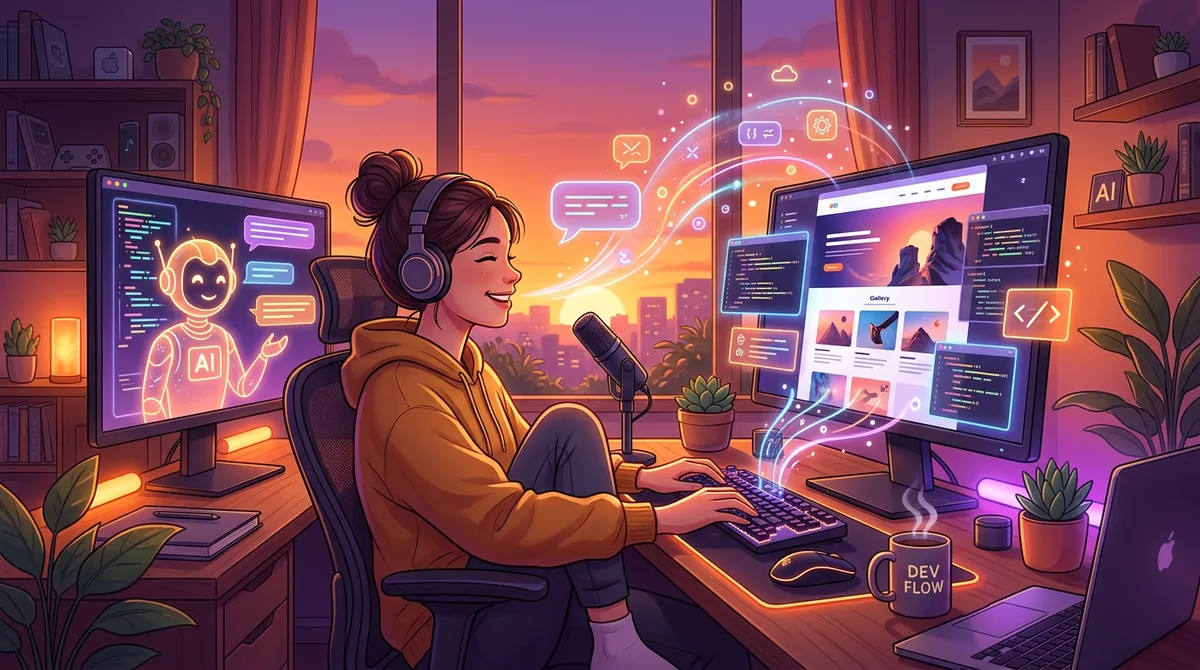
There's a new term circulating in the developer and creator communities that captures something people have been doing for the past year but didn't have a name for: vibe coding. It describes the practice of building software - and specifically websites - by describing what you want to an AI and iterating through conversation rather than writing code line by line. It sounds informal because it is. And it's becoming one of the most productive ways to build for the web.
If you've ever used an AI website builder and found yourself in a flow state - prompting, reviewing, tweaking, prompting again - you've already been vibe coding. This guide explains the concept, breaks down how it applies specifically to website building, and gives you practical techniques to get better results from the approach.
Vibe coding isn't a gimmick or a rebrand of existing tools. It represents a genuine shift in how people interact with code generation technology. Understanding it properly will make you faster, help you build better websites, and change how you think about the relationship between human intent and machine output.
What Is Vibe Coding?
Vibe coding is a development approach where you communicate the intent, feel, and direction of what you want to build - the "vibe" - and an AI translates that into working code. Instead of specifying exact implementation details (use a CSS Grid with 3 columns, 24px gap, auto-fit minmax 300px), you describe the outcome you want ("a responsive grid of feature cards, three across on desktop, stacking on mobile") and let the AI handle the implementation.
The term was popularized in early 2025 by developers who noticed that working with AI code generation tools felt fundamentally different from traditional programming. Traditional coding is precise, sequential, and syntax-focused. Vibe coding is descriptive, iterative, and outcome-focused. You're not writing instructions for a compiler - you're having a conversation with an intelligence that understands both your language and the language of code.
Here's what makes vibe coding distinct from simply "using an AI tool":
- It's iterative by design. You don't try to get a perfect result in one prompt. You start with a rough description, review the output, and refine through follow-up instructions. Each iteration gets closer to what you want.
- It blends prompting and direct editing. Experienced vibe coders switch between telling the AI what to change and editing the code themselves. The AI handles the broad strokes; you handle the precise adjustments.
- It's outcome-first. You focus on what the website should look like and how it should behave, not on the technical implementation. The AI makes the technical decisions, and you validate the results visually.
- It embraces imperfection. The first generation is a starting point, not a final product. Vibe coding accepts that AI output needs refinement and builds that refinement into the workflow.
Why Vibe Coding Works Exceptionally Well for Websites
Vibe coding applies to all kinds of software development, but it's uniquely well-suited to website building for several reasons.
Websites Are Visual and Descriptive
Websites are primarily visual products. Describing a website's appearance and behavior in natural language is intuitive - "a dark background with white text, a large hero image, and a floating navigation bar" communicates clearly to both humans and AI. Compare this to describing a database schema or an authentication flow in natural language, which is much harder to get right. The visual, descriptive nature of websites makes them ideal for the conversational input that vibe coding relies on.
The AI Has Deep Training Data
Large language models have been trained on millions of websites. They understand the patterns, conventions, and best practices of web design deeply. When you say "pricing section with three tiers," the AI knows what that looks like because it has seen thousands of implementations. This deep pattern knowledge means the AI's first-pass output is usually close to what you want, making the iterative refinement process faster.
Feedback Is Immediate
Web code produces an immediately visible result. You can see whether the AI understood your intent by looking at the rendered page. This instant feedback loop is essential for vibe coding because it lets you quickly assess each iteration and decide on the next adjustment. You don't need to run test suites or deploy to staging - you just look at the page and decide if the vibe is right.
Most Websites Follow Known Patterns
Landing pages, portfolios, business sites, and marketing pages follow established structural patterns. Hero sections, feature grids, pricing tables, testimonial carousels, contact forms, FAQ accordions - these are well-defined components that the AI generates reliably. Vibe coding leverages this by letting you describe at the pattern level ("add a testimonial section") rather than the implementation level.
The Vibe Coding Workflow for Website Building
Vibe coding follows a specific workflow that maximizes the strengths of AI generation while maintaining your creative control. Here's the process that experienced vibe coders follow.
Step 1: The Initial Prompt
Start with a description of the overall website. Don't try to specify every detail - focus on the big picture: what type of site, what sections, what general aesthetic. A good initial prompt gives the AI enough direction to produce a strong first draft without over-constraining it.
Example: "Build a landing page for a project management tool called TaskFlow. Modern and clean design, dark mode, with a hero section that has a headline and demo screenshot, a three-column feature section, customer logos bar, pricing with two tiers, and a final CTA. Use blues and purples."
This prompt gives the AI your site type, brand name, layout structure, color direction, and content sections. That's enough for a solid first generation.
Step 2: Review and React
Look at the generated site and form an instinctive reaction. Does it feel right? Is the overall direction correct? Don't get into details yet - assess the big picture first. Vibe coding is called "vibe" coding because this assessment is partly intuitive. You're checking whether the site captures the feeling you had in mind.
If the overall direction is wrong (wrong aesthetic, wrong layout approach, wrong tone), it's better to adjust your initial prompt and regenerate than to try fixing everything incrementally. If the direction is right but details need work, move to step 3.
Step 3: Iterative Refinement
Now you refine through targeted follow-up prompts. Each prompt should address one or two specific things:
- "Make the hero section taller and add more whitespace around the headline"
- "Change the pricing cards to have a subtle border instead of a shadow"
- "The feature icons are too small - make them 48px and add a colored background circle"
- "Add a FAQ section before the final CTA with five questions about project management tools"
Keep each prompt focused. Compound prompts with five or six changes often produce inconsistent results because the AI may misinterpret priorities or miss items.
Step 4: Visual Editing for Precision
This is where vibe coding separates from just "using an AI." When you know exactly what you want to change - a specific color, spacing, font size, or text - it's faster and more precise to click on the element and edit it directly than to describe the change in words.
Playcode is built for this exact workflow - click on any element in the live preview to edit it visually. Change text, adjust colors, tweak spacing. This blend of AI-driven conversation and direct visual editing is the core of productive vibe coding. If you need even deeper control, the underlying code is also accessible.
Step 5: Publish and Iterate Post-Launch
When the site looks right, publish it. Vibe coding doesn't end at launch - it continues as you gather feedback, analyze performance, and decide on improvements. Need to update the pricing? Change the headline? Add a new testimonial? Open the project, make the change through a prompt or a direct edit, and republish. The same iterative workflow that built the site maintains it.
Prompt Strategies for Better Results
The quality of your vibe coding output depends heavily on how you communicate with the AI. Here are proven strategies that produce better websites.
Be Specific About Structure, Flexible About Style
Tell the AI exactly what sections you want and in what order, but let it make aesthetic decisions within your general direction. "Hero section, then features, then pricing, then FAQ, then CTA" gives clear structure. "Make it look good with a modern feel" gives the AI room to apply its design knowledge.
Use Reference Points
The AI understands references to well-known design patterns and brands. "A hero section similar to Stripe's homepage style" communicates a specific aesthetic instantly. "Pricing cards like Tailwind UI" tells the AI about card design, spacing, and typography expectations. References compress complex visual descriptions into a few words.
Describe the Feeling, Not Just the Layout
This is the "vibe" in vibe coding. "Professional but approachable" produces different results than "corporate and authoritative." "Playful with rounded corners and bright accents" creates a different site than "minimal with lots of whitespace." The AI uses these emotional cues to make design decisions about color, typography, spacing, and imagery.
Provide Real Content Early
Placeholder content ("Lorem ipsum") produces generic-looking results. Feed the AI your actual headline, subheadline, feature descriptions, and pricing details in the prompt. Real content gives the AI context to make better design decisions - it will size elements, choose layouts, and balance whitespace based on the actual text rather than placeholder lengths.
Use "Change" Prompts, Not "Make It Better" Prompts
Vague prompts like "make it look better" or "improve the design" produce unpredictable results because the AI doesn't know what "better" means to you. Instead, identify what specifically doesn't work and describe the change: "The hero section feels cramped - add more vertical padding and increase the headline font size." Specific observations lead to specific improvements.
Playcode as a Vibe Coding Platform
Not every AI tool supports vibe coding well. The workflow requires a specific combination of capabilities that most tools only partially provide. Here's what makes a platform work for vibe coding and how Playcode delivers on each requirement.
AI Chat + Visual Editor in One Place
Vibe coding requires seamless switching between prompting the AI and making direct edits. Playcode combines both in a single interface - an AI chat for conversational input and a visual editor where you click on any element to change it. You never need to switch between applications. This tight integration is what makes the prompt-edit-prompt cycle feel fluid rather than fragmented.
Live Preview
Every change - whether from an AI prompt or a manual code edit - appears immediately in a live preview. This instant feedback is essential for vibe coding because you're making decisions based on how the site looks and feels. Waiting for builds, refreshes, or deployments would break the flow that makes vibe coding productive.
Agency-Style Guidance
Most AI tools just execute whatever you type. Playcode works like a premium design agency - it asks clarifying questions, suggests improvements, and guides you toward the right result. This is the differentiator that separates a genuine vibe coding platform from an AI toy. Without guidance, you waste time on trial and error. With it, you get to production-ready results faster.
Publishing Built In
Vibe coding includes the full lifecycle from idea to live website. Playcode lets you publish directly with an included subdomain - no separate hosting setup, no deployment configuration, no DNS management. Your vibe-coded site goes from your editor to a live URL in one click. Plans start at $21/year on the annual plan or $25/month, with AI credits included to start.
Iterative by Design
Playcode preserves your project state between sessions. You can vibe code a site today, come back next week with new ideas, and continue the conversation. The AI understands the context of your existing site when you make follow-up requests, so each iteration builds on previous work rather than starting over.
Vibe Coding vs. Traditional Website Development
Vibe coding doesn't replace traditional web development - it complements it. Understanding where each approach excels helps you use both effectively.
Traditional development gives you maximum control, reproducibility, and the ability to build arbitrarily complex systems. If you need a custom animation library, a complex state management system, or pixel-perfect responsive behavior across twelve breakpoints, traditional development is the right tool.
Vibe coding gives you maximum speed for standard patterns. If you're building a website that follows established conventions - and the vast majority of websites do - vibe coding gets you there in a fraction of the time. The AI handles the 80% that follows known patterns, and you handle the 20% that makes your site unique through targeted prompts and code edits.
Many professional developers now use vibe coding for initial scaffolding and then switch to traditional development for custom features. "Vibe code the landing page, then hand-code the interactive demo" is a common and effective workflow. The two approaches aren't competing - they're collaborating.
Common Vibe Coding Mistakes (and How to Avoid Them)
Vibe coding has its own set of pitfalls that are different from traditional development mistakes. Here are the most common ones.
Trying to Get It Perfect in One Prompt
The biggest mistake newcomers make is writing a massive initial prompt that tries to specify every detail of the site. This usually produces worse results than a focused initial prompt followed by iterative refinements. The AI handles complexity better when it's delivered in layers, not all at once.
Never Looking at the Code
If you're only interacting through prompts and never looking at the generated code, you're missing half the value of vibe coding. Reading the code helps you understand what the AI did, spot potential issues (like accessibility problems or performance concerns), and make precise adjustments. Even if you're not a developer, scanning the HTML structure teaches you how websites work.
Ignoring Responsiveness
AI-generated websites are usually responsive by default, but "responsive" doesn't always mean "good on mobile." After the initial generation, test the site at different screen sizes. If something doesn't look right on mobile, tell the AI specifically: "The feature grid overlaps on screens below 600px - make it stack vertically." Specific observations produce specific fixes.
Not Using Real Content
Vibe coding with placeholder text produces placeholder-quality results. The AI makes better layout and spacing decisions when it has real headlines, real feature descriptions, and real pricing to work with. Always provide your actual content, even if it's a rough draft.
Skipping the Human Review
AI output always benefits from human review. Check the generated site for logical errors (wrong information, broken links), accessibility issues (missing alt text, poor contrast), and SEO basics (proper heading hierarchy, meta descriptions). The AI gets you 90% of the way, but the last 10% of quality comes from your review.
Getting Started with Vibe Coding Today
You don't need to prepare or learn anything special to start vibe coding. Here's a practical starting point.
Pick a project. Choose something real but low-stakes - a personal portfolio, a landing page for a side project, or a redesign of an existing page. Having a real goal focuses your prompts and makes the process more productive than experimenting aimlessly.
Write your first prompt. Describe the site in 2-3 sentences. Include the type of site, the main sections, and the general aesthetic. Don't overthink it - you'll refine from here.
Generate and react. Look at the result and notice your gut reaction. What works? What doesn't? Turn those observations into your next prompt.
Try visual editing. Click on any element in the preview - a headline, a button, a section - and change it directly. Swap colors, adjust text, tweak spacing. This direct manipulation builds your confidence and gives you precise control over the final result.
Publish when it's good enough. Perfectionism kills vibe coding productivity. Publish when the site communicates what it needs to communicate and looks professional. You can always iterate after launch - that's one of the core advantages of the approach.
The best way to learn vibe coding is to do it. Open Playcode's AI website builder, describe something you want to build, and start the conversation. Within fifteen minutes, you'll have a working website and an intuitive understanding of how the workflow feels.
Frequently Asked Questions
What is vibe coding?
Vibe coding is a development approach where you work alongside AI by describing what you want in natural language, reviewing the generated output, and iterating through conversation and direct code edits. Instead of writing every line yourself, you guide the AI with prompts and refine the results. The term captures the intuitive, flow-state nature of the process - you communicate the vibe of what you want and the AI translates it into working code.
Do I need to know how to code to vibe code?
No. Vibe coding is accessible to non-coders because the primary input is natural language, not programming syntax. You describe what you want and the AI generates the code. However, having some familiarity with HTML and CSS helps you make more precise refinements when you need them. Platforms like Playcode show you the generated code, so you can learn by reading what the AI produces - many people pick up web development basics naturally through vibe coding.
What is the best platform for vibe coding a website?
The best platform for vibe coding websites combines AI generation with a visual editor and a live preview. Playcode is built for this workflow - you describe your site, watch it generate in real time, click on any element to edit it visually, and publish with an included subdomain. The key requirement is that the platform lets you both prompt the AI and edit directly, since effective vibe coding involves switching between the two.
How is vibe coding different from using a regular website builder?
Regular website builders use drag-and-drop interfaces where you manually position and configure every element. Vibe coding uses natural language - you describe what you want and the AI builds it. The fundamental difference is the input method: visual manipulation versus conversational description. Vibe coding is faster for creating initial layouts, easier for making major changes (describe them in words rather than rearranging elements), and produces real code you can read and modify.
Can I build a production website using vibe coding?
Yes. Vibe coding produces real HTML, CSS, and JavaScript that is ready for production deployment. The output is standard web code, not a proprietary format locked to any platform. For content-driven websites - landing pages, portfolios, business sites, marketing pages - vibe-coded sites are fully production-quality. You can publish them directly through your AI builder or export the code to host anywhere you choose. Read more about building websites with AI for a step-by-step walkthrough.
The Bottom Line
Vibe coding isn't a trend or a marketing term - it's a genuine shift in how websites get built. The combination of natural language input, AI generation, visual editing, and live preview creates a workflow that's faster and more accessible than anything that came before it. You describe the vibe, the AI builds it, and you refine until it's right.
The approach works because it plays to the strengths of both humans and AI. Humans are good at knowing what they want, recognizing when something looks right, and making judgment calls about quality. AI is good at translating descriptions into working code, generating complete structures quickly, and applying established design patterns consistently. Vibe coding is the workflow that lets each side do what it does best.
Whether you're a developer looking to move faster, a founder who needs a website this week, or someone who has always wanted to build for the web but never learned to code - vibe coding is worth trying. The barrier to entry is a text prompt, and the ceiling is as high as your imagination allows.
Start vibe coding now. Open Playcode's AI website builder - describe your website, watch it come to life, and click to edit anything visually. No credit card required. AI credits included to start.