QUICK ANSWER
How much does AI app development cost?
Using the stated U.S. role-hour model, illustrative commissioned-project scenarios run from about $33,000-$71,000 for a bounded AI workflow proof to $132,000-$287,000 for a production knowledge assistant and $295,000-$590,000 for integration-heavy decision support. These are planning estimates, not quotes or averages; model usage, evaluation, data, monitoring, and human review continue after launch.
An AI app budget has two different meters. One pays for defining, building, evaluating, and releasing the application. The other pays for every model call, retrieval query, monitoring signal, review queue, and production change after launch.
This guide keeps those meters separate. It uses a transparent U.S. labor-cost proxy for commissioned delivery and an editable workload calculator for recurring operations. Replace every hour, rate, token price, traffic assumption, and human-review policy with evidence from your own use case.
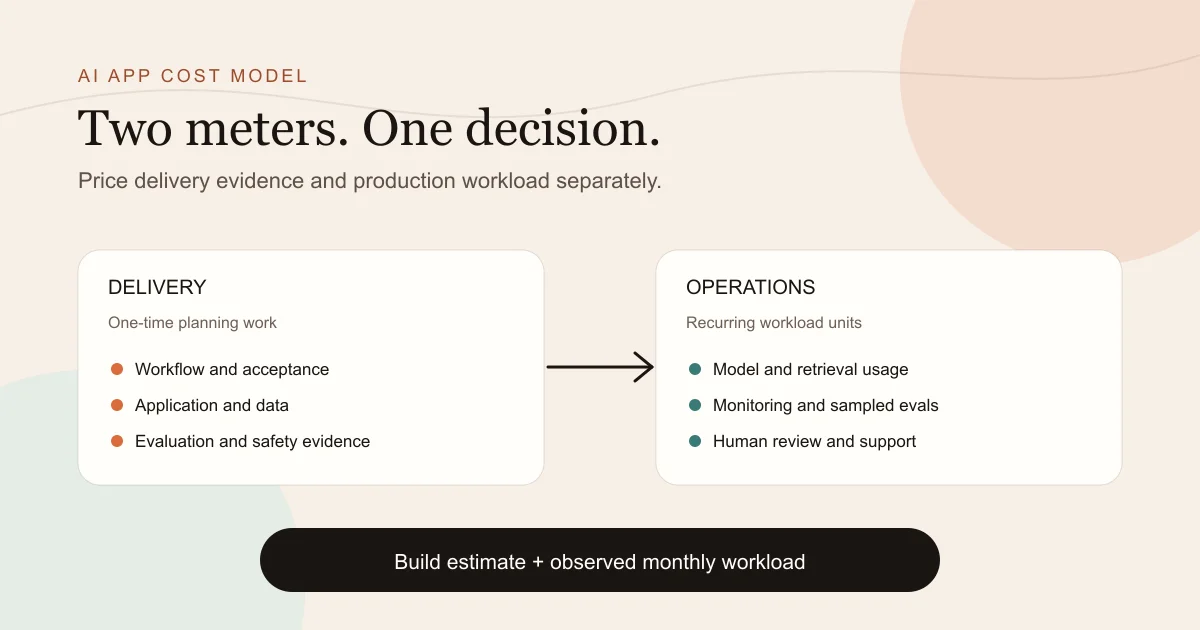
Planning assumptions behind the AI ranges
The static scenarios price commissioned delivery under the stated scope. The calculator exposes the same role streams and keeps recurring model workload separate. Replace all defaults before using the result in a decision.
| Assumption | Value used | Why it changes the estimate |
|---|---|---|
| U.S. employee-cost proxy | Product $73/hour, software engineering $97/hour, data work $86/hour, and evaluation or QA $74/hour. | Rounded rates derive from BLS occupation medians and a broader compensation share. They are not freelancer, agency, international, or procurement prices. |
| Role-hour bands | Every scenario states product, engineering, data, and evaluation hours; they are editorial scope assumptions. | A new tool, data source, permission boundary, language, modality, or escalation path changes the work rather than adding one generic AI multiplier. |
| Model prices | The calculator starts with illustrative input and output rates per million tokens and requires the reader to replace them. | Provider, model, tier, caching, batch, long-context, reasoning, tool, image, audio, and regional meters can differ and change. |
| Evaluation sample | The calculator applies the same editable token profile to a sampled evaluation percentage as a simple planning proxy. | A real evaluation can use different graders, models, people, fixtures, and review depth. Price that design explicitly. |
| Contingency | 20% for a bounded proof, 25% for a production knowledge assistant, and 30% for integration-heavy decision support. | These editorial reserves cover named unknowns only. They do not replace discovery, evidence, or professional review. |
EDITABLE AI COST WORKSHEET
Model delivery and usage separately
Every number is editable. Defaults are illustrative planning assumptions, not provider prices, quotes, guarantees, or market averages.
| Workstream | Hours | USD/hour | Subtotal |
|---|---|---|---|
| Product and workflow design | $5,840 | ||
| Application and AI engineering | $31,040 | ||
| Data and retrieval work | $10,320 | ||
| Evaluation, QA, and safety review | $11,840 |
Monthly AI workload
Planning build plus twelve months of the editable workload above. Excludes taxes, legal or compliance advice, data licensing, moderation staffing, and provider charges you did not enter.
How this AI app cost model works
The model starts with a testable decision or task, prices the application and evidence needed to support it, then forecasts production workload from observable units. It does not treat a prompt demo as a finished product.
Define the decision and the unacceptable failures
Name what the AI may draft, recommend, retrieve, classify, or summarize, what stays deterministic, and what requires a person. Build a frozen evaluation set with expected evidence, abstention, privacy, safety, latency, and escalation behavior before choosing a model or estimating scale.
Sources: [nist-ai-rmf], [nist-genai-profile]
Estimate four AI-specific workstreams
Price product and workflow design, application and AI engineering, data or retrieval work, and evaluation, QA, or safety review separately. The example loaded rates divide current BLS occupation medians by the broader professional-occupation wage share of compensation. They are employee-cost proxies, not agency rates.
Sources: [bls-oews-2025], [bls-employer-costs-2026]
Convert the production workload into billable units
Forecast requests, input and output tokens, cached context where applicable, retrieval or storage services, tools, media, monitoring, and sampled evaluation. Use the exact current provider meter for the chosen model and region. Do not copy a headline token price across providers or workloads.
Sources: [openai-api-pricing], [anthropic-pricing], [gemini-pricing]
Re-estimate from observed quality and operations
Measure the accepted-answer rate, unsupported-output rate, escalation load, latency, retries, token distribution, provider errors, and cost per completed user job. A model, prompt, retrieval corpus, policy, traffic pattern, or required quality threshold change reopens both cost and acceptance evidence.
Sources: [nist-ai-rmf], [nist-genai-profile], [nist-ssdf]
What this AI cost estimate includes
This owner covers AI-specific application delivery and operation. The broader app development cost guide owns generic web and native platform scope. SaaS development cost and MVP development cost are separate business-model and project-stage topics, not estimates this guide attempts to own. This page does not estimate training a foundation model from scratch, buying a model company, or a universal AI transformation program.
Included
- Use-case and harm definition, acceptance criteria, abstention, escalation, and human-review policy.
- Application, model API, structured-output, tool, retrieval, data preparation, and provider-failure work.
- Frozen evaluation sets, adversarial and privacy tests, regression runs, monitoring, and incident handling.
- Editable token, request, retrieval, monitoring, and support workload assumptions.
- A bounded web-first proof and production AI workflow delivered through supported provider APIs.
Not included
- A universal average AI app price, fixed schedule, or guaranteed accuracy, savings, adoption, or business outcome.
- Foundation-model pretraining, custom hardware clusters, proprietary data acquisition, and data-license negotiation.
- Legal, privacy, security, employment, medical, financial, accessibility, or regulated-professional advice.
- A claim that a provider API, prompt, benchmark, or framework certifies the full application.
- Native iOS or Android packaging, signing, and store submission by Playcode.
Three illustrative AI app development cost scenarios
These are commissioned-project planning estimates using the role rates and exclusions shown. They are not market averages, provider subscription prices, or Playcode prices.
Bounded AI workflow proof
Testing one low-consequence drafting, classification, retrieval, or summarization job with a named human owner.
- One-time
- $33,000-$71,000 planning estimate, including a 20% contingency.
- Recurring
- Workload-derived model calls, retrieval, evaluation samples, monitoring, and human review.
Includes
- 320-680 role-hours: product 40-80, engineering 160-320, data 40-120, and evaluation 80-160.
- One bounded workflow, one primary data source, structured output, a frozen evaluation set, abstention, and a manual escalation path.
Excludes
- Autonomous external actions, regulated decisions, model training, complex permissions, multiple providers, and native packaging.
Uncertainty: Low to medium only when accepted and rejected behavior, data rights, the review owner, and the production workload are already known.
Sources: [bls-oews-2025], [bls-employer-costs-2026], [nist-ai-rmf], [nist-genai-profile]
Production knowledge assistant
A permission-aware assistant over approved business knowledge with citations, abstention, monitoring, and support.
- One-time
- $132,000-$287,000 planning estimate, including a 25% contingency.
- Recurring
- Provider units plus retrieval or storage, scheduled evaluation, monitoring, incident response, and content ownership.
Includes
- 1,200-2,640 role-hours: product 120-240, engineering 600-1,200, data 240-600, and evaluation 240-600.
- Approved-source registry, ingestion and deletion rules, permission checks, citations, no-answer behavior, provider adapter, and regression evidence.
Excludes
- Unreviewed confidential sources, guaranteed factuality, open-ended tool execution, 24/7 staffed support, and certification.
Uncertainty: Medium until corpus size, permissions, freshness, language coverage, accepted-answer threshold, traffic, and review load are observed.
Sources: [bls-oews-2025], [bls-employer-costs-2026], [openai-api-pricing], [anthropic-pricing], [gemini-pricing], [nist-genai-profile]
Integration-heavy decision support
A workflow that reads several systems, proposes a bounded decision, and requires confirmation before any external action.
- One-time
- $295,000-$590,000 planning estimate, including a 30% contingency.
- Recurring
- Provider and tool usage, integration monitoring, reconciliation, evaluations, human approval, and incident ownership.
Includes
- 2,600-5,200 role-hours: product 200-400, engineering 1,200-2,400, data 600-1,200, and evaluation 600-1,200.
- Server-authorized tools, proposal versus execution separation, confirmation, idempotency, permissions, provider failure handling, audit, and recovery tests.
Excludes
- The AI independently authorizing money movement, employment, medical, legal, credit, access, or another consequential decision.
Uncertainty: High until each system contract, permission, side effect, failure, reconciliation owner, review threshold, and traffic pattern is tested.
Sources: [bls-oews-2025], [bls-employer-costs-2026], [nist-ai-rmf], [nist-genai-profile], [nist-ssdf]
What changes AI application cost
Token price is only one row. The expensive part is often defining and proving behavior that remains useful when data, users, providers, and failure conditions change.
| Category | One-time | Recurring | Main drivers |
|---|---|---|---|
| Use case, policy, and human boundary User job, decision consequence, allowed output, abstention, escalation, review, feedback, and incident ownership. Sources: [nist-ai-rmf], [nist-genai-profile] | Product, domain-owner, policy, interface, engineering, and evaluation role-hours. | Review queues, exception handling, policy updates, appeals where applicable, and incident response. | Consequence of a wrong or unsupported output.; Required human authority, response time, explanation, and correction path. |
| Data, retrieval, and permissions Source rights, ingestion, chunking or indexing, freshness, deletion, permission filtering, citations, and no-answer behavior. Sources: [nist-ai-rmf], [nist-genai-profile], [nist-ssdf] | Data inventory, cleanup, connectors, access checks, retrieval design, fixtures, and privacy testing. | Storage, indexing, retrieval, refresh, deletion, access review, and source-owner time. | Corpus volume, formats, languages, freshness, and permission boundaries.; Required citation precision, recall, deletion latency, and weak-match rejection. |
| Model, tools, and workload Model selection, prompt and context size, output length, caching, batch work, tools, media, retries, latency, and fallback. Sources: [openai-api-pricing], [anthropic-pricing], [gemini-pricing] | Provider adapter, structured output, tool contracts, rate-limit handling, fallback, and load testing. | Input, output, cached context, tools, images, audio, storage, and other provider-specific billable units. | Request distribution rather than one average prompt.; Provider, model, tier, modality, context, caching, tools, retry rate, and fallback mix. |
| Evaluation and production operations Frozen fixtures, graders, human review, adversarial cases, regression gates, traces, cost alerts, quality monitoring, and recovery. Sources: [nist-ai-rmf], [nist-genai-profile], [nist-ssdf] | Evaluation design, baseline runs, acceptance thresholds, launch evidence, dashboards, alerts, and runbooks. | Sampled and scheduled evaluation, grader or reviewer use, monitoring, support, model-change review, and incident learning. | Required quality threshold, sample size, languages, consequences, and review depth.; Model, prompt, corpus, policy, provider, and workload change frequency. |
Re-estimate when the evidence boundary moves
An AI estimate expires when the task, data, model, provider, required quality, human authority, or workload changes. Keep a named evidence version rather than treating an old benchmark as permanent proof.
What moves the estimate
- The accepted-output, abstention, citation, privacy, safety, latency, or escalation threshold is not defined.
- Source rights, permissions, freshness, deletion, or cross-account isolation remain unresolved.
- Traffic, token distributions, tools, retries, modalities, languages, provider tiers, or review volume are guesses.
- A consequential action, regulated domain, autonomous loop, or provider dependency enters scope.
Re-estimate when
- The model, provider, price, context strategy, prompt, retrieval corpus, tool set, or output schema changes.
- A production evaluation shows new failure clusters, drift, higher escalation, or a different accepted-answer rate.
- Request volume, input or output distribution, retry rate, latency target, or human-review capacity changes.
- A new language, modality, user role, data category, integration, external action, or jurisdiction is added.
Recurring AI app costs after launch
Forecast each meter from observed units. Do not assume the cheapest model, a no-cost tier, or a single average prompt describes the production workload.
| Cost | Cadence | Planning range | Boundary |
|---|---|---|---|
| Model and tool usage Sources: [openai-api-pricing], [anthropic-pricing], [gemini-pricing] | Per request or provider meter | Workload-derived; enter current input, output, cache, tool, image, audio, or other unit rates for the exact provider configuration. | Pricing differs by provider, model, feature, tier, context, and modality. Recheck the official page and the observed usage record. |
| Retrieval and data operations Sources: [nist-ai-rmf], [nist-genai-profile] | Monthly storage and usage plus refresh work | Workload-derived; include ingestion, storage, indexing, retrieval, transfer, source refresh, deletion, and data-owner time. | The chosen source, database, vector, search, or file provider can add separate meters and permission obligations. |
| Evaluation and monitoring Sources: [nist-ai-rmf], [nist-genai-profile], [nist-ssdf] | Per release, scheduled run, and sampled production traffic | Evaluation model or human-review units plus traces, logs, alerts, dashboards, and retained evidence. | Sample enough to detect important failures and protect privacy; the worksheet percentage is only a planning proxy. |
| Human review and operations Sources: [bls-oews-2025], [bls-employer-costs-2026], [nist-ai-rmf] | Per review item, incident, release, and policy change | Owner hours for escalations, corrections, provider outages, evaluation review, source changes, incidents, and user support. | A human-in-the-loop label is not a capacity plan. Forecast queue volume, service level, authority, and fallback behavior. |
Choose the smallest AI investment that can answer the risk
Start with the part that requires AI, keep deterministic rules deterministic, and expand only when the evaluation and operating evidence support it.
The output is assistive, low consequence, reviewable, and one bounded task can be evaluated against representative examples.
Choose: Build a bounded AI workflow proof.
Tradeoff: You learn about quality, data, latency, and review load without promising a general assistant or autonomous system.
The user needs answers over approved knowledge and permission-aware citations matter more than broad open-ended generation.
Choose: Build a production knowledge assistant with explicit no-answer behavior.
Tradeoff: You accept ongoing source ownership, retrieval operations, evaluation, and permission testing.
The workflow touches external systems or proposes a consequential action.
Choose: Separate proposal from execution and require deterministic server authorization plus human confirmation.
Tradeoff: The implementation and operating cost rises, but the model does not become the authority for permissions or side effects.
The task, accepted failures, data rights, review owner, or production workload cannot yet be stated.
Choose: Fund discovery and an evaluation design before a build commitment.
Tradeoff: You delay implementation while avoiding a polished demo with no defensible production boundary.
PROVE THE AI JOB FIRST
Turn the highest-risk assumption into an evaluated web workflow
Use Playcode to build the application around a bounded provider API job, then test the task, data, abstention, permissions, failures, and human handoff before expanding the scope.
Build an AI app with PlaycodeProvider accounts, credentials, usage charges, data rights, and professional review remain the operator’s responsibility.
See current Playcode plans and included AI creditsPlaycode subscription pricing is separate from the project and provider planning estimates above.
What this AI cost model cannot tell you
This is a planning model, not professional advice or a product assessment. AI applications can affect people, privacy, security, accessibility, and regulated decisions. Qualified owners must determine the requirements and evidence for the actual use case.
- The BLS rates are U.S. employee-cost proxies, not agency, freelancer, global, procurement, or Playcode prices.
- Scenario hours, contingency, token defaults, and evaluation percentages are editorial assumptions, not measured market averages.
- Provider prices and features change. The exact model, tier, region, caching, batch, tools, media, and commercial terms must be rechecked.
- The model excludes data licenses, legal review, regulated-professional review, moderation teams, customer acquisition, taxes, and unentered providers.
- NIST AI RMF, the GenAI Profile, and SSDF organize risk work; citing them does not certify, approve, or prove an application.
- No universal AI productivity, accuracy, cost reduction, revenue, adoption, or delivery-time percentage is claimed.
- Playcode can build provider API workflows when the API path exists and credentials are supplied; no native or one-click model connector is claimed.
- Playcode builds and hosts web apps. Native iOS or Android packaging, signing, and store submission remain separate workstreams.
Sources and evidence dates
Government, standards-body, and first-party provider sources support the current method. Pricing pages were checked on 2026-08-01 and need a fresh check before a budget or release decision.
[bls-oews-2025] U.S. Bureau of Labor Statistics:Occupational Employment and Wages, May 2025
Checked August 1, 2026. Supports: Median hourly wages of $65.38 for software developers, $57.80 for data scientists, $50.14 for QA analysts/testers, and $49.19 for project management specialists.
[bls-employer-costs-2026] U.S. Bureau of Labor Statistics:Employer Costs for Employee Compensation, March 2026
Checked August 1, 2026. Supports: For private-industry professional and related occupations, wages and salaries were 67.6% and benefits 32.4% of compensation.
[openai-api-pricing] OpenAI Developers:API pricing
Checked August 1, 2026. Supports: OpenAI publishes model and feature-specific API meters; current input, cached input, output, tools, media, and other applicable units must be selected for the workload.
[anthropic-pricing] Anthropic:Claude Platform pricing
Checked August 1, 2026. Supports: Anthropic publishes model, input, output, prompt caching, batch, long-context, and feature-specific pricing with workload-dependent conditions.
[gemini-pricing] Google AI for Developers:Gemini Developer API pricing
Checked August 1, 2026. Supports: Google publishes model and feature-specific Gemini API pricing, including distinct text, media, caching, grounding, and other applicable meters.
[nist-ai-rmf] National Institute of Standards and Technology:Artificial Intelligence Risk Management Framework 1.0
Checked August 1, 2026. Supports: The voluntary AI RMF organizes AI risk work across govern, map, measure, and manage functions throughout the AI lifecycle.
[nist-genai-profile] National Institute of Standards and Technology:Generative AI Profile, NIST AI 600-1
Checked August 1, 2026. Supports: The Generative AI Profile identifies risks that are novel to or intensified by generative AI and suggested lifecycle actions for governing, mapping, measuring, and managing them.
[nist-ssdf] National Institute of Standards and Technology:Secure Software Development Framework 1.1
Checked August 1, 2026. Supports: Secure software practices, requirements, risks, provenance, verification, and response belong throughout development and operation.
AI app development cost questions
What is the average AI app development cost?
There is no useful universal average. A bounded drafting tool, permission-aware knowledge assistant, and integration-heavy decision workflow have different product, data, evaluation, risk, and operating obligations. Use the visible scenarios as planning examples, then replace every assumption.
Are model tokens the biggest AI app cost?
Not necessarily. At modest traffic, product decisions, data preparation, retrieval, integration, evaluation, monitoring, and human review can exceed the model bill. At high traffic or with long context, tools, media, retries, or expensive models, provider usage can become material. Model both meters.
How should I estimate model API cost?
Measure requests by workload, then multiply the observed input, cached input, output, tools, media, retries, and other billable units by the exact current provider rates. Use percentiles or workload segments rather than one average prompt, and include sampled evaluation and fallback traffic.
Does using AI make development cheaper?
AI can reduce some drafting or implementation work, but no universal savings percentage is defensible. It does not remove workflow decisions, data rights, provider integration, deterministic authorization, evaluation, security, accessibility, incident response, or human review. Measure saved hours in the actual process.
What makes an AI app expensive?
High-consequence decisions, complex permissions, private or changing data, multiple tools and providers, strict citations, multilingual or multimodal inputs, low latency, large context, frequent evaluation, moderation, human-review queues, and demanding operating targets all add cost.
Should I fine-tune a model or use retrieval first?
Start from the failure you need to fix. Retrieval can help when answers depend on current approved sources; prompt or tool changes may address format and workflow; fine-tuning can suit repeated behavior when the provider and evidence support it. Compare each option on the same frozen evaluation set and price data, training, hosting, review, and updates.
How often should an AI app be re-estimated?
Re-estimate whenever the model, provider, price, prompt, context strategy, corpus, tool set, traffic distribution, required quality, policy, human-review load, or consequential action changes. A quarterly source check is a ceiling for this guide, not a substitute for release-specific evidence.
Can Playcode build an AI app?
Playcode can build a web app that calls a model or other provider through an available API when you supply the required credentials and requirements. The exact provider setup, data rules, evaluation, permissions, and operating boundary still need to be designed and tested. No native or one-click connector is implied.
START WITH A BOUNDED BRIEF
Build the AI workflow you can actually evaluate
Describe the user job, allowed sources, required output, unacceptable failures, and human decision boundary. Playcode AI can build the web app, and Playcode Cloud can run its backend, data, jobs, and recovery path.
Start building the AI workflowNo credit card required. AI credits are included to start; provider credentials and external usage charges may still apply.