QUICK ANSWER
How much does custom software development cost?
Using the stated U.S. role-hour model, illustrative commissioned-project scenarios run from about $28,000-$63,000 for a single-workflow proof to $134,000-$273,000 for a department system, $312,000-$625,000 for a cross-department platform, and $614,000 or more for migration-heavy or regulated scope. These are planning estimates, not quotes or averages, and recurring ownership is separate.
Custom software is not expensive because it is custom in the abstract. It becomes expensive when a company-specific workflow has many roles, exceptions, permissions, systems, old records, acceptance rules, rollout groups, and operating obligations that cannot be ignored.
This guide prices those obligations directly. It uses a transparent U.S. labor-cost proxy, four bounded commissioned-project scenarios, and an editable ownership worksheet. Replace every hour, rate, integration, migration, support, and provider input with evidence from the workflow you actually intend to own.
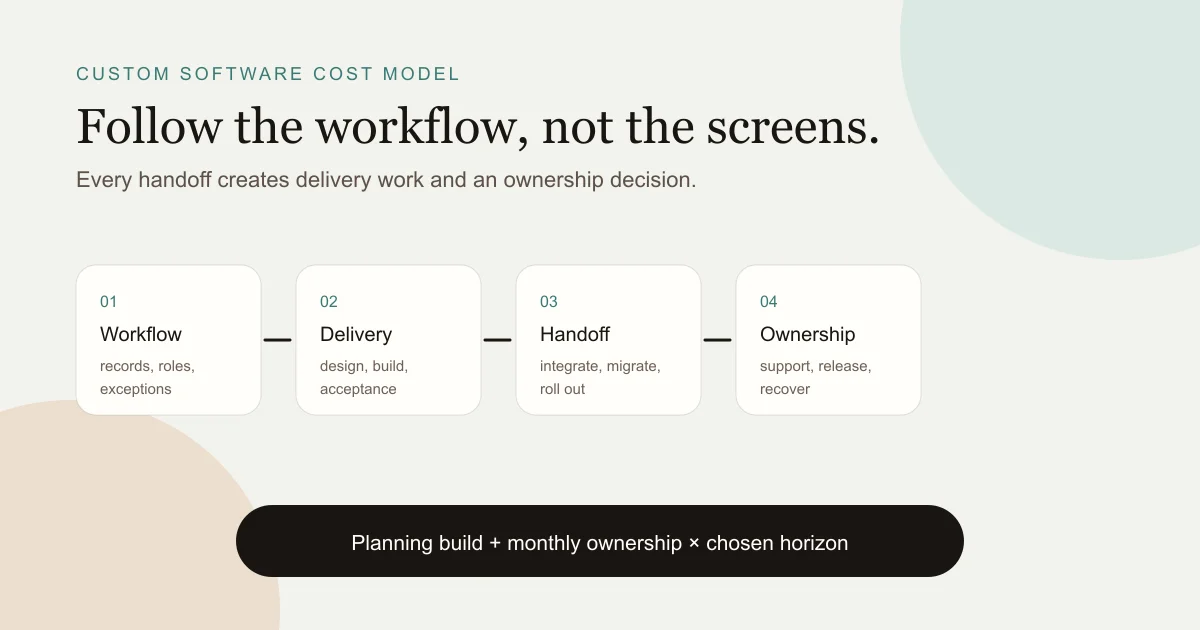
Planning assumptions behind the custom software ranges
The scenarios describe commissioned U.S. employee-cost planning proxies. They do not claim what an agency should charge or what a self-build must cost in cash. The calculator exposes delivery, migration, rollout, and ownership inputs separately.
| Assumption | Value used | Why it changes the estimate |
|---|---|---|
| U.S. employee-cost proxy | Workflow discovery $73/hour, interaction design $74/hour, engineering $97/hour, and QA or acceptance evidence $74/hour. | Rounded rates derive from BLS occupation medians and a broader compensation share. Replace them for your country, team, procurement, or self-build model. |
| Role-hour bands | Every scenario states discovery, design, engineering, and quality hours tied to a named workflow scope. | The bands are editorial assumptions, not survey averages. A new role, exception, report, provider, migration, or rollout group changes the estimate. |
| Integration effort | The worksheet multiplies an editable integration count by editable engineering hours per integration. | This is a planning shortcut. A read-only export, two-way operational system, payment flow, identity provider, and regulated data exchange are not equivalent. |
| Migration and rollout | Migration uses editable engineering hours; rollout uses editable discovery or change-owner hours. | Real work may also require data specialists, QA, trainers, support, legal review, or vendor services. Add the roles instead of hiding them. |
| Contingency and ownership horizon | 15-30% contingency by scenario, with an editable monthly ownership model and a default 36-month horizon. | Contingency covers named unknowns only. The horizon makes support and remaining vendor cost visible but does not predict ROI. |
EDITABLE OWNERSHIP WORKSHEET
Price delivery and ownership separately
Defaults are illustrative planning assumptions. They are not quotes, guarantees, agency rates, market averages, or ROI promises.
| Workstream | Hours | USD/hour | Subtotal |
|---|---|---|---|
| Workflow discovery and ownership | $8,760 | ||
| Interaction and service design | $7,400 | ||
| Software engineering | $77,600 | ||
| QA, security, and acceptance evidence | $17,760 |
Scope additions
Recurring ownership
Planning build plus 36 months of the editable ownership workload. Excludes taxes, legal advice, business change management, and provider costs you did not enter.
How this custom software cost model works
The model begins with the current business process and its owner, prices the software and change needed to replace or support it, then carries the estimate through migration, rollout, and a chosen ownership horizon.
Map the current workflow and its exceptions
Name the triggering event, records, roles, decisions, handoffs, deadlines, exceptions, reports, and final owner. Separate what the software should enforce from what remains a human policy. A screen list without lifecycle and acceptance rules is not enough to estimate.
Sources: [bls-oews-2025], [bls-employer-costs-2026]
Price delivery work by role-hours
Estimate workflow discovery, interaction and service design, engineering, and QA or acceptance evidence. The example loaded rates divide current BLS occupation medians by the broader professional-occupation wage share of compensation. They approximate employee cost, not agency bill rates.
Sources: [bls-oews-2025], [bls-employer-costs-2026]
Add integrations, migration, and rollout as separate work
For each external system, define authorization, data contract, rate limits, retries, failure ownership, and reconciliation. For each legacy source, define mapping, cleanup, rehearsal, rejected rows, cutover, rollback, and verification. Price training, staged rollout, documentation, and support readiness rather than hiding them in contingency.
Sources: [nist-ssdf], [wcag-22]
Carry the model through an ownership horizon
Add runtime, remaining vendor subscriptions, data operations, support, dependency and security work, accessibility regression checks, releases, incident response, and bounded recovery. Re-estimate when the workflow, user group, provider, data, policy, or service target changes.
Sources: [nist-ssdf], [wcag-22]
What this custom software estimate includes
This owner prices company-specific workflow software and its ownership obligations. The broader app development cost guide owns generic application platform and native-delivery breadth. AI-specific model, retrieval, evaluation, and inference cost belongs to the separate AI app cost owner. Build-versus-buy selection is also a distinct decision job; this page prices the custom side once that option is being considered.
Included
- Workflow discovery, record and lifecycle definition, roles, permissions, exceptions, acceptance criteria, and service design.
- Application, backend, database, files, jobs, reporting, audit, export, recovery, and supported web delivery.
- External API or webhook integrations with credentials, retries, limits, failures, and reconciliation.
- Legacy data inventory, cleanup, mapping, rehearsal, cutover, rejected rows, rollback, and verification.
- Training, documentation, staged rollout, support readiness, operating ownership, and an editable ownership horizon.
Not included
- A universal average price, fixed timeline, agency or freelancer rate benchmark, ROI promise, or guaranteed savings.
- A build-versus-buy recommendation, vendor comparison, SaaS product roadmap, or MVP fundraising and validation plan.
- Legal, tax, privacy, security, accessibility, employment, procurement, or regulated-professional advice.
- Provider access, licensing, data rights, commercial approval, or usage charges not entered in the worksheet.
- Native iOS or Android packaging, signing, and store submission by Playcode.
Four illustrative custom software cost scenarios
These are commissioned-project planning estimates using the assumptions shown. They are not market averages, agency prices, Playcode subscription prices, or ceilings.
Single-workflow proof
Replacing one high-friction spreadsheet, inbox, form, or handoff with a bounded web workflow.
- One-time
- $28,000-$63,000 planning estimate, including a 15% contingency.
- Recurring
- Runtime, remaining provider licenses, owner support, data operations, and release work are separate.
Includes
- 280-630 role-hours: discovery 40-80, design 30-70, engineering 160-360, and quality 50-120.
- One primary record lifecycle, one or two roles, bounded permissions, ordinary reporting, acceptance tests, and web delivery.
Excludes
- Complex migration, money movement, offline synchronization, regulated data, organization-wide rollout, and native packaging.
Uncertainty: Low to medium only when the process owner, record, lifecycle, exceptions, acceptance result, and pilot group are already known.
Sources: [bls-oews-2025], [bls-employer-costs-2026], [nist-ssdf], [wcag-22]
Department operating system
A team workflow with several roles, an admin path, files or reports, and ordinary integrations.
- One-time
- $134,000-$273,000 planning estimate, including a 20% contingency.
- Recurring
- Runtime, data operations, integration monitoring, support, policy changes, and scheduled releases.
Includes
- 1,260-2,580 role-hours: discovery 120-240, design 100-220, engineering 800-1,600, and quality 240-520.
- Several roles, server authorization, history, export, one or two ordinary APIs, staged rollout, training, monitoring, and recovery.
Excludes
- Large legacy migration, enterprise identity complexity, regulated evidence, strict high availability, and native channels.
Uncertainty: Medium until integration contracts, imported data quality, permission rules, support hours, and rollout groups are confirmed.
Sources: [bls-oews-2025], [bls-employer-costs-2026], [nist-ssdf], [wcag-22]
Cross-department workflow platform
Several teams sharing authoritative records, approvals, integrations, reports, and operating ownership.
- One-time
- $312,000-$625,000 planning estimate, including a 25% contingency.
- Recurring
- Broader runtime, integration and data reconciliation, release coordination, access review, support, and incident response.
Includes
- 2,820-5,640 role-hours: discovery 240-480, design 180-360, engineering 1,800-3,600, and quality 600-1,200.
- Multiple workflows and roles, versioned decisions, audit, data exchange, migration rehearsal, staged cutover, training, and bounded recovery.
Excludes
- Unlimited departments, undefined global availability, automatic compliance, arbitrary legacy-system support, and native packaging.
Uncertainty: High until each team owns its records, transitions, acceptance, provider failures, cutover decisions, and post-launch support.
Sources: [bls-oews-2025], [bls-employer-costs-2026], [nist-ssdf], [wcag-22]
Migration-heavy or regulated system
Sensitive or high-consequence operations with complex legacy data, formal controls, evidence, and specialist review.
- One-time
- $614,000-$1.34 million or more as a planning estimate with 30% contingency.
- Recurring
- Case-specific evidence, contracts, monitoring, support, access review, incident response, and professional oversight.
Includes
- 5,300-11,600 role-hours: discovery 400-800, design 200-500, engineering 3,500-7,500, and quality or evidence 1,200-2,800.
- Complex migration or integrations, sensitive permissions, audit, formal verification, staged rollout, operator training, and recovery rehearsal.
Excludes
- A universal compliance checklist, legal advice, guaranteed approval, and any claim that the high bound is a ceiling.
Uncertainty: High. Fund discovery, data profiling, integration proofs, migration rehearsal, and qualified review before a fixed commitment.
Sources: [bls-oews-2025], [bls-employer-costs-2026], [nist-ssdf], [wcag-22]
What changes custom software development cost
Estimate the workflow and ownership system, not a screen count. Each category can reopen scope because it creates records, permissions, failure modes, evidence, and ongoing responsibility.
| Category | One-time | Recurring | Main drivers |
|---|---|---|---|
| Workflow, records, and permissions Trigger, record lifecycle, roles, ownership, decisions, exceptions, deadlines, reports, audit, export, deletion, and acceptance. Sources: [bls-oews-2025], [bls-employer-costs-2026], [nist-ssdf], [wcag-22] | Discovery, service design, data modeling, interface, authorization, implementation, and acceptance evidence. | Policy changes, access reviews, support, corrections, new exceptions, and reporting changes. | Distinct lifecycle states, role scopes, exception paths, and decision authority.; Required audit, export, retention, deletion, accessibility, and recovery behavior. |
| Integrations and provider boundaries Accounts, credentials, permissions, API or webhook contracts, limits, retries, duplicates, ordering, outage behavior, and reconciliation. Sources: [nist-ssdf] | Provider setup, implementation, sandbox fixtures, failure tests, operational handoff, and launch verification. | Provider licenses and usage, monitoring, credential rotation, version changes, reconciliation, and outage handling. | Read-only versus two-way behavior and whether money, identity, or sensitive data moves.; Provider approval, region, rate limits, event ordering, commercial terms, and support quality. |
| Migration, cutover, and adoption Source inventory, ownership, cleanup, mapping, rehearsal, rejected rows, verification, rollback, training, documentation, and phased rollout. Sources: [bls-oews-2025], [bls-employer-costs-2026], [nist-ssdf] | Data profiling, transformation, parallel checks, cutover rehearsal, user training, support preparation, and launch coordination. | Data-quality review, correction, onboarding, training refresh, deprecation, and remaining old-system licenses. | Source count, data quality, history, relationships, attachments, and reconciliation requirements.; User groups, change resistance, parallel running, cutover window, and rollback tolerance. |
| Quality, rollout, and ownership Security and accessibility requirements, performance, browser and device coverage, acceptance, release, monitoring, support, recovery, and change ownership. Sources: [nist-ssdf], [wcag-22] | Threat and failure analysis, tests, evidence, rollout controls, dashboards, alerts, documentation, runbooks, and recovery rehearsal. | Incidents, dependencies, browsers, accessibility regressions, provider changes, backups, releases, support, and evidence refresh. | Consequence of failure, service hours, availability, recovery, privacy, and professional-review needs.; Release frequency, user count, device coverage, support response, and retained evidence. |
Use unknowns to decide when to estimate again
A custom software estimate is stable only while the workflow, records, roles, providers, migration, acceptance, rollout, and operating target remain stable. Name unknowns and owners instead of hiding them inside one large contingency.
What moves the estimate
- No single owner can state the current workflow, authoritative record, exceptions, decision rights, or acceptance result.
- Integration access, credentials, provider contract, rate limits, error handling, or reconciliation remains unknown.
- Legacy data ownership, quality, mapping, rejected rows, cutover, rollback, retention, or deletion is unresolved.
- Rollout groups, training, support hours, availability, recovery, accessibility, security, or professional review are missing.
Re-estimate when
- A workflow, role, permission, record, exception, report, integration, migration source, or data category enters or leaves scope.
- An external provider changes access, commercial terms, API behavior, policy, quota, version, or reliability.
- A pilot reveals missing states, user groups, migration defects, accessibility barriers, support load, or acceptance criteria.
- The rollout, service hours, recovery target, release frequency, retention, deletion, security, or evidence obligation changes.
Recurring custom software ownership costs
Do not apply a universal maintenance percentage. Forecast the actual runtime, providers, data work, support window, change queue, release cadence, evidence, and recovery obligations.
| Cost | Cadence | Planning range | Boundary |
|---|---|---|---|
| Runtime and observability Sources: [nist-ssdf] | Monthly usage and service review | Usage-dependent; enter runtime, database, storage, transfer, jobs, logs, alerts, backups, and monitoring for the chosen architecture. | Service levels, data volume, traffic, file use, retention, environments, and recovery change the workload. |
| Remaining vendor and integration cost Sources: [nist-ssdf] | Subscription, seat, transaction, message, or provider meter | Use the current charge for every service the custom system still depends on; custom software rarely removes every vendor. | Include identity, email, payments, maps, messaging, analytics, support, and source systems only when the actual workflow uses them. |
| Support, incidents, and data operations Sources: [bls-oews-2025], [bls-employer-costs-2026], [nist-ssdf] | Monthly owner time plus incident-driven work | Owner hours for access, corrections, imports, exports, retention, deletion, support, provider failures, incidents, and bounded repair. | Name the support window, escalation owner, privacy boundary, and recovery decision. A whole-app restore is not the default fix for one bad record. |
| Releases and evidence refresh Sources: [bls-oews-2025], [bls-employer-costs-2026], [nist-ssdf], [wcag-22] | Per release, dependency change, policy change, and scheduled review | Engineering, QA, security, accessibility, documentation, training, and rollout hours for the actual change queue. | Estimate planned and emergency work separately. The worksheet converts quarterly engineering hours to a monthly planning equivalent. |
Choose the next scope decision
The lowest-risk custom build proves the highest-cost uncertainty before the organization funds every workflow, integration, and migration obligation.
One owned workflow creates measurable friction and can be isolated without pretending to replace the full operating system.
Choose: Build a single-workflow proof.
Tradeoff: You postpone broad integration and migration while learning whether the record model and user behavior are correct.
A department owns the process, acceptance criteria, data, permissions, rollout group, and continuing support.
Choose: Fund a department operating system with staged rollout.
Tradeoff: You accept a bounded integration and ownership surface instead of solving every adjacent team need at once.
Several departments share records and decisions, but the interfaces and migration assumptions have not been rehearsed.
Choose: Fund integration proofs, data profiling, and a migration rehearsal before the platform commitment.
Tradeoff: The evidence work costs money before feature delivery, but it replaces fiction in the largest risk categories.
No one owns the workflow, data rights, acceptance, rollout, support, recovery, or budget for continued change.
Choose: Defer the custom build until ownership exists.
Tradeoff: The organization continues with current friction, but avoids creating another unowned system.
PROVE THE WORKFLOW FIRST
Turn the highest-risk process into working evidence
Use Playcode to build one bounded record lifecycle with real roles, states, failures, and acceptance checks. Learn from the working web tool before funding every department, migration, and provider.
Explore internal tools with PlaycodeProvider accounts, credentials, commercial terms, data rights, and professional review remain the operator’s responsibility.
See current Playcode plans and Cloud limitsPlaycode subscription pricing is separate from the commissioned-project planning estimates above.
What this custom software model cannot tell you
This guide cannot price an unnamed workflow or determine professional obligations. Sensitive, regulated, mission-critical, employment, financial, health, identity, and public-sector systems require qualified review. The output is a planning conversation, not legal, security, privacy, accessibility, procurement, or compliance advice.
- The BLS rates are U.S. employee-cost proxies, not agency, freelancer, global, procurement, self-build, or Playcode prices.
- Scenario role-hours, integration effort, migration effort, rollout effort, contingency, and ownership defaults are editorial assumptions.
- No universal average, fixed timeline, maintenance percentage, ROI, savings, adoption, uptime, approval, or business outcome is promised.
- The model excludes taxes, legal review, regulated-professional review, customer acquisition, broad organizational change, and unentered providers.
- NIST SSDF and WCAG help identify work to investigate; citing them does not certify, approve, or prove the software.
- Integrations require an available API, webhook, export, or token path plus accounts, permissions, credentials, terms, and ongoing provider ownership.
- Code export, authorized record export, provider handoff, bounded repair, and whole-app recovery are different contracts.
- Playcode builds and hosts web apps. Native iOS or Android packaging, signing, and store submission remain separate workstreams.
Sources and evidence dates
Primary government and standards-body sources support the current labor proxy and lifecycle boundaries. The workflow hours and scenarios remain visible page-authored assumptions.
[bls-oews-2025] U.S. Bureau of Labor Statistics:Occupational Employment and Wages, May 2025
Checked August 1, 2026. Supports: Median hourly wages of $65.38 for software developers, $50.14 for QA analysts/testers, $50.00 for web and digital interface designers, and $49.19 for project management specialists.
[bls-employer-costs-2026] U.S. Bureau of Labor Statistics:Employer Costs for Employee Compensation, March 2026
Checked August 1, 2026. Supports: For private-industry professional and related occupations, wages and salaries were 67.6% and benefits 32.4% of compensation.
[nist-ssdf] National Institute of Standards and Technology:Secure Software Development Framework 1.1
Checked August 1, 2026. Supports: Secure practices, requirements, risk decisions, provenance, verification, response, and acquisition communication belong throughout the software lifecycle.
[wcag-22] World Wide Web Consortium:Web Content Accessibility Guidelines 2.2
Checked August 1, 2026. Supports: WCAG 2.2 provides testable accessibility success criteria organized around perceivable, operable, understandable, and robust principles.
Custom software development cost questions
What is the average custom software development cost?
There is no useful universal average. One workflow proof, a department system, a cross-department platform, and migration-heavy regulated software have different records, roles, exceptions, integrations, evidence, rollout, and ownership. Use the visible scenarios as planning examples and replace every assumption.
What makes custom software expensive?
The main drivers are usually workflow and exception complexity, roles and permissions, authoritative records, integrations and failure handling, migration quality, formal acceptance, rollout and training, security or accessibility evidence, support hours, and continued ownership. Screen count alone hides those obligations.
How do I estimate an integration?
Define the provider account, permission, credentials, data contract, direction, rate limits, retries, duplicates, event ordering, outage behavior, reconciliation, commercial approval, testing, monitoring, and owner. Estimate each item. Do not treat every API as the same number of hours.
How do I estimate data migration?
Inventory each source and owner, profile quality, map fields and relationships, define transformations and rejected rows, rehearse on a bounded copy, reconcile counts and application reads, plan cutover and rollback, then verify retention, deletion, export, and post-cutover support. Price those steps by role-hours.
What recurring custom software costs should I budget?
Include runtime, database, files, transfer, backups, logs, monitoring, remaining vendor licenses, provider usage, data operations, support, incidents, dependencies, security, accessibility regression work, documentation, training, releases, access reviews, and recovery. Use expected units and owner hours, not a universal maintenance percentage.
Is custom software cheaper than SaaS?
This page does not make that build-versus-buy decision. Compare the same horizon and workload: subscription, seats, add-ons, integration, workarounds, migration, exit, internal ownership, custom delivery, operations, and change. The lower total is not automatically better if it fails a mandatory workflow or risk requirement.
Can AI reduce custom software cost?
AI can reduce some drafting and implementation work, but no universal percentage applies. It does not remove workflow ownership, data decisions, permissions, integrations, migration, acceptance, security, accessibility, rollout, support, or recovery. Measure saved hours in the real delivery process.
Can Playcode build custom software?
Playcode can build and run web apps, portals, dashboards, and internal tools with backend, database, files, jobs, HTTPS, previews, custom domains, snapshots, and rollback. Provider integrations require an available API path and user-supplied credentials. Native mobile packaging and certification are not implied.
START WITH ONE OWNED RECORD
Build the custom workflow before funding the whole platform
Describe the authoritative record, roles, states, exceptions, acceptance result, and operating owner. Playcode AI can build the web tool, and Playcode Cloud can run its backend, data, jobs, and recovery path.
Build a custom web appNo credit card required. AI credits are included to start; provider credentials and external usage charges may still apply.