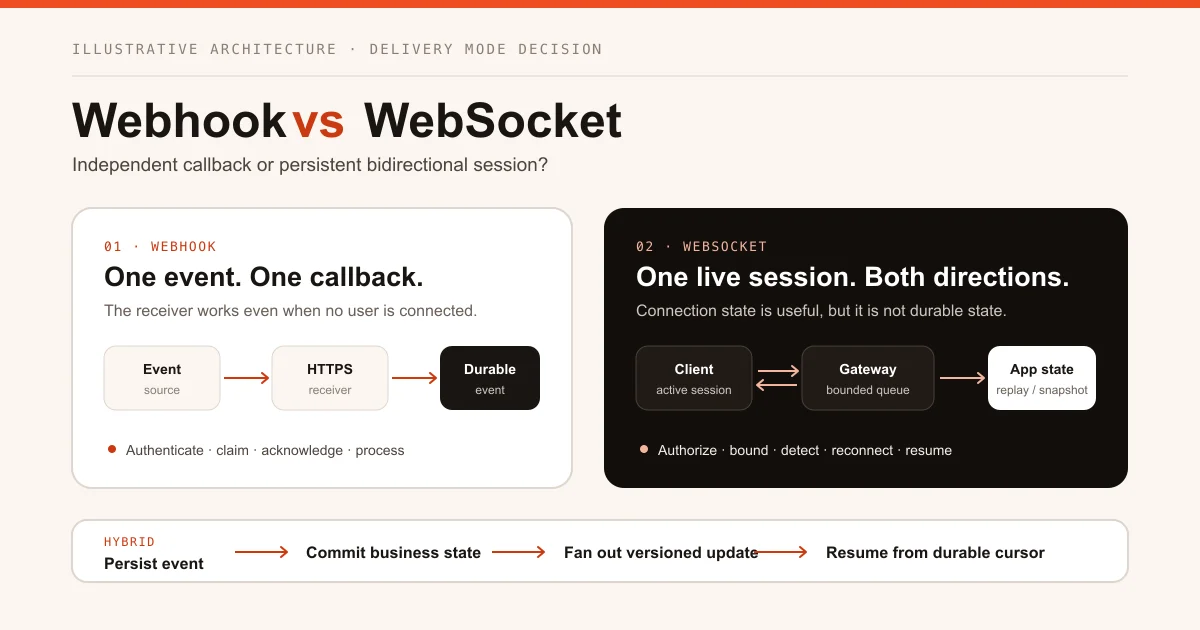
Webhooks deliver independent event callbacks. WebSockets keep an interactive channel open. The first is shaped around durable acceptance when nobody may be watching; the second is shaped around active sessions, connection state, flow control, and recovery after a gap.
This page owns the callback-versus-persistent-connection decision for the exact query “webhook vs websocket.” Webhook versus API is a separate owner about event callbacks versus caller-initiated request-response exchanges. The planned webhook examples guide owns runnable receiver patterns and provider-neutral fixtures; this page includes only enough message structure to make the transport decision. A future WebSocket implementation guide would need its own connection, authorization, resume, fanout, and load-test proof rather than inheriting this comparison.
Direct answer
What is the difference between a webhook and a WebSocket?
A webhook is a separate HTTP callback sent after an event; it is well suited to system-to-system notifications that must be accepted and processed without a user staying connected. A WebSocket is a long-lived, bidirectional connection for an active session. Use WebSockets for interactive live updates, webhooks for asynchronous provider events, and a hybrid when durable events must also reach connected users immediately.
- Independent provider event
- Start with a webhook.
- Active two-way session
- Start with a WebSocket.
- Durable event, live screen
- Persist first, then fan out.
One is an event delivery. One is a live session.
The architectural difference appears before payload design. A webhook receiver must be ready for an authenticated event that arrives independently of a user session. A WebSocket gateway must continuously account for who is connected, what each connection may subscribe to, how much data is queued, and how a returning client catches up.
State before pixels
Durable acceptance and active delivery are separate jobs
Webhook path
- Event sourceknows something happened
- HTTPS receiverauthenticates this delivery
- Event + pending workcommits durable identity
- Workerapplies effect and reconciles
The recipient browser can be closed. The durable receiver and provider recovery contract carry the event.
WebSocket path
- Authenticated clientopens one WSS session
- Connection gatewayauthorizes room and message
- Bounded client queuemeasures lag and backpressure
- Durable app statesupports replay or snapshot
The connection makes live fanout possible. Durable state makes interruption survivable.
A hybrid joins the two after commit: webhook event → business transition → authorized WebSocket notification. Socket fanout never becomes the only copy of the event.
Webhook callback
- Best when
- A provider or service knows that an event happened and your backend must accept it whether or not a user is online.
- Avoid when
- A browser and server must exchange many low-latency messages during one active session, such as cursor movement, presence, or a live control surface.
- Operating rule
- Authenticate each delivery, durably claim its provider identity, acknowledge within the provider contract, and process or reconcile independently of the sender connection.
WebSocket session
- Best when
- Two endpoints remain active and both need to send messages with less request overhead, such as collaborative state, live operations, or chat presence.
- Avoid when
- The recipient may be offline for hours and the event must remain durable without an explicit application log, replay cursor, or snapshot recovery path.
- Operating rule
- Authenticate the connection, authorize every message, bound each client queue, detect dead peers, and make reconnect plus state resume an application-level contract.
Durable event plus WebSocket fanout
- Best when
- An external event must be stored even with no connected client, while active users should see the resulting state change promptly.
- Avoid when
- The product has no active-session requirement, or the team cannot operate both callback ingestion and a connection gateway safely.
- Operating rule
- Commit the event and business transition first, then publish a versioned notification to authorized sockets. Reconnecting clients repair from a snapshot or durable cursor, not socket memory.
Webhook vs WebSocket across ten production decisions
A live demo can make either model look easy. Production design begins with the gaps: which state survives a disconnected user, which delivery can repeat, which order is meaningful, and what happens when a consumer cannot keep up. The source links establish protocol and provider behavior; the recommendation column is editorial analysis.
| Decision | Webhook | WebSocket | Rule |
|---|---|---|---|
| Connection lifecycle [1]IETF RFC 6455: The WebSocket Protocol [2]WHATWG: WebSockets Standard [3]GitHub Docs: Best practices for using webhooks | Each event is an independent inbound HTTP exchange. The sender connects, delivers, receives the documented acknowledgement, and closes or reuses HTTP transport according to its own implementation. | The client and server perform an opening handshake, keep one connection open, exchange messages in either direction, and eventually close cleanly or lose the connection abnormally. | Choose WebSocket only when the active connection itself creates product value. Otherwise, an event callback keeps connection state out of the application. |
| Direction and interaction [1]IETF RFC 6455: The WebSocket Protocol [2]WHATWG: WebSockets Standard [3]GitHub Docs: Best practices for using webhooks | Delivery is initiated by the event producer toward one registered receiver. A response acknowledges that delivery; it is not a continuing conversation channel. | Both endpoints can send application messages while the connection is open, which fits interactive sessions where server and client initiate updates. | Use a callback for one-way event notification. Use a WebSocket when both sides need to initiate messages during the same live session. |
| Offline and disconnected recipients [1]IETF RFC 6455: The WebSocket Protocol [4]GitHub Docs: Handling failed webhook deliveries [5]Stripe Docs: Receive events at your webhook endpoint | The receiver can persist the event and continue processing without an end user connected. Recovery still depends on the provider retry or redelivery contract and your reconciliation path. | Messages sent only to a live connection disappear from the recipient experience when that connection is absent unless the application also writes a durable log, snapshot, or unread state. | If offline users must catch up, store durable state first. A socket can notify about the committed state but should not be its only copy. |
| Latency and freshness [1]IETF RFC 6455: The WebSocket Protocol [2]WHATWG: WebSockets Standard [5]Stripe Docs: Receive events at your webhook endpoint | A provider may queue delivery, retry later, or deliver out of order. Arrival time is not automatically the event time, and no universal webhook latency exists. | An open connection can remove repeated handshakes from the message path, but event-loop load, network conditions, fanout, buffering, and reconnection still affect observed latency. | Do not choose from the word “realtime.” Define a measurable freshness budget and include reconnect, queue, and processing time in it. |
| Retry and delivery identity [1]IETF RFC 6455: The WebSocket Protocol [3]GitHub Docs: Best practices for using webhooks [4]GitHub Docs: Handling failed webhook deliveries [5]Stripe Docs: Receive events at your webhook endpoint | The provider decides automatic or manual redelivery behavior. The receiver needs a durable provider event or delivery identity so an exact retry does not repeat the business effect. | A dropped connection does not tell the application which messages were durably applied. Add message IDs, acknowledgements, resume cursors, and duplicate handling when effects matter. | Retries are an application contract in both models. Webhook identity spans independent requests; WebSocket identity must survive connection epochs. |
| Ordering scope [1]IETF RFC 6455: The WebSocket Protocol [5]Stripe Docs: Receive events at your webhook endpoint | Providers can deliver events out of order. Apply entity versions or retrieve current authoritative state before allowing an older callback to regress a record. | Frames travel in protocol order on one connection, but reconnects, multiple gateways, fanout workers, and replay sources can create gaps or cross-source reordering at the application layer. | Attach a stream or entity version to meaningful messages. Treat a new connection as a new epoch and repair gaps from durable state. |
| Backpressure and slow consumers [2]WHATWG: WebSockets Standard [3]GitHub Docs: Best practices for using webhooks | A burst can overwhelm receiver concurrency or the processing queue. Authenticate and durably accept only within bounded capacity, then follow the provider-specific failure and redelivery contract. | Every slow connection can accumulate outbound data. Browser clients expose bufferedAmount, while the server still needs per-client high-water marks, coalescing, drop, or disconnect policy. | Bound memory before traffic arrives. Coalesce disposable presence updates, but persist important state and disconnect a client that cannot catch up safely. |
| Authentication and authorization [1]IETF RFC 6455: The WebSocket Protocol [3]GitHub Docs: Best practices for using webhooks [5]Stripe Docs: Receive events at your webhook endpoint | Validate the provider-defined signature or secret over the required bytes before parsing. Then map the provider identity to your account and authorize the target record separately. | Use WSS, authenticate the handshake or first bounded message, validate browser Origin where relevant, reauthorize each command and subscription, and reauthenticate after reconnect or expiry. | Transport authentication never grants blanket access to a tenant, room, document, or operation. Authorization stays message- and record-specific. |
| Failure recovery [1]IETF RFC 6455: The WebSocket Protocol [2]WHATWG: WebSockets Standard [4]GitHub Docs: Handling failed webhook deliveries [5]Stripe Docs: Receive events at your webhook endpoint | Inspect failed deliveries, redeliver or reconcile according to the provider, and keep pending, completed, rejected, and quarantined states visible to operators. | Detect abnormal closure, reconnect with bounded exponential backoff and jitter, authenticate again, send the last durable cursor, and request a snapshot when replay cannot close the gap. | Recovery is not “retry forever.” Give each model a bounded retry budget, a durable repair source, an operator-visible terminal state, and a safe replay action. |
| Operating cost [1]IETF RFC 6455: The WebSocket Protocol [2]WHATWG: WebSockets Standard [3]GitHub Docs: Best practices for using webhooks | Cost follows delivered requests, signature work, durable ingestion, queued processing, provider retries, retention, and reconciliation. Idle recipients create no connection fleet. | Cost follows concurrent connections, gateway memory and file descriptors, keepalive traffic, fanout, egress, load-balancer behavior, connection churn, and the durable system behind resume. | Estimate peak events per second for callbacks and peak concurrent connections plus fanout for sockets. A hybrid must budget both surfaces and their shared durable state. |
Design for the interruption, not only the open connection
Each model has a different moment of truth. A webhook must cross the durable acceptance boundary before acknowledgement. A WebSocket must keep session state bounded and make a new connection converge on current durable state after interruption.
01 Establish
Webhook
Register a public HTTPS receiver and provider-specific secret, event selection, permissions, and acknowledgement behavior.
WebSocket
Open WSS, validate Origin when applicable, authenticate identity, select any required subprotocol, and bind an authorized connection epoch.
Evidence: Rejected invalid credentials; allowed event or room; bounded request or handshake; no secret in URL or routine logs.
02 Receive
Webhook
Verify the current delivery before parsing, validate event identity, store the event and pending work durably, then acknowledge.
WebSocket
Validate message type, schema, size, connection identity, tenant, room, record permission, message ID, and expected version before acting.
Evidence: Known event or message produces one authorized durable transition. Malformed and cross-tenant fixtures produce none.
03 Flow control
Webhook
Bound concurrent acceptance and queue depth. Leave work pending for a worker rather than performing slow provider calls before acknowledgement.
WebSocket
Measure per-client queued bytes and lag. Coalesce disposable updates, stop fanout, or close slow clients before memory becomes unbounded.
Evidence: A controlled burst keeps memory and latency inside the declared budget, and overflow reaches one intentional state.
04 Interrupt
Webhook
Provider delivery can fail while the receiver is unavailable or slow. Preserve enough provider and local evidence to find the gap.
WebSocket
A clean Close differs from abnormal loss. Stop new writes, record the connection epoch and last applied sequence, and avoid reconnect loops.
Evidence: Forced outage or disconnect is visible with bounded identifiers, not raw payloads or credentials.
05 Recover
Webhook
Redeliver, replay, or call the provider API according to its contract. Deduplicate the effect and reconcile current authoritative state.
WebSocket
Reconnect with jitter, reauthenticate, resume after the durable cursor, and fall back to a snapshot when history is unavailable or inconsistent.
Evidence: The repaired record equals the authoritative state, no duplicate side effect occurs, and the operator can explain the recovery.
Five product scenarios make the boundary concrete
Start from who must receive the result and whether that recipient is guaranteed to be online. Then decide what is durable before introducing a connection gateway or provider callback.
Provider status reaches a live operations dashboard
HybridSituation
A payment or fulfillment provider changes an order while an operator may or may not have the dashboard open.
Design
Accept the authenticated webhook into a durable event and update the order transactionally. After commit, publish order ID plus new version to authorized dashboard sockets. A disconnected dashboard loads the current order snapshot later.
Failure boundary
If socket fanout fails, the committed order remains correct. If the webhook is duplicated or late, provider identity and version rules prevent a second or regressive transition.
Two people edit one document together
WebSocketSituation
Active participants exchange edits, presence, and cursor signals many times per minute while the document must survive disconnection.
Design
Use an authenticated room-scoped WebSocket for live operations. Give durable operations stable identities and sequence or conflict rules; coalesce disposable cursor movement; persist document state independently of connection memory.
Failure boundary
A reconnect sends the last durable cursor and requests missing operations or a fresh snapshot. Presence can expire, but committed document state cannot depend on a live socket.
A repository push starts a background workflow
WebhookSituation
A code host emits an event whether or not a Playcode project owner has a browser open.
Design
Verify the provider delivery, store its durable identity and pending work, acknowledge within the provider contract, then let a worker evaluate the allowed repository and action.
Failure boundary
A receiver outage is recovered through provider-specific redelivery or reconciliation. The browser is not part of the acceptance path and cannot be the only evidence that the event arrived.
Chat typing and presence indicators
WebSocketSituation
Connected users benefit from immediate ephemeral signals, but nobody needs to recover every cursor or typing transition after returning hours later.
Design
Publish short-lived presence messages to authorized room members. Apply tight size and rate limits, coalesce superseded state, and let expiry clear abandoned presence.
Failure boundary
A slow client drops or replaces disposable signals instead of buffering them indefinitely. Durable chat messages use their own stored record and acknowledgement path.
A background export finishes while the user is away
HybridSituation
A long-running job completes after the browser tab may have closed, and the user needs the result on the next visit.
Design
Commit the export status and authorized file metadata first. Notify a connected session by WebSocket when present; otherwise the next page load reads the durable job record. An external provider callback, if involved, stays a webhook boundary.
Failure boundary
A missing socket notification cannot erase the completed export. Download authorization is checked against current server state, not a stale message payload.
Make durable identity visible in the message contract
These reserved test records are conceptual. They show where identity, stream position, and entity version belong without pretending that a generic field name creates reliability or that one envelope is portable across providers.
Durable callback envelope
A webhook delivery identity exists outside any user session
The provider delivery is authenticated under its own contract, then mapped to a durable event record before slow work begins.
Fixture boundary: This reserved test record is not a universal provider payload. Signature fields, event IDs, versions, retry schedules, and acknowledgement responses must follow the selected provider documentation.
Connection-aware message envelope
A socket message carries application identity across reconnects
The connection epoch helps diagnose a session, while stream sequence and message ID survive long enough to detect gaps and duplicates.
Fixture boundary: This is an application envelope, not a WebSocket standard field set. It does not create durability by itself; the server still needs an authorized source of truth, retention policy, and resume behavior.
Reconnect decision
Resume from durable state, not from connection memory
A returning client states the last durable sequence it applied. The server reauthorizes access and chooses replay or snapshot deliberately.
Fixture boundary: Pseudocode only. Authentication transport, history retention, snapshot schema, concurrency, and slow-consumer behavior must be implemented and tested for the application.
Test disconnects, duplicates, gaps, and slow consumers
The happy path proves syntax. The decision becomes credible only after deliberate outages, wrong identities, duplicate or missing deliveries, queue pressure, reconnect, and a published environment smoke produce the expected bounded states.
| Model | Scenario | Expected evidence |
|---|---|---|
| Webhook | Authenticated event while no browser is connected | One durable event and business transition are recorded, acknowledgement follows the provider contract, and the next authorized page load sees current state. |
| Webhook | Wrong signature with malformed payload | Authentication rejects the delivery before parsing, durable writes, socket fanout, or raw-body logging. |
| Webhook | Duplicate and out-of-order provider deliveries | The exact duplicate creates no second effect, changed reuse is quarantined, and an older entity version cannot regress current state. |
| WebSocket | Authorized connection, message, and clean close | The expected subprotocol and room scope are established, one valid message changes one allowed record, and shutdown drains or rejects new work deliberately. |
| WebSocket | Invalid Origin, expired identity, oversized message, and wrong tenant | Each boundary fails before business state changes, uses a bounded close or error contract, and exposes no secret or private payload in telemetry. |
| WebSocket | Slow client under a controlled burst | Queue bytes and lag reach a configured threshold; disposable signals coalesce or drop, important state remains durable, and memory stays bounded. |
| WebSocket | Abnormal disconnect followed by reconnect | Backoff prevents a reconnect storm, identity is checked again, the last durable cursor is used, and replay or snapshot closes the gap without duplication. |
| Hybrid | Durable event commits but WebSocket fanout fails | The source-of-truth record remains correct, fanout is retryable or disposable according to policy, and connected or returning clients repair from durable state. |
| Hybrid | Published environment smoke during a rolling deploy | HTTPS and WSS use environment credentials, the webhook still commits once, sockets drain and reconnect with jitter, and clients converge on one versioned record. |
Secure the delivery, then authorize the business action
A valid connection or signature establishes only one transport fact. It does not prove that a tenant may join a room, read a record, download a file, or apply the action named in a payload.
- Use HTTPS for webhook receivers and WSS for browser-facing WebSockets. Keep API tokens, webhook secrets, signing keys, session credentials, and resume capabilities in server-side configuration or bounded secure storage, never in public URLs or routine logs.
- For webhooks, preserve the provider-required bytes and validate the current delivery before parsing. Apply provider timestamp, event identity, and redelivery rules exactly; there is no universal signature or retry envelope.
- For browser WebSockets, validate the expected Origin when it is part of the threat model, authenticate the connection, and reauthorize every room, record, command, file, and fanout topic. Cookie presence alone is not record authorization.
- Bound handshake rate, message size, parse depth, per-identity actions, concurrent subscriptions, outbound queue bytes, and reconnect attempts. Use safe close behavior without exposing sensitive policy details.
- Treat transport identity and business permission separately. A signed callback or authenticated socket may still name a tenant, record, user, or operation the actor is not allowed to access.
- Keep telemetry structured and bounded: connection epoch, stream, message or delivery ID, entity version, state, latency, queue bytes, attempt, close code, and safe error code. Redact payloads, secrets, personal data, and private content.
Eight failure modes that change the architecture
The live screen looks current until a user refreshes and sees older data.
- Likely cause
- Socket messages changed browser state without committing the authoritative record, or a reconnect snapshot came from a stale cache.
- Check
- Compare the displayed entity version, server record version, stream sequence, and cache scope for the same fictional fixture.
- Fix
- Commit authoritative state before fanout. Make the socket message a versioned notification and repair from a server-authorized snapshot.
Memory rises as one client falls behind.
- Likely cause
- The server queues every outbound message per connection with no byte limit, coalescing rule, or slow-consumer terminal state.
- Check
- Throttle one controlled client while publishing a bounded burst; record per-client queued bytes, lag, process memory, and disconnect reason.
- Fix
- Set high-water marks. Coalesce ephemeral state, retain important changes durably, and close clients that cannot catch up inside the declared budget.
A deploy causes thousands of clients to reconnect at once.
- Likely cause
- Connections close simultaneously and clients retry immediately with identical timing, while the gateway has no drain or admission policy.
- Check
- Run a controlled drain and chart reconnect attempts, successful handshakes, authentication load, and backoff distribution by second.
- Fix
- Advertise or enforce bounded drain behavior, use exponential backoff with jitter, cap attempts, and stagger admission during recovery.
A reconnected client silently misses several important updates.
- Likely cause
- The product treats reconnect as a fresh live subscription and has no last-applied sequence, replay retention, or snapshot comparison.
- Check
- Disconnect after sequence 17, commit versions 18 through 20, reconnect, and verify the client can prove how it reached version 20.
- Fix
- Persist a durable cursor or entity version. Replay the bounded gap when available; otherwise send an authorized current snapshot.
A valid message reaches a user in another tenant.
- Likely cause
- The connection authenticated once, but room subscriptions or fanout topics trust browser-supplied tenant and record IDs.
- Check
- Use two ordinary accounts and known IDs to subscribe, publish, reconnect, and resume across the tenant boundary.
- Fix
- Resolve tenant and record scope from server identity for every subscription and message. Include authorized scope in fanout and cache isolation.
A webhook outage produces a permanent gap even after the receiver returns.
- Likely cause
- The design assumed automatic provider retries and kept no provider delivery view, reconciliation cursor, or documented redelivery procedure.
- Check
- Review the exact provider delivery history and compare current provider objects or events with local durable identities and versions.
- Fix
- Implement the provider-specific redelivery or API reconciliation path. Do not infer retry behavior from a different provider.
The system processes one event twice after socket reconnect or webhook redelivery.
- Likely cause
- Delivery identity is scoped only to one process or connection, so the same durable intent receives a new local identity after recovery.
- Check
- Repeat the exact provider event and application message across restart and connection epochs; inspect durable unique keys and effect records.
- Fix
- Give business effects stable identities beyond transport sessions, return the prior result for an exact retry, and quarantine changed-content reuse.
Infrastructure cost grows even when user activity does not.
- Likely cause
- Idle sockets, aggressive keepalives, reconnection churn, over-broadcast fanout, webhook retry storms, or unbounded retention are not measured separately.
- Check
- Break cost and capacity into concurrent connections, messages, fanout recipients, queued bytes, egress, callback attempts, processing, and retention.
- Fix
- Expire unused subscriptions, batch or coalesce disposable updates, fix retry loops, right-size retention, and remove WebSockets from workflows without active-session value.
Webhook and WebSocket questions
Is a webhook the same as a WebSocket?
No. A webhook is an independent HTTP callback sent after an event. A WebSocket is a persistent connection over which either endpoint can send messages while the connection remains open. They can work together, but their lifecycle, delivery, recovery, and capacity responsibilities are different.
Are WebSockets faster than webhooks?
An already-open WebSocket can reduce repeated connection and request overhead for interactive messages, but “faster” is not universal. Network conditions, gateway load, fanout, event loops, buffering, provider queues, and downstream processing all affect end-to-end freshness. Measure the exact workload instead of assigning a guaranteed latency to either model.
Do WebSockets guarantee message delivery?
No application-level durable-delivery guarantee comes from opening a WebSocket. A connection can close after one endpoint sends a message but before the application proves the effect was stored. Important messages need stable IDs, acknowledgements, durable state, duplicate handling, and a replay or snapshot recovery path.
Do webhooks guarantee event order?
Not universally. Stripe explicitly says event delivery order is not guaranteed, and other providers define their own behavior. Store event identity and entity version, reject regression, and reconcile from authoritative state when order matters. Never copy one provider’s ordering or retry behavior into a generic webhook assumption.
What happens to WebSocket messages when a user is offline?
A live connection cannot deliver to a disconnected user. If the update matters later, store it as durable business state, an unread record, or a replayable stream independently of the socket. On reconnect, authenticate again and load a snapshot or resume after a durable cursor.
How should WebSocket backpressure be handled?
Monitor queued bytes and lag for every connection. The browser API exposes bufferedAmount for data queued by send() but not yet transmitted. On the server, set a per-client high-water mark, coalesce disposable presence updates, persist important state elsewhere, and close a consumer that cannot catch up safely.
When should a product use both webhooks and WebSockets?
Use both when an external event must be accepted even with no user online and connected users should see the committed result promptly. Persist and apply the webhook first, then fan out a versioned notification. A failed socket notification must not roll back or hide the authoritative event.
Which costs more, webhooks or WebSockets?
It depends on workload and provider pricing. Webhook cost follows request volume, retries, processing, queues, retention, and reconciliation. WebSocket cost follows concurrent connections, memory, keepalives, connection churn, fanout, egress, and durable resume infrastructure. Estimate both peak event rate and peak concurrent connections before choosing.
Can Playcode run a WebSocket service or webhook receiver?
Playcode Cloud can run backend processes, jobs, WebSockets, HTTPS endpoints, a database, and recovery under current plan limits. Playcode can build provider integration logic when the provider exposes a supported path and you supply the required credentials and requirements. This is not a claim of a native or one-click connector, universal scale, or a tested provider flow.
Standards, provider examples, and verification date
RFC 6455 and the WHATWG standard establish WebSocket protocol and browser API behavior. GitHub and Stripe documentation show two different webhook operating contracts. Their retry, acknowledgement, and ordering rules are provider examples, not universal webhook semantics.
- IETF RFC 6455: The WebSocket Protocol · checked 2026-07-19The opening handshake, bidirectional messages, frame ordering, masking, Origin guidance, Ping and Pong control frames, closing behavior, abnormal closure, and security considerations.
- WHATWG: WebSockets Standard · checked 2026-07-19The browser WebSocket interface, connection states, message events, bufferedAmount, subprotocol negotiation, close events, and the browser API boundary around Ping and Pong.
- GitHub Docs: Best practices for using webhooks · checked 2026-07-19A provider-specific example of HTTPS, webhook secrets, bounded acknowledgement, asynchronous processing, event selection, redelivery, and stable delivery identity.
- GitHub Docs: Handling failed webhook deliveries · checked 2026-07-19GitHub-specific failure and redelivery behavior, including that failed deliveries are not automatically redelivered and need manual or scripted recovery.
- Stripe Docs: Receive events at your webhook endpoint · checked 2026-07-19A provider-specific example of signature verification, automatic and manual retry, duplicate events, non-guaranteed event ordering, asynchronous handling, and API reconciliation.
- Playcode: Cloud · checked 2026-07-19The Playcode runtime boundary used by the CTA: backend, database, HTTPS, background jobs, WebSockets, snapshots, and rollback under current plan limits.
- Playcode: AI App Builder · checked 2026-07-19The Playcode builder boundary used by the CTA: describe and iterate on a custom web application while keeping provider credentials and live integration proof separate.
From transport choice to running app
Build the durable state behind the live update
Describe the event source, active users, message rate, state owner, authorization boundary, retry or reconnect behavior, and recovery goal. Playcode can build the application and run its backend when the provider path and requirements are available.
You provide provider accounts, credentials, permissions, capacity assumptions, and final environment smokes. No native or one-click connector is implied.