Private employee self-service, bounded by role

Employee Portal Builder Your Team Can Trust

Describe the resources employees need, the requests they submit, what managers review, and which fields HR may see. Playcode builds the authenticated workflow and helps you test invitation expiry, cross-account privacy, session revocation, retention, export, and deletion before real employee use.

No credit card required · No coding needed

Quick answer

What does employee portal software help you build?

Employee portal software gives authenticated staff a private place for approved resources, requests, acknowledgements, and role-specific actions. With Playcode, you describe the employee, manager, and HR visibility rules, then build and test invitations, sessions, offboarding, retention, export, and deletion as one database-backed workflow.

1.1M+users
26M+projects
Since 2016

Used by people at

Counts registered accounts using corporate email domains from the companies above. Playcode is a self-serve product, not a contracted vendor to these brands.

From Employee Workflow to a Portal You Can Verify

Prove one resource and request lifecycle before expanding the portal

01

Define Identities, Relationships, and Visible Fields

Separate the signed-in person, employee record, manager relationship, HR role, invitation, and session. List the exact profile, resource, request, and acknowledgement fields each relationship may read or change.

Keep sensitive employment, payroll, benefits, health, and regulated records outside the first portal. A smaller allowlist is easier to test and safer to operate.

Preview
AI Chat
Publish
I'm a realtor in Miami. I need a website to show my listings and get buyer leads.
4 Questions
2 / 4
What's the main style for your real estate site?
AModern & minimal with clean lines
BLuxury feel with large property photos
CProfessional & corporate
DI'll describe my own style below
Or type your own answer...
Skip
Next
Describe what you want to change...
Economy
Build Progress
4/6
Site layout & navigation
3s
Hero section with CTA
5s
Property listings grid
8s
Building contact form...
About page & bio
Footer & SEO meta
miami-homes.playcode.io
Miami Dream Homes
Your trusted partner in Miami real estate
Search by neighborhood...
Featured Listings
NEW
$1,250,000
Coral Gables Villa
4 bd|3 ba|2,400 sqft
OPEN
$890,000
Brickell Condo
2 bd|2 ba|1,200 sqft
Get in Touch
02

Build One Private Resource and Request

Ask Playcode to build time-limited invitations, authenticated sessions, resource metadata, a versioned acknowledgement, one employee request, a manager review state, and the protected HR action needed to close it.

Test every list, detail, update, acknowledgement, export, and download decision signed out, as the intended employee, as another employee, as the direct manager, as an unrelated manager, and as HR.

03

Publish, Offboard, and Exercise Retention

Publish over HTTPS with fictional accounts. Expire an invitation and session, revoke every active session during offboarding, export only allowlisted employee data during the approved retention window, and delete it after the window ends.

Use bounded IDs and reason codes in audit events, not invitation tokens, private notes, document contents, or credentials. Rehearse record repair separately from whole-app recovery.

Your website is live!

https://
miami-homes.playcode.io
Site is secure - SSL certificate active
Or connect your domainmiami-dream-homes.com
Miami Dream Homes
Your trusted partner
Miami Dream Homes
Your trusted partner
Replace scattered employee handoffs

Give Staff a Bounded Self-Service Workflow

Employees get clarity without turning every internal record into a shared directory

Shared folders, forms, and chat threads

  • A folder link becomes the entire access model
  • Employees cannot tell whether a request was received or reviewed
  • Managers see either too little context or every private field
  • A repeated click creates a second request or acknowledgement
  • Offboarding closes an account but leaves old sessions active

An employee portal workflow

  • Server rules resolve identity, relationship, field, record, and action
  • Requests and acknowledgements bind to one visible version
  • Employee, manager, and HR views use explicit field allowlists
  • Exact retries return one result while changed retries conflict
  • Offboarding revokes sessions and starts a named retention path
A useful first release

What Your Employee Portal Can Include

Start with private self-service records, not a replacement for every HR system

01

Employee, manager, and HR views

Use server-enforced field allowlists and current reporting relationships so a role name alone never grants broad access to every employee record.

02

Invitation and session lifecycle

Issue single-purpose, time-limited invitation tokens, store only their hashes, make exact acceptance retries safe, expire sessions, and revoke all active access when employment ends.

03

Private resource metadata

Track title, audience, version, owner, retention, and authorized storage reference separately from the document bytes and their download path.

04

Versioned employee requests

Move one request through submitted, manager review, HR review, and resolved states with expected versions, idempotency, and bounded audit events.

05

Version-bound acknowledgements

Record which employee acknowledged which approved resource version and reject an attempt that silently refers to an outdated version.

06

Retention, export, and deletion

Allow a named owner to export approved fields during a defined retention window, then delete the employee-scoped records after the window expires.

A practical employee-portal implementation guide

Prove Privacy Across Two Accounts Before Real Staff Arrive

Model identity, relationships, visible fields, lifecycle, retention, and recovery as server contracts rather than hidden controls.

Before you build

Prerequisites

  • An employee, relationship, invitation, and session model

    A login does not explain who is an active employee, who manages whom, which HR role is current, whether an invitation expired, or whether an old session was revoked.

    Ready when: You can change a manager, expire one invitation, revoke every session for one offboarded employee, and preserve unrelated employee records without editing browser-only flags.

  • A field and action visibility matrix

    Profile visibility, private request notes, manager summaries, HR notes, resource metadata, acknowledgements, export, and deletion need different readers and actors.

    Ready when: The matrix gives a result for signed out, employee self, another employee, direct manager, unrelated manager, and HR across list, detail, update, acknowledgement, export, and deletion paths.

  • A minimal-data, retention, and storage decision

    An employee portal should not collect payroll, benefits, health, or regulated records merely because the database can store them. Resource metadata also does not secure file bytes by itself.

    Ready when: Every collected field has a purpose, reader, retention owner, export rule, deletion rule, and storage boundary. Unneeded sensitive fields are absent from the schema, fixtures, logs, and screenshots.

Implementation sequence

Do, observe, verify
  1. 01
    Playcode AI prompt, data model, and authentication handlers

    Model employees, relationships, invitations, and sessions

    Create separate records for identity, employee membership, manager relationship, role assignment, invitation, and session. Give invitations a purpose, unguessable token whose hash is stored, and expiry; open sessions only from a server-authenticated identity; give sessions expiry and revocation timestamps; make employment status authoritative on the server.

    Expected result

    The same portal URL produces signed-out, invited, active, expired, revoked, offboarded, and denied states without conflating an email address with current access.

    Verify

    Accept one fictional invitation twice, reject a different email, cross its expiry boundary, expire one session, and revoke two open sessions during offboarding.

  2. 02
    Server profile, resource, request, acknowledgement, and export routes

    Enforce field and relationship visibility on every handler

    Resolve the current identity, active employee status, manager relationship or HR role, requested record, field allowlist, and action before returning or changing data. Return only selected fields rather than loading a full private record into the browser.

    Expected result

    An employee sees only their allowlisted view, a direct manager sees only manager fields for direct reports, and HR access stays explicit. Another employee and unrelated manager receive no private record.

    Verify

    Replay known employee and request IDs across two ordinary accounts, two managers, HR, and a signed-out request; inspect the raw server payload, not only hidden interface elements.

  3. 03
    Resource publisher, employee self-service form, and manager or HR review queue

    Build versioned resources, requests, and acknowledgements

    Version each approved resource; bind acknowledgements to that version; validate requests on the server; use a scoped idempotency key and input fingerprint for creates; and require expected versions for every review transition.

    Expected result

    An exact retry returns the original request or acknowledgement, changed input under the same key conflicts, and a stale manager or HR decision cannot overwrite the newer record.

    Verify

    Submit the same fictional request twice, alter it under the same key, race two review versions, acknowledge the current resource, and attempt an acknowledgement against the previous version.

  4. 04
    Server storage adapter, notification adapter, and protected operator view

    Separate file storage, notifications, and the durable record

    Store authorized resource metadata separately from file bytes. If a provider is added, keep credentials server-side, validate upload and download boundaries, commit the core request first, and track notification or storage failure as a retryable secondary state.

    Expected result

    A provider outage cannot duplicate or erase the employee request, a known storage reference is not a permission grant, and an operator can retry the failed side effect without repeating the durable action.

    Verify

    Fail the storage or notification adapter after the core record saves, inspect one stable request ID, retry only the failed side effect, and attempt the resource path from another employee account.

  5. 05
    Published HTTPS portal and protected HR operations path

    Publish and rehearse offboarding, export, deletion, and recovery

    Run the fictional employee flow on the final URL, offboard the employee, revoke every session, export only allowlisted subject data during the approved retention window, delete it after expiry, and document when to repair one record versus restore the whole app.

    Expected result

    The intended flow works once, old sessions are denied immediately, exports omit manager or HR-only notes, deletion waits for the named window, and operators have a bounded recovery decision.

    Verify

    Use private browsing and two fictional employees, hold two sessions open during offboarding, compare the export field list, cross the retention boundary, verify deletion, and inspect bounded audit events for private payload leakage.

Decisions that change the build

Should access come from a broad role or a current relationship?

  • Broad employee, manager, and HR roles only
  • Role baseline plus current employee-manager and record relationships

Choose: Use the smallest role baseline, then require the current relationship, record scope, visible field, and action on the server.

Tradeoff: Relationship-aware checks add explicit rules and fixtures, but stop a manager label from becoming access to every employee or request.
Where should private resource files live?

  • Playcode persistent file storage within current plan limits
  • A separately configured file or object-storage provider

Choose: Choose the simplest path that satisfies the approved file, size, location, retention, and access requirements. Keep portal authorization and resource metadata explicit either way.

Tradeoff: First-party app storage keeps the initial workflow smaller. A provider may match an existing system, but adds credentials, limits, outage handling, and a separate download-authorization boundary.

Before you share it

Test checklist

  • Happy path

    Invite one fictional employee, sign in, open one approved resource, acknowledge its current version, submit one request, review it as the direct manager, and resolve it as HR.

    Expected: One active membership, acknowledgement, and request exist; each role sees its allowed fields; and the audit trail records bounded IDs and state changes.

  • Invalid input

    Request the employee profile, resource, request, and export while signed out, as another employee, and as an unrelated manager; then submit a stale acknowledgement and stale request version.

    Expected: Every unauthorized path is denied server-side, no private fields appear, and stale versions change no resource, acknowledgement, or request state.

  • Duplicate or retry

    Accept the same invitation twice, repeat the same request and acknowledgement keys, change input under an existing key, and retry a failed notification after the request saves.

    Expected: Exact retries return the original result, changed fingerprints conflict, record counts stay single, and only the failed side effect retries.

  • Published smoke test

    Use two fictional employee accounts and two open sessions on the published HTTPS URL, then expire one session and offboard the intended employee.

    Expected: The intended account completes the workflow once, the other account stays isolated, and every old session is denied after expiry or offboarding.

If something goes wrong

Common failure cases

One employee can see another employee profile or request

Likely cause
The server checked sign-in or a broad role but did not verify subject identity, current manager relationship, selected fields, and requested action.
Check
Replay the exact list and detail requests from a second ordinary employee and an unrelated manager, then inspect the raw response fields.
Fix
Require active identity, current relationship, record scope, field allowlist, and action authorization together on every protected handler.

An employee acknowledged an older resource after a new version was published

Likely cause
The acknowledgement stored only a resource ID or title and did not bind the action to the current approved version.
Check
Compare the acknowledgement resource version with the current resource record and the version shown when the action was submitted.
Fix
Require the current resource version on submission, reject stale versions, and store one employee-resource-version acknowledgement identity.

A repeated request created a second workflow record

Likely cause
The form retry had no scoped idempotency key, or the server recorded the key only after side effects completed.
Check
Compare idempotency key, normalized input fingerprint, employee ID, request IDs, and request count without logging private note contents.
Fix
Persist the scoped key, fingerprint, and durable result before retryable provider actions, then return that result for an exact retry.

An offboarded employee can still open the portal

Likely cause
The workflow disabled the account but trusted a long-lived browser session or file URL without checking current employment status.
Check
Repeat profile, request, resource, and download calls from every session that was open before offboarding.
Fix
Revoke all subject sessions at offboarding and verify current active membership on every protected request and download.

An employee export contains HR-only notes or file storage references

Likely cause
The export serialized internal records directly instead of applying a subject-specific export allowlist.
Check
Compare the exported keys with the approved subject matrix and scan fixtures for manager summaries, HR notes, tokens, and storage references.
Fix
Build exports from explicit allowlisted fields, test forbidden keys, and keep code export, subject-data export, file handoff, and app recovery separate.
One privacy model, different teams

Employee Portals for Bounded Self-Service Work

Change the resource and request types without weakening the access rules

Operations Team

Resources, access requests, acknowledgements

Give staff one authenticated view for approved operating resources, equipment or system-access requests, and version-bound acknowledgements.

Distributed Company

Private updates and manager review

Route employee requests through the current manager relationship while keeping HR-only fields and unrelated employee records out of the view.

People Operations

Invitation and offboarding control

Issue time-limited invitations, inspect bounded lifecycle events, revoke sessions at offboarding, and apply named retention and deletion decisions.

Service or Field Team

Mobile self-service records

Let authenticated staff find approved resources, submit one bounded request, and see its current state without exposing a broad company directory.

Picture the access lifecycle

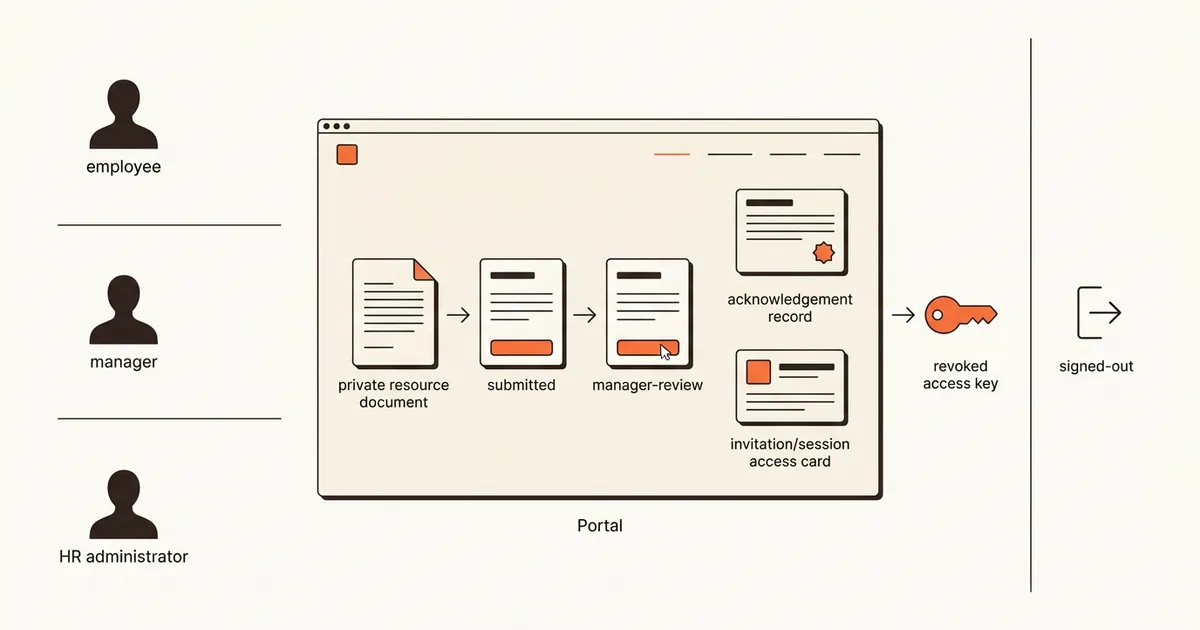
Three Role Views Around One Private Workflow

The concept separates employee, manager, and HR perspectives around a private resource, submitted request, manager review, acknowledgement, invitation, and revoked session.

Illustrative employee portal sequence with employee, manager, and HR roles around a private resource, request review, acknowledgement, invitation, revoked access, and signed-out state
Illustrative conceptThis is an illustrative employee-portal sequence with fictional role and lifecycle states, not a Playcode product screenshot or workflow proof. The actual result depends on your employee relationships, field matrix, resources, requests, retention rules, and design brief.
Download the deterministic reference

Inspect the Employee Portal Trust Contract

The dependency-free ZIP passes a fresh-extraction 14-test suite for field visibility, signed-out and cross-account denial, hashed invitation tokens, session identity and revocation, scoped retries, versioned requests and acknowledgements, retention-bound export, deletion, and bounded audit output. SHA-256: e73f5af19ff3600c740dee51e5934f40e41613d64bc6cd7ccd16b57cc9808637. It is reference proof, not a public Playcode deployment or packaged HR product.

3 roles
employee, manager, and HR field allowlists
2 accounts
ordinary employees in privacy denial fixtures
14 tests
deterministic lifecycle and privacy checks
1 version
required for each request decision and acknowledgement
0 secrets
emails, private notes, tokens, and storage paths in audit output

Download the Employee Portal Reference ZIP

Choose the right internal surface

An Employee Portal Is a Private Workflow, Not an Internal Homepage

The difference appears in field visibility, lifecycle, and offboarding behavior

Employee needShared intranet or folderPlaycode employee portal
Identity and accessPossession of a link stands in for current permissionInvitations, sessions, employment state, relationships, and actions are checked
Visible employee fieldsOne broad profile or directory viewEmployee, direct-manager, and HR field allowlists stay separate
RequestsForm submission disappears into email or chatVersioned states, idempotent creates, current owner, and bounded audit events
AcknowledgementsA generic checkbox detached from content changesEach acknowledgement binds employee, resource, and approved version
Offboarding and retentionAccount removal leaves old sessions or links unexplainedSessions revoke, exports stay allowlisted, and deletion follows a named window
The engine

A software team in one agent

Playcode AI runs the same frontier models that power ChatGPT and Claude - and orchestrates them like a team: it plans the work, delegates to sub-agents, runs long jobs in the background, and reviews its own changes.

Every frontier model

The latest models from every major lab, in one picker. Switch anytime.

ClaudeGPTGeminiGrok

Sub-agents

Big jobs split across specialists - one explores your code, one writes, one audits - working in parallel.

Background tasks

Long builds and migrations keep running while you keep talking. They report back when done.

migration - running

It sees your designs

Have a design in Figma? Paste a screenshot - or a page you like, or a bug - and it builds from what it sees.

Tuned by years of iteration to write production software - structured, typed, maintainable - not throwaway prototypes.

Production code

Real code you can open, read, and edit

Under every project is a codebase the agent keeps production-grade. And you are never locked out of it: open the file explorer and edit any file yourself - server included. No AI required.

Quality is the default

Complete states, secure boundaries, structured code - the bar is what a professional agency would ship.

Every file is yours to open

Browse the whole project - frontend, backend, configuration - and edit directly in the built-in editor.

Developers are welcome

Invite your developer with the right role, or export the project code and files. Nothing is trapped in Playcode.

For teams and organizations

Share it like you share a doc

Playcode is built for organizations, not just solo builders. Workspaces hold your projects, people, and billing; roles and teams decide exactly who sees what.

Workspaces with their own billing

Create a workspace per company, client, or department - each with its own members, projects, and subscription.

Three clear roles

Admins manage, editors build, viewers watch. Set roles on the whole workspace, on a team, or on a single project.

Teams that scope access

Group people into teams and give each team its own projects - or a whole folder of them. Private projects stay private, even inside a shared workspace.

Share outside the workspace

Send a project to any email - a client, a contractor - with exactly the access you choose. No extra seat needed.

Share "Inventory tracker"
Acme Ops workspace
Private
client@partner.co
Editor Invite
Operations team
8 people
Editor
MK
Maya Kowalski
maya@acme.co
ADMIN
JR
Jon Reyes
jon@acme.co
EDITOR
LS
Lena Sato
lena@acme.co
VIEWER
Restricted - only people invited can open it
Real-time

Multiplayer by default

Work on one project together. Write in the same AI chat together. Every message, edit, and setting is fully synchronized - live, for everyone, on every device.

acme-launch · Playcode
MKJR
Maya's laptop
Maya
Add a 'Book a call' button to the hero
Jon
And link it to our calendar, please
Playcode AIDone - button added to the hero and linked to your calendar.Preview updated
Describe the next change...
Jon's phone
Maya
Add a 'Book a call' button to the hero
Jon
And link it to our calendar, please
Playcode AIDone - button added to the hero and linked to your calendar.
Message...
Already there. No refresh.

Same project, same moment

Everyone works in the project at the same time - even in the code editor - without lock-outs or "who has the latest version".

Every device

Start on the laptop, check from your phone: the same live state follows you everywhere you sign in.

Nothing to refresh

Changes arrive over a live connection the instant they happen. Reloading the page is a habit you can drop.

Feels instant

It never makes you wait

Instant

Every click applies immediately on your device. Syncing happens behind you, not in front of you.

Offline

Connection dropped? Your changes queue locally and replay the moment you are back.

Reload-proof

The queue survives closing the tab. Nothing you did is lost while you are away.

Real People. Real Websites Built with AI.

"I built my entire portfolio site in 20 minutes. My clients think I hired a designer. Already got 3 new inquiries this month."
Marcus T. · Freelance Graphic Designer, Austin TX
"We switched from Wix to Playcode. The AI actually understands what we need instead of giving us cookie-cutter templates. Saved us thousands."
Sarah Chen · Owner, Bloom & Petal Floristry
"I update my property listings from my phone while showing apartments. Clients are impressed when I tell them I built the site myself."
David Morales · Real Estate Agent, Miami FL

Simple Pricing

Start small. Upgrade when you're ready.

Starter

$0to start

Try the AI website builder and see results

  • AI credits included to start
  • Publish your site instantly
  • Subdomain included
  • Website hosting included
  • No credit card required
Get Started

Pro

Most Popular
$25/month

Everything you need to build

  • 100 AI credits/month
  • All AI models (12+)
  • Visual editing
  • Custom domains
  • Website hosting included
  • Export your code anytime
  • Private projects
  • Unlimited collaborators

Cancel anytime. No hidden fees.

How credits work

Credits are used when AI helps you. Simple edits cost less, complex features cost more.

  • "Change button color" ~0.3-0.5 credits
  • "Add a contact page" ~2-3 credits
  • "Build full landing page" ~5-10 credits

Most users never run out. 100 credits = lots of building.

Employee Portal Builder Questions

Yes. Describe the employees, manager relationships, HR role, private resources, request states, acknowledgements, invitation rules, sessions, retention, export, and deletion path in plain English. Playcode builds real code while you guide the workflow through chat and visual editing. Test every private path before real staff use it.

No. This owner is for authenticated employee self-service: private resources, requests, acknowledgements, and role-specific actions. A broad employee directory, org chart, company intranet, or news feed has a different search job and privacy surface and is deliberately excluded here.

No replacement is claimed. Keep payroll, benefits, health, regulated employment records, legal decisions, and provider-controlled functions in their approved systems. Build only the bounded self-service workflow whose data, access, retention, export, and deletion rules your organization can name and test.

The server should verify the signed-in manager role, current employee-manager relationship, requested record, visible field allowlist, and action for every request. Test the same known employee and request IDs as the direct manager and an unrelated manager, then inspect the raw response fields.

Offboarding should change the authoritative employee status, revoke every active session, revoke unused invitations, deny protected requests immediately, and start the named retention path. Export only approved subject fields during that window, then delete the employee-scoped records when the authorized window ends.

Yes, if the workflow includes it. Bind each acknowledgement to the authenticated employee, exact resource ID, and current approved resource version. Reject a stale version, make an exact retry return the original record, and decide how a later resource version requests a new acknowledgement.

The app can use Playcode persistent file storage within current plan limits or a separately configured provider. Resource metadata is not the file bytes or permission by itself. Validate file type and size, authorize each access on the server, keep provider credentials server-side, and define retention and deletion.

No compliance or legal conclusion is claimed. Data minimization, field allowlists, session revocation, bounded audit events, retention, export, deletion, and two-account tests are engineering controls. Your organization must identify applicable law, policy, employment obligations, record owners, review, and approved systems before collecting real data.

The project code can be exported. Treat code export, employee-subject export, resource-file handoff, provider data, and whole-app recovery as separate contracts. Use an explicit subject-data allowlist and test that manager summaries, HR notes, invitation tokens, credentials, and storage references stay out of the employee export.

Still have questions? Contact us

Build the Employee Portal You Can Explain and Test

Describe the role, field, resource, request, acknowledgement, invitation, offboarding, retention, and deletion rules. Playcode builds the first working version so you can verify every boundary before real employee use.

An employee portal with private resources, requests, and acknowledgements...Build My Employee Portal

No credit card required. AI credits included.