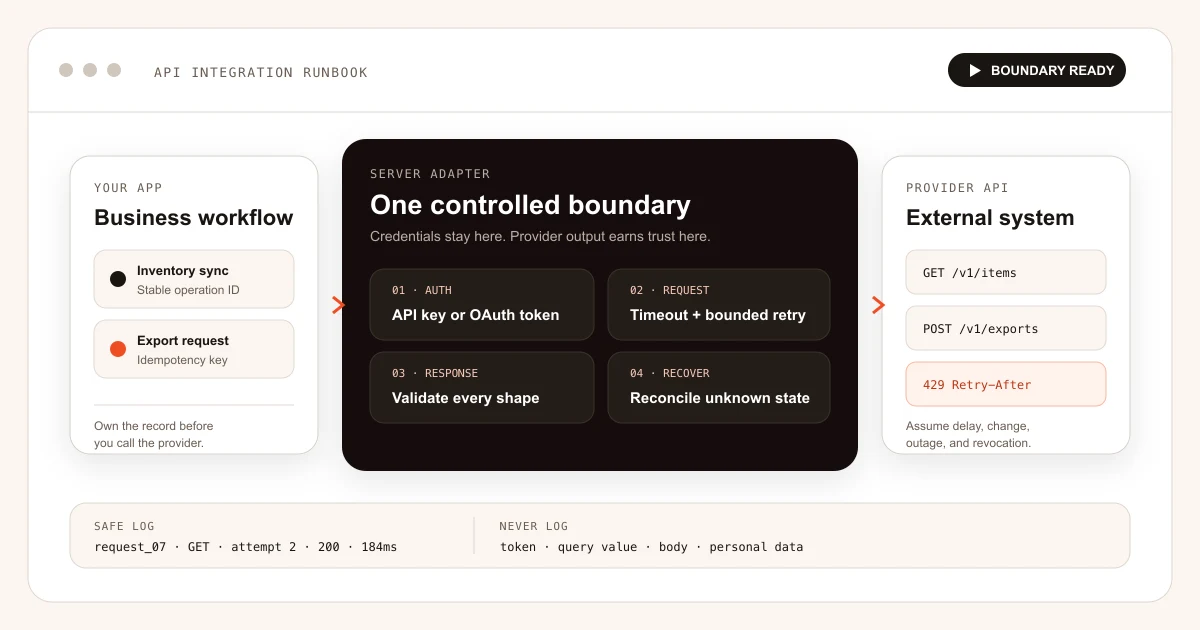
A useful API integration is not a `fetch()` call wrapped in a success toast. It is a controlled server boundary that knows how to authenticate, paginate, validate provider responses, respect rate limits, time out, retry only safe work, record ambiguous outcomes, and recover when a token or provider fails.
This guide follows one fictional inventory and export workflow through those decisions. The downloadable Node.js cookbook runs without network access or real credentials, so you can inspect the API-key and OAuth adapters, fake-provider failures, privacy-safe logs, operation export, and reconciliation behavior before you connect a real account.
The owner boundary is deliberate: this article consumes third-party APIs through outbound server calls. It does not expose your own REST API, implement an inbound webhook receiver, or claim a native connector.
QUICK ANSWER
What are good API integration examples?
Good API integration examples show more than a successful request. They keep API keys or OAuth tokens server-side, validate every response, follow cursor pagination, honor `Retry-After`, bound timeouts and retries, reuse one idempotency key for the same mutation attempt, record ambiguous outcomes, handle revocation and outages, redact logs, and provide export plus reconciliation paths.
Define the provider boundary before writing the adapter
Begin with one business job and the provider documentation that governs it. Credentials and retry behavior are consequences of that contract, not details for an AI generator to guess.
- One current provider contract and test account: Record the approved HTTPS origin, API version, account or app-registration path, environments, operation names, scopes, pagination format, rate-limit fields, error model, data terms, and revoke path from current first-party documentation. Use a sandbox or dedicated test account when the provider offers one.
- One authoritative business record and sync direction: Name the local record, provider record, stable identities, source of truth for each field, create and update direction, conflict rule, deletion behavior, and the state shown to a user when the provider result is unknown.
- A fixture matrix without production data: Prepare valid, invalid, expired-token, revoked-token, paginated, rate-limited, timeout, malformed-response, duplicate, and outage fixtures. Use reserved `.test` identities and synthetic values rather than copying customer payloads into source or prompts.
- Named privacy, export, and recovery owners: Decide which provider fields are necessary, what may enter routine logs, how long operational records remain, who authorizes export or deletion, and whether recovery means retry, reconciliation, record repair, provider reauthorization, or a wider application restore.
Credentials and access
| Credential | Minimum access | Storage and rotation |
|---|---|---|
| Provider API key Server-issued key or token for one provider account and environment | Grant only the resources and actions needed by the named workflow. Separate read and mutation credentials or test and production accounts when the provider supports it. | Inject through server-only runtime configuration behind one provider adapter. Never put the key in browser code, a URL, repository, image, prompt, analytics event, exception, or routine log. Name the provider revoke and replace path, support a bounded overlap only when documented, smoke the replacement without printing it, then verify the old key is rejected. |
| OAuth client and grant Client registration plus access token and, when issued, refresh token | Request the narrowest current scopes and redirect paths for the exact account and operation. Follow the provider flow and current OAuth security guidance rather than copying one generic consent recipe. | Keep client secrets and refresh tokens server-side. Encrypt durable tokens where appropriate, bind them to the internal account, and keep access tokens out of browser storage, screenshots, URLs, prompts, and logs. Handle expiry with one coordinated refresh, fail closed after the refreshed credential is rejected, expose reauthorization as a deliberate state, and test provider revocation and local deletion separately. |
Where should the provider call live?
The integration boundary owns credentials, provider-specific shapes, retry rules, and translation into your application records. Putting that logic in every page or component makes policy drift and partial failure much harder to see.
| Approach | Best for | Tradeoff |
|---|---|---|
| One server adapter per provider | Most credentialed reads and mutations where the application needs one controlled origin, schema, timeout, log, and error translation. | Adds a server hop and adapter code, but keeps secrets, policies, provider changes, and observability out of browser components. |
| Delegated OAuth adapter per connected account | Workflows that act on behalf of different users or organizations and require consented, revocable, scoped access. | Needs account binding, state and redirect validation, token expiry and refresh, revocation, reauthorization, privacy, and cross-account authorization tests. |
| Asynchronous sync worker with an operation ledger | Large pagination jobs, imports, exports, scheduled reconciliation, or provider work that should not block a person waiting in the interface. | Requires durable cursor and operation state, leases, retry scheduling, progress, cancellation, reconciliation, and an operator repair path. |
| Browser-direct request | Rare public, non-sensitive endpoints whose provider explicitly supports browser origins and whose response contains no private account data. | Cannot protect a secret, centralize provider policy, or reliably hide private data. CORS permission is not authentication or business authorization. |
Recommended:Start with one provider-specific server adapter and one local record contract. Add delegated OAuth only when the provider job truly acts for separate accounts. Move bulk or slow work behind a durable operation ledger. Keep browser-direct calls for explicitly public data with no credential or private record boundary.
Build a third-party API integration in 11 accountable steps
Each step produces an observable boundary or record and names the check that proves it. The cookbook supplies deterministic fixtures; a real provider account and published smoke remain separate release gates.
STEP 01
Write the integration contract around one business job
Define what the application needs from the provider and how that result changes one local record.
List the approved origin, API version, operations, request fields, response fields, pagination, rate-limit headers, timeouts, retryable statuses, provider identities, and the local fields each operation may change.
For the cookbook, the read job collects fictional inventory pages. The mutation job asks the provider to prepare one export. The application owns a stable operation identity and never treats a missing response as proof that the provider did nothing.
Expected result: One reviewed table maps each provider operation to a local record, authority rule, credential, failure state, and reconciliation path.
Verify it: Walk one successful read, one successful mutation, one timeout after a possible provider commit, and one revoked grant; reject any state whose owner or next action is ambiguous.
STEP 02
Create the provider app or key with minimum access
Use the provider test environment and current setup path, then record exactly what the credential can do.
For OAuth, begin with the provider documentation plus RFC 9700 OAuth 2.0 Security Best Current Practice. Validate redirect URIs and state, use the provider-recommended authorization flow, bind the resulting grant to the intended internal account, and do not infer business authorization from token validity.
For an API key, scope by project, environment, resource, action, origin or network restriction, and expiry where the provider supports them. Record the issue, rotation, revoke, and incident owner without storing the value in that record.
Expected result: A test credential exists in server-only configuration with a documented account, environment, scope, owner, expiry or review date, and revoke path.
Verify it: Call one permitted test operation, attempt one operation outside the intended scope, rotate or revoke a fixture credential, and confirm no credential appears in source, browser output, URLs, screenshots, prompts, or logs.
STEP 03
Put API-key and OAuth behavior behind one auth interface
Make the HTTP adapter request headers without teaching business code how credentials are stored or refreshed.
An API-key adapter injects one header from server configuration and fails after local revocation. An OAuth adapter returns the current access token, coordinates refresh so concurrent requests do not stampede the token endpoint, refreshes at most once after a 401, and then exposes reauthorization instead of looping.
The cookbook uses fixture values only. It demonstrates the boundary, not a complete authorization-code or PKCE flow. Implement the exact provider consent, callback, token, scope, and revoke contract from current first-party documentation.
const auth = {
  async headers() {
    const token = await tokenStore.currentAccessToken(accountId)
    return { authorization: `Bearer ${token}` }
  },
  async refresh() {
    return tokenStore.refreshOnce(accountId)
  },
  async revoke() {
    await tokenStore.revokeAndDelete(accountId)
  },
}
Expected result: Business code asks for authenticated provider operations without reading, formatting, logging, or refreshing credential values itself.
Verify it: Run API-key success, expired-token refresh, concurrent refresh, repeated 401, and revoked-grant fixtures; scan source, built client code, logs, and exported operational records for credential patterns.
STEP 04
Pin the provider origin and bound every request
Centralize method, path, headers, timeout, redirect, body, response size, and retry policy in one server adapter.
Store the approved provider origin in server configuration and accept only relative allowlisted operation paths from application code. Do not turn a provider URL field into an open proxy or let redirects carry credentials to another origin.
Use RFC 9110 HTTP semantics as the baseline for method, status, authentication, and `Retry-After` behavior, then apply the provider-specific contract. Set connection and total timeouts, body limits, accepted media types, and a bounded retry budget.
Expected result: Every outbound provider request uses the same approved origin, timeout, body and response limits, request identity, safe log shape, and retry classifier.
Verify it: Attempt a protocol-relative path, redirect to another origin, slow response, oversized response, unsupported media type, 429, 503, and ordinary 4xx; confirm each takes the documented bounded path.
STEP 05
Validate provider responses before updating business state
Treat a 2xx response body as untrusted input until its runtime shape and business identity pass.
If the provider publishes an OpenAPI 3.2.0 contract, generate or maintain operation schemas from the reviewed version, but still run validation at the server boundary. The current specification does not make a provider implementation or generated client trustworthy by itself.
Check content type, maximum body, required fields, types, enum values, stable provider identity, page cursor, and operation-specific invariants. Translate provider shapes into a smaller local model and quarantine unknown or contradictory states instead of spreading raw JSON across the application.
Expected result: A successful HTTP response can change the local record only after one operation-specific runtime validator returns the bounded internal shape.
Verify it: Return malformed JSON, HTML with status 200, missing IDs, wrong types, unknown enum values, repeated cursors, and a valid object for another account; confirm none updates the intended record.
STEP 06
Traverse pagination with stable order and checkpoints
Follow the provider cursor contract without assuming one successful page means the collection is complete.
Use the provider next cursor or link exactly as documented, cap page size and total pages, reject repeated cursors, and record a privacy-safe checkpoint for resumable jobs. A cursor is continuation state, not authorization, and it may expire or become invalid.
Decide how inserts, updates, and deletions during traversal affect the result. When the provider offers snapshots or changed-since cursors, record their version. Otherwise make the import idempotent by provider record identity and run a bounded reconciliation pass.
Expected result: The fixture retrieves all five records across three pages, stops on a null cursor, and fails closed on a repeated cursor or configured page ceiling.
Verify it: Run empty, one-page, three-page, repeated-cursor, invalid-cursor, inserted-between-pages, revoked-mid-run, and page-limit fixtures; compare provider identities with the final local set.
STEP 07
Separate retryable transport failure from mutation identity
Retry a safe read within budget and retry a mutation only when one logical attempt has durable identity.
Honor a valid provider `Retry-After` value for 429 or a documented unavailable response, cap the delay, add provider-appropriate backoff, and stop after the declared attempt budget. Do not retry validation, authentication, authorization, not-found, or business-conflict failures as if time will fix them.
For a mutation, define an application idempotency key with scope, request fingerprint, concurrent-first-write rule, retention, replay response, changed-content conflict, and reconciliation. `Idempotency-Key` is a common application convention, not a guarantee supplied by generic HTTP semantics.
await provider.request({
  method: 'POST',
  path: '/v1/exports',
  body: { kind: 'inventory' },
  operationId: 'export-2026-07-19',
  idempotencyKey: 'export-attempt-0001',
})
Expected result: A 429 waits for the bounded provider delay, then the same mutation attempt reuses one key and produces one receipt. A mutation without retry identity stops after the first ambiguous failure.
Verify it: Drop a success response after provider commit, repeat the exact request, reuse the key with changed content, race two first attempts, exhaust 503 retries, and reconcile the provider receipt before any manual replay.
STEP 08
Model outage, revocation, and unknown outcome as real states
Keep the local business record reviewable when the provider cannot answer or the account disconnects.
Distinguish `pending`, `complete`, `failed`, `unknown`, and `revoked`. A timeout on a read means no usable result. A timeout on a mutation may mean the provider acted and the response was lost, so mark the operation unknown and look it up by stable identity before retrying.
After revocation, stop scheduled work, suppress repeated authorization noise, preserve only the bounded operational history needed for reconciliation, and show the account owner a deliberate reauthorization or data-export path. Provider outage must not erase or falsely complete the local record.
Expected result: The interface and operator record explain whether work is pending, safely retryable, unknown, failed, complete, or blocked by a revoked grant.
Verify it: Force token expiry, rejected refresh, explicit revoke, network timeout, three unavailable responses, unknown mutation status, later provider recovery, and a disconnected account with queued work.
STEP 09
Run the fake-provider suite before any live credential
Prove deterministic boundary behavior without depending on a provider account, network timing, or production data.
The downloadable cookbook uses Node.js built-ins, fixture credentials, a fake provider, an in-memory operation ledger, and reserved `.test` identities. Eleven tests cover successful API-key pagination, OAuth refresh and revocation, one-refresh-only 401 handling, 429 delay, idempotent mutation, timeout and outage, unsafe mutation, malformed response, cursor guards, export and reconciliation, and changed-operation conflict.
Treat the in-memory ledger as executable teaching, not restart-safe storage. Replace it with durable records and uniqueness constraints, rerun the suite against that adapter, then add provider-contract tests without weakening the failure cases.
Expected result: A fresh extracted artifact passes all eleven tests with no dependency installation, network request, production record, or real credential.
Verify it: Download the ZIP, verify its SHA-256, extract it into an empty directory, run `npm test` on Node.js 22 or newer, compare packaged bytes with the reviewed source, and scan the archive for secret patterns.
STEP 10
Deploy the adapter and smoke the real provider boundary
Publish reviewed server code and configuration, then verify the exact account, operation, and failure path from the target environment.
Playcode Cloud can run the application server, database-backed operation records, jobs, HTTPS, and recovery workflow under current plan and runtime limits. The provider account, app registration, credential, scopes, pricing, approval, rate limits, and API contract remain external requirements.
Use the provider test account first. Publish server-only configuration, verify DNS and HTTPS where needed, run one safe read and one reversible or isolated mutation, inspect the bounded operation record, revoke the test credential, and confirm the public browser bundle and logs contain no secret.
Expected result: The target environment completes one provider read and one isolated mutation, records provider identity and status, rejects a revoked credential, and exposes no credential or private payload.
Verify it: Run the redacted smoke from outside the editor, capture request and operation IDs rather than bodies, inspect bounded logs, verify local and provider records, then reconcile or remove the fictional test data.
STEP 11
Monitor, export, reconcile, and recover without guessing
Give operators enough bounded state to explain and repair the integration without replaying raw requests.
Log operation ID, provider request or receipt ID, method class, status, attempt, latency, rate-limit state, bounded error code, and account reference only when necessary. Do not log tokens, authorization headers, full URLs with query values, bodies, customer fields, refresh responses, or arbitrary provider errors.
Export versioned operational records separately from credentials and business-data exports. Reconcile unknown work by provider identity or an authoritative status endpoint. Prefer credential reauthorization, provider retry, operation repair, or record-level correction before a whole-app restore that can move unrelated valid data backward.
Expected result: An operator can find an affected account and operation, explain the last safe state, export the bounded ledger, reconcile the provider, and choose the narrowest recovery action.
Verify it: Rehearse a provider incident, expired grant, malformed 200, unknown mutation, missing page, ledger export and import, provider reconciliation, record repair, and wider application recovery with the data consequences documented.
Test the boundary, not only the happy response
Keep deterministic fake-provider tests in the build and a smaller redacted provider smoke in each environment. A live success does not replace controlled failure fixtures.
| Test | Scenario | Expected result |
|---|---|---|
| happy path | API-key pagination returns five fictional records across three pages, and OAuth refresh produces one authorized read. | Every provider ID appears once, the final cursor is null, one bounded operation record exists per page, and no credential or response body enters logs. |
| invalid input | The provider returns a malformed successful response, repeats a cursor, rejects a scope, or the same operation identity is reused with changed input. | Runtime validation or the operation fingerprint fails before business state changes, cursor loops stop, and the error remains correction-oriented without private payloads. |
| retry | The provider returns 429 with `Retry-After`, times out, returns 503 repeatedly, or loses a mutation response after possible commit. | The client waits only within the configured cap, retries safe reads or one identified mutation within budget, never retries an unidentified mutation, and reconciles unknown outcomes before replay. |
| production smoke | The published server uses a provider test account for one safe read, one isolated mutation, one revoked credential, and one bounded log inspection. | The read and mutation match provider and local identities, revocation blocks further calls, HTTPS and configuration work, and browser code, logs, exports, and errors contain no credential or private body. |
Failure modes worth designing before launch
Most integration incidents are not mysterious. They are unmodeled states that only looked like a generic request error in the first version.
| Symptom | Likely cause | Check | Fix |
|---|---|---|---|
| A mutation timed out and the interface offers a blind Retry button. | The provider may have committed the first request, but the application has no stable operation identity, provider receipt lookup, or unknown state. | Search the local operation ledger and provider by the original idempotency, request, or business identity before sending another mutation. | Add a durable operation record, application-defined key and fingerprint, explicit unknown state, and reconciliation lookup. Retry only after the contract proves the same attempt is safe. |
| The OAuth integration refreshes repeatedly but every call remains unauthorized. | The grant was revoked, scopes changed, the refresh response is bound to another account or environment, or code retries 401 without a one-refresh ceiling. | Inspect bounded token metadata, account binding, environment, scope, expiry, provider error code, and refresh count without printing token values. | Refresh once, then move the connection to revoked or reauthorization-required. Stop queued work until the account owner completes the current provider consent path. |
| A nightly sync completes but records are missing. | The client processed only the first page, repeated or expired a cursor, exceeded a hidden page cap, or changed ordering while records were inserted. | Compare page count, cursor history, provider identities, changed-since boundary, local record count, and the provider authoritative count when one exists. | Implement the documented cursor contract, repeat and page ceilings, resumable checkpoints, idempotent upsert by provider identity, and a bounded reconciliation pass. |
| The provider returns 200, but the app crashes or stores the wrong status. | Provider JSON was trusted as a static type, the API version changed, or an error envelope was returned under a successful transport status. | Capture a redacted fixture at the adapter boundary and compare content type, schema version, required identity, enum, and operation-specific invariants. | Validate at runtime, translate into a bounded local model, quarantine unknown states, and update the reviewed contract plus fixtures before accepting the new shape. |
| Rate-limit retries create a traffic spike and a longer outage. | `Retry-After` was ignored, every worker retried at once, the delay was unbounded or absent, or ordinary 4xx responses were classified as transient. | Graph attempts by provider account, response status, retry delay, concurrency, and operation class using bounded metadata. | Honor and cap the provider delay, use bounded backoff and concurrency, stop at the attempt budget, and retry only documented transient failures and identified operations. |
| Support logs or an export contain tokens or customer payloads. | The generic HTTP client logged full headers, URLs, bodies, arbitrary provider errors, or the token response by default. | Scan logs, traces, error reports, support exports, analytics, screenshots, and archives for credential patterns and known fictional privacy markers. | Revoke exposed credentials, remove and restrict the data, switch to allowlisted structured events, hash or omit identifiers where possible, and add regression scans before release. |
Operate the integration as a business dependency
Deploy
Publish one reviewed provider adapter per environment with pinned origin, server-only credentials, explicit API version, timeout and body limits, runtime schemas, and a redacted smoke checklist. Provider setup and approval remain external even when Playcode builds and hosts the app.
Run schema or data migrations separately, deploy first against the provider test account, verify a safe read and isolated mutation, then enable production work in a bounded cohort with a rollback and reconciliation owner.
Monitor
Measure request count, status class, latency, timeout, rate-limit delay, retry budget, token refresh and revocation, pagination pages, response-validation failures, unknown operations, reconciliation age, queue depth, and outcome state without logging credential or private payload values.
Alert on sustained provider failure, repeated refresh rejection, growing unknown state, cursor loops, validation drift, reconciliation backlog, and spend or quota exhaustion. Provider availability and application correctness are separate signals.
Recover
Choose the narrowest action: refresh or reauthorize one grant, retry one identified operation, resume one cursor, reconcile one account, repair one record, redeploy known code, or restore the wider app only after comparing the data that would move backward.
Keep code export, versioned operation-ledger export, authorized business-data export, credential revocation, provider reconciliation, and whole-app recovery as separate procedures with named owners and rehearsed results.
Security and privacy controls for every adapter
A provider credential authenticates the application to an external service. It does not authorize every internal user, account, record, or action that the provider API can name.
- Keep API keys, client secrets, access tokens, refresh tokens, authorization headers, and revoke responses server-side and out of source, URLs, browser bundles, screenshots, prompts, fixtures, logs, traces, exports, and analytics.
- Pin the approved HTTPS provider origin and allowlisted operation paths. Block user-controlled arbitrary URLs, credential-bearing redirects, local or private network targets, and unexpected content types or body sizes.
- Use minimum scopes, separate environments, bounded token lifetime where supported, one coordinated refresh, explicit revocation and local deletion, and a current reauthorization path.
- Validate provider authentication separately from internal tenant, role, record, action, and field authorization. Test the same known provider identity across two ordinary internal accounts.
- Treat provider responses, error strings, cursor values, file links, and redirect locations as untrusted input. Validate and encode before storage, rendering, logging, or another network request.
- Use application-defined idempotency only with a documented key scope, request fingerprint, concurrent-first-write behavior, retention, replay result, changed-content conflict, and downstream reconciliation.
- Minimize provider and customer data, document purpose and retention, authorize exports and deletion, and use allowlisted operational logs with bounded identifiers rather than bodies.
- Apply per-account and global rate, concurrency, response-size, pagination, time, retry, and spend limits so one revoked or abusive integration cannot exhaust the application or provider quota.
API integration questions
What is an API integration example?
It is a concrete application workflow that calls an external API, translates its response into local records, and defines credentials, validation, pagination, retry safety, failure states, logs, deployment, and recovery. A one-line request is a syntax example, not a production integration example.
Should an API key ever be used in browser JavaScript?
Not when the key grants private account access or can be reused. Put it behind a server adapter and send only the bounded result the signed-in user may access. Browser-direct calls are appropriate only for explicitly public, non-sensitive provider endpoints designed for browser origins.
When should I use OAuth instead of an API key?
Use the provider model that matches the job. OAuth is usually appropriate when different users or organizations grant scoped, revocable access to their own provider accounts. An account-level API key can fit a single controlled server integration. Current provider documentation decides the available and required flow.
How should API pagination be implemented?
Follow the provider cursor or link contract, cap page size and total pages, reject repeated cursors, store privacy-safe checkpoints for resumable jobs, and reconcile by stable provider identity. Do not invent an offset when the provider documents a cursor, and do not assume the first page is complete.
Should every failed API request be retried?
No. Retry only documented transient failures within a bounded budget. A safe read can usually be repeated. A mutation needs stable operation identity and a provider or application idempotency contract. Authentication, authorization, validation, not-found, and business conflicts normally need correction rather than time.
What does Retry-After mean?
`Retry-After` tells a client when the server suggests trying again, expressed as seconds or an HTTP date under HTTP semantics. Parse it carefully, cap the delay to your operating policy, apply provider-specific guidance, and still stop after the integration retry budget.
How do I handle a provider timeout after a POST?
Assume the result is unknown until proved otherwise. Keep the original operation identity and request fingerprint, query provider status or reconcile by business identity, and reuse the same idempotency key only when the provider contract supports it. Do not create a fresh attempt merely because the response was lost.
Does Playcode have native connectors for every API?
No. Playcode can help build and run API, webhook, or token-based integrations when the target service exposes a supported path and you provide the account, credentials, requirements, and current provider constraints. This article and cookbook do not represent a native or one-click connector.
Does this guide show how to expose my own REST API?
No. It shows how an application consumes third-party APIs. Designing and exposing your own resource contract, authentication, authorization, validation, HTTP errors, versioning, and documentation is a different job covered by the REST API guide.
Build the application around the boundary
Turn one provider contract into a tested workflow
Describe the provider, business record, credential model, failure states, and recovery rules. Playcode can build and run the server adapter and application when the service exposes the required API path and you provide the credentials.
Build an API-connected appProvider account, API access, scopes, pricing, approval, and live smoke remain external requirements. No native or one-click connector is implied.