QUICK ANSWER
What should a business impact analysis template include?
A business impact analysis template should map dated functions and services to disruption consequences across configurable time bands, minimum resources and dependencies, priority recommendations, evidence classifications, confidence, gaps, and recommended MTD, RTO, and RPO requirements. Those values remain recommendations until accountable owners approve targets and choose recovery or continuity strategies elsewhere.
A business impact analysis should make the consequences of disruption reviewable before anyone chooses how to recover. It needs a dated function and service boundary, configurable time bands, impact statements with evidence and confidence, minimum people, facility, technology, information, and supplier requirements, dependencies, priorities, gaps, and clearly labeled MTD, RTO, and RPO recommendations.
The downloadable pack includes an editable Markdown worksheet, a completed fictional aggregate example in Markdown and JSON, a matching CSV function register, a closed JSON Schema, and a dependency-free validator with mutation tests. It stops at recovery requirements. Target approval, threat treatment, recovery strategies, runbooks, continuity arrangements, incident command, readiness, investment decisions, compliance decisions, and outcome promises remain outside this analysis.
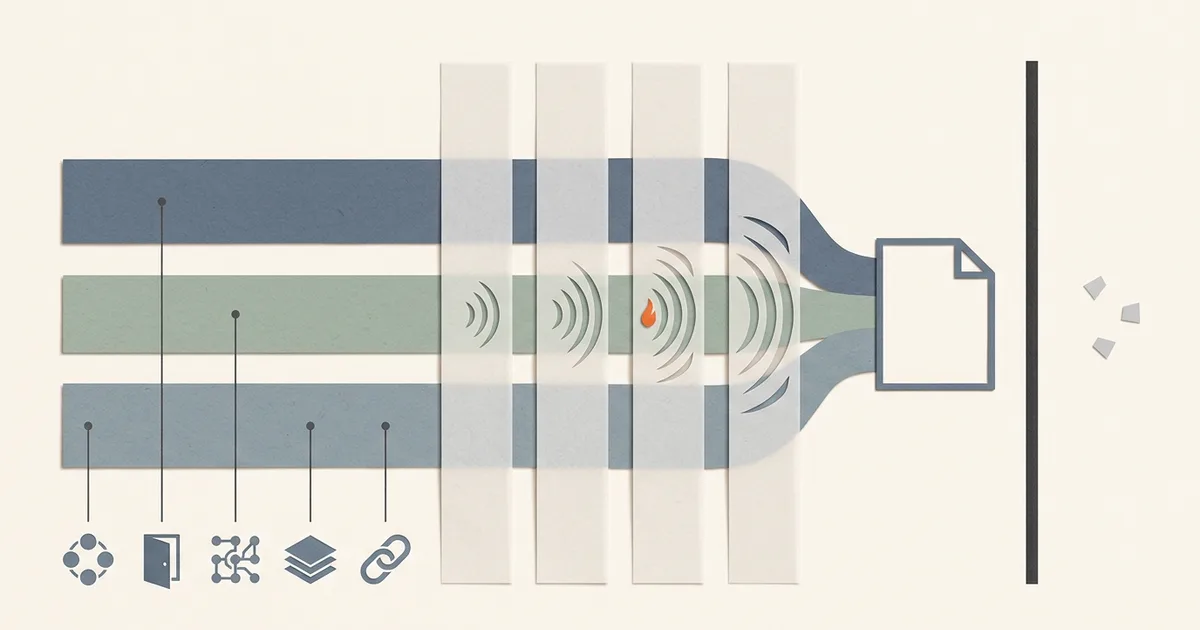
Move from dated evidence to bounded recovery recommendations
Define the analysis boundary before collecting impacts. Then connect every consequence, resource, dependency, and recommendation to a dated source, classification, confidence level, and reviewer. Hand recommendations to accountable recovery and continuity owners without taking over their decisions.
Define functions, services, scenario, and configurable time bands
Give each in-scope business function a stable ID, an owner role, the service it provides, and a neutral disruption scenario. Define increasing time bands that fit the organization rather than assuming every impact appears after the same number of hours. Record exclusions before interviews begin.
Sources: [bia-pack], [ready-bia]
Record consequences with dates, source status, and confidence
For every function and time band, state the operational, financial, service, contractual, supplier, safety, or reputation consequence and its basis. Classify it as observed, inferred, or assumed, cite aggregate source IDs, preserve the evidence date, and keep low-confidence extrapolations visible as gaps.
Sources: [bia-pack], [nist-bia]
Map minimum resources and dependencies for each function
Identify only the minimum people roles, facilities, technology, information, infrastructure, and supplier capabilities needed to provide the minimum service. Use reciprocal function and dependency IDs, aggregate authorized evidence, and review dates without adding contacts, credentials, recovery designs, or technical steps.
Sources: [cisa-service-continuity], [ready-bia]
Recommend priority, MTD, RTO, and RPO without approving them
Use the assessed consequence curve to recommend a recovery priority, maximum tolerable disruption, recovery time objective, and recovery point objective. State the minimum operating level and rationale, keep RTO within MTD, and label every value recommended-pending-approval with null approval fields.
Sources: [nist-bia], [cisa-service-continuity]
Review gaps and hand requirements to adjacent owners
Review source freshness, assumptions, confidence, unresolved dependencies, and long-band extrapolations. The BIA ends with consequences and recommended requirements. Continuity owners decide how functions continue; disaster-recovery owners approve applicable targets and own strategies, recovery evidence, execution, testing, and reconstitution.
Sources: [fema-continuity], [json-schema-2020-12], [bia-pack]
What this business impact analysis pack owns
Use the pack to produce a dated, aggregate analysis of disruption consequences and minimum operating requirements. Its output is a set of evidence-backed recommendations for accountable human review, not an approved recovery or continuity plan.
Included
- Controlled analysis ID, status, version, creation date, evidence-review date, next-review date, analysis owner role, evidence reviewer role, aggregate organization boundary, neutral disruption scenario, assumptions, included function IDs, and explicit exclusions
- Three fictional aggregate business functions assessed across four configurable and contiguous time bands, with a category, severity, consequence statement, basis, source IDs, observed, inferred, or assumed status, confidence, and evidence date for every impact
- Minimum people-role, facility, technology, information, and supplier requirements plus reciprocal dependency mappings, accountable role IDs, source classifications, confidence, evidence dates, and review dates
- Priority recommendations and recommended MTD, RTO, and RPO values with minimum operating levels, rationale, source IDs, confidence, evidence and review dates, recommended-pending-approval status, and empty approval fields
- Two visible evidence gaps, review history, explicit false boundary flags, editable Markdown, completed JSON and Markdown, matching CSV, closed schema, strict validator, seventy tests, and deterministic ZIP build
Not included
- Threat identification, likelihood scoring, risk scoring, risk treatment, control selection, residual-risk acceptance, or ownership of the risk register
- Approval of MTD, RTO, RPO, service levels, recovery priorities, recovery budgets, supplier commitments, legal interpretations, or compliance determinations
- Recovery strategy, backup design, restore evidence, technology selection, technical commands, executable runbooks, activation, traffic return, recovery exercises, or reconstitution
- Business continuity arrangements, manual workaround design, crisis communications, emergency response, cybersecurity investigation, evidence preservation, containment, eradication, notification, or incident command
- Readiness assessment, certification, audit opinion, investment approval, insurance advice, or any operational, financial, legal, safety, compliance, recovery, availability, or business-outcome promise
DOWNLOADABLE RESOURCE
Download the business impact analysis template pack
The ZIP packages an editable worksheet with a completed fictional aggregate analysis, matching JSON and CSV, a closed schema, a strict validator, tests, and a deterministic allowlisted build. Rebuild it locally to verify the exact contents.
Business impact analysis template pack
A provider-neutral aggregate BIA for time-band impacts, minimum resources and dependencies, priority recommendations, evidence quality, gaps, and recommended MTD, RTO, and RPO values.
Format: Markdown, JSON, CSV, JSON Schema, and dependency-free Node.js validator/tests in one ZIP
Locally reproduced August 1, 2026. SHA-256: f3e0d6e972a894eb17bab9f5a2d229d8819823e964ce1f204000e16dacc79412
Included
- Editable Markdown worksheet and completed fictional Juniper Ridge Services example with four role IDs, three business functions, four time bands, five aggregate sources, five dependencies, twelve impact assessments, and six minimum resource requirements
- Matching JSON and CSV with three priority and MTD/RTO/RPO recommendations, two assumptions, two evidence gaps, dated reviews, recommended-pending-approval status, null approval fields, and ten explicit false boundary flags
- Closed Draft 2020-12 JSON Schema, strict dependency-free validator, seventy positive and mutation tests, README, package commands, and deterministic ten-file ZIP builder
Verification boundary
The allowlisted source files were validated and rebuilt locally with fixed UTC archive timestamps. This proves artifact structure and internal Markdown, JSON, CSV, schema, and cross-reference consistency, not public availability before deployment, real evidence, approved targets, recovery execution, continuity arrangements, readiness, compliance, investment merit, or results.
Three bounded business impact analysis shapes
Choose a scope that matches the decision boundary. Each shape ends with dated consequences, minimum requirements, and recommendations for human review. None should silently become a risk register, continuity plan, disaster-recovery plan, incident-response plan, or runbook.
Single-function analysis
Use when: One business function has a clear service boundary and accountable owner, but its disruption consequences and minimum dependencies have not been documented consistently.
Assess the function across configurable time bands, connect each impact to dated aggregate evidence, record its minimum resource and dependency set, and recommend MTD, RTO, RPO, and priority for separate approval.
Structure
- One stable function ID with service, owner role, four or more time-band impact records, source classification, confidence, and gaps
- Minimum people, facility, technology, information, and supplier capabilities plus recommended-pending-approval recovery requirements
Watch for: A narrow function can still depend on shared identity, facilities, data, or suppliers. The analysis should expose those dependencies without choosing a recovery strategy.
Sources: [bia-pack], [nist-bia]
Shared-service dependency analysis
Use when: Several functions rely on the same minimum facility, information, technology, infrastructure, or supplier capability and need comparable consequence records.
Model the dependency once, reference every affected function reciprocally, compare impact timing and minimum operating levels, and preserve function-specific recommendation confidence and gaps.
Structure
- Configurable common time bands with separate evidence-backed impacts, severities, and minimum operating levels for each function
- Reciprocal shared-dependency references, aggregate source records, priority recommendations, and clearly unapproved MTD/RTO/RPO values
Watch for: A shared dependency may create a common failure boundary, but the BIA does not establish likelihood, select treatment, or prove simultaneous recoverability.
Sources: [ready-bia], [cisa-service-continuity]
Low-confidence supplier or long-band analysis
Use when: A material supplier capability or longer disruption band is supported by an assumption or inference rather than current authorized aggregate evidence.
Keep the consequence and recommendation visible, lower confidence, identify the source classification, create a dated gap with an owner and validation plan, and prevent the record from implying approval or readiness.
Structure
- Assumed or inferred source and impact records with evidence dates, review dates, confidence, basis, and a minimum-purpose validation plan
- Open gap, accountable role, due date, review history, false approval fields, and an explicit handoff to continuity or recovery owners
Watch for: Removing uncertain records hides decision risk. Retaining them does not make them facts, authorize supplier reliance, or approve an investment or continuity arrangement.
Sources: [fema-continuity], [json-schema-2020-12], [bia-pack]
Decide whether the analysis is ready for human review
Review-ready means every function, impact, resource, dependency, recommendation, date, and gap can be traced and challenged. It does not mean the targets are approved or that a recovery or continuity capability exists.
A function lacks a named aggregate service, owner role, complete time-band impacts, source IDs, classifications, confidence, evidence dates, or minimum resource and dependency records.
Choose: Keep the analysis in draft and close the function evidence contract before recommending recovery requirements.
Tradeoff: The review waits, but an untraceable severity or missing dependency cannot quietly become a target assumption.
A recommended RTO exceeds MTD, approval fields are populated, recommendation status implies approval, or priority values are duplicated or incomplete.
Choose: Reject the record, restore recommended-pending-approval status, clear approval fields, and route the target decision to its accountable owner.
Tradeoff: There is an explicit approval handoff, but analysis and authorization remain auditable instead of collapsing into one artifact.
A material consequence, supplier capability, or long-band projection is inferred or assumed with low confidence or stale evidence.
Choose: Retain the record, label its evidence quality, assign a dated gap and validation plan, and avoid presenting it as an observed fact.
Tradeoff: The analysis exposes uncertainty, which is more useful than false precision when accountable owners compare options.
The work starts choosing risk treatments, continuity arrangements, recovery technologies, strategies, backup methods, runbook steps, incident actions, exercises, or investments.
Choose: Stop the BIA at consequences and recommended requirements, then hand the relevant inputs to the separate canonical owner.
Tradeoff: The workflow has visible handoffs, but decision authority, evidence, implementation, and readiness claims do not blur together.
Make impact evidence reviewable
Turn the BIA record into a controlled internal workflow
Describe the function inventory, time-band assessment, dependency map, evidence register, recommendation review, and gap queue your team needs. Playcode can build the internal software around that process without approving targets or claiming continuity or recovery readiness.
Explore internal toolsThe downloadable template and this ordinary informational article do not grant AI signup credits.
Use the disaster recovery plan after applicable IT recovery targets are approvedBIA recommendations and disaster-recovery strategy, execution, evidence, testing, and reconstitution remain separate canonical jobs.
What this template cannot establish
The pack validates a fictional aggregate record for structure, chronology, references, parity, and boundary fields. It cannot observe an organization, interview an owner, verify a dependency, approve a target, or test an operational capability.
- The fictional functions, time bands, severities, evidence dates, resource requirements, dependencies, priorities, MTD, RTO, RPO, confidence, and gaps are examples, not benchmarks or recommendations for another organization.
- Observed, inferred, and assumed labels describe the example record. The validator cannot inspect the source behind an evidence reference, decide whether evidence is sufficient, or convert an inference into a fact.
- A structurally valid analysis does not approve MTD, RTO, RPO, service levels, priorities, supplier commitments, legal interpretations, compliance conclusions, recovery budgets, or investments.
- The BIA does not select risk treatment, continuity arrangements, backup products, recovery strategies, technology, facilities, suppliers, incident actions, technical commands, or runbook steps.
- The pack does not run an exercise, restore data, continue a business function, recover a service, assess readiness, certify compliance, or promise operational, financial, legal, safety, availability, recovery, or business outcomes.
- This ordinary informational article and downloadable template do not grant AI signup credits. Eligibility, if any, belongs to separately qualified commercial entry pages.
Sources and verification record
The same-release artifact is the direct source for its fictional records and tests. Public guidance supports the BIA function, consequence, time-band, resource, dependency, and recommendation model while preserving the boundary with approval, continuity, and recovery execution.
[bia-pack] Playcode:Business impact analysis fictional aggregate example
Checked August 1, 2026. Supports: The locally validated four role IDs, three aggregate functions, four time bands, five sources, five dependencies, twelve impact assessments, six minimum resource requirements, three unapproved recovery recommendations, two assumptions, two gaps, seventy tests, explicit boundary flags, and exact artifact hash. Public availability remains unverified until deployment.
[nist-bia] National Institute of Standards and Technology:NIST SP 800-34 Rev. 1 and supplemental BIA template
Checked August 1, 2026. Supports: Current final NIST contingency-planning guidance and its supplemental BIA template for business processes, outage impacts, maximum tolerable downtime, recovery time and point objectives, resource requirements, and recovery priorities. Its primary scope is federal information systems.
[ready-bia] Ready.gov:Business Impact Analysis
Checked August 1, 2026. Supports: Public guidance for assessing operational and financial effects of disruption, considering timing and duration, consulting people familiar with the work, identifying critical processes and resources, and prioritizing recovery. It does not approve this example.
[cisa-service-continuity] Cybersecurity and Infrastructure Security Agency:CRR Supplemental Resource Guide, Volume 6: Service Continuity Management
Checked August 1, 2026. Supports: Current-hosted 2016 guidance for impact time frames, continuity requirements, priorities, RTO and RPO, and required applications, facilities, data, people, infrastructure, and support. It does not prescribe this exact artifact or establish readiness.
[fema-continuity] Federal Emergency Management Agency:Continuity Guidance Circular, 2018 edition with 2024 update
Checked August 1, 2026. Supports: Continuity guidance distinguishing analysis of consequences from process and resource mapping and from the continuity plan that determines how essential functions continue. It supports the handoff boundary, not a readiness claim.
[json-schema-2020-12] JSON Schema:JSON Schema Draft 2020-12
Checked August 1, 2026. Supports: The schema vocabulary and meta-schema version used by the packaged closed schema. The dependency-free validator adds cross-reference, chronology, boundary, companion-parity, and safety checks beyond declarative schema structure.
Business impact analysis template questions
What files are included in the business impact analysis template?
The ZIP includes an editable Markdown worksheet, completed fictional aggregate Markdown example, matching JSON and CSV function register, closed Draft 2020-12 JSON Schema, dependency-free validator, seventy tests, README, package commands, and deterministic allowlisted ZIP builder.
What is the difference between MTD, RTO, and RPO in a BIA?
MTD is the assessed maximum tolerable disruption boundary. RTO is the recommended time to restore a minimum service, while RPO is the recommended data-loss window. This pack records dated recommendations and requires RTO to stay within MTD, but accountable owners approve targets elsewhere.
Does a BIA approve recovery targets or priorities?
No. This pack produces priority, MTD, RTO, and RPO recommendations with evidence, rationale, confidence, and review dates. Every recommendation remains recommended-pending-approval, approval fields remain null, and the review history explicitly records that targets were not approved.
Is a BIA a disaster recovery plan or business continuity plan?
No. The BIA identifies disruption consequences, minimum resources and dependencies, and recommended requirements. A business continuity plan owns how functions continue across people, facilities, suppliers, and work arrangements. A disaster recovery plan owns approved IT recovery targets, strategies, evidence, execution, verification, exercises, and reconstitution.
Does the template include risk treatment, incident response, or runbooks?
No. Threat likelihood, risk scoring, treatment, incident command, cybersecurity investigation, evidence preservation, containment, eradication, notifications, technical commands, activation, recovery strategies, and executable steps belong to separate accountable records and owners.
Does a valid pack prove readiness, compliance, or business outcomes?
No. Validation proves internal structure, chronology, references, companion parity, and explicit boundary fields in a fictional example. It does not verify real evidence, approve targets, test continuity or recovery, certify readiness or compliance, promise results, or grant AI signup credits.
Build the workflow around the analysis
Create the tool your team uses to review impacts and requirements
Start with the fictional pack, replace it with authorized aggregate evidence, then describe the internal analysis and review workflow you want Playcode to build and run.
Build an internal toolNamed humans still own source authorization, research ethics, target approval, risk treatment, continuity, recovery strategy and execution, incident response, readiness, compliance, investment decisions, and every real-world outcome.