QUICK ANSWER
What should a competitive analysis template include?
A competitive analysis template should include a bounded decision context, fictional or identified alternatives, explicit criteria, source URLs, retrieval and expiry dates, fact-versus-inference labels, confidence, evidence gaps, disclosed weights, calculation rules, and an accountable review date. It should preserve raw evidence separately from interpretation and avoid turning incomplete observations into vendor rankings or product recommendations.
A useful competitive analysis is a dated evidence ledger, not a winner table. It records the decision context, fictional alternatives, explicit criteria, source URLs and retrieval dates, fact-versus-inference status, confidence, gaps, weights, calculation rules, and the next review date before anyone turns observations into a recommendation.
This downloadable pack includes editable Markdown, draft and completed fictional JSON records, a closed JSON Schema, and a dependency-free validator. It contains no claims about real vendors, pricing, market position, product quality, legal collection methods, or business outcomes. The structure cannot choose a product, write a roadmap, or replace accountable review.
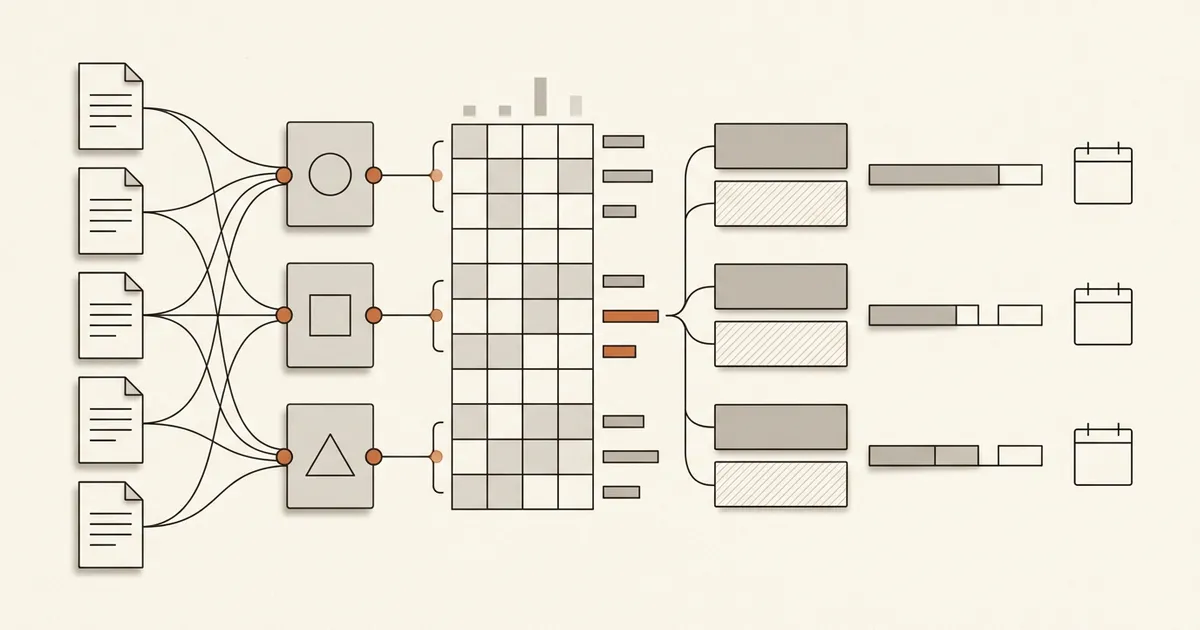
Build a dated evidence ledger before summarizing
Make the research question, collection boundary, evidence status, and scoring method visible so a later reviewer can challenge the analysis without reconstructing it from a slide.
Bound the decision and alternative set
State the audience, use case, decision date, geography or segment when relevant, included alternative types, excluded jobs, and accountable reviewer. Include direct, indirect, substitute, and status-quo choices only when the same bounded customer job makes them comparable.
Sources: [competitive-pack], [cmu-competitive-analysis], [sba-competitive-analysis]
Declare criteria before collecting attractive facts
Define each criterion, its unit or evaluation rule, why it matters, the evidence needed, and the review owner. Keep customer need, product capability, cost, operating constraint, and evidence quality distinct instead of hiding them inside one vague score.
Sources: [competitive-pack], [cmu-competitive-analysis], [sba-competitive-analysis]
Capture every observation with provenance
Give each evidence item a stable ID, authorized public or owned source, exact URL, retrieval timestamp, observed text or bounded fact, expiry date, and status. Reserved example.test sources keep the shipped example fictional and prevent accidental vendor claims.
Sources: [competitive-pack], [rfc-2606]
Separate facts, inferences, and gaps
Label source-backed observations as facts only within their recorded scope. Link every inference to supporting evidence and a confidence rationale. Preserve missing, conflicting, or stale evidence as a gap rather than converting absence into a negative claim.
Sources: [competitive-pack]
Expose weights and calculation rules
Record who selected each weight, why it fits the decision context, how weights reconcile, how missing evidence is handled, and whether any score is informational only. Never let an undisclosed default or missing value create a winner.
Sources: [competitive-pack], [cmu-competitive-analysis]
Review, expire, and hand off the record
Check source access, freshness, labels, gaps, weights, and calculation parity before sharing. Use the closed Draft 2020-12 schema and dependency-free validator to check record shape and references, then set review and expiry dates. Send live pricing or vendor facts to their current owners, and keep any product recommendation or roadmap decision outside this ledger.
Sources: [competitive-pack], [sba-competitive-analysis], [json-schema-2020-12]
The competitive-analysis boundary
Use this record to preserve dated evidence and an explicit comparison method. Keep current vendor publishing, selection, strategy, and legal judgments with their accountable owners.
Included
- Decision context, fictional alternatives, explicit criteria, authorized source URLs, retrieval and expiry dates, fact-versus-inference status, confidence, evidence gaps, weights, calculation rules, and review ownership
- Editable Markdown, fictional draft and completed JSON, closed Draft 2020-12 schema, dependency-free validator, mutation tests, and deterministic archive
- Neutral evidence summaries that remain traceable to sources and do not rank, recommend, or make outcome claims
Not included
- Live vendor pricing, current feature claims, market share, vendor ranking, a winner, product-selection recommendation, or an alternative/comparison page claim
- Legal competitive-intelligence advice, unauthorized access or collection, personal data, credentials, private sources, or an assurance that collection is lawful
- SWOT synthesis, market-size research, product roadmap, release priority, sales claim, expected return, adoption, quality, performance, or business outcome
DOWNLOADABLE RESOURCE
Download the competitive analysis template pack
Start with the Markdown worksheet or draft JSON, inspect the fictional example, and replace every source and observation before using the ledger for a real decision.
Competitive analysis template pack
A fictional evidence-led comparison pack covering context, alternatives, criteria, sources, observations, inferences, gaps, weights, review, and expiry without ranking or recommendation.
Format: Markdown, JSON, JSON Schema, validator, and tests in one reproducible ZIP archive
Locally reproduced August 1, 2026. SHA-256: 4acdee0b46fada8509603520570b3258e8ea24cd84d36bb2c26a01ba4d6a106b
Included
- Editable Markdown worksheet and fictional completed analysis
- Draft and completed JSON ledgers using fictional alternatives and reserved sources
- Closed Draft 2020-12 JSON Schema and dependency-free validator
- Mutation tests for provenance, freshness, labels, confidence, gaps, weights, unsafe content, boundaries, and deterministic archive bytes
Verification boundary
Validated the draft and fictional example, ran the packaged mutation tests, checked closed object shapes and references, copied an exact flat allowlist, fixed archive metadata, and reproduced the same ZIP bytes across builds and time zones.
Three ways to frame a neutral comparison
The record adapts to different decision contexts without changing the evidence, inference, gap, weighting, and expiry contract.
Fictional workflow-intake alternatives
Use when: A team is comparing categories that may serve the same intake-and-routing job through different operating models.
Compare fictional self-service, assisted, and status-quo alternatives against bounded intake, routing, ownership, and maintenance criteria using reserved source records.
Structure
- Keep observed capability separate from an inference about team fit
- Record missing operating evidence as a gap instead of a zero score
Watch for: The example does not identify real vendors, establish current pricing, or recommend which operating model to buy or build.
Sources: [competitive-pack], [cmu-competitive-analysis]
Fictional appointment-request alternatives
Use when: A small team needs to compare several ways to collect a preferred time without confusing a request with a confirmed appointment.
Define the customer job, evidence needed for each criterion, and confidence limits before comparing fictional form, phone, and status-quo paths.
Structure
- Keep provider confirmation and user preference as separate facts
- Expire any operating observation before it becomes a timeless claim
Watch for: The ledger does not prove availability, response time, conversion, staffing, compliance, or business outcomes.
Sources: [competitive-pack], [sba-competitive-analysis]
Fictional inventory-visibility alternatives
Use when: An operations team is comparing categories for a bounded visibility and reconciliation problem, not ranking an entire market.
Use explicit freshness, reconciliation, access, export, and ownership criteria while keeping source-backed observations separate from workflow-fit inferences.
Structure
- Disclose weights and the decision context that produced them
- Block calculation when required evidence is stale, missing, or conflicting
Watch for: An evidence ledger is not a roadmap, implementation plan, expected-return model, security review, or product-selection recommendation.
Sources: [competitive-pack]
Decide whether the ledger is reviewable
A complete-looking matrix can still hide weak provenance, stale facts, or subjective weighting. Stop when the evidence contract cannot support the comparison.
An observation has no exact source URL, retrieval date, scope, or expiry.
Choose: Mark it unsupported and exclude it from calculation until the reviewer records current, authorized evidence.
Tradeoff: The matrix has fewer filled cells, but an unattributed memory does not become a vendor fact.
An inference is presented as a fact or has no linked evidence and confidence rationale.
Choose: Relabel it as an inference, link the supporting evidence, state the reasoning, and preserve contradictory or missing evidence as gaps.
Tradeoff: The conclusion looks less certain, but reviewers can challenge the reasoning instead of debating an unsupported assertion.
Weights do not sum to the declared total or their owner and rationale are hidden.
Choose: Block the score, disclose the weighting decision, and reconcile the calculation before comparing totals.
Tradeoff: Scoring waits, but a silent preference cannot manufacture a winner.
The requested output is a vendor ranking, recommendation, live-pricing table, or roadmap decision.
Choose: Keep the evidence ledger neutral and hand the reviewed record to the current comparison, pricing, product, or strategy owner.
Tradeoff: The template stops short of a decision, but evidence collection does not absorb accountable recommendation authority.
Evidence-led comparison pack
Start with sources, status, gaps, and expiry
Download the fictional ledger and validator, then replace every alternative, source, observation, and weight before using it for a real decision.
Download the competitive analysis packSame-release artifact. Local bytes are verified; public availability is checked only after deployment.
Open the current AI app builder comparisonUse the live comparison owner for dated vendor facts and product-selection guidance.
What this template cannot prove
A strict record can expose missing evidence and hidden assumptions. It cannot make incomplete sources current or turn a score into objective truth.
- A source-backed observation is limited to its retrieval date, wording, access path, geography, segment, version, and other recorded scope.
- Confidence and weighting are reviewable judgments, not proof of vendor quality, market position, future behavior, or customer fit.
- The fictional pack contains no real competitor facts and does not provide legal advice, product selection, vendor ranking, pricing, SWOT, market-size, roadmap, or outcome guidance.
- This ordinary informational article is AI-credit-ineligible. Adjacent product and comparison pages follow their own current route policies.
Sources and verification record
These primary references were checked on 2026-08-01. They support alternative identification, market and competitive research questions, and the structured pack format without reviewing this template or any vendor.
[competitive-pack] Playcode:Competitive analysis fictional example
Checked August 1, 2026. Supports: The locally reviewed fictional ledger, criteria, evidence and inference states, confidence, gaps, weights, expiry, schema, validator rules, and mutation tests. Public availability remains unverified until deployment.
[cmu-competitive-analysis] Carnegie Mellon University Swartz Center for Entrepreneurship:Competitive Analysis
Checked August 1, 2026. Supports: Considering direct, indirect, substitute, status-quo, and former alternatives; researching before summarizing; and separating a detailed research matrix from a presentation summary.
[sba-competitive-analysis] U.S. Small Business Administration:Market research and competitive analysis
Checked August 1, 2026. Supports: Bounding competition by product or service and market segment, considering direct and indirect alternatives, and distinguishing existing-source research from direct customer research.
[json-schema-2020-12] JSON Schema:JSON Schema Draft 2020-12
Checked August 1, 2026. Supports: The schema dialect declared by the structured draft and fictional ledger.
[rfc-2606] RFC Editor:Reserved Top Level DNS Names
Checked August 1, 2026. Supports: Reserved example names used by the fictional source and alternative records.
Competitive analysis template FAQ
Does this template rank competitors or recommend a winner?
No. It preserves dated evidence, inferences, gaps, weights, and calculation context. A ranking or product recommendation belongs to an accountable decision owner using current reviewed facts.
Can I use this as a live vendor pricing comparison?
No. Pricing is volatile and scope-sensitive. Send current pricing and vendor facts to the existing live comparison or pricing owner, with exact dates, units, plan boundaries, and sources.
How should missing competitor information be scored?
Do not silently score missing evidence as zero. Record a gap, state whether the criterion blocks comparison, and explain any approved handling rule before calculating totals.
Are inferences allowed in a competitive analysis?
Yes, when each inference is labeled, linked to source-backed evidence, scoped to the decision context, assigned a confidence and rationale, and kept distinct from observed facts.
Does the pack teach competitive-intelligence collection law?
No. It requires an authorized-source record and rejects credentials, private data, and personal information, but it does not provide legal advice or certify that a collection method is lawful.
Does this article grant Playcode AI signup credits?
No. This ordinary informational article is AI-credit-ineligible. Adjacent product and comparison pages follow their own current route policies.
Build from a reviewed decision
Turn the chosen workflow into working software
Describe the approved job and constraints. Playcode can help build and run the app while your team keeps competitor evidence, recommendations, and roadmap decisions with their accountable owners.
Explore the AI app builderThis article is AI-credit-ineligible. Product entry eligibility follows the current route policy.