QUICK ANSWER
What should a product roadmap template include?
A product roadmap template should connect a vision and audience to dated evidence, a few outcome themes, explicit planning horizons, measurable outcome signals, high-level initiative hypotheses, dependencies, and review decisions. It should show uncertainty and change history without replacing PRD requirements, backlog prioritization, milestones, release dates, or a committed delivery schedule.
A useful product roadmap is a changeable decision record, not a feature calendar. It connects current evidence to outcome themes, places a small set of hypotheses in explicit horizons, shows uncertainty, and records why a review kept, moved, paused, promoted, or removed an item.
This guide includes an editable Markdown template, a machine-readable JSON record, a closed JSON Schema, a fictional completed example, and a dependency-free validator. It deliberately stops before PRD requirements, backlog details, staffing, milestones, release dates, and project-plan delivery commitments.
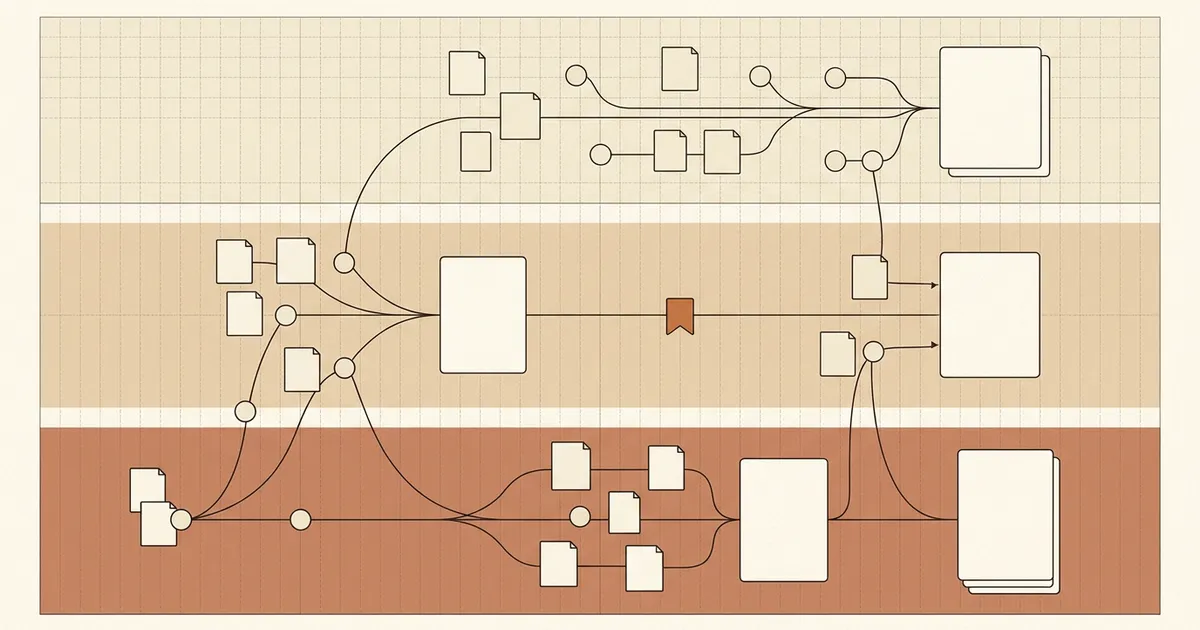
Build a roadmap from evidence to review
The model keeps evidence, strategic intent, outcome choices, horizons, and review decisions traceable while preserving separate owners for detailed requirements and delivery planning.
Define the product frame and steward
Name the product, vision, audience, roadmap steward, review participants, review cadence, and the way readers should interpret horizons. A roadmap should explain who maintains it and how it changes rather than appearing as an ownerless presentation.
Sources: [gov-roadmap], [gov-product-manager], [roadmap-pack]
Freeze the evidence cutoff
Record the evidence available at the review: user research, performance data, operational signals, market observations, and constraints. Keep an observed date, owner, source reference, and limitation so a decision cannot cite an undated assertion.
Sources: [gov-user-needs], [gov-priorities], [hackney-roadmap], [roadmap-pack]
Group work around outcomes and themes
Use a small set of themes that express user or operational value. Give each outcome a baseline, direction, measure, evidence links, and review signal before attaching an initiative hypothesis. Keep detailed product behavior in the PRD.
Sources: [gov-roadmap], [hackney-roadmap], [gov-product-manager]
Place hypotheses in uncertainty horizons
Define Now, Next, and Later locally, then make confidence decrease with distance. Horizons express relative intent and learning order; they are not release dates, sprint boundaries, milestones, or delivery commitments.
Sources: [gov-roadmap], [hackney-roadmap], [roadmap-pack]
Record each review decision
At every review, keep, move, promote, pause, or remove items with the evidence cutoff, rationale, decision makers, and next review date. Validate cross-references and preserve prior decisions instead of silently rewriting the roadmap.
Sources: [gov-priorities], [gov-roadmap], [json-schema-2020-12], [roadmap-pack]
The product roadmap ownership boundary
This record owns strategic product intent at the level needed for repeated evidence-based review. It links to more detailed owner systems without inheriting their authority.
Included
- Product vision, audience, steward, contributors, interpretation, and review cadence
- Dated evidence with source owner, observation, limitation, and safe reference
- Outcome themes, measures, baselines, target direction, and decision signals
- Now, Next, and Later horizon definitions with explicit relative uncertainty
- High-level initiative hypotheses, dependencies, open questions, and review decisions
- Closed record shapes, stable IDs, foreign keys, boundary flags, and deterministic archive bytes
Not included
- PRD requirements, feature specifications, acceptance criteria, requirement approval, and user-story ownership
- Sprint backlog order, task assignment, engineering estimates, capacity, staffing, and person-level allocation
- Project-plan milestones, fixed delivery schedule, release date commitments, deployment authorization, and rollback execution
- Budget approval, procurement, legal advice, security or compliance certification, and executive authorization
- A guarantee that evidence is representative, an initiative will ship, or an outcome will improve
DOWNLOADABLE RESOURCE
Download the reproducible product roadmap pack
The archive keeps the editable review surface and machine-readable record together. Its validator rejects broken evidence links, unknown themes or horizons, incoherent decisions, unsafe references, hidden delivery fields, and commitment flags that become true.
Product roadmap template pack
A reproducible starter pack for an evidence-led outcome roadmap with Now, Next, and Later horizons and review-decision history.
Format: ZIP with Markdown, JSON, JSON Schema, and Node.js validation scripts
Locally reproduced August 1, 2026. SHA-256: e4bcd456628d75def7644357e73946e16af178ad08317d407973d3f9399a88f9
Included
- Editable Markdown template and fictional completed Markdown example
- Machine-readable JSON example and closed draft 2020-12 JSON Schema
- Evidence, themes, outcomes, horizons, hypotheses, dependencies, and review decisions
- Dependency-free validator with mutation, cross-reference, boundary, and secret-safety tests
- Deterministic nine-file ZIP builder with fixed timestamps and an exact allowlist
Verification boundary
Run npm test and npm run validate after extraction. Rebuild with node build-pack.mjs, inspect the exact archive allowlist, and compare its SHA-256 with the value shown here.
Three evidence-led roadmap patterns
The same record can serve different product contexts when every horizon remains a reviewed expression of intent rather than a disguised delivery promise.
Now-Next-Later product roadmap
Use when: A product team needs to show immediate learning, the next decision area, and more uncertain later options without attaching release dates.
Define each horizon, require confidence to decrease with distance, connect every outcome to evidence, and record why review decisions move items between horizons.
Structure
- Now contains active learning with current evidence and a measurable review signal
- Next and Later retain increasing uncertainty and fewer implementation details
- Every move creates a dated review decision instead of overwriting history
Watch for: Now does not mean committed to a sprint or release. The delivery plan owns dates, dependencies, estimates, milestones, and authorization.
Sources: [gov-roadmap], [hackney-roadmap], [roadmap-pack]
Evidence-to-investment roadmap
Use when: Several candidate opportunities compete and stakeholders need to see what evidence would justify further investment.
Organize candidates by outcome theme, record current evidence and limitations, define a measurable decision signal, and pause items whose assumptions need more research.
Structure
- Research and performance evidence have dated cutoffs and accountable owners
- Decision rules explain keep, promote, pause, move, and remove outcomes
- Open questions remain assigned and visible at the next review
Watch for: The roadmap can record an investment recommendation but cannot approve budget, procurement, staffing, or a delivery commitment.
Sources: [gov-user-needs], [gov-priorities], [gov-product-manager]
Service improvement roadmap
Use when: User, operational, and organizational outcomes need one strategic view across a live service.
Balance user and operational evidence, connect product goals to strategy, include reliability and support outcomes, and review priorities as new performance signals arrive.
Structure
- Themes connect user, operational, and organizational value without becoming a feature list
- Measures and evidence sources make the expected direction observable
- A reusable master record supports clear communication and recurring review
Watch for: A roadmap review does not replace service governance, risk acceptance, security review, or the delivery team’s executable plan.
Sources: [gov-roadmap], [hackney-roadmap], [gov-product-manager]
Decide whether a roadmap item is reviewable
A roadmap item earns a horizon through evidence and a named outcome, not by sounding important. Apply the rules at every review and preserve the decision record.
An outcome has no dated evidence, baseline, measure, or review signal
Choose: Keep it out of Now and gather the missing evidence or state the limitation before the next review.
Tradeoff: The roadmap carries fewer active items, but stakeholders can distinguish a learning gap from a delivery promise.
An initiative describes detailed behavior, acceptance criteria, or user stories
Choose: Move that detail to the PRD and keep only the high-level hypothesis and linked owner ID in the roadmap.
Tradeoff: Readers follow a link for detail, while requirement authority and roadmap intent stay independently reviewable.
A horizon is interpreted as a fixed release window or project milestone
Choose: Rewrite the horizon definition and point delivery dates, estimates, dependencies, and authorization to the project plan.
Tradeoff: The roadmap gives less date certainty, but it remains adaptable as evidence and priorities change.
New evidence changes the expected outcome or relative priority
Choose: Create a dated move, pause, promote, or remove decision with the evidence cutoff and rationale.
Tradeoff: The record grows, but stakeholders can audit change instead of comparing conflicting snapshots.
A dependency, risk, or open question lacks an accountable owner
Choose: Keep the affected item outside Now until the uncertainty has an owner and a review point.
Tradeoff: An attractive initiative may wait, while responsibility for the unresolved assumption stays visible.
Editable artifact
Start with the evidence ledger
Download the pack, replace the fictional Signal Harbor record, and run its validator before the roadmap review.
Download the roadmap packThe validator checks record consistency. It cannot decide product strategy or approve delivery.
Move detailed behavior into the PRD templateThe PRD owns requirements and acceptance. The roadmap owns evidence, outcomes, horizons, and review decisions.
What this roadmap cannot prove
Structure and traceability improve the review surface, but they cannot turn assumptions into representative evidence or strategic intent into a delivery commitment.
- The included Signal Harbor evidence, people, measures, references, and decisions are fictional and must not be presented as research findings.
- A valid record does not prove that evidence is representative, priorities are correct, dependencies are complete, or an outcome will improve.
- Now, Next, and Later are locally defined uncertainty horizons, not universal durations, sprint labels, milestones, or release dates.
- The roadmap does not approve PRD requirements, backlog order, estimates, staffing, budget, security, compliance, deployment, or production release.
- Source guidance and organization practices can change after the checked date; recheck the authoritative pages before relying on them.
Authoritative source map
These primary sources and the same-release artifact were checked on 2026-08-01. Each entry names the limited claim it supports; none endorses this template or Playcode.
[roadmap-pack] Playcode:Product roadmap example JSON
Checked August 1, 2026. Supports: The same-release fictional record, closed shape, cross-reference graph, boundary flags, native validation result, and reproducible archive described on this page.
[gov-roadmap] GOV.UK Service Manual:Developing a roadmap
Checked August 1, 2026. Supports: Roadmaps should express vision, value, objectives, priority, uncertainty, maintenance, and regular iteration; they are distinct from delivery backlogs.
[gov-priorities] GOV.UK Service Manual:Deciding on priorities
Checked August 1, 2026. Supports: Prioritization should be repeated, use a clear method, involve the delivery team and stakeholders, and draw on performance analysis and user research.
[gov-user-needs] GOV.UK Service Manual:Understand users and their needs
Checked August 1, 2026. Supports: Teams should use user research, secondary research, prototypes, analytics, and other data to understand the problem and test assumptions early.
[hackney-roadmap] Hackney Development System:Product Roadmap
Checked August 1, 2026. Supports: An official public-sector playbook uses Now, Next, and Later, outcome-oriented product goals, evidence, metrics, flexibility, and repeated prioritization.
[gov-product-manager] UK Government Digital and Data Profession:Product manager capability framework
Checked August 1, 2026. Supports: Product management balances user and business needs, frames problems with multidisciplinary teams, seeks the right outcomes, and makes evidence-based priority decisions.
[json-schema-2020-12] JSON Schema:JSON Schema draft 2020-12
Checked August 1, 2026. Supports: Draft 2020-12 is the published JSON Schema vocabulary used to describe the machine-readable roadmap record in the pack.
Product roadmap template questions
What is the difference between a product roadmap and a PRD?
A product roadmap records evidence, outcome themes, horizons, high-level hypotheses, and review decisions. A PRD defines a specific product problem, requirements, acceptance evidence, and exclusions. Link their stable IDs instead of copying requirement detail into the roadmap.
Should a product roadmap include release dates?
Only when your organization has separately approved those commitments and labels them accurately. This template uses Now, Next, and Later as relative uncertainty horizons and explicitly leaves release dates, milestones, estimates, and delivery commitments to the project plan.
What belongs in a roadmap theme?
A theme should express a coherent area of user, operational, or organizational value. It should connect strategy to measurable outcomes and current evidence without becoming a bucket of unrelated features or detailed user stories.
How often should a roadmap be reviewed?
Set a cadence appropriate to how quickly evidence, constraints, and priorities change. The cited GOV.UK guidance describes at least quarterly roadmap iteration in its context. Review sooner when material evidence or a dependency changes.
Can the validator decide what should be in Now?
No. It verifies closed shapes, IDs, references, horizon order, evidence cutoffs, decision history, safe example values, and false commitment flags. Named product reviewers still judge evidence quality, opportunity, risk, and relative priority.
Does this article or template grant AI credits?
No. This is ordinary informational content with a downloadable artifact. The page is AI-credit-ineligible and does not grant signup AI credits; product eligibility and plan limits are separate.
From reviewed outcome to working evidence
Prototype the next learning step in Playcode
After a roadmap review selects a bounded hypothesis, use Playcode to build a working app or prototype and gather evidence for the next decision.
Open the AI app builderThis informational article is AI-credit-ineligible and does not grant signup AI credits. Product eligibility and plan limits are separate.