The fastest way to overbuild an online course is to record every lesson before you know whether the intended learner wants the result, can follow the sequence, or can demonstrate the promised change. A useful first release is a small learning experiment, not a full content library.
This guide starts with audience evidence and one observable learner outcome. You will map the smallest curriculum backward from that outcome, run an invited pilot, observe behavior and support needs, revise the weak points, and make a go, revise, or stop decision before choosing heavier software or production work.
QUICK ANSWER
How do you create an online course?
Choose a specific learner and problem, validate that people seek the outcome, define one observable result, and map the smallest lessons and practice needed to produce it. Deliver that sequence to a small invited pilot, observe where learners hesitate or succeed, revise from evidence, then launch through a reachable channel and decide whether a standard platform or custom app is justified.
Collect evidence before you choose modules or software
A pilot can stay small only when the audience, outcome, evidence boundary, and decision owner are explicit. Gather these inputs before writing lessons or comparing course platforms.
- Access to the intended learner: Identify a specific group you can reach directly through customer conversations, a professional community, an existing audience, a partner, or invited interviews. “Anyone interested in the topic” is not a testable audience. Record their current situation, prior knowledge, constraints, and why the outcome matters now.
- Problem and demand evidence: Bring interview notes, repeated support or sales questions, observed workarounds, waitlist responses, search behavior, or paid commitments. Separate evidence of wanting the outcome from compliments about the course idea. A like, survey yes, or social impression does not prove that someone will practice or change behavior.
- One observable outcome and a sample: Write what a learner should be able to do, produce, explain, or decide by the end. Cornell learning-outcome guidance recommends measurable statements that align activities and assessment. Create one representative outcome sample or rubric before deciding what content belongs in the course.
- A bounded pilot commitment: Choose the maximum number of learners, sessions or release window, creator hours, feedback touchpoints, and support availability. State what the pilot will not include. The boundary protects you from treating every learner request as a new module or permanent feature.
- Consent, rights, access, and inclusion boundaries: Decide how participation and feedback will be explained, what learner information is necessary, who may see it, how long notes remain useful, and how a participant can withdraw. Confirm rights for readings, images, quotations, worksheets, and recordings. Ask about access needs before selecting a delivery format.
Choose the pilot format that exposes the biggest uncertainty
The best first format is not the one that looks most scalable. It is the one that lets you see whether the learner can reach the outcome and lets you diagnose why they cannot.
| Approach | Best for | Tradeoff |
|---|---|---|
| Live cohort pilot | New subjects, high learner uncertainty, discussion-heavy work, or skills where observing questions and practice is more valuable than polished delivery. | You get fast qualitative evidence and can adapt in the room, but scheduling and facilitation can hide unclear materials unless you record which interventions were needed. |
| Asynchronous pilot | A stable, repeatable task whose instructions, practice, and evidence can be completed without live interpretation. | It exposes whether the sequence can stand alone, but silent abandonment is harder to diagnose and a creator may mistake page completion for learning. |
| Hybrid pilot | A mostly self-paced sequence with one or two live checkpoints for practice review, questions, or outcome assessment. | It balances independent work with observation, but it can accidentally combine the production cost of asynchronous content with the scheduling cost of a cohort. |
Recommended:Choose live or hybrid when you are still learning the audience language, misconceptions, and support burden. Choose asynchronous only when the task and outcome are already clear enough to test without continuous interpretation. Keep the same learner, outcome, and decision rule across formats so the pilot answers one question.
Create and validate an online course pilot
Turn audience evidence into one observable outcome, the smallest aligned curriculum, an invited pilot, and a go, revise, or stop decision.
STEP 01
Define one learner and one costly problem
Describe the learner in the situation where the course should help, not as a broad demographic.
Write a learner statement with current role or situation, prior knowledge, triggering problem, present workaround, constraint, and desired change. “New managers preparing their first weekly one-to-one” is more actionable than “leaders.”
Interview or observe people who match that statement. Ask about the last time the problem occurred, what they tried, what happened, and what made progress difficult. Avoid pitching the course during the evidence portion of the conversation.
Record exclusions. A course designed for a beginner with guided practice may not serve an expert seeking accreditation, a regulated decision, or individualized professional advice.
Expected result: The brief names one reachable learner, one recurring problem, supporting evidence, and explicit exclusions.
Verify it: Give the statement to a neutral reader. They should be able to identify who the course is for, the moment of need, and who it is not for without seeing a topic list.
STEP 02
Validate demand with behavior, not enthusiasm
Look for evidence that the intended learner already spends time, effort, reputation, or money on the outcome.
Rank evidence by commitment. Repeated attempts, workarounds, requested help, a booked interview, an accepted pilot invitation, a deposit, or a completed prerequisite are stronger than a poll response or compliment.
Test the promise in the language learners use. Invite a small number of matching people to a bounded pilot with the outcome, effort, date, format, and feedback expectation stated plainly. Do not imply certification, guaranteed results, or a finished product.
Set the recruitment decision before outreach: what response pattern would justify the pilot, what would require a different promise or channel, and what would stop the idea. Use a pattern appropriate to your audience size rather than a universal conversion percentage.
Expected result: The decision record contains behavioral demand evidence, an honest invitation, and a predeclared recruitment gate.
Verify it: Remove likes, impressions, and uncommitted survey answers from the evidence list. Confirm that the remaining signals still justify asking people to invest the pilot effort.
STEP 03
Write one observable learner outcome
Define what the learner will demonstrate instead of how much content the creator will deliver.
Use an observable verb and a realistic context: diagnose, produce, compare, configure, explain, demonstrate, or decide. Avoid outcomes such as understand, learn, master, or feel confident unless you pair them with observable evidence.
Create the smallest representative task that would show the outcome. Add a short rubric with the required qualities, unacceptable failure, and evidence source. Keep the rubric understandable to the learner.
Check alignment: if the promised result requires supervised practice, licensed judgment, expensive equipment, a long behavior change, or multiple dependent skills, narrow the pilot outcome rather than hiding the gap inside more modules.
Expected result: The course has one observable outcome, one representative task, and one reviewable evidence rule.
Verify it: Ask two people to score the same fictional outcome sample with the rubric. Resolve ambiguous criteria before learners encounter them.
STEP 04
Map the smallest curriculum backward
Include only knowledge and practice needed to produce the outcome evidence.
Start at the final task. List the decisions, component skills, misconceptions, prerequisite knowledge, and practice a learner needs immediately before it. Continue backward until the first action matches the learner starting point.
For each step, choose an explanation, worked example, learner action, feedback moment, and observable checkpoint. Remove material that is merely interesting, could be a reference, or serves a later outcome.
Cornell course-design guidance places outcomes before assessment, activities, and materials. Use that order to keep the pilot from becoming a content inventory.
Expected result: Every pilot lesson or activity has a direct line to the representative task and outcome.
Verify it: For each item, finish the sentence “the learner needs this to ___ in the outcome task.” Remove, defer, or relabel any item that cannot complete the sentence.
STEP 05
Choose live, asynchronous, or hybrid delivery
Select the format that makes the most important uncertainty observable within the pilot boundary.
Use live delivery when learner language, misconceptions, or facilitation needs are still unknown. Use asynchronous delivery when you specifically need to test whether instructions and practice work without live rescue. Use hybrid delivery when independent work needs one bounded review point.
Write the learner effort, schedule or access window, feedback channel, accessibility accommodation path, missed-session option, and support hours. Avoid “learn at your own pace” when deadlines, cohort feedback, or creator availability create real constraints.
Create only the materials required for the chosen format: a live outline and worksheet, a small sequence of asynchronous lessons, or a combination. Do not record a complete library merely because the final product might use video.
Expected result: The delivery plan names the format, learner effort, feedback points, support boundary, access path, and deferred production work.
Verify it: Walk through the plan as a learner with the stated availability and access needs. Every required action should have a time, place, and fallback.
STEP 06
Recruit a small invited pilot
Invite people who match the learner definition and disclose that the course is being tested.
Send a direct invitation that states the outcome, who it is for, what participants will do, the time commitment, format, dates, cost if any, feedback expectation, known limitations, and what happens if the pilot changes or stops.
Screen for the prerequisite and situation defined in the brief. Do not fill the group with friends or colleagues who will participate politely but do not face the problem. Record why each participant matches or does not match the intended learner.
Collect only the information necessary to deliver and evaluate the pilot. Explain whether sessions or calls are recorded, obtain permission before recording or quoting, and provide a reasonable withdrawal path.
Expected result: The pilot roster contains matching learners who received the same honest scope, effort, evidence, and feedback expectations.
Verify it: Ask each accepted learner to restate the outcome, effort, format, and pilot status in their own words. Correct any expectation that exceeds the brief before the first session.
STEP 07
Run the pilot and observe the work
Capture what learners do, ask, skip, repeat, and produce instead of relying on end-of-course satisfaction.
Use the same outcome task and rubric for the pilot. Note starting condition, time on meaningful practice, repeated questions, points of hesitation, examples learners need, interventions the creator provides, and the final outcome evidence.
Open University course-authoring guidance recommends releasing a course to a pilot group before launch and collecting feedback for revision. Treat that as a design input, while keeping direct outcome evidence separate from experience feedback.
Separate content problems from audience, format, facilitation, and access problems. A learner may understand the explanation but lack a prerequisite; complete every page but fail the task; or succeed only after unplanned one-to-one support.
Ask brief feedback questions after behavior has been observed: what did you expect, where did you stop, what did you try, what changed your decision, and what remains difficult? Do not ask only whether the course was enjoyable.
Expected result: Every participant has an outcome-evidence state plus observations about friction, intervention, support, and mismatch.
Verify it: A reviewer should be able to distinguish observed behavior, learner quotation, creator interpretation, and missing evidence in the notes.
STEP 08
Revise from behavior and feedback
Fix the earliest high-impact barrier before adding scope or production polish.
Group observations by learner mismatch, missing prerequisite, unclear promise, sequencing, explanation, practice, feedback, format, access, or support. Count repeated patterns, but retain important isolated failures when they reveal exclusion or harm.
Choose the smallest change likely to improve outcome evidence: narrow the audience, rewrite the outcome, add a prerequisite, move practice earlier, replace an example, split a step, change the feedback moment, or alter the delivery format.
Run the changed step with a fresh or clearly reset learner before treating the issue as fixed. Do not declare success because the creator now understands the material better or because the page looks more polished.
Expected result: The revision log connects each material change to an observed problem, expected effect, owner, and retest.
Verify it: Review the change list. Defer any addition that has no learner observation, outcome requirement, accessibility need, or explicit risk behind it.
STEP 09
Launch through a channel you can actually reach
Move from invitation to a bounded public or repeatable offer without assuming broad distribution will appear.
Choose one reachable launch channel: the audience or partner used for research, an owned list, a relevant community where promotion is permitted, existing customers, a workshop, or direct outreach. Match the promise and prerequisites to the validated learner.
Publish the outcome, audience, prerequisites, effort, format, dates or access window, price if any, support boundary, refund or cancellation terms where relevant, accessibility contact, and who the course is not for. Keep every claim inside the pilot evidence.
Test the public path from the learner perspective: invitation or page, decision information, enrolment or booking, confirmation, first access, help, and withdrawal or cancellation. A working payment or page view does not prove the learning experience.
Expected result: The course has one honest launch promise, one reachable distribution path, and a tested learner handoff into the validated sequence.
Verify it: Ask a matching person who did not join the pilot to review the launch information. They should accurately predict the outcome, effort, format, limits, and next step.
STEP 10
Measure the outcome and make the next-build decision
Use the scorecard to choose go, revise, or stop before buying more production or software complexity.
Review outcome evidence first, then activation, the earliest meaningful drop-off, support load, refunds or withdrawals where applicable, and the difference between intended and actual learners. Completion is a navigation state, not proof of learning.
Choose GO when the predeclared evidence bar is met, no repeated blocking issue remains, and the delivery burden can be repeated responsibly. Choose REVISE when the problem is real but a specific audience, curriculum, format, or support issue blocks consistent evidence. Choose STOP when matching learners cannot be recruited, the outcome remains absent after fair revisions, or the promise is not responsible or viable.
Only after this decision should you compare a standard course platform with a custom app. Write the recurring learner and operator jobs first. Software should support a proven workflow, not manufacture demand or repair an undefined learning outcome.
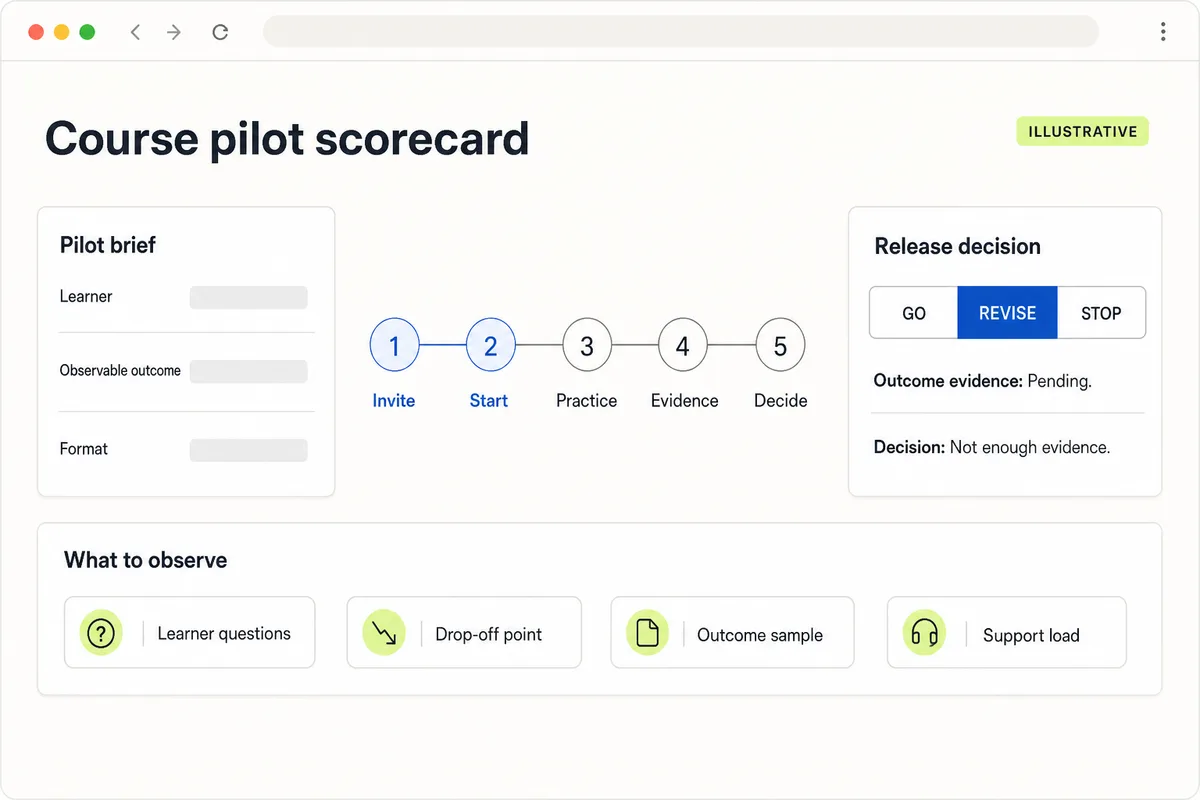
# COURSE PILOT SCORECARD

Pilot decision date:
Decision owner:

## 1. PILOT BRIEF
Intended learner:
Costly problem:
Observable outcome:
Representative outcome task:
Pilot format and boundary:
Explicit exclusions:

## 2. PREDECLARED EVIDENCE BAR
Minimum outcome evidence:
Acceptable support boundary:
Blocking safety, access, or rights failures:
Recruitment signal required:

## 3. OBSERVATIONS
Matching learners invited / started:
Outcome evidence observed:
Earliest meaningful drop-off:
Repeated learner questions:
Unplanned creator interventions:
Support load:
Withdrawals or refunds, if applicable:
Audience mismatches:

## 4. DECISION
GO when:
- The predeclared outcome evidence bar is met.
- No repeated blocking issue remains.
- The delivery burden can be repeated responsibly.

REVISE when:
- Demand exists, but one named audience, sequence, practice, format, or support issue blocks consistent evidence.
- The smallest corrective change and retest are explicit.

STOP when:
- Matching learners cannot be recruited through a realistic channel.
- The outcome remains absent after fair, bounded revisions.
- The promise creates unacceptable evidence, access, rights, safety, or viability risk.

Decision: GO / REVISE / STOP
Evidence behind the decision:
Smallest next action:
What remains deliberately unbuilt:
Expected result: The owner records a go, revise, or stop decision with evidence, a smallest next action, and a deliberate unbuilt list.
Verify it: A reviewer who was not involved in delivery should be able to trace the decision to the predeclared evidence bar and observations without relying on creator enthusiasm.
Test the pilot as a learning claim, not a content launch
Use controlled learner states and the same outcome rubric. These checks reveal whether the promise, sequence, feedback, and release path work without treating completion or satisfaction as a substitute for evidence.
| Test | Scenario | Expected result |
|---|---|---|
| happy path | A matching learner with the stated prerequisite follows the pilot sequence and submits the representative outcome task. | The learner can explain the promise and effort, complete the required practice, submit evidence in the intended format, and receive feedback against the published rubric. |
| invalid input | A prospective learner lacks the prerequisite, expects a different outcome, or needs a form of support outside the pilot boundary. | The invitation or screening path explains the mismatch before enrolment and offers an honest alternative, prerequisite, later cohort, or decline without changing the promise silently. |
| retry | A matching learner misses a session, cannot access one activity, or submits outcome evidence that cannot be reviewed. | The documented fallback preserves the same learning outcome and evidence rule, records the interruption, and avoids giving unlimited private support that would make the pilot unrepeatable. |
| production smoke | A new learner follows the real launch invitation or public page through confirmation and first meaningful course action. | Audience, outcome, prerequisite, effort, format, limits, first action, support path, and withdrawal or cancellation information remain accurate and usable in the released path. |
Diagnose the course before adding more content
When the pilot underperforms, identify the earliest broken assumption. Recording more lessons is rarely the first diagnostic step.
| Symptom | Likely cause | Check | Fix |
|---|---|---|---|
| People praise the idea but matching learners do not join | The problem is not urgent, the promise is unclear, the audience is too broad, the channel does not reach the intended learner, or the requested commitment exceeds the perceived outcome. | Return to recent behavior. Compare who was invited, the exact moment of need, prior attempts, objections, and which part of the commitment stopped the decision. | Narrow the learner or problem, rewrite the invitation in observed language, reduce the pilot boundary, test a reachable channel, or stop when committed demand remains absent. |
| Learners complete the material but cannot produce the outcome | The activities rehearse recognition or consumption instead of the target performance, the outcome is too broad, or the rubric does not match the instruction. | Map every activity to the representative task and inspect learner work at the first point where performance diverges from the rubric. | Narrow the outcome, move authentic practice earlier, add feedback at the failure point, remove unrelated content, and retest the changed sequence. |
| The pilot works only with constant creator rescue | A prerequisite is missing, instructions or examples are incomplete, the format does not fit the task, or the promise assumes individualized coaching. | List every unplanned intervention, who needed it, when it occurred, and whether it explained, motivated, assessed, or completed work for the learner. | Make the support part of the honest offer, add the missing prerequisite or feedback, change format, narrow the audience, or stop calling the sequence self-paced. |
| Feedback is positive but the evidence is inconclusive | Questions measured enjoyment or confidence, the outcome sample was optional, the group was too mismatched, or the evidence bar was written after results were seen. | Separate observed task evidence from satisfaction comments, page completion, attendance, creator interpretation, and missing submissions. | Predeclare the evidence bar, make the representative task part of the next bounded pilot, recruit matching learners, and retain an honest not-enough-evidence state. |
Pilot, observe, and correct the course
Deploy
Release one bounded offer with the validated audience, outcome, prerequisite, effort, format, support window, and decision boundary. Do not announce modules, credentials, community access, outcomes, or automation that the pilot did not establish.
Keep a dated copy of the promise, pilot materials, rubric, scorecard, and decision. If the audience or outcome changes, treat it as a new experiment rather than merging incompatible evidence.
Monitor
Review outcome evidence, first meaningful action, earliest drop-off, repeated questions, audience mismatch, unplanned interventions, support load, accessibility barriers, withdrawals, and refunds where applicable. Compare by pilot revision, not only as one lifetime total.
Schedule content and rights review for examples, sources, links, worksheets, recordings, claims, and public learner quotations. Remove or re-consent material whose permission or context no longer supports publication.
Recover
If a release promise is wrong or the experience becomes unavailable, stop new invitations, tell affected learners what changed, preserve reasonable access or provide the stated cancellation path, and document the correction before reopening.
If a revision weakens outcome evidence, restore the previous bounded sequence or pause the offer. Keep the decision record and learner communication, not only the newest content files.
Protect learners, evidence, and trust
A small pilot is still a real relationship. Minimize what you collect, state the evidence boundary, respect participation choices, and avoid turning generated polish into an unsupported educational claim.
- Collect only learner information needed for delivery, access, support, and the declared evaluation. Restrict notes and recordings to named reviewers, set a deletion date, and remove direct identifiers from shared analysis where possible.
- Obtain permission before recording sessions, publishing learner work, quoting feedback, or reusing a participant story. A course invitation should not make public proof a condition of receiving ordinary support.
- Review readings, images, worksheets, music, video, examples, trademarks, and generated media for rights and attribution. A source link does not automatically grant reuse rights.
- Provide an accessible way to receive instructions, complete core practice, request accommodation, and report a barrier. Generated visuals supplement the explanation; they do not carry the only essential information.
- Do not promise accreditation, certification, employment, income, health, legal, safety, or regulated outcomes without the relevant authority and evidence. Escalate high-stakes material to qualified review.
Online course creation questions
How do I validate an online course idea before recording it?
Interview people who match a specific learner situation, examine their recent attempts and workarounds, and invite a few of them to a bounded pilot with a clear outcome and effort. Treat booked participation, completed prerequisites, repeated behavior, or payment as stronger evidence than likes, survey enthusiasm, or compliments.
What makes a good online course learning outcome?
A useful outcome names what the learner can observably do, produce, explain, or decide in a realistic context. Pair it with a representative task and a short rubric. “Create a reviewed three-step client onboarding plan” is testable; “understand client onboarding” does not define evidence.
Should my first online course be live or self-paced?
Use live or hybrid delivery when learner language, misconceptions, practice, or support needs are still uncertain. Use self-paced delivery when the task is stable and you specifically need to test whether the sequence works without live rescue. Choose the format that exposes the biggest uncertainty, not the one that appears most scalable.
How much content does an online course pilot need?
Only enough explanation, example, practice, feedback, and assessment to produce one observable outcome for the intended learner. Work backward from the representative task. Defer background material, extra outcomes, polished production, community features, and bonus modules unless they solve an observed barrier.
What feedback should I ask pilot learners for?
Observe behavior first, then ask what learners expected, where they hesitated or stopped, what they tried, which example or feedback changed their action, and what remains difficult. Separate quotations from your interpretation. Satisfaction can inform tone and experience, but it does not replace outcome evidence.
Which metrics are useful for an online course pilot?
Start with outcome evidence, then first meaningful action, earliest drop-off, repeated questions, unplanned creator interventions, support load, audience mismatch, withdrawals, and refunds where applicable. Attendance, page completion, and watch time describe activity, not whether the learner achieved the promised outcome.
When is a custom course app justified?
Consider custom software after repeated delivery proves a stable audience, outcome, sequence, and operating job that standard course tools cannot support well enough. Write the recurring learner and operator needs, evidence, limits, and support burden first. A custom app can support a proven workflow; it cannot create demand or define the learning outcome for you.
After the pilot proves the job
Turn a Proven Course Workflow Into a Custom App
When the audience, outcome, sequence, and recurring operating needs are clear, use Playcode to describe and build a custom course application around the evidence instead of guessing the feature list first.
Explore the AI Course BuilderThe linked builder page retains the shared 60-second Playcode workflow video. The scorecard image above is illustrative; your application depends on the validated brief, workflow, content, and review.