QUICK ANSWER
What is the difference between a landing page and a website?
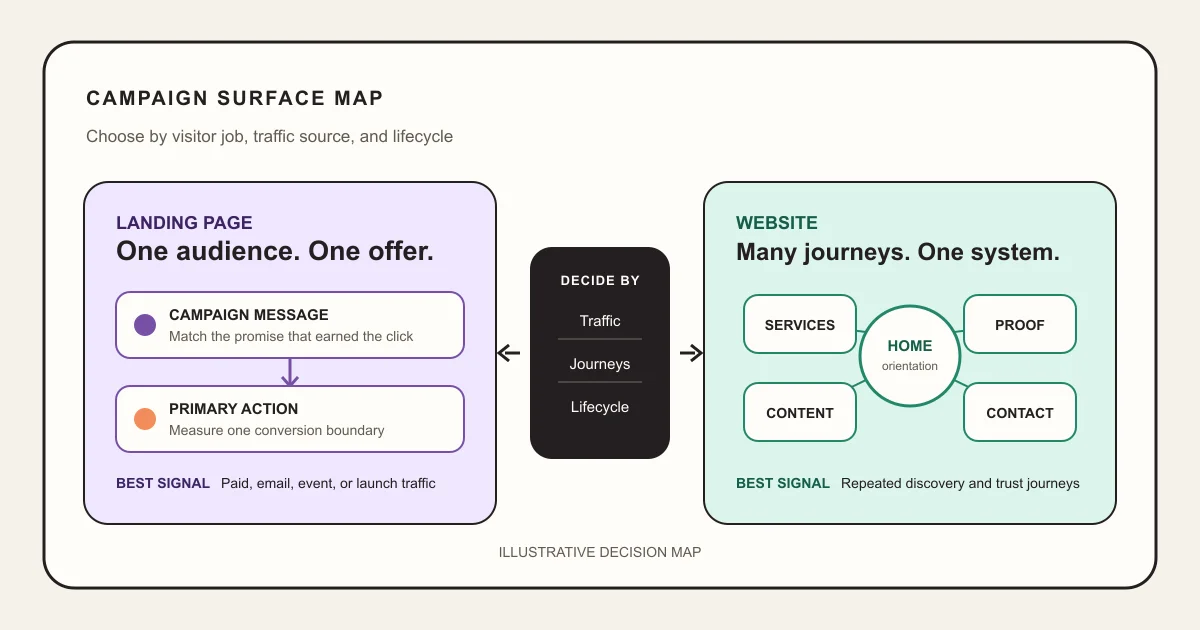
A landing page is one focused destination for a defined audience, message, and action. A website connects multiple pages for broader discovery, trust, support, and repeat journeys. Use a landing page for a bounded campaign, a focused homepage for one offer that still needs durable identity, and a multi-page website when visitors need distinct topics or routes.
A landing page is a destination shaped around one audience, promise, and primary action. A website is a connected set of pages that supports broader discovery, trust, service, policy, and return journeys. A homepage can act as a focused first surface, but it still anchors a wider site as that site grows.
This guide compares three practical choices with the same nine criteria. It does not treat fewer links as automatically better, promise that either format will convert or rank, or turn the decision into a design-style preference. The output is a campaign worksheet, a lifecycle owner, and an explicit trigger for adding or retiring pages.
Complete the Campaign Surface Worksheet
Use four sourced passes before choosing a page count. Record the answers in the campaign brief so the surface can be tested and retired deliberately.
Write the click promise and intended action
Name the audience, source, message they saw, question they expect answered, primary action, durable success record, and information that must be visible before that action is responsible. A destination should match the expectation created by the ad or referring message.
Sources: [google-ads-landing], [google-ads-final-url]
Map the complete journey
List every page or section needed for orientation, comparison, the primary task, alternate paths, and completion. Keep the campaign path focused, but do not remove navigation when people need it to understand or locate content.
Assign search and measurement ownership
Give every durable topic one canonical URL, then define campaign source, medium, campaign, and content values with a consistent naming policy. Do not mint duplicate pages for minor message changes when one owner plus controlled variants can answer the job.
Choose a lifecycle and migration trigger
Select a landing page, focused homepage, or multi-page website. Record the review date, owner, archive or redirect rule, reusable assets, and the new search, navigation, or repeated-journey requirement that would change the choice.
What this comparison includes
The comparison covers public acquisition surfaces and their operating contract, not every page named a landing page by analytics software.
Included
- A dedicated campaign landing page built around one defined promise and primary action
- A focused homepage that can start with one offer while anchoring a durable business identity
- A connected multi-page website for several topics, journeys, and return visits
- Traffic, navigation, content, SEO ownership, analytics, production meter, trust, accessibility, maintenance, retirement, and migration
Not included
- Commercial landing-page-builder selection, templates, or vendor rankings
- Website versus web-app product architecture, authenticated workflows, or application state
- Sales-page versus landing-page, microsite, squeeze-page, or homepage terminology debates
- A rule that hiding navigation, shortening copy, or adding a form automatically improves conversion
- Guaranteed conversion rate, campaign performance, search rankings, leads, revenue, or approval
Nine criteria for choosing the surface
Use every row. A cheaper build, a shorter page, or one traffic source cannot replace the complete journey and lifecycle decision.
Visitor job and promise
A campaign click needs one promise resolved quickly, while a website must support several questions and return visits.
Traffic source and intent
Paid, email, event, referral, branded, and organic visitors arrive with different context and measurement needs.
Navigation and journey depth
The surface must help people complete the intended journey without hiding required trust, policy, or support information.
Content breadth and search ownership
One focused URL and a durable multi-page information architecture solve different discovery and canonical-ownership jobs.
Conversion and measurement boundary
A useful decision names the durable outcome, campaign identity, attribution fields, and where success is verified.
Actual production meter
Count the campaign destinations, message variants, durable page owners, conversion endpoints, and review cycles the team must operate.
Trust, proof, and required information
A shorter page is not permission to hide the useful information and accessible routes visitors need to understand the offer and act.
Maintenance and lifecycle
Campaign surfaces have start, review, and retirement dates; websites need durable navigation, ownership, and freshness.
Migration and reuse trigger
The first surface should preserve useful content, analytics, URLs, and proof when the business outgrows it.
Campaign Surface Matrix
Compare all nine rows before committing to a page count. The best first surface is the smallest one that preserves the visitor promise, required information, measurement, operating workload, ownership, and next migration.
Dedicated campaign landing page
Best for: A bounded paid, email, partner, event, waitlist, or launch campaign with one audience, one message, and one primary action.
A dedicated URL matches the referring promise and concentrates the journey. It still needs truthful context, accessible interaction, durable analytics, required information, and a retirement plan.
| Criterion | Finding |
|---|---|
| Visitor job and promise | Match one campaign promise to one primary action and make the page useful and relevant to the expectation created by the click. Sources: [google-ads-landing], [google-ads-final-url] |
| Traffic source and intent | Use it when traffic arrives with bounded context from an ad, email, event, partner, or launch message. Record consistent campaign parameters rather than inferring intent from the URL alone. Sources: [google-analytics-campaigns], [google-ads-landing] |
| Navigation and journey depth | Keep the primary journey obvious, while retaining the links, orientation, and alternate content paths people need. A process step may be focused; accessibility does not require one universal navigation pattern. Sources: [wcag-multiple-ways], [wcag-consistent-navigation] |
| Content breadth and search ownership | Own one distinct campaign or offer job. Avoid near-duplicate permanent URLs for minor message variants, and canonicalize or redirect retired duplicates when appropriate. Sources: [google-seo-starter] |
| Conversion and measurement boundary | Define the durable result behind the CTA, such as a saved request or confirmed signup, and preserve source, medium, campaign, and creative naming without fragmenting case or spelling. Sources: [google-analytics-campaigns] |
| Actual production meter | Count live campaign destinations, controlled message variants, UTM naming rows, conversion endpoints, and scheduled review or retirement checks. Each extra campaign URL is another maintained production owner. Sources: [google-analytics-campaigns], [google-seo-starter] |
| Trust, proof, and required information | Include useful, relevant information and accessible routes visitors need to understand the offer and complete the decision. Focus is not permission to hide necessary context. Sources: [google-ads-landing], [wcag-multiple-ways] |
| Maintenance and lifecycle | Assign campaign start, review, stop, owner, and post-campaign behavior. Expired claims or offers need removal, replacement, or a useful redirect rather than an abandoned live page. Sources: [google-seo-starter], [google-ads-final-url] |
| Migration and reuse trigger | Preserve the offer copy, proof, measurement taxonomy, and successful path. Promote durable topics into the main website only when they have a distinct long-term job. Sources: [google-seo-starter], [playcode-ai-app-builder] |
Tradeoffs
- Focus can reduce unrelated choices, but removing useful navigation or trust information can make the destination harder to understand or use.
- A separate URL improves campaign control while creating another owner to maintain, canonicalize, link, measure, refresh, redirect, or retire.
Focused homepage
Best for: A new business or product with one main offer that needs a durable identity, direct sharing destination, and room to add a few supporting journeys.
The homepage acts as the first focused surface while remaining the orientation point for a growing site. It is a strong default when the campaign and business promise are still nearly identical.
| Criterion | Finding |
|---|---|
| Visitor job and promise | Lead with the dominant offer, then orient visitors to the small set of supporting questions that establish identity and trust. Sources: [google-seo-starter], [wcag-consistent-navigation] |
| Traffic source and intent | Use one homepage when direct, branded, referral, and early campaign traffic share substantially the same promise. Preserve campaign parameters for attribution. Sources: [google-analytics-campaigns] |
| Navigation and journey depth | Provide a stable orientation point and consistent links to the few pages people need. Do not turn one long homepage into hidden navigation for unrelated tasks. Sources: [wcag-consistent-navigation], [wcag-multiple-ways] |
| Content breadth and search ownership | Let the homepage own the broad brand and category promise. Add a new URL only when a distinct topic deserves its own useful content and search job. Sources: [google-seo-starter] |
| Conversion and measurement boundary | Measure the same durable outcome across sources, then segment by consistent campaign fields. Treat multiple CTAs as separate decisions only when they produce different records or stages. Sources: [google-analytics-campaigns] |
| Actual production meter | Count active campaign variants and UTM naming rows against one maintained canonical homepage, plus its durable conversion endpoints and linked page owners. Add a page only when a permanent job earns another owner. Sources: [google-analytics-campaigns], [google-seo-starter] |
| Trust, proof, and required information | Use the homepage to establish the offer and next route. Put longer supporting information on ordinary linked pages when that keeps it understandable and locatable. Sources: [google-seo-starter], [wcag-multiple-ways] |
| Maintenance and lifecycle | Maintain one durable owner and review its headline, proof, links, and campaign variants together. Do not leave obsolete campaign language as the permanent business promise. Sources: [google-seo-starter] |
| Migration and reuse trigger | Keep the homepage as the orientation node while moving proven distinct jobs to linked pages. Preserve ordinary links so people and crawlers can understand the relationship. Sources: [google-seo-starter], [playcode-ai-app-builder] |
Tradeoffs
- One maintained owner reduces duplication, but campaign-specific messages and attribution need disciplined variants and parameters.
- The homepage can stay focused only while new services, audiences, policies, proof, and support journeys remain genuinely secondary.
Multi-page website
Best for: A business with several services, audiences, locations, resources, trust questions, support needs, or durable search topics.
A connected website gives each meaningful job a stable owner and provides more than one route to important information. Campaign pages can coexist when they remain distinct and maintained.
| Criterion | Finding |
|---|---|
| Visitor job and promise | Separate materially different service, audience, content, and repeated-journey jobs into useful routes while keeping the overall promise coherent. Sources: [google-seo-starter] |
| Traffic source and intent | Route organic, referral, direct, and campaign visitors to the most relevant durable owner. A campaign can still use a dedicated landing page when its job differs from the permanent topic. Sources: [google-ads-final-url], [google-analytics-campaigns] |
| Navigation and journey depth | Use logical, consistent navigation and provide multiple ways to locate important pages. Keep important content reachable through ordinary links rather than isolated in the sitemap. Sources: [google-seo-starter], [wcag-multiple-ways], [wcag-consistent-navigation] |
| Content breadth and search ownership | Group related topics, use descriptive URLs, and keep one canonical owner for each useful piece of content. Page count alone does not create search value. Sources: [google-seo-starter] |
| Conversion and measurement boundary | Carry the same durable conversion definitions across pages, then record the landing page, path, and campaign fields needed to understand which journey led to the result. Sources: [google-analytics-campaigns] |
| Actual production meter | Count durable canonical page owners, ordinary navigation links, conversion endpoints, and content review cycles. Treat every separate campaign landing page as an additional production owner with its own measurement and retirement work. Sources: [google-seo-starter], [google-analytics-campaigns] |
| Trust, proof, and required information | Give important supporting information stable, reachable page owners and ordinary links from the moments where visitors need it. Sources: [wcag-multiple-ways], [google-seo-starter] |
| Maintenance and lifecycle | Assign a content owner, review date, evidence source, and retirement path to each durable page. Navigation and repeated components must remain consistent as the site changes. Sources: [wcag-consistent-navigation], [google-seo-starter] |
| Migration and reuse trigger | Fold successful campaign content into durable owners when the job becomes permanent. Redirect obsolete URLs only after preserving the closest useful intent and measurement history. Sources: [google-seo-starter], [playcode-ai-app-builder] |
Tradeoffs
- Topic ownership and navigation support discovery and trust, while every new page adds content, link, accessibility, evidence, analytics, and freshness obligations.
- A larger site can serve repeated journeys, but duplicating the same offer across many thin pages creates confusion instead of useful breadth.
Decision rules and stop conditions
Use the first matching hard rule, then confirm the full matrix. These rules choose a starting surface; they do not predict campaign performance.
One bounded campaign, one audience, one promise, and one primary action have a clear start and stop date
Choose: Use a dedicated landing page with a named owner, durable success record, campaign taxonomy, review date, and retirement rule.
Tradeoff: You gain message control and another measurable URL, while accepting another content, accessibility, analytics, canonical, and maintenance obligation.
The business has one dominant offer and campaign visitors need nearly the same orientation as direct or branded visitors
Choose: Use a focused homepage and preserve campaign attribution through consistent parameters and controlled message variants.
Tradeoff: You avoid a duplicate owner, but the homepage must not become a rotating campaign banner that loses the durable business promise.
Visitors need several durable service, proof, policy, content, audience, location, or support journeys
Choose: Build a multi-page website with one useful owner per topic and ordinary links from a stable navigation hierarchy.
Tradeoff: The site can support broader discovery and trust, but every route needs evidence, accessibility, measurement, freshness, and retirement ownership.
A proposed page repeats an existing owner and differs only by cosmetic wording, audience label, or campaign parameter
Choose: Keep one canonical owner and test the message or creative without minting another permanent indexable page.
Tradeoff: You give up some URL-level separation while reducing duplicate content, split authority, and lifecycle drift.
The team cannot name the durable success record, required information, lifecycle owner, or retirement behavior
Choose: Stop before building. Complete the worksheet and acceptance boundary first.
Tradeoff: The campaign starts later, but the resulting surface can be tested, maintained, and retired without losing visitor work or analytics meaning.
MAP THE JOURNEY
Describe the traffic, promise, required information, and durable result
Give Playcode one audience, one click promise, the supporting routes people need, the success record, the operating meter, and the migration trigger. Build the smallest complete surface.
Start BuildingThe first version should prove the visitor journey, not assume that more or fewer pages will perform better.
Limits of this comparison
The guide supplies a decision model. It does not replace user research, an accessibility review, analytics design, legal review, or a real campaign test.
- The page does not estimate conversion rate, traffic, cost per acquisition, search demand, ranking, revenue, or payback for a specific business.
- A page called a landing page in analytics may be any session entry URL; this guide uses the campaign-design meaning.
- Removing navigation is not a universal conversion rule, and adding navigation is not a universal accessibility fix. Test the actual journey.
- Search ownership depends on useful distinct content, internal links, canonicals, competition, and crawl behavior. More pages do not guarantee visibility.
- Privacy, consent, regulated claims, terms, accessibility, and sector-specific disclosures require separate qualified review.
- Playcode can build and run public websites and app workflows, but this guide does not guarantee campaign outcomes or fit outside current product limits.
Primary sources and review record
These first-party sources define the destination, campaign measurement, site-structure, accessibility, and product boundaries used in the matrix. Access dates record this review.
[google-ads-landing] Google Ads Help:Landing page
Checked August 1, 2026. Supports: A landing page as the page reached after an ad click, plus relevance, usefulness, navigation, links, and expectation matching in landing-page experience.
[google-ads-final-url] Google Ads Help:About Final URL expansion in Search
Checked August 1, 2026. Supports: The current relationship between query relevance, campaign settings, URL inclusion or exclusion, and the selected final destination.
[google-analytics-campaigns] Google Analytics Help:URL builders: Collect campaign data with custom URLs
Checked August 1, 2026. Supports: UTM campaign parameters, source and creative identification, case-sensitive naming, and consistent campaign taxonomy for traffic attribution.
[google-seo-starter] Google Search Central:SEO Starter Guide
Checked August 1, 2026. Supports: Logical site organization, descriptive URLs, useful content, duplicate-content reduction, redirects, and canonical ownership.
[wcag-multiple-ways] W3C Web Accessibility Initiative:Understanding Success Criterion 2.4.5: Multiple Ways
Checked August 1, 2026. Supports: Providing more than one way to locate a page within a set of pages, with a process-step exception and examples for small sites.
[playcode-ai-app-builder] Playcode:AI App Builder
Checked August 1, 2026. Supports: The current Playcode boundary for building websites and web apps, iterating in chat, publishing, and growing a public surface into a workflow when required.
Landing page and website questions
Can a landing page be part of a website?
Yes. A campaign landing page can live on the same domain and use the website for durable supporting information. Keep its audience, promise, action, campaign measurement, owner, and retirement rule distinct, and do not duplicate an existing permanent topic merely to create another URL.
Is a homepage a landing page?
It can be the page where a visitor lands, but that does not make it a dedicated campaign landing page. A homepage usually orients several visitor types and anchors a broader identity. Use it as the campaign destination when the campaign promise and durable business promise are substantially the same.
Should a landing page remove all navigation?
Not automatically. Keep the primary path obvious, but preserve the routes people need for orientation, evidence, accessibility, or task completion. Test the complete journey with real users and assistive technology instead of treating link count as a universal conversion rule.
Is a landing page better for SEO than a website?
Neither format guarantees rankings. A distinct, useful landing page can own a campaign or offer job, while a logical website can support several durable topics and internal relationships. Avoid thin duplicates, keep one canonical owner per job, use ordinary links, and maintain the content visitors actually need.
Do I need a website before I run a campaign?
You need a trustworthy destination that supplies the information and action the campaign promises. That may be a dedicated landing page, a focused homepage, or a website. Decide where identity, evidence, required disclosures, support, and follow-up live before sending traffic, then obtain qualified review where the sector requires it.
When should a landing page become a website?
Expand when visitors repeatedly need distinct service, audience, proof, content, policy, location, or support journeys that no longer fit one focused page. Keep successful messaging and analytics definitions, assign each durable topic one URL, link the hierarchy, and redirect or retire obsolete campaign pages deliberately.
Can Playcode build both?
Playcode can build and publish a focused public page or a connected website, then add forms, records, portals, dashboards, or other web-app workflows when the brief and current product limits fit. It does not guarantee traffic, conversions, rankings, leads, revenue, or campaign approval.
BUILD THE SMALLEST COMPLETE SURFACE
Start with one focused destination or one clear website hierarchy
Build the selected surface, verify the message and durable action, then add pages only when a distinct visitor job earns a durable owner.
Start BuildingNo credit card required. AI credits are included to start; production requirements and plan limits still apply.