QUICK ANSWER
What is a RAID log template?
A RAID log template is a review ledger whose frozen convention is R means risks, A means assumptions, I means issues, and D means dependencies. Risks are uncertain events, assumptions are beliefs to validate, issues are observed conditions, and dependencies are needed inputs or outputs. Use typed cross-links when a risk, assumption, or dependency materializes into an issue.
A useful RAID log coordinates risks, assumptions, issues, and dependencies without flattening them into one generic action list. Freeze the four-letter convention, give every record a stable ID and owner, attach dated evidence, and link a risk, assumption, or dependency to the issue it becomes.
This downloadable pack contains an editable Markdown template, a completed fictional example, canonical JSON, an issue-only RFC4180 CSV, a closed JSON Schema, and 67 dependency-free validation tests. The CSV opens in Excel or Google Sheets but is neither an XLSX file nor a native integration. Detailed risk scoring, decision rationale and approval, project-status narrative, schedule commitments, and release authority stay with their separate owners.
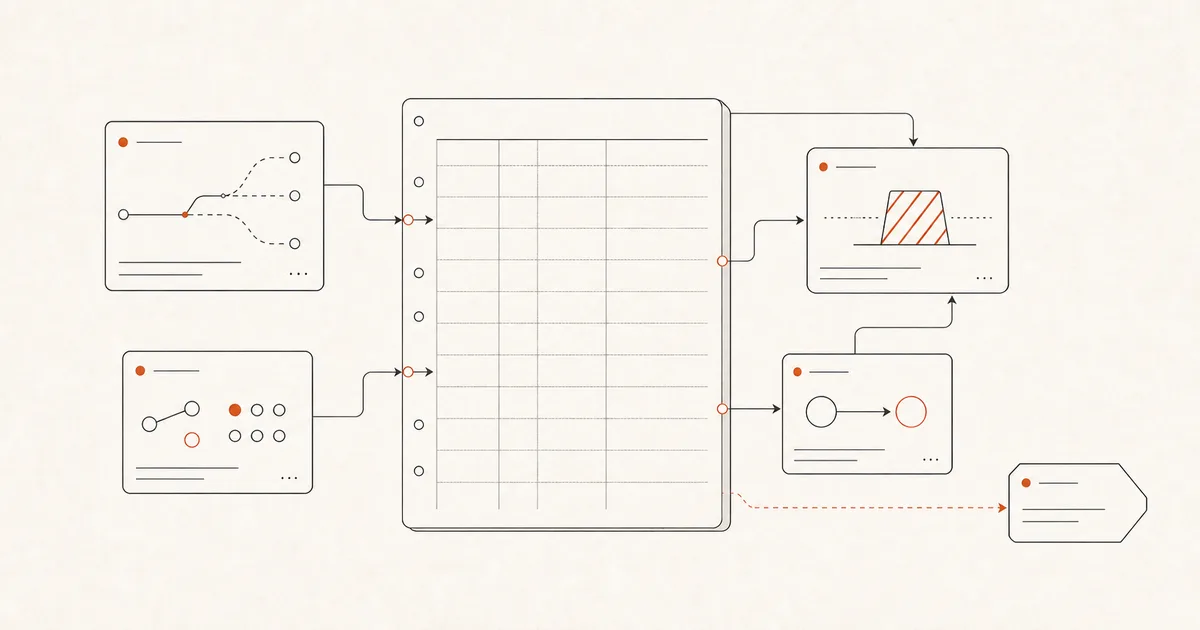
Issue log template: track observed conditions separately
An issue log template records conditions that have already been observed, with a stable ID, owner, observed evidence, current impact, status, resolution summary, and review dates. Inside this canonical RAID owner, issue records stay separate from uncertain risks, beliefs, and dependencies. Bug triage, project status, action execution, and decisions retain their own records and authority.
Freeze the R/A/I/D convention and project boundary
For this pack, R means risks, A assumptions, I issues, and D dependencies. Record the bounded objective, horizon, accountable ledger owner, review cadence, timezone, revision, and state before adding entries. Do not inherit a spreadsheet until its letter meanings and category rules are explicit.
Sources: [raid-pack], [gov-synergy]
Create records with category-specific facts
Write a risk as an uncertain event with probability, impact, trigger, response, and contingency. Write an assumption as a belief with evidence, validation, and due time. Write an issue from an observed condition and evidence. Write a dependency with direction, counterpart, needed-by time, and failure mode.
Sources: [raid-pack], [orange-book]
Assign owners, review dates, and safe evidence references
Give each record a stable category-prefixed ID, accountable owner, opening time, last review, next review, and one or more safe relative evidence references. Use approved evidence stores in a real workflow. The fictional pack uses reserved identities and paths so it cannot be mistaken for a live project.
Sources: [raid-pack], [gov-synergy], [defra-initiation-lessons]
Link materialization instead of rewriting history
When a risk trigger occurs, an assumption is contradicted, or a dependency misses its needed time, create an issue with its own ID and observed evidence. Add a typed, timestamped, reciprocal materialization link. Preserve the source record so reviewers can distinguish what was uncertain from what was observed.
Sources: [raid-pack], [gov-synergy]
Keep decisions and status narrative outside the ledger
Store only an external decision ID, owner, and safe relative path. Keep the decision question, options, rationale, conditions, outcome, and approval in the controlled decision record. Build the dated status report from reviewed evidence and variance; do not turn the RAID log into a forecast or delivery promise.
Sources: [raid-pack], [gov-synergy]
Validate the revision before human review
Run the closed Draft 2020-12 schema and the dependency-free semantic validator, then review every category, cross-link, source, owner, external decision reference, and boundary. Append a contiguous change record. Passing structure is a gate for review, not proof that the underlying judgment or evidence is correct.
Sources: [raid-pack], [json-schema-2020-12]
The RAID coordination boundary
This page owns a four-category coordination ledger and the links between changing records. Adjacent control documents keep their own detail, evidence, and authority.
Included
- Frozen risks, assumptions, issues, and dependencies convention with category-specific states and fields
- Stable ledger, entry, owner, materialization, decision-reference, revision, and evidence identities
- Opening, review, due, needed-by, materialization, and change chronology in explicit calendar formats
- Reciprocal record links and typed risk, assumption, or dependency materialization into an issue
- Markdown, JSON, closed JSON Schema, dependency-free validator, negative tests, and reproducible ZIP packaging
- Issue-only RFC4180 CSV projected deterministically from canonical JSON for Excel or Google Sheets
Not included
- Detailed likelihood-impact scoring, residual-risk analysis, treatment history, enterprise-risk acceptance, or risk authority; use the risk-register owner
- Decision question, options, rationale, outcome, conditions, approval, or authority; keep those in a controlled decision record
- Reporting-period narrative, baseline variance, overall health, progress summary, forecast, confidence, or delivery commitment; use the project-status-report owner
- Software bug or defect reproduction, severity, affected versions, test evidence, triage, fix, or retest; use the defect-tracking owner
- Action-item assignment, due date, execution status, completion evidence, recurring work, or task workflow; use the action-log or task-system owner
- Service-level target or SLA tracking, incident command, escalation, response, recovery workflow, or operational ticket state; use the accountable incident or service-management owner
- Project plan, work breakdown, schedule baseline or commitment, assignment queue, contract, budget approval, change authorization, or release plan
- Authentication, authorization, durable storage, concurrent updates, notification delivery, retention, audit protection, export, recovery, or production monitoring
- Security, privacy, accessibility, legal, regulatory, compliance, safety, financial, employment, release, production, or business-outcome approval
DOWNLOADABLE RESOURCE
Download the RAID log template pack
Start with the Markdown template for review, compare the completed fictional example, use canonical JSON plus schema for a bounded application contract, or open the derived issue-only CSV in Excel or Google Sheets. The CSV is not an XLSX file or native integration. The included tests reject projection drift, category drift, unsafe paths, formulas, multiline cells, contacts, false authority, broken links, chronology errors, sensitive input, and incomplete revisions.
RAID log template pack
A fictional six-entry ledger plus a deterministic three-row issue-only CSV covering stable issue details, source materializations, evidence paths, owners, status, and reviews.
Format: Markdown, JSON, issue-only RFC4180 CSV, JSON Schema, and dependency-free Node.js validator/tests in one ZIP
Locally reproduced August 1, 2026. SHA-256: a696ebc45c3180bcc5dfb8a6f3f356dfb77dbbb7c71da6006605f8bb51ab332f
Included
- Editable review-first Markdown RAID log template
- Completed fictional Markdown and canonical JSON examples
- Issue-only RFC4180 CSV derived from canonical JSON for Excel or Google Sheets
- Closed JSON Schema Draft 2020-12 record contract
- Dependency-free structural, cross-record, and CSV projection validator with 67 tests
- Deterministic allowlisted ZIP builder and boundary-focused README
Verification boundary
Checked the exact eleven-file source, public, and archive allowlists; source-to-public-to-archive byte parity; two timezone-separated rebuilds; clean extraction; 67 validator tests; canonical example validation; exact JSON-to-CSV issue projection; RFC4180 CRLF rows and quote handling; formula, newline, path, contact, decision-field, and non-issue-row exclusion; closed schema; category prefixes and fields; owner and evidence references; UTC chronology and valid IANA timezone; reciprocal links; materialization direction and source state; external decision separation; contiguous revisions; encoded-path and sensitive-input rejection; all-false authority boundaries; and exact archive digest.
Four RAID patterns that should stay different
The examples share stable ownership and review mechanics, but each category answers a different question. The fictional values teach the record contract and are not project benchmarks or decisions.
Risk trigger becomes an observed issue
Use when: An uncertain event has an observable trigger and later occurs during a controlled project exercise.
Keep the original risk with its response and contingency, create a separate issue with observed evidence and current resolution, and join them through a timestamped materialization record.
Structure
- Risk ID retains the earlier uncertainty, owner, trigger, response, review date, and evidence reference
- Issue ID records what happened, the current impact, resolution step, and reciprocal source link
Watch for: The RAID log coordinates the relationship. Detailed score, treatment evidence, and acceptance remain in the risk register and accountable review.
Sources: [raid-pack], [orange-book]
Assumption is invalidated by evidence
Use when: A belief used for planning is tested and a recorded observation contradicts it.
Preserve the assumption, validation rule, due time, and contradicting evidence. Create an issue for the observed condition and link the two without rewriting the original belief as if it had always been known.
Structure
- Assumption state and evidence remain distinct from issue status and resolution
- One materialization link connects the invalidated belief to the observed condition
Watch for: An assumption marked validated is still contextual and reviewable. It is not a permanent fact, approval, forecast, or guarantee.
Sources: [raid-pack], [gov-synergy]
Dependency misses its needed-by time
Use when: A required input from another team or system is not available at the recorded time.
Keep the inbound or outbound dependency, counterpart, needed-by time, and failure mode. Create a separate issue for the observed absence and link the current resolution to the source dependency.
Structure
- Dependency record states what is needed, from whom, by when, and what failure would affect
- Issue record states the timestamped observation and current containment or resolution work
Watch for: A dependency record does not bind the counterpart, prove delivery, update a schedule, or authorize a proceed-or-delay decision.
Sources: [raid-pack], [gov-synergy]
External decision stays external
Use when: A RAID entry needs a decision, but rationale, conditions, outcome, and approval belong in a controlled record.
Store the decision ID, accountable owner ID, and safe relative path only. Let affected RAID entries reference that ID while the decision system keeps authority, evidence, options, rationale, outcome, and later supersession.
Structure
- RAID entry declares only the external decision reference needed for coordination
- Decision content and approval fields are forbidden from the bundled ledger contract
Watch for: A valid reference proves neither that the decision exists nor that the named person had authority. Verify both in the controlled source system.
Sources: [raid-pack], [json-schema-2020-12], [defra-initiation-lessons]
Decide where each record belongs
Choose the owner by the question being answered. Do not make one ledger field impersonate a detailed control document or grant authority.
The statement describes something uncertain that might happen
Choose: Create a risk with an observable trigger, response, contingency, owner, evidence, and next review. Put detailed scoring and treatment history in the risk register.
Tradeoff: Reviewers follow a second record for depth, but the RAID log stays a concise coordination index.
The statement is a belief currently treated as true
Choose: Create an assumption with current evidence, a falsifiable validation method, due time, owner, and consequence if contradicted.
Tradeoff: The team must spend time validating the belief, but hidden planning premises become reviewable.
The condition has already been observed
Choose: Create an issue with observed evidence, current impact, resolution step, owner, and review date. Link any source risk, assumption, or dependency through a typed materialization.
Tradeoff: The ledger carries two linked records instead of one rewritten row, preserving the difference between anticipation and observation.
The record describes an input or output needed from another team or system
Choose: Create a dependency with direction, counterpart, needed-by time, failure mode, owner, and latest check. Create an issue only after the failure is observed.
Tradeoff: A dependency remains visible before it blocks work without pretending the counterpart has committed delivery.
The row contains rationale, approval, overall health, variance, or forecast language
Choose: Move decision content to a controlled decision record and reporting narrative to the dated project status report. Keep only stable references in the RAID ledger.
Tradeoff: Information is distributed across accountable records, but approval and reporting meaning stay attached to their evidence and owner.
START WITH THE FOUR RECORD CONTRACT
Download the RAID log pack and inspect every boundary
Adapt the frozen convention, replace the fictional entries with minimum-purpose reviewed records, keep materializations typed, and leave detailed risk, decision, status, schedule, and release authority with their separate owners.
Download the RAID log template packThe ZIP is locally reproduced. Public availability and adapted source accuracy require separate verification.
Use the risk register for scoring and treatment detailThis RAID owner coordinates four record classes. The risk-register owner handles detailed scoring, response, residual assessment, acceptance, and history.
What a validated RAID log cannot prove
A closed record shape can expose category drift, broken references, unsafe paths, date errors, and explicit authority claims. The real value still depends on complete sources, timely review, access, judgment, and governance.
- The validator checks structure and selected consistency rules. It does not authenticate evidence, inspect linked systems, calculate priority, or decide whether an entry is complete or correctly classified.
- The fixed R/A/I/D convention is this pack’s contract. Another organization may use different letters or meanings and must reconcile them before importing records.
- A risk row does not replace the detailed risk register, treatment evidence, specialist control testing, or authorized risk acceptance.
- An external decision reference does not prove the decision exists, remains current, or was made by someone with the required authority.
- An issue status does not establish overall project health, and a dependency state does not commit another party or update the controlled schedule.
- A real application still needs authenticated identities, server-side authorization, durable storage, optimistic concurrency, audit integrity, minimum-purpose data, retention, export, recovery, monitoring, and human review.
- This ordinary informational article does not grant AI signup credits. The linked product page follows its own current eligibility rules.
Current primary sources and verification record
The same-release artifact is the direct source for its fields, examples, validator, tests, and archive. Current official references support four-category RAID use, risk principles, concise project initiation records, and closed schemas without prescribing or approving this original implementation. No external template text was copied.
[raid-pack] Playcode:RAID log fictional example
Checked August 1, 2026. Supports: The locally reviewed six entries, three materializations, one external decision reference, three revisions, exact record boundary, validator behavior, tests, and reproducible archive. Public availability remains unverified until deployment.
[gov-synergy] UK Government:Synergy programme summary business case
Checked August 1, 2026. Supports: Official 2026 use of a programme RAID log for risks, assumptions, issues, and dependencies, including contingency actions when risks realize and become issues, with decisions handled by separate governance.
[orange-book] UK Government:The Orange Book: Management of Risk - Principles and Concepts
Checked August 1, 2026. Supports: Current 2026 principles for integrating risk with objectives and decisions, using the best available information, clear ownership, identification, assessment, treatment, monitoring, reporting, and continual improvement.
[json-schema-2020-12] JSON Schema:JSON Schema Draft 2020-12
Checked August 1, 2026. Supports: The current specification family declared by the bundled closed schema. Cross-record identities, chronology, materialization, and false-authority rules remain in the dependency-free semantic validator.
[defra-initiation-lessons] UK Department for Environment, Food & Rural Affairs:Defra project initiation lessons learned report
Checked August 1, 2026. Supports: The value of a concise project initiation document covering context, parameters, scope, audience, and RAIDs, supported by collaborative buy-in and an agreed information location.
RAID log template questions
What does RAID stand for in a RAID log?
In this template, RAID means risks, assumptions, issues, and dependencies. Freeze that convention before importing or comparing records because the four categories have different evidence, states, dates, and follow-up. Do not silently reuse a sheet whose letters mean something else.
What is the difference between a risk and an issue?
A risk is an uncertain event that might affect the objective; it needs a trigger, response, contingency, owner, and review. An issue is a condition that has already been observed; it needs evidence, current impact, resolution, owner, and status. Link them when the risk materializes.
Can I use this as an issue log template?
Yes. Use the I records in this canonical RAID log for observed conditions, evidence, current impact, status, resolution summary, owner, related records, and review dates. Keep software bugs and defects in the defect tracker, overall project narrative in the status report, executable tasks in the action log, and rationale or approval in the decision log.
What is the difference between an assumption and a dependency?
An assumption is a belief currently treated as true and should have evidence, a validation method, and a due time. A dependency is an input or output needed from a named counterpart and should have direction, needed-by time, failure mode, owner, and latest review.
Should a RAID log include decisions?
It can reference a decision by stable ID, accountable owner, and safe path. Keep the question, options, evidence, rationale, conditions, outcome, approval, and supersession in the controlled decision record. A reference inside a valid RAID file does not prove authority or approval.
Is a RAID log the same as a risk register?
No. This RAID log coordinates four record classes and their links. The risk register owns detailed risk context, scoring rubric, inherent and residual assessment, response and treatment evidence, triggers, review history, acceptance record, and specialist or release handoffs.
Is a RAID log a project status report?
No. A project status report is a dated narrative about the reporting period, observed progress, evidence, baseline variance, current risks and dependencies, decisions, and a caveated forecast. The RAID log supplies reviewed source references but does not establish overall health or commit delivery.
Can Playcode turn a RAID log into an internal tool?
Playcode can help build a bounded workflow around reviewed RAID records, owners, states, evidence references, cross-links, revisions, and external decision references. The real tool still needs source authorization, server-side access control, concurrent-update handling, audit integrity, retention, export, recovery, monitoring, and target-environment verification.
BUILD THE REVIEWED RAID WORKFLOW
Turn the ledger contract into a bounded internal tool
Give Playcode the accepted categories, fields, owners, evidence rules, state transitions, materialization links, review cadence, revision history, external decision boundary, and failure cases. Verify identity, authority, access, concurrency, recovery, and target behavior before operational use.
Build and verify the RAID workflowThis ordinary informational article does not grant AI signup credits. No risk response, decision, status, schedule, release, compliance, or business outcome is guaranteed.