QUICK ANSWER
What should a project status report template include?
A project status report template should name the reporting period, overall status and supporting evidence; summarize observed progress; compare actual results with the frozen baseline; surface current risks, decisions, and dependencies; and state a forecast with confidence, assumptions, and caveats. It should not rewrite the project plan, hide uncertainty, or treat a color as proof.
A useful project status report is a dated observation, not a green dashboard or a rewritten plan. It links the reporting period and health statement to evidence, shows actual variance against an unchanged baseline, surfaces current risks and dependencies, records decisions without granting authority, and qualifies every forecast.
This downloadable pack includes an editable Markdown worksheet, a valid unknown-status JSON starter, a closed JSON Schema, a fictional completed amber example, and a dependency-free validator with deterministic mutation tests. It does not define work, replace the project plan or risk register, commit a delivery schedule, approve a decision, or guarantee an outcome.
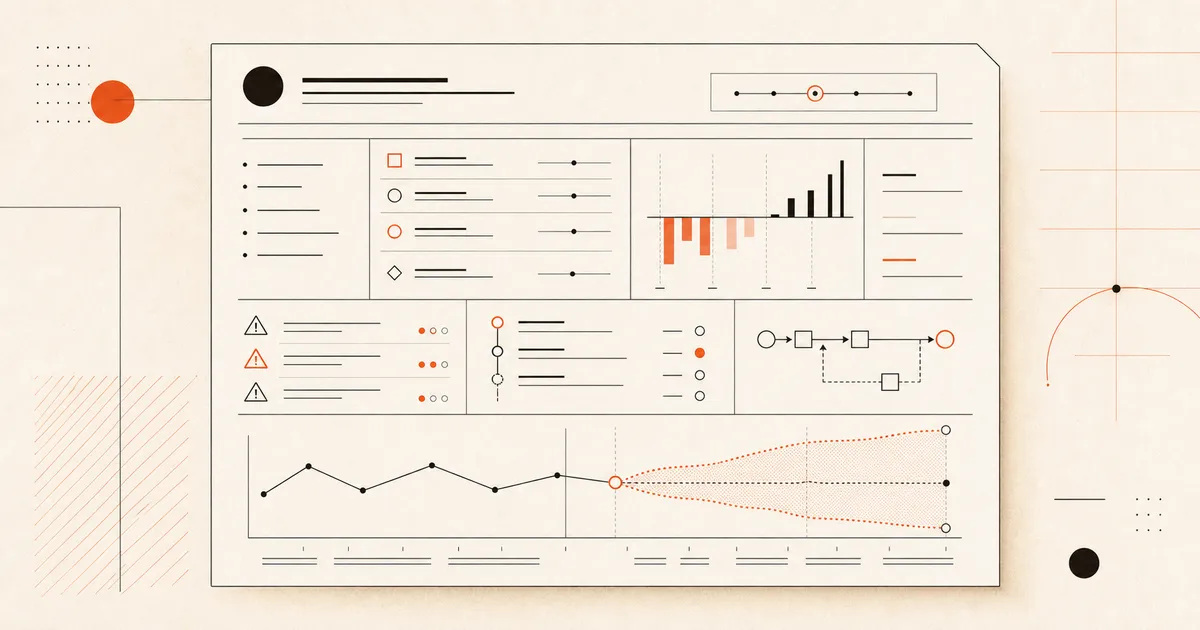
Build a status snapshot from evidence, not optimism
Freeze the reporting window first. Then separate direct observations from interpretation, preserve the baseline, expose current uncertainty, and let accountable humans use the report as input to decisions rather than as automatic authority.
Freeze the reporting period and evidence cutoff
Give the snapshot a stable report ID, revision, project ID, period start and end, UTC reporting time, and prepared-by role. Include only evidence observed by the cutoff. Keep later events for the next revision so readers can reproduce what was knowable when the status was stated.
Sources: [status-report-pack], [govs-002], [gao-schedule-guide]
Support the health statement with traceable evidence
Use unknown until evidence supports green, amber, or red. Reference sanitized metric snapshots, test results, delivery records, risk records, dependency checks, or controlled decision records by stable ID and hash. A color summarizes reviewed evidence; it does not replace the underlying observations or certify their authenticity.
Sources: [status-report-pack], [owasp-logging], [rfc-2606]
Report variance without moving the baseline
For each scope, schedule, cost, quality, or capacity variance, cite the exact baseline revision and record actual, direction, severity, cause, impact, and evidence. If the baseline needs to change, route that through its separate control. A status report should preserve the comparison rather than making an adverse variance disappear.
Sources: [status-report-pack], [gao-schedule-guide], [govs-002]
Keep risks, decisions, and dependencies current and bounded
Show the current risk state and response, record whether a decision is needed, recorded, or deferred, and timestamp the latest dependency check. Link to the accountable source records instead of copying an entire risk register, decision authority matrix, contract, or delivery plan into the snapshot.
Sources: [status-report-pack], [govs-002]
Qualify the forecast and validate contradictions
State whether the forecast is unchanged, revised, uncertain, or unavailable, then name confidence, assumptions, change from the prior report, and an explicit non-commitment caveat. Use the closed schema and validator to reject broken references, impossible chronology, unsupported green status, unsafe URLs, and boundary claims before human review.
Sources: [status-report-pack], [gao-schedule-guide], [json-schema-2020-12]
One reporting snapshot, not the project operating system
Use the pack to communicate what was observed in one period and what remains uncertain at the reporting cutoff. Keep planning, detailed control records, approvals, and sensitive evidence with their own owners.
Included
- Stable report and project IDs, revision, reporting period, reporting cutoff, prepared-by role, prior-report link, and fictional-example flag
- Overall unknown, green, amber, or red status with a factual rationale and resolving evidence IDs
- Observed progress and current focus, without a work breakdown or implied delivery commitment
- Sanitized evidence references with kind, UTC observation time, HTTPS location, SHA-256 digest, redaction confirmation, and note
- Observed variance against an exact frozen baseline reference, including direction, severity, cause, impact, and evidence
- Current risk, recorded or needed decision, dependency state, and a forecast with confidence, assumptions, change, and caveat
Not included
- A project plan, work breakdown structure, backlog, assignment queue, delivery schedule, milestone commitment, or baseline update
- A risk register, issue log, change request, decision authority matrix, approval workflow, budget authorization, procurement record, or contract
- A manufactured green status, automatic health score, factual guarantee, delivery promise, forecast certainty, or claim that missing evidence is positive
- Passwords, access tokens, private URLs, customer records, personal data, restricted security findings, confidential contracts, or raw unrestricted logs
- Proof that evidence is authentic, complete, current, representative, correctly interpreted, or sufficient for a release or investment decision
- A guarantee of scope, cost, date, quality, security, compliance, availability, adoption, revenue, savings, or project success
DOWNLOADABLE RESOURCE
Download the project status report template pack
Start with the Markdown worksheet for review or the valid JSON starter for automation. Compare the fictional amber example, inspect the closed Draft 2020-12 schema, then run the included validator and tests without installing dependencies.
Evidence-led project status report template pack
A fictional project reporting snapshot connecting one period and an amber health statement to sanitized evidence, observed variance, current risks, recorded and needed decisions, dependencies, and a low-confidence forecast.
Format: Markdown, JSON, JSON Schema, and dependency-free Node.js validator/tests in one ZIP
Locally reproduced August 1, 2026. SHA-256: e0580253a6aa3da442ffca6975806c2c08be874ceb31fe2ce719b33d04c59d5d
Included
- Editable Markdown worksheet and a valid fictional unknown-status JSON starter
- Completed fictional amber JSON example for one reporting period
- Closed Draft 2020-12 JSON Schema with exact root and nested record shapes
- Dependency-free Node.js validator covering dates, UTC timestamps, URLs, evidence, cross-references, chronology, status contradictions, forecast caveats, and boundaries
- Forty-four deterministic mutation tests for valid and rejected record states
- README, package commands, fixed source timestamps, exact eight-file allowlist, and reproducible ZIP bytes
Verification boundary
Rebuilt twice with fixed source timestamps and stripped ZIP metadata. Verified the exact eight-file allowlist, source-to-public-to-archive byte parity, clean extraction, 44 validator tests, starter and example validation, closed schema, exact object keys, date and UTC chronology, reserved fictional HTTPS URLs, hashes, redaction, evidence references, variance, risk, decision and dependency states, forecast caveats, green-status contradictions, no secret-like values, and all-false boundaries.
Three honest status-report patterns
The record shape stays stable while evidence and uncertainty change. Each pattern states only what the period supports and keeps adjacent planning or control records separate.
Unknown opening snapshot
Use when: The reporting period is frozen, but comparable evidence has not yet been reviewed well enough to support green, amber, or red.
Publish the cutoff, current evidence gap, observed progress, known risks and dependencies, and an unavailable forecast. Keep status evidence empty and say what review would support the next statement instead of defaulting to green.
Structure
- Unknown status with no asserted status-evidence IDs
- Unavailable forecast with not-assessed confidence and a non-commitment caveat
- Explicit evidence gap rather than a positive inference from silence
Watch for: Unknown is a valid evidence state. It should trigger review, not be silently converted to amber or green by a scoring formula.
Sources: [status-report-pack], [govs-002]
Amber variance and dependency snapshot
Use when: Evidence shows some bounded progress while an adverse variance, high-impact risk, at-risk dependency, or low-confidence forecast needs attention.
Link the amber rationale to the exact evidence IDs, preserve the baseline reference, describe actual variance and impact, timestamp the dependency check, and keep the forecast assumptions visible. The bundled fictional example follows this pattern.
Structure
- Factual amber rationale supported by metric, test, and dependency evidence
- Favorable and adverse observations shown together without averaging them into green
- Low-confidence forecast labeled as an estimate rather than a date commitment
Watch for: Amber is not a universal formula or automatic escalation level. Accountable reviewers still interpret significance in the project context.
Sources: [status-report-pack], [gao-schedule-guide]
Narrowly supported green snapshot
Use when: Current evidence supports the health statement and there is no high adverse variance, unresolved high-impact risk, unresolved dependency, or unsupported forecast contradiction.
Cite the supporting evidence, keep lower-level risks and limitations visible, and state the forecast assumptions. A green snapshot covers one reporting cutoff only; it does not erase uncertainty or guarantee the next period.
Structure
- Non-empty status evidence with no validator-detected green contradiction
- Current risk, variance, dependency, and forecast records remain visible
- Green statement qualified to the named period and evidence cutoff
Watch for: Passing the validator cannot prove green status. It only rejects a small set of explicit contradictions; a human must still assess evidence quality and context.
Sources: [status-report-pack], [json-schema-2020-12]
Decide whether the snapshot is ready to share
A structurally valid file is only a review gate. Check whether the evidence actually supports the language, whether the baseline is stable, and whether any record belongs in a controlled private process.
The report says green while evidence is absent, a high adverse variance remains, a high-impact risk is unresolved, a dependency is blocked or unknown, or the forecast is unsupported.
Choose: Change the status to unknown, amber, or red as the reviewed evidence warrants, keep the contradiction visible, and record the reason rather than editing the underlying observations.
Tradeoff: The update looks less reassuring, but readers can act on the real constraint instead of a manufactured summary.
A variance is described without an exact baseline reference or the baseline was silently changed during the reporting period.
Choose: Restore the controlled baseline reference, report the observed difference, and route any proposed baseline change through its separate owner.
Tradeoff: The variance remains visible, preserving measurement integrity and the history behind a later baseline decision.
A decision is marked recorded without its controlled reference, time, outcome, rationale, and evidence.
Choose: Keep it needed or deferred until the accountable decision record exists. Do not use the status report to imply authority or approval.
Tradeoff: The snapshot carries an open decision, but it does not convert a discussion or dashboard field into authorization.
The forecast omits confidence, assumptions, change from the prior report, or a clear non-commitment caveat.
Choose: Mark the forecast uncertain or unavailable and add the missing qualification before sharing it beyond the review group.
Tradeoff: The forecast is less precise, but its uncertainty and decision limits are visible instead of hidden in a single date.
Evidence contains a secret, personal data, private URL, customer record, restricted finding, or confidential commercial material.
Choose: Remove it from the public pack and point to a controlled evidence store using the organization’s access, retention, and incident process.
Tradeoff: The general report carries less raw detail, while sensitive material remains protected and reviewable by qualified owners.
FROM STATUS EVIDENCE TO A BOUNDED WORKFLOW
Turn the reporting contract into a reviewable tool
Use the exact records, roles, evidence links, states, validations, and exclusions as the brief for a project reporting workflow that keeps uncertainty visible.
Explore internal tool buildingVerify access control, evidence handling, status rules, audit history, exports, and recovery in the target environment.
Download the software project plan templateUse the project-plan owner for objectives, work structure, schedule, responsibilities, delivery controls, and plan changes. This page owns only a dated reporting snapshot.
What this project status report cannot prove
A structured snapshot can expose missing evidence, stale checks, broken references, chronology errors, and explicit status contradictions. Its conclusions still depend on the quality, coverage, access, judgment, and context behind the record.
- The validator checks closed shape and selected consistency rules. It does not authenticate evidence, inspect the referenced system, calculate project health, or decide whether green, amber, or red is correct.
- A metric can be accurate but misleading if its definition, population, period, source query, freshness, or exclusions differ from the frozen baseline.
- A current risk summary does not replace the detailed risk register, issue process, incident response, or qualified security and privacy review.
- A recorded decision field does not prove that the decision maker had authority, required advice was obtained, conditions were satisfied, or the decision remains current.
- A dependency check can become stale immediately and does not bind an external party, provider, supplier, or internal team to a future action.
- A forecast is conditional on named assumptions and evidence available at the cutoff. It is not a delivery commitment, deadline, contract term, budget authorization, or guarantee.
- The fictional Atlas example, records, counts, dates, roles, evidence, status, variance, risks, decisions, dependencies, and forecast are teaching material, not benchmarks.
- This ordinary informational article does not grant AI signup credits. The linked product page follows its own current eligibility rules.
Current primary sources and verification record
The same-release artifact is the direct source for its fictional records, schema, validator, and tests. Current official sources support controlled project delivery, baseline-aware progress and forecast reporting, safe evidence handling, closed schemas, and reserved fictional hosts without endorsing this pack.
[status-report-pack] Playcode:Evidence-led project status report fictional example
Checked August 1, 2026. Supports: The locally reviewed amber snapshot, unknown starter, exact record boundary, evidence references, variance, risks, decisions, dependencies, forecast caveats, validator behavior, tests, and reproducible archive. Public availability remains unverified until deployment.
[govs-002] UK Government Project Delivery and Cabinet Office:Government Functional Standard GovS 002: Project Delivery, version 2.1
Checked August 1, 2026. Supports: Current official expectations for directing and managing government portfolios, programmes, and projects, including governance and controlled delivery information. It does not prescribe or approve this template.
[gao-schedule-guide] U.S. Government Accountability Office:GAO Schedule Assessment Guide: Best Practices for Project Schedules
Checked August 1, 2026. Supports: Official guidance on measuring performance against an approved plan, monitoring variance, preserving schedule status, and treating forecast changes and risk analysis as evidence-dependent. It does not make a status report a schedule or commitment.
[owasp-logging] OWASP Foundation:Logging Cheat Sheet
Checked August 1, 2026. Supports: Current primary security guidance to exclude, mask, sanitize, hash, or encrypt sensitive log data and protect evidence from unauthorized access or modification.
[json-schema-2020-12] JSON Schema:JSON Schema Draft 2020-12
Checked August 1, 2026. Supports: The current Draft 2020-12 specification family used by the included closed schema. The dependency-free semantic validator adds cross-reference and status rules outside JSON Schema validation.
[rfc-2606] RFC Editor:Reserved Top Level DNS Names
Checked August 1, 2026. Supports: The reserved .test top-level domain used by every fictional evidence URL in the bundled example. It does not validate the evidence itself.
Project status report template questions
How do you write a project status report?
Freeze the reporting period and evidence cutoff, summarize only observed progress, state overall status with resolving evidence IDs, compare actual results to the unchanged baseline, surface current risks, decisions, and dependencies, and qualify the forecast with confidence, assumptions, and a non-commitment caveat.
What is the difference between a project status report and a project plan?
A project plan defines intended objectives, work structure, responsibilities, schedule, controls, and delivery approach. A status report is a dated observation of what happened, what varies from the controlled baseline, what remains at risk or dependent, what decisions exist, and what the evidence currently supports.
Should a project status report use red, amber, and green?
It can, but the color needs a factual rationale and evidence. Use unknown when evidence is insufficient. Do not average away a high-impact issue, assume silence means green, or treat a color as a universal formula, forecast, approval, or guarantee.
What should an amber project status mean?
Amber should mean the current reviewed evidence shows a material constraint or uncertainty that needs attention but does not support the organization’s red definition. State the exact variance, risk, dependency, or forecast caveat. The template does not impose one universal threshold.
How should project variance be reported?
Cite the exact frozen baseline revision, then record the actual observation, variance, direction, severity, cause, impact, and evidence IDs. Do not rewrite the baseline inside the report. A proposed baseline change belongs in its separate controlled process.
Is a project forecast a delivery commitment?
No. A forecast is a conditional estimate based on evidence and assumptions at a stated cutoff. Record its state, confidence, assumptions, change from the prior report, and caveat. Contracts, delivery commitments, approvals, and baseline decisions stay with their accountable owners.
Can this template prove that project status is correct?
No. The pack can reject missing keys, broken evidence references, unsafe URLs, impossible chronology, selected forecast contradictions, unsupported green states, and forbidden boundary flags. It cannot authenticate evidence, judge materiality, grant authority, or predict delivery.
BUILD A REPORTING WORKFLOW FROM THE EVIDENCE MODEL
Make every status statement traceable and reviewable
Describe the reporting period, records, roles, evidence, variance, risk, decision, dependency, forecast, access, audit, export, and recovery boundaries you need.
Build an internal tool with PlaycodeThis informational article does not grant AI signup credits. Verify permissions, evidence handling, calculations, state transitions, audit history, export, and recovery before relying on a generated workflow.