QUICK ANSWER
What should a vendor onboarding process include?
A vendor onboarding process should define the business sponsor, vendor and service scope, required evidence references, human reviewers, decision states, access and data boundaries, renewal and expiry dates, provider failure handling, audit events, and offboarding. Record what was reviewed without asserting that a document is true or that the vendor is compliant, secure, tax-valid, sanctions-cleared, bank-verified, or approved for payment.
A useful vendor onboarding process turns a request into a bounded human decision. It identifies the sponsor, vendor and service scope, required evidence references, reviewers, data and access limits, expiry dates, provider-failure owners, renewal gates, audit events, and the path to suspension or offboarding.
This downloadable pack includes an editable Markdown template, a fictional JSON record, a schema, and a dependency-free validator with mutation tests. It records what people reviewed without claiming that a vendor or document is true, compliant, secure, sanctions-cleared, tax-valid, bank-verified, payable, risk-scored, or connected through a provider integration.
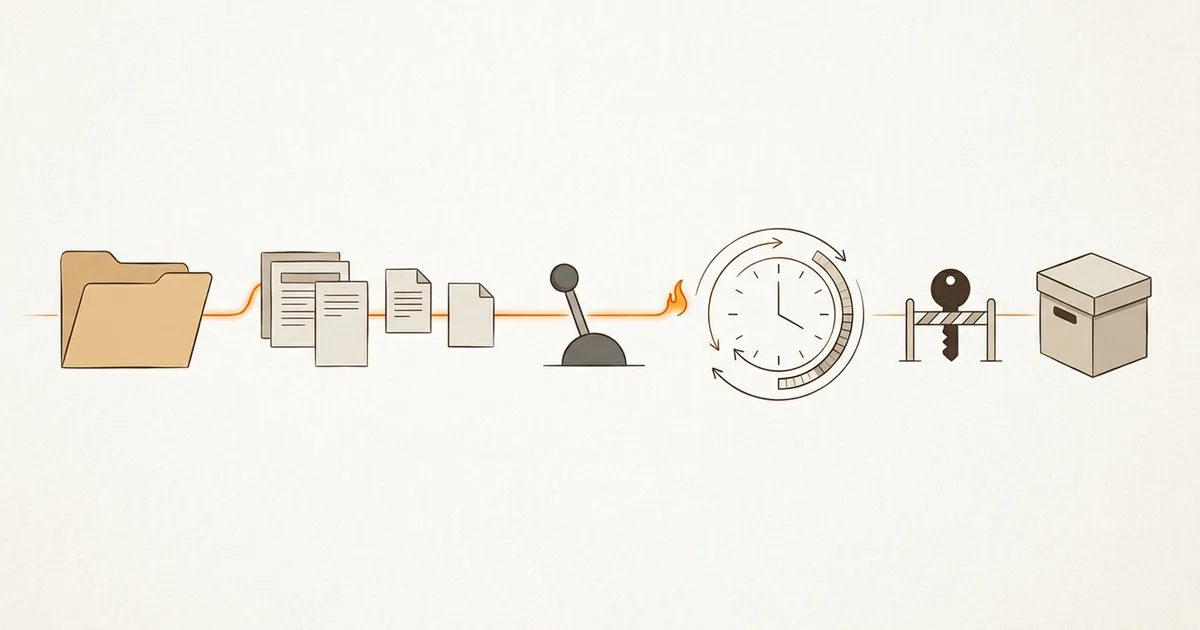
Build a vendor process around explicit human decisions
Start with the service relationship rather than a universal checklist. Different scopes create different evidence, privacy, access, renewal, legal, tax, sanctions, security, and operational review needs, so the record must preserve owners and limits instead of manufacturing one vendor score.
Name the sponsor, service, supplier, and exact scope
Create one stable vendor ID, scope ID, process version, business sponsor, procurement coordinator, included service, and exclusions. Identify whether the supplier touches systems, data, customers, facilities, money, or other providers. NIST treats supply-chain risk as an organizational capability with communicated supplier requirements, not a document pile detached from the acquisition.
Sources: [nist-sp1305], [nist-sp1326]
Define privacy and access before requesting evidence
Write the purpose, minimum allowed data categories, prohibited categories, retention and deletion owners, incident owner, requested systems, least access, and expiry. The NIST Privacy Framework is a voluntary risk-management tool, while FTC guidance separately emphasizes limiting sensitive access, defining vendor data handling, and planning deletion. A field in this pack does not prove those practices occurred.
Collect opaque references and record review status
Keep sensitive documents in controlled systems and store only stable external references. Use pending, received, reviewed for process, needs follow-up, or expired. Name the human owner, reviewer, review time, expiry, and what the item does not establish. For ICT suppliers, NIST SP 1326 describes due-diligence considerations, but this general pack neither performs that assessment nor produces a risk score.
Sources: [nist-sp1326], [nist-sp1305]
Route tax and sanctions work to the qualified owner
The IRS describes Form W-9 as a way to provide a taxpayer identification number to a requester for information-return purposes. OFAC operates current sanctions-list data and search services. Record an opaque reference and human review handoff when those processes apply; never copy taxpayer IDs into this fixture or convert receipt into tax validity, sanctions clearance, bank verification, payment approval, or legal advice.
Sources: [irs-w9], [ofac-sanctions-list-service]
Make a scoped human decision before access
The decision maker chooses pending, activate, activate with conditions, hold, reject, suspend, or offboard for the named vendor, scope, and process version. Bind the decision to the referenced evidence states and rationale. Provisioning can follow only an activate decision, and activation is not vendor approval, payment authorization, or proof of an external fact.
Sources: [nist-sp1305], [ftc-vendor-security]
Operate expiry, provider failure, renewal, and offboarding
Assign review-by and expiry dates, block activation when required references expire, and record provider failures without changing the business decision automatically. At offboarding, assign access revocation, data return or deletion, provider handoffs, and audit closure to people who can verify them in their real systems. Preserve the old record and issue a new version when scope or evidence changes.
Sources: [nist-privacy-framework], [ftc-vendor-security], [nist-sp1305]
What this vendor onboarding pack owns
Use it as a provider-neutral intake, evidence-reference, decision, activation, renewal, and offboarding record. It coordinates owners and gates without pretending to be the specialist systems or reviews it references.
Included
- A versioned vendor, service, sponsor, scope, purpose, data, access, and ownership boundary
- Evidence-reference states with human reviewers, timestamps, expiry dates, notes, and explicit limits
- Pending, activate, activate-with-conditions, hold, reject, suspend, and offboard decisions made by named human roles
- Access sequencing, renewal and expiry, provider-failure routing, append-only audit references, and offboarding actions
- A deterministic fictional ZIP with Markdown, JSON, JSON Schema, validator, and mutation tests
Not included
- Generic approval workflow architecture and version-safe transition design, which remain with /blog/approval-workflow-guide
- Commercial vendor portal builder or software-selection intent, reserved for the future /vendor-portal-builder owner after product proof
- Technical vendor-portal construction, authentication, database, provider API, deployment, and operations, reserved for a future implementation article
- Evidence truth, identity verification, document validation, legal advice, compliance certification, sanctions or tax clearance, bank verification, security assurance, payment approval, or risk scoring
- A native provider connector, automated screening, credential exchange, procurement suite, accounts-payable system, contract-management system, or production portal
- A guarantee of supplier performance, safety, availability, privacy, security, approval, savings, payment, or a successful commercial relationship
DOWNLOADABLE RESOURCE
Download the vendor onboarding process pack
The ZIP contains an editable process template plus a fictional reserved-domain fixture, JSON Schema, dependency-free validator, validator tests, package commands, and a README. Replace every fixture and choose qualified owners before real use. Keep documents, credentials, personal data, bank details, and taxpayer IDs out of the pack.
Vendor onboarding process pack
A deterministic seven-file pack for recording vendor scope, evidence references, human decisions, privacy, access, renewal, provider failure, audit, and offboarding boundaries.
Format: ZIP with Markdown and JSON
Locally reproduced August 1, 2026. SHA-256: c40005581706b6297ad1f962a45ca281fa3af409648ac06dfa9ca14d824a8f50
Included
- Editable Markdown prompts for sponsor, scope, evidence, decisions, access, privacy, renewal, failures, audit, and offboarding
- A fictional JSON example with reserved example.test data, opaque references, human role IDs, and no secrets or personal information
- A JSON Schema plus dependency-free validator for IDs, references, evidence states, decision bindings, access timing, expiry, and closure actions
- Twenty-two local mutation tests for schema parity, unsafe activation, unknown roles, malformed or expired evidence, premature access, missing renewal and offboarding gates, provider failures, secrets, and audit references
- A deterministic build script that fixes timestamps, removes ZIP metadata variance, and reproduces the archive byte for byte
Verification boundary
Rebuilt locally on 2026-08-01 from the page-local seven-file allowlist with fixed timestamps and stripped ZIP metadata. Byte-compared source, public copies, and archive entries; enforced the published schema boundary; passed twenty-two Node tests from both public files and a clean extraction; scanned source and archive text for secret and personal-data patterns; and matched the SHA-256. Public HTTP and content-type verification remain pending deployment.
Three fictional vendor onboarding boundaries
These examples show how the decision boundary changes with the service. They are planning patterns, not completed assessments, verified vendors, approved payments, integrations, or security results.
Low-data professional service
Use when: A specialist provides a bounded deliverable without production-system access, customer contact, payment processing, or sensitive data.
Name the sponsor, deliverable, excluded activities, file-exchange boundary, opaque contract and tax-reference handoffs, human decision, review date, and end date. Keep taxpayer identifiers and payment instructions in their qualified systems rather than the onboarding record.
Structure
- Scope: one deliverable, approved file channel, named sponsor, no credentials, no customer contact, and no production data
- References: commercial terms and any applicable tax handoff recorded as opaque IDs with review status and expiry
- Closure: confirm deliverable handoff, revoke shared access, apply the assigned retention decision, and append an audit reference
Watch for: Receipt of a contract or tax reference does not establish identity, legal sufficiency, tax validity, bank ownership, payment approval, or sanctions clearance.
Sources: [irs-w9], [ofac-sanctions-list-service], [nist-privacy-framework]
Software supplier with restricted access
Use when: An ICT supplier needs a bounded test or administration role and the organization has separate security and privacy reviewers.
Record the service and system boundary, supplier requirements, external security and privacy references, human reviewers, the narrow access role, activation conditions, expiry, monitoring owner, provider-failure action, and revocation path. Keep the specialist assessment outside this pack.
Structure
- Requirements: named system, environment, data categories, least-access role, supplier obligations, owner, and expiry
- Decision: reviewed-reference states plus an explicit human activate or hold outcome for the exact scope and process version
- Operation: reconcile access, route provider outages without changing the decision, renew deliberately, and revoke at offboarding
Watch for: A reviewed security reference is not security verification, compliance certification, provider testing, production approval, or proof that the supplier follows the stated practice.
Sources: [nist-sp1305], [nist-sp1326], [ftc-vendor-security]
Operational supplier renewal and offboarding
Use when: A current supplier approaches expiry, changes scope, loses an owner, experiences a provider failure, or is leaving the relationship.
Preserve the earlier decision, inventory current references and access, mark expired items, assign a renewal reviewer, and choose renew, hold, suspend, or offboard. Offboarding names access revocation, data return or deletion, provider handoffs, open payment handoffs, and audit closure without asserting they occurred automatically.
Structure
- Renewal gate: current scope, sponsor, required-reference expiry, privacy boundary, access inventory, failure history, and human review date
- Decision: a new version-bound renew, hold, suspend, reject, or offboard record with explicit rationale and conditions
- Exit: revoke access, execute the assigned data action in the real system, reconcile outstanding handoffs, and record closing evidence
Watch for: An offboarding checklist does not prove access was revoked, data was deleted, money was reconciled, legal duties were met, or a provider completed an external action.
Sources: [nist-privacy-framework], [ftc-vendor-security], [nist-sp1305]
Choose only the status the record supports
Every decision is bound to one vendor, service scope, process version, evidence-reference set, reviewer group, data boundary, access request, and expiry. Preserve specialist decisions outside this record.
Required references are pending, expired, marked needs follow-up, or lack the named human reviewer for the current scope.
Choose: Keep the process pending or on hold, name the missing owner and next action, and prohibit new access until a human records a supportable scoped decision.
Tradeoff: Onboarding may take longer, but the record does not convert receipt or automation into an unsupported activate decision.
Every scope-required reference has a current reviewed-for-process status, qualified specialist handoffs are recorded, and the human owner accepts bounded conditions.
Choose: Record activate or activate with conditions, bind it to the process version, and allow only the named minimum access with expiry.
Tradeoff: The relationship can proceed within a narrow boundary, but the decision still proves no external fact and authorizes no payment.
The scope, vendor identity reference, data category, access request, owner, evidence requirement, expiry, provider behavior, or jurisdiction changes materially.
Choose: Suspend affected work, preserve the earlier record, create a new process version, and ask the responsible humans to review the changed boundary.
Tradeoff: Existing convenience may pause, but stale evidence and decisions do not silently spread to a new relationship.
The relationship ends, an owner cannot support renewal, required references expire, access cannot be reconciled, or a human rejects the scope.
Choose: Record rejected, suspended, or offboarded; assign access revocation, data handling, provider handoffs, and audit closure; then verify completion in the systems that own those actions.
Tradeoff: Closure work is explicit and reviewable, but the pack never claims that revocation, deletion, screening, or payment reconciliation happened merely because a row exists.
Move from policy to a bounded workflow
Build the internal tool around your human decisions
Bring the sponsor, service scope, evidence references, roles, decision states, privacy limits, access lifecycle, expiry, and offboarding gates into one internal workflow. Keep qualified reviews and external systems outside the claims the tool can make.
Build an Internal ToolGenerated software still needs real authorization, privacy, security, provider, legal, tax, sanctions, bank, payment, operations, and recovery review for its environment.
Design the generic approval state machine separately.Use that guide for immutable decisions, stale writes, retries, escalation, notifications, repair, and recovery mechanics.
What the pack cannot establish
A structured record improves accountability and traceability. Its usefulness still depends on accurate scope, qualified owners, current external systems, evidence quality, jurisdiction, and actual execution.
- An opaque reference shows where a record is expected to live; it does not prove authenticity, completeness, currency, ownership, legal effect, or review quality.
- A reviewed-for-process status means only that the named human recorded a process review. It is not validation, verification, certification, clearance, assurance, or approval for payment.
- NIST supply-chain publications help organizations structure supplier-risk work, but this general template is not a NIST assessment and SP 1326 is specifically scoped to ICT suppliers.
- IRS and OFAC sources identify current official external processes. This pack performs no tax, identity, bank, sanctions, legal, or payment check and stores none of their sensitive source data.
- Access, deletion, export, incident, renewal, suspension, and offboarding tasks remain unproved until the responsible owner verifies them in the authoritative system.
- Provider failures can delay, duplicate, or obscure external work. A safe-action row preserves ownership but does not prove a provider integration, response, or recovery.
- A vendor onboarding decision cannot guarantee supplier performance, availability, privacy, security, compliance, cost savings, payment, or business outcomes.
Official sources checked for this process
Each source supports one bounded part of the method. The article does not combine them into a universal standard or treat a reference as evidence that any fictional vendor passed a review.
[nist-sp1305] National Institute of Standards and Technology:NIST SP 1305: CSF 2.0 Quick-Start Guide for C-SCRM
Checked August 1, 2026. Supports: Establishing and operating supply-chain risk management plus defining and communicating supplier requirements.
[nist-sp1326] National Institute of Standards and Technology:NIST SP 1326: C-SCRM Due Diligence Assessment Quick-Start Guide
Checked August 1, 2026. Supports: Current July 2026 due-diligence considerations for ICT supplier assessments and the boundary between an evidence reference and an informed human assessment.
[nist-privacy-framework] National Institute of Standards and Technology:NIST Privacy Framework
Checked August 1, 2026. Supports: A voluntary enterprise risk-management tool for identifying and managing privacy risk without implying certification.
[ftc-vendor-security] Federal Trade Commission:Cybersecurity for Small Business: Vendor Security
Checked August 1, 2026. Supports: Supplier and third-party risk review, limited access, written vendor data-handling expectations, deletion planning, and the need for separate assessment processes.
[ofac-sanctions-list-service] U.S. Department of the Treasury, Office of Foreign Assets Control:Sanctions List Service
Checked August 1, 2026. Supports: The current official sanctions-list data and search service that a qualified sanctions process may reference outside this pack.
[irs-w9] Internal Revenue Service:About Form W-9
Checked August 1, 2026. Supports: The official stated purpose of Form W-9 and the boundary between a tax-information handoff and a tax-validity or payment decision.
Vendor onboarding process questions
Who should own the vendor onboarding process?
Name one procurement or operations coordinator and one business sponsor. Then assign specialist owners only where the scope requires them, such as privacy, security, legal, tax, sanctions, bank, payment, access, renewal, or offboarding. Automation may route work, but a named human must own every decision.
What documents are required to onboard a vendor?
There is no universal document list. Requirements depend on service scope, data, access, jurisdiction, contract, payment path, and organizational policy. Record required evidence types and opaque external references, then let qualified owners choose and review the actual documents in approved systems.
Does reviewed evidence mean a vendor is verified or compliant?
No. Reviewed for process means only that a named human recorded a review event for one reference and process version. It does not establish document truth, identity, compliance, sanctions or tax clearance, bank ownership, security, legal sufficiency, payment approval, or supplier performance.
When can a vendor receive access?
Only after a human records activate or activate with conditions for the specific scope and access request. Grant the minimum role, bind it to an owner and expiry, reconcile the observed state, and preserve suspension and revocation paths. Activation is not vendor approval and does not justify broader or permanent access.
How should vendor renewal work?
Set the review-by date before process and evidence expiry. Reconfirm scope, sponsor, privacy and access boundaries, current references, provider failures, and outstanding conditions. Preserve the old decision and create a new version-bound renew, hold, suspend, or offboard decision.
What should happen when a vendor or provider system fails?
Keep the current business decision unchanged, record the external boundary and symptom, stop unsafe side effects, and route manual review or reconciliation to the named owner. Do not infer success from a timeout, retry blindly, or treat this pack as proof of a provider integration.
What belongs in vendor offboarding?
Name the trigger, owner, effective time, access revocation, data return or deletion decision, provider handoffs, unresolved obligations, and closing audit reference. Verify each action in its authoritative system; checking a template box does not prove revocation, deletion, reconciliation, or legal completion.
Is this the same as an approval workflow or vendor portal guide?
No. This article owns provider-neutral vendor intake, evidence-reference states, human onboarding decisions, renewal, and offboarding. The approval workflow guide owns generic workflow mechanics. A future vendor portal builder page would own commercial tool intent, while a future implementation article would own technical portal construction.
Start with one vendor and one scope
Turn the reviewed boundary into a working process
Use Playcode to build the intake and coordination workflow, then test the real roles, data, access, expiry, provider failures, audit, and offboarding paths. Preserve human authority and specialist systems at every gate.
Start BuildingPlaycode does not verify vendors, evidence, compliance, sanctions, tax, bank details, security, payments, provider integrations, or supplier outcomes automatically.