QUICK ANSWER
What should a business requirements document include?
A useful business requirements document should define the business problem, current-state evidence, measurable outcomes, actors, records, permissions, requirements, exceptions, acceptance evidence, rollout, rollback, open questions, and accountable owners. Every must-have requirement should trace back to a source and forward to a testable acceptance criterion and release boundary.
RELATED TEMPLATE
Requirements gathering template for business discovery
A requirements gathering template should capture the business problem; dated evidence with an observation, source, owner, and limitation; affected actors and records; proposed requirements traced to source actors, source records, and acceptance IDs; and open questions with owners, due dates, blocking states, and resolutions. Use this BRD pack for business discovery and intake, but keep raw session notes elsewhere. Project authorization stays with the charter; implementation-ready product behavior belongs in the PRD.
A business requirements document should help decision-makers agree on the problem, desired outcomes, people and records affected, operating constraints, acceptance boundary, and rollout risk before a team commits to a product solution. This downloadable pack makes those decisions editable and traceable.
The pack includes a structured Markdown template, completed fictional JSON example, JSON Schema, acceptance matrix, stakeholder and permission matrix, traceability matrix, and deterministic checks. It deliberately keeps the BRD boundary distinct from a product requirements document and from project-management software.
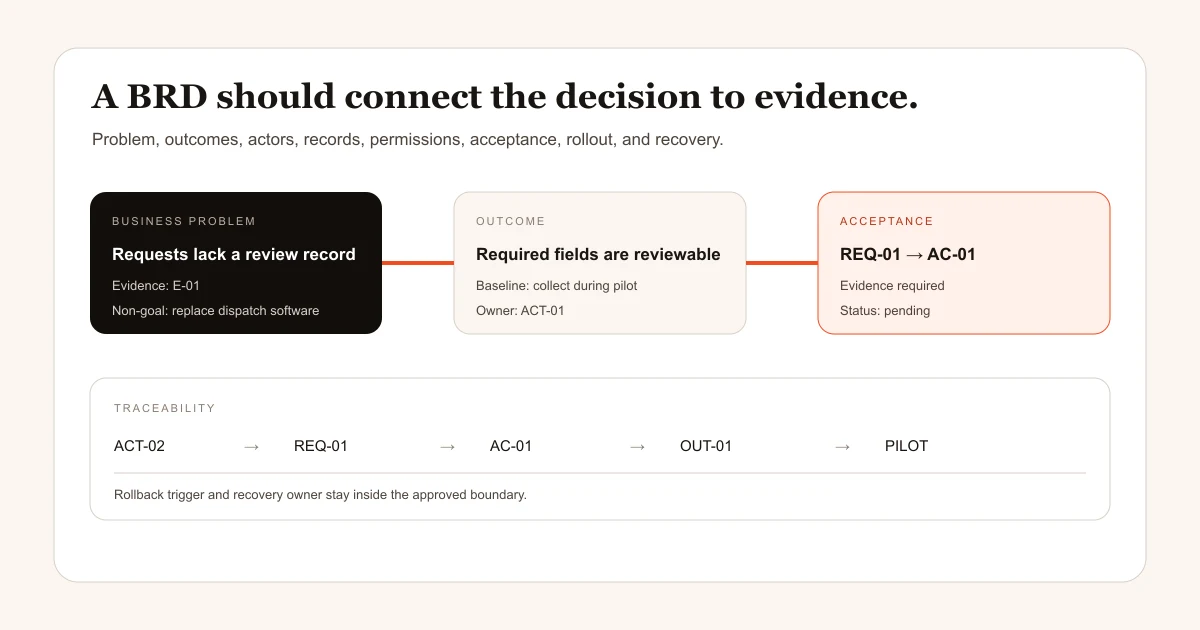
How this BRD template was designed
The template works backward from an approval decision: what evidence reviewers need, which requirements follow, and what would make rollout unsafe.
Write atomic, verifiable business requirements
Each requirement gets one obligation, an owner, source actors and records, and acceptance IDs. Ambiguous quality words belong in a measurable criterion or an explicit discovery question.
Sources: [nasa-requirements]
Model actors, records, and permissions together
The permission matrix shows each actor-record pair, the allowed actions, and a limiting constraint. Unlisted access should remain denied, and privilege should match the job being performed.
Sources: [owasp-authorization]
Trace approval to evidence and recovery
Requirements link to acceptance evidence and rollout boundaries, while exception and decision records preserve who acted, when, what changed, and why. Approval fails while blocking questions or required evidence remain unresolved.
Sources: [nasa-requirements], [owasp-logging]
What the BRD pack covers
Use the pack to reach a reviewable business decision before writing detailed product behavior or starting implementation.
Included
- Problem, current-state evidence, non-goals, outcomes, measures, and accountable owners
- Actors, records, permissions, business requirements, exceptions, acceptance, rollout, and rollback
- Editable Markdown, fictional JSON example, JSON Schema, three CSV matrices, and eleven deterministic checks
Not included
- Detailed interface states, product interaction rules, technical architecture, sprint plans, or vendor selection
- Project-management software, automated approval routing, production deployment, or provider integration
- Legal, privacy, security, accessibility, retention, procurement, or compliance approval
DOWNLOADABLE RESOURCE
Download the business requirements document pack
The ZIP keeps the editable BRD, completed example, machine-readable schema, review matrices, and checks on one reviewed version.
Business requirements document template pack
A traceable BRD for problem evidence, outcomes, actors, records, permissions, exceptions, acceptance, rollout, rollback, and open decisions.
Format: Markdown, JSON, JSON Schema, CSV, and Node.js tests in one ZIP
Locally reproduced August 1, 2026. SHA-256: 24b72adf411b1445cfcee45319770cd76058785ed1dce7281a5399c058bccc82
Included
- Editable twelve-section BRD with an explicit BRD-versus-PRD boundary
- Completed fictional JSON record, JSON Schema, and three operational matrices
- Eighteen deterministic checks for identity, closed-object shape, stable owners, references, permissions, traceability, and approval readiness
Verification boundary
The allowlisted archive was reproduced, extracted, byte-compared, and tested locally. This verifies the pack, not a customer project, deployed product, or approved business outcome.
Three decision boundaries the BRD can document
These examples show where business approval needs different evidence while using the same traceable record structure.
Business decision brief before product discovery
Use when: Stakeholders agree a problem exists but the baseline or solution is still uncertain.
Document the observable problem, available evidence, non-goals, desired outcomes, unknown baseline, decision owner, and questions that block approval.
Structure
- Problem evidence with source date and limitation
- Outcome measure with an honest unknown baseline
- Blocking questions with owners and resolution dates
Watch for: Do not convert an unmeasured impact into a promised revenue, time-saving, or adoption result.
Sources: [nasa-requirements]
Actor, record, and permission review
Use when: A proposed capability changes who can create, read, update, delete, approve, or support a record.
List actors and authoritative records first, then record each allowed action, denied action, limiting constraint, and escalation owner.
Structure
- Stable actor and record IDs
- Action-level permission matrix with denied-by-default gaps
- Authorization acceptance tests and audit evidence
Watch for: A role name alone is not an authorization design; resource scope and request-time checks still need definition.
Sources: [owasp-authorization], [owasp-logging]
Pilot approval with rollback boundary
Use when: Reviewers need to decide whether a bounded release is ready to begin or expand.
Trace each must-have requirement to evidence, resolve blocking questions, name the rollback trigger and owner, and retain the approval decision with its exact version.
Structure
- Requirement-to-acceptance traceability
- Prerequisites, migration boundary, rollback trigger, and recovery owner
- Decision record with evidence IDs and a revisit condition
Watch for: Passing a document validator does not prove the implementation, migration, monitoring, or rollback exercise works.
Sources: [nasa-requirements], [owasp-logging]
Decide whether the BRD is the next accountable record
Use this artifact when the unresolved decision is the business problem, outcome, ownership, or operating boundary. Use the separate BRD vs PRD comparison when the document choice itself is unresolved.
The business problem, outcome, ownership, or operating boundary is disputed
Choose: Start with the BRD and stop before detailed product behavior.
Tradeoff: The team delays solution design until the business decision has accountable evidence.
The business boundary is approved but user and product behavior remain unclear
Choose: Create a PRD linked to the approved BRD version.
Tradeoff: Two linked artifacts require version discipline but keep business and product approvals distinct.
The change is small, reversible, and owned by one reviewer
Choose: Use the BRD sections as a short decision brief instead of filling every table.
Tradeoff: A shorter record reduces ceremony but may not support complex permission, migration, or audit decisions.
The initiative changes regulated, safety-critical, financial, or personal-data operations
Choose: Use the pack only as an organizing aid and involve qualified owners before approval.
Tradeoff: A generic BRD cannot determine the obligations, evidence, or approvals that apply.
FROM REQUIREMENT TO INTERNAL TOOL
Build after the business boundary is reviewable
Use the approved actors, records, permissions, states, and acceptance criteria as a grounded brief for your internal application.
Explore internal tool buildingKeep unresolved blockers visible instead of prompting an implementation to guess.
Read the website planning guideIt covers the adjacent planning flow for a public website project.
Limits to review before approval
The template makes missing decisions visible, but qualified reviewers still own the evidence and policy behind them.
- A fictional example does not establish a market benchmark, production baseline, or expected business result.
- The JSON validator checks internal references and approval readiness rules, not the truth or sufficiency of supplied evidence.
- Security, privacy, retention, accessibility, legal, procurement, and compliance obligations require their own accountable review.
- Approval of a BRD does not verify product behavior, deployment, provider integration, migration, or rollback execution.
Sources and evidence boundary
These sources support the requirement, authorization, logging, and traceability structure. The pack itself is a Playcode editorial artifact.
[nasa-requirements] NASA:Appendix C: How to Write a Good Requirement
Checked August 1, 2026. Supports: Clear, unambiguous, atomic, measurable, verifiable, complete, and bidirectionally traceable requirement checks.
[owasp-logging] OWASP Cheat Sheet Series:Logging Cheat Sheet
Checked August 1, 2026. Supports: Recording when, where, who, and what for events while limiting sensitive or excessive log content.
Business requirements document questions
What is a business requirements document?
A BRD is a reviewable record of the business problem, desired outcomes, affected actors and records, operating constraints, requirements, acceptance boundary, rollout risk, and accountable decisions.
Can I use this BRD as a requirements gathering template?
Yes, for business discovery and intake. Use its problem, evidence, actor, record, permission, open-question, and source fields to preserve what was learned and what remains unresolved. Promote only reviewed business requirements into the controlled BRD version. Keep raw notes in their authorized research system, project authorization in the charter, and implementation-ready product behavior and acceptance in the PRD.
What is the difference between a BRD and a PRD?
A BRD owns the business problem and approval boundary; a PRD usually owns product users and behavior. This pack owns the BRD artifact. Use the BRD vs PRD comparison for the full selection boundary, then link exact versions when both are needed.
Can a BRD have an unknown baseline?
Yes. Record the baseline as unknown, explain the limitation, assign baseline collection, and avoid presenting a target as a guaranteed outcome. Discovery is more useful than invented precision.
Why does this BRD template include permissions?
Permissions are business decisions when they determine which actors may view, change, approve, or support important records. Capturing actor, record, action, constraint, and denied paths makes that boundary reviewable.
What makes a requirement traceable?
A traceable requirement points backward to its source actor, evidence, outcome, or constraint and forward to acceptance criteria, an accountable owner, and the release boundary where it will be evaluated.
Does a completed BRD mean implementation can start?
Only when the accountable owners approve the exact version and any delivery prerequisites are satisfied. The pack does not replace product, technical, security, legal, accessibility, procurement, or rollout review.
BUILD FROM APPROVED REQUIREMENTS
Turn the reviewed record and permission model into an internal app
Bring the approved BRD boundary into Playcode, build the workflow, and verify the implementation against its acceptance evidence.
Build an internal toolPlaycode helps you build software; it does not approve the business case or external obligations for you.