QUICK ANSWER
What should a work order template include?
A practical work order template should include a stable ID, version, requester, included and excluded scope, priority, accountable owner, assignee, due target, state, acceptance criteria, evidence, and an append-only audit history. Digital implementations also need authorization, conflict handling, safe retries, cancellation, and recovery rules.
A work order is useful when it carries a request from intake through ownership, evidence, acceptance, and closure without hiding important decisions in chat. This downloadable pack provides an editable workbook, portable CSV, printable form, completed fictional JSON record, schema, state model, and deterministic checks.
The pack is intentionally provider neutral. It helps you define the record and workflow boundary before building an internal tool, but it does not claim to provide packaged dispatch, scheduling, invoicing, payment, or field-service operations.
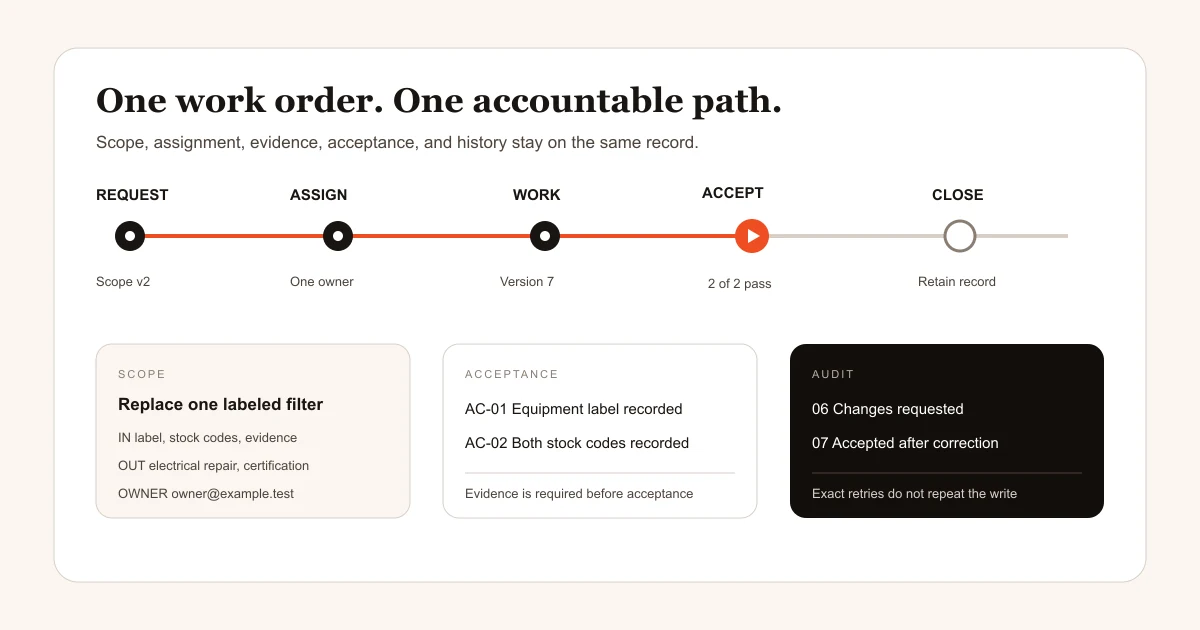
How this template was designed
The pack starts with the decisions a reviewer needs, then adds only the technical fields required to preserve those decisions safely.
Keep authorization visible in the record design
The requester, accountable owner, assignee, and acceptance owner are separate fields. That makes least-privilege and deny-by-default decisions reviewable instead of assuming every operator can perform every action.
Sources: [owasp-authorization]
Make changes reconstructable
Each state change appends who acted, when it occurred, what changed, why it changed, and which record version resulted. Sensitive data still needs minimization and an approved retention policy.
Sources: [owasp-logging]
Separate a safe retry from a new request
The validator models an exact technical retry as the same intended effect and rejects changed content under the same key. That page-local rule is stricter than simply assuming every operation can be repeated.
Sources: [rfc-http-semantics]
What the pack covers
Use the files to agree on the work-order record, review path, and evidence boundary before implementing storage or automation.
Included
- Request identity, version, scope, priority, ownership, state, and due target
- Assignment, acceptance, audit, cancellation, retry, conflict, and recovery fields
- Editable XLSX, CSV, printable HTML, JSON example, schema, and tests
Not included
- Packaged dispatch, route optimization, appointment, inventory, invoicing, or payment software
- A provider integration, production deployment, notification delivery, or customer workflow
- A guarantee that the template meets a specific legal, safety, retention, or compliance policy
DOWNLOADABLE RESOURCE
Download the work order template pack
The ZIP keeps the editable workbook, portable formats, completed example, state model, schema, and tests on the same reviewed version.
Work order template pack
A versioned work-order record for scope, assignment, acceptance evidence, audit history, retry conflicts, and operational recovery.
Format: XLSX, CSV, printable HTML, JSON, JSON Schema, Markdown, and Node.js tests in one ZIP
Locally reproduced August 1, 2026. SHA-256: 8a5d03f80de8b58db8bb54833bca992a0234774ac209e63c7dbdaaf0cf17e05f
Included
- Six-sheet editable workbook plus portable CSV and printable form
- Completed fictional JSON record, JSON Schema, and explicit state model
- Fourteen deterministic checks for identity, transitions, canonical retry fingerprints, acceptance, malformed records, and audit continuity
Verification boundary
The allowlisted archive was reproduced, extracted, byte-compared, and tested locally. This verifies the downloadable files, not a deployed work-order system.
Three bounded ways to use the template
Each example changes the scope and evidence, while keeping authorization and audit decisions explicit.
Facilities request with an acceptance owner
Use when: A bounded physical task needs scope, assignment, and review evidence.
Record the asset reference, included and excluded work, accountable owner, assignee, and evidence the reviewer must see before acceptance.
Structure
- Request and scope with one accountable owner
- Assignment event followed by criterion-level evidence
- Acceptance and closure as separate decisions
Watch for: Do not use this generic pack as a substitute for safety permits, regulated maintenance records, or specialist dispatch software.
Sources: [owasp-authorization], [owasp-logging]
Creative production request with revision control
Use when: A deliverable needs a defined review boundary and a bounded correction loop.
Write observable acceptance criteria before work begins, preserve the current scope version, and record changes requested without silently replacing earlier decisions.
Structure
- Deliverable scope, exclusions, owner, and due target
- Review evidence, changes requested, and a new record version
- Final acceptance decision with retained history
Watch for: A due target is a planning field, not a confirmed provider appointment or guaranteed completion date.
Sources: [owasp-logging]
Digital request with safe retry and conflict rules
Use when: A form or internal tool can submit the same write more than once.
Keep one retry key tied to one request fingerprint, return the existing identity for an exact retry, and reject changed reuse as a conflict.
Structure
- Idempotency key and canonical request fingerprint
- Record version checked before each accepted edit
- Audit event for the resulting state, actor, and reason
Watch for: HTTP method semantics alone do not define your application conflict, retention, or authorization policy.
Sources: [rfc-http-semantics], [owasp-authorization], [owasp-logging]
Choose the smallest work-order format that preserves the decision
The template is a starting point. Keep, remove, or extend fields based on risk and the review path you actually operate.
The work is low risk and completed by one person
Choose: Start with the core record, scope, owner, one acceptance check, and closure note.
Tradeoff: A smaller record is faster to use but provides less separation of duties.
Another person must approve the result
Choose: Keep assignment and acceptance as separate decisions with criterion-level evidence.
Tradeoff: Review is more auditable, but the team must maintain clear owner and reviewer roles.
The request is written by software or can be retried
Choose: Keep request fingerprint, idempotency key, record version, and conflict handling.
Tradeoff: The implementation needs durable state and a defined retention window for retry keys.
The domain has regulated safety, scheduling, payment, or retention duties
Choose: Use the pack only as an intake brief and validate the real system with qualified domain owners.
Tradeoff: A generic template cannot encode obligations that vary by jurisdiction, provider, and operation.
TURN THE RECORD INTO A TOOL
Build an internal work-order surface around your approved fields
Once scope, roles, states, permissions, and acceptance are agreed, use Playcode to create the interface and workflow for your team.
Explore internal tool buildingStart with a copy of the pack and keep provider-specific promises out of the first prompt.
Read the CRM build guideIt shows how records and workflow decisions become an internal application.
Limits to review before adoption
A clean template improves decision quality only when local owners define and enforce the surrounding policy.
- Priority words need a written local policy; the template does not decide what qualifies as urgent.
- Retention, privacy, safety, access, and evidence rules vary by organization and jurisdiction.
- The validator checks the supplied fictional record shape and state rules, not production storage, concurrency, or authorization.
- No template guarantees completion, provider availability, appointment, quote, payment, or business outcome.
Sources and evidence boundary
These sources support the authorization, logging, and retry design choices. The exact work-order fields and validator are Playcode editorial artifacts.
[owasp-logging] OWASP Cheat Sheet Series:Logging Cheat Sheet
Checked August 1, 2026. Supports: Recording when, where, who, and what for events while avoiding excessive or sensitive logging.
[rfc-http-semantics] RFC Editor:RFC 9110, section 9.2.2: Idempotent Methods
Checked August 1, 2026. Supports: The definition of idempotent request semantics and the conditions under which automatic retries are appropriate.
Work order template questions
What is the difference between a work order and a work request?
A request captures the need. A work order is the controlled record that carries approved scope, ownership, state, acceptance, and history through completion or cancellation.
Can I edit the work order template in Excel?
Yes. The pack includes an XLSX workbook with Work Order, Assignment, Acceptance, Audit Log, Lists, and Fictional Example sheets, plus CSV and printable HTML alternatives.
Why are acceptance criteria included?
They turn “done” into a reviewable decision. Each criterion states the expected result, required evidence, observed evidence, result, and reviewer.
Why does the digital record include an idempotency key?
It helps an implementation distinguish an exact technical retry from a new or changed command. The included validator returns the prior identity for an exact retry and flags changed reuse as a conflict.
Is this field-service or dispatch software?
No. It is a downloadable operational record and design aid. It does not provide packaged scheduling, routing, inventory, invoicing, payment, provider, or field-service capabilities.
Can the template satisfy my compliance requirements?
Not by itself. Have qualified owners map the fields, access rules, evidence, retention, and recovery process to the obligations that apply to your organization and jurisdiction.
BUILD FROM THE APPROVED BOUNDARY
Create the work-order interface your team actually needs
Use the reviewed fields and state model as a starting brief, then build and refine the internal tool in Playcode.
Build an internal toolPlaycode helps you build software; the pack does not activate third-party operations on its own.