From scattered listings to an accountable directory

Build a Directory Website People Can Search and Trust

Describe the listings, categories, locations, contributors, owners, reviewers, and publication rules. Playcode AI builds the public directory and the protected workflow behind it, so every visible result has a canonical record, source, state, freshness date, and correction path.

No credit card required · No coding needed

Quick answer

What does it take to build a directory website?

A useful directory needs more than listing cards. Define one canonical identity per organization or resource, separate submitter, owner, and reviewer permissions, model moderation and freshness states, and give visitors dependable search, filters, pagination, corrections, and canonical listing URLs. External verification, maps, payments, and notifications still need separate providers and credentials.

1.1M+users
26M+projects
Since 2016

Used by people at

Counts registered accounts using corporate email domains from the companies above. Playcode is a self-serve product, not a contracted vendor to these brands.

Build the Listing System Before the Listing Grid

Start with ownership and review, then make the public directory searchable

01

Define One Canonical Listing Record

Name the stable listing ID, provider or resource identity, owner, submitter, source, source-updated date, category, location, contact fields, visibility, moderation state, and version. Decide which fields are public, private, reviewer-only, or supplied by an external source.

Treat an ownership claim as a request for review, not proof. Record the claimant and evidence reference separately from the canonical listing until an authorized reviewer resolves it.

Preview
AI Chat
Publish
I'm a realtor in Miami. I need a website to show my listings and get buyer leads.
4 Questions
2 / 4
What's the main style for your real estate site?
AModern & minimal with clean lines
BLuxury feel with large property photos
CProfessional & corporate
DI'll describe my own style below
Or type your own answer...
Skip
Next
Describe what you want to change...
Economy
Build Progress
4/6
Site layout & navigation
3s
Hero section with CTA
5s
Property listings grid
8s
Building contact form...
About page & bio
Footer & SEO meta
miami-homes.playcode.io
Miami Dream Homes
Your trusted partner in Miami real estate
Search by neighborhood...
Featured Listings
NEW
$1,250,000
Coral Gables Villa
4 bd|3 ba|2,400 sqft
OPEN
$890,000
Brickell Condo
2 bd|2 ba|1,200 sqft
Get in Touch
02

Build Submission, Moderation, and Correction States

Implement explicit draft, pending, published, rejected, and removed states with allowed transitions. Give submitters a reviewable receipt, owners a bounded correction path, reviewers a queue, and administrators a documented takedown and appeal process.

Protect every list, detail, edit, publish, reject, merge, remove, restore, export, and appeal action on the server. Hidden buttons and private-looking URLs are not authorization.

03

Publish Searchable Pages and Operate Their Freshness

Expose only published records through category, location, keyword, and attribute filters. Give each listing one stable canonical URL, paginate large result sets, and redirect merged duplicates to the surviving record instead of leaving two competing pages.

Track source-through dates, schedule human freshness review, retry notifications separately, and keep reports, corrections, removals, appeals, exports, logs, and recovery procedures bounded and auditable.

Your website is live!

https://
miami-homes.playcode.io
Site is secure - SSL certificate active
Or connect your domainmiami-dream-homes.com
Miami Dream Homes
Your trusted partner
Miami Dream Homes
Your trusted partner
The directory ownership test

Replace a Listing Grid with a Reviewable Source of Truth

The public page is the final view of an owned and moderated record

A directory-shaped website

  • Each submission silently creates another public page
  • A claimant can overwrite a listing by knowing its URL
  • Published means approved, current, and verified all at once
  • Search mixes stale, duplicate, removed, and private records
  • Email failure loses the correction or repeats the change

An accountable directory workflow

  • One canonical record survives duplicate merge and redirect
  • Submitter, owner, reviewer, and administrator actions stay distinct
  • Moderation, source freshness, and verification evidence stay separate
  • Public search reads only authorized published fields and states
  • Reports and corrections save before notifications retry
What the first directory can include

The Records and Controls Behind Useful Listings

Build one category and region completely before multiplying the taxonomy

01

Canonical listing and provider identity

Give every business, member, place, or resource one stable internal identity, source lineage, current version, canonical public URL, and redirect history after a merge.

02

Submitter, owner, reviewer, and administrator roles

Resolve the signed-in actor and allowed record scope on the server for submissions, claims, review decisions, corrections, reports, removals, appeals, and exports.

03

Moderation and claim-review states

Keep draft, pending, published, rejected, and removed transitions explicit. Store ownership evidence separately and never turn a submitted claim into an automatic verified badge.

04

Taxonomy, location, search, and pagination

Use controlled category IDs, normalized location fields, deliberate relevance rules, stable filters, and paginated result URLs without creating uncontrolled duplicate index pages.

05

Duplicate merge and canonical redirects

Detect candidates with explainable signals, send ambiguous pairs to review, merge only with an authorized decision, and redirect old public URLs to the surviving listing.

06

Freshness, corrections, reporting, and retry

Show source freshness, route corrections and reports to a durable queue, keep takedown and appeal decisions bounded, and retry provider notifications without repeating the record change.

A practical directory implementation guide

Make Every Public Listing Traceable, Correctable, and Safe to Merge

Define the authority behind each field, then test the moderation and discovery workflow as ordinary users before launch.

Before you build

Prerequisites

  • A canonical listing contract and source policy

    The directory needs one authoritative ID and a named source for each public field before imports, submissions, owner edits, or corrections can coexist safely.

    Ready when: For one fictional listing, you can identify its stable ID, source, field owner, source-updated time, public URL, version, and retention rule without relying on its display name.

  • A role, moderation, and appeal policy

    Submitters, claimed owners, reviewers, and administrators need different powers, while publication, verification evidence, takedown, and appeal remain separate decisions.

    Ready when: A written matrix names who may submit, claim, view private evidence, edit, publish, reject, remove, merge, redirect, export, and resolve an appeal in every state.

  • A bounded taxonomy and search promise

    Categories, locations, and relevance rules become public information architecture. Uncontrolled values create duplicate filters, confusing results, and crawlable near-duplicates.

    Ready when: The first release has one category tree, normalized location fields, supported filters, relevance order, page size, and canonical URL rule with a named human owner.

Implementation sequence

Do, observe, verify
  1. 01
    Playcode AI prompt and the server data model

    Model canonical identity, roles, and field authority

    Describe the listing, source, source revision, user, submission, ownership claim, reviewer assignment, moderation decision, correction, report, duplicate candidate, redirect, notification attempt, and audit records. Resolve actor and listing scope from server state.

    Expected result

    The same organization or resource has one canonical identity while contributions, claims, evidence, review work, and external delivery remain separate reviewable records.

    Verify

    Create two fictional accounts and confirm that a submitter cannot publish, a claimant cannot self-verify, a reviewer cannot act outside assignment or scope, and an administrator action leaves a bounded audit event.

  2. 02
    Protected reviewer queue and server transition service

    Implement the moderation state machine

    Allow draft to pending submission, pending to published or rejected review, published to pending correction or removed action, and rejected or removed to a documented appeal path. Require current versions for edits and review decisions.

    Expected result

    Each state has a clear owner, allowed next action, timestamp, reason, and visible public effect, with stale and unauthorized transitions failing closed.

    Verify

    Exercise every allowed transition once, then attempt direct publication, a stale review, a removed-listing edit, an unassigned review, and an appeal from the wrong account.

  3. 03
    Directory search API, filter controls, and public listing routes

    Normalize taxonomy, location, and public discovery

    Store controlled category IDs and normalized location fields, define keyword matching and tie-breakers, return only authorized published fields, paginate deterministically, and emit one canonical URL for each result and supported filter page.

    Expected result

    The same query and filter state produces explainable results and stable pagination without exposing pending, rejected, removed, private, or unrelated-tenant records.

    Verify

    Search exact name, category, location, typo, empty result, and page boundary fixtures. Compare list counts with detail records and inspect canonical and pagination links for duplicate or unbounded URLs.

  4. 04
    Duplicate-review queue and canonical listing service

    Review duplicates, merge records, and preserve redirects

    Generate candidates from normalized names, source IDs, addresses, phones, or other permitted signals, but require human review for ambiguous matches. Merge field-by-field into one survivor and retain old identifiers and public redirects.

    Expected result

    An exact duplicate does not create a second public owner, and an ambiguous candidate cannot erase distinct organizations or silently move claims, reports, or private evidence.

    Verify

    Test exact retry, likely duplicate, false positive, concurrent correction, merge reversal plan, and every former public URL. Confirm the survivor retains source lineage, version, audit order, and redirect history.

  5. 05
    Owner workspace, reviewer queue, freshness job, and provider workers

    Operate freshness, corrections, reports, and providers

    Show the last accepted source-through date, schedule stale-data review, save corrections and reports before delivery, enforce takedown and appeal policy, redact routine logs, and retry email, SMS, maps, verification, or payment-provider work independently when those services are added.

    Expected result

    A provider outage cannot lose or repeat a directory decision, stale records are visible to authorized reviewers, and public claims never imply freshness, verification, placement, payment, or legal approval that the workflow did not establish.

    Verify

    Fail one notification after a saved correction, retry it twice, expire one fictional source, request removal, appeal it, inspect privacy-safe logs, export the authorized record set, and rehearse bounded repair before whole-app restore.

Decisions that change the build

Who should control changes to a published listing?

  • Directory editors remain the canonical field owners
  • Claimed owners edit fields directly
  • Owners propose changes that return to review

Choose: Begin with owner-proposed changes that return policy-sensitive fields to review. Keep source-derived fields read-only until the source or an authorized editor updates them, and reserve direct edits for low-risk fields only after evidence supports that shortcut.

Tradeoff: Review slows corrections and adds operational work, but it protects taxonomy, source lineage, duplicate handling, and public trust. Direct owner editing is faster but requires stronger identity proof, field-level policy, version conflicts, audit history, and abuse recovery.
Should search use database queries or a separate search provider?

  • Database-backed search and filters
  • External search or geocoding provider

Choose: Start with explicit database filters and simple text relevance for a bounded directory. Add a provider only when measured query, typo, language, geo, or scale requirements exceed that contract.

Tradeoff: Database search keeps ownership and failure modes simple. A provider can improve recall and geo features while adding credentials, indexing lag, cost, privacy review, synchronization, outages, and relevance tuning.

Before you share it

Test checklist

  • Happy path

    A submitter creates one fictional resource, a reviewer publishes it, visitors find it by category and location, the owner proposes a correction, and the reviewer accepts the current version.

    Expected: One canonical listing moves through allowed states, search and detail agree, source freshness stays visible, and each actor sees only the fields and actions their role allows.

  • Invalid input

    Attempt direct publication by a submitter, self-verification by a claimant, wrong-scope review, private evidence access, invalid category and location values, unbounded filters, and export while signed out.

    Expected: Every action fails clearly without public state, private-field exposure, uncontrolled taxonomy values, misleading success, or provider side effects.

  • Duplicate or retry

    Repeat one submission after a timeout, submit the same source identity under another name, apply a stale correction, merge two candidates, revisit the old URL, fail notification delivery, and retry only delivery.

    Expected: The technical retry returns one result, duplicate evidence enters review, stale writes fail, the merge preserves one canonical record and redirect, and the saved decision is not repeated by notification retry.

  • Published smoke test

    In a fresh private browser on the published HTTPS site, run public search and pagination, then sign in as fictional submitter, owner, reviewer, and administrator accounts to exercise the bounded workflow.

    Expected: Canonical listing pages, filters, moderation states, role denial, correction and report receipts, source freshness, logs, export, and recovery checks match the documented contract in the deployed environment.

If something goes wrong

Common failure cases

The same organization appears on two public listing URLs

Likely cause
Submission created records from display names without checking the canonical source identity or the duplicate-review queue.
Check
Compare internal listing IDs, normalized source IDs, address and contact signals, versions, claims, public canonicals, and redirect history.
Fix
Send the records to authorized duplicate review, merge field-by-field into one survivor, and redirect every retired public URL.

A claimed owner changes a published category or location immediately

Likely cause
A successful claim was treated as unlimited edit authority and policy-sensitive fields bypass moderation.
Check
Inspect actor scope, claim evidence state, field policy, prior version, transition, reviewer assignment, and audit event.
Fix
Return sensitive changes to pending review, restrict direct edits by field, and repeat the claimant, reviewer, and stale-version tests.

A removed or pending listing still appears in search

Likely cause
The search index or cache did not share the authoritative visibility state and tenant or publication scope.
Check
Compare canonical record state and version with search document state, filter scope, cache key, update time, and removal event.
Fix
Filter authoritatively, update or rebuild the affected search document idempotently, invalidate scoped caches, and test removed-state recurrence.

A stale listing shows a recent page-updated date

Likely cause
The interface displays render time or reviewer activity instead of the accepted source-through time.
Check
Compare source revision and source-through fields with accepted version, page render time, moderation time, and displayed freshness label.
Fix
Display source freshness from the accepted listing version and keep render, review, and provider-sync timestamps separate.

A correction saved but the submitter sees an error and resubmits it

Likely cause
The durable correction and provider notification were treated as one transaction and one retry identity.
Check
Compare correction ID, save result, current listing version, notification attempt, provider response, and retry count.
Fix
Return the saved correction receipt, keep delivery attempts separate, and retry only the failed notification with its own identity.

Pagination produces duplicates or skips listings

Likely cause
Results use an unstable sort or offset while records change between page requests.
Check
Inspect the complete sort tuple, cursor or offset, filter state, listing versions, and boundary records across consecutive pages.
Fix
Use a deterministic sort with a stable ID tie-breaker and a cursor or snapshot rule that matches the directory freshness contract.
Picture the reviewer surface

A Pending Listing with Ownership and Freshness in View

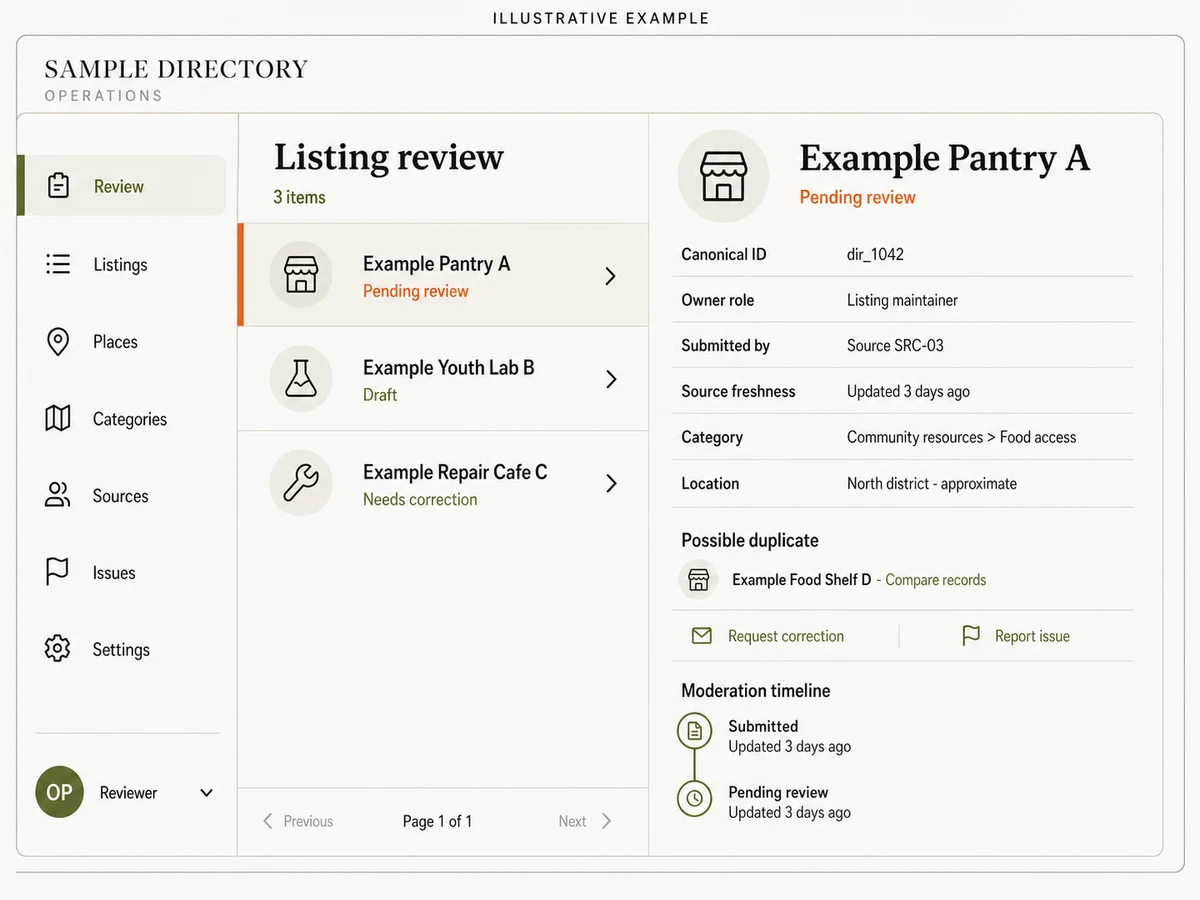
The concept keeps canonical identity, contributor context, source freshness, duplicate review, corrections, and reporting beside the selected record.

Illustrative Sample Directory review queue with three example records, Example Pantry A pending review, canonical ID, owner role, source ID, source freshness, approximate location, duplicate comparison, correction, report, and moderation timeline
Illustrative conceptIllustrative Sample Directory review concept, not a Playcode product screenshot. Example Pantry A, Example Food Shelf D, the role and source IDs, three-day freshness label, approximate location, duplicate signal, and moderation states are invented examples; none proves identity, source accuracy, freshness, ownership, verification, or a moderation outcome. The actual result depends on your listing model, roles, policies, sources, providers, tests, and brief.
One ownership model, different directories

Directory Websites for Resources, Members, Suppliers, and Places

Change the public fields without weakening identity, moderation, or corrections

Local Business and Place Directory

Search by category and location

Publish source-backed business or place records with normalized addresses, owner claims, change requests, duplicate review, freshness checks, reports, and stable canonical pages.

Community Resource Directory

Current service and eligibility details

Track service area, audience, hours, accessibility, language, eligibility, contact route, source-through date, correction ownership, and urgent takedown without collecting unnecessary private data.

Professional Member Directory

Member profiles with bounded claims

Separate association membership, public specialties, regions, profile ownership, external credential evidence, renewals, removal, appeal, and privacy choices instead of presenting one universal verified status.

Supplier and Partner Directory

Reviewed capability and region filters

Let suppliers propose capabilities, locations, contacts, and documents while reviewers control taxonomy, publication, duplicate merge, source freshness, reporting, and authorized export.

Choose what the first release can prove

Compare Directory Build Paths by Their Operating Boundary

A polished collection page and an accountable directory answer different questions

Build pathWhat remains unclearUseful first boundary
Static listing pagesOwnership, updates, duplicates, moderation, freshness, and correction handlingUse only to test public information architecture, visual hierarchy, categories, and search language
Open submission formCanonical identity, authorization, abuse, review, and retry behaviorSave a pending submission with a stable receipt and send possible duplicates to review
Owner self-serviceClaim evidence, sensitive-field policy, stale writes, takedown, and appealLet owners propose bounded corrections while reviewers retain publication authority
Provider-backed directoryCredentials, source lag, outages, cost, privacy, reconciliation, and coverage limitsKeep provider state separate, show accepted source freshness, and degrade to reviewable local records
The engine

A software team in one agent

Playcode AI runs the same frontier models that power ChatGPT and Claude - and orchestrates them like a team: it plans the work, delegates to sub-agents, runs long jobs in the background, and reviews its own changes.

Every frontier model

The latest models from every major lab, in one picker. Switch anytime.

ClaudeGPTGeminiGrok

Sub-agents

Big jobs split across specialists - one explores your code, one writes, one audits - working in parallel.

Background tasks

Long builds and migrations keep running while you keep talking. They report back when done.

migration - running

It sees your designs

Have a design in Figma? Paste a screenshot - or a page you like, or a bug - and it builds from what it sees.

Tuned by years of iteration to write production software - structured, typed, maintainable - not throwaway prototypes.

Production code

Real code you can open, read, and edit

Under every project is a codebase the agent keeps production-grade. And you are never locked out of it: open the file explorer and edit any file yourself - server included. No AI required.

Quality is the default

Complete states, secure boundaries, structured code - the bar is what a professional agency would ship.

Every file is yours to open

Browse the whole project - frontend, backend, configuration - and edit directly in the built-in editor.

Developers are welcome

Invite your developer with the right role, or export the project code and files. Nothing is trapped in Playcode.

For teams and organizations

Share it like you share a doc

Playcode is built for organizations, not just solo builders. Workspaces hold your projects, people, and billing; roles and teams decide exactly who sees what.

Workspaces with their own billing

Create a workspace per company, client, or department - each with its own members, projects, and subscription.

Three clear roles

Admins manage, editors build, viewers watch. Set roles on the whole workspace, on a team, or on a single project.

Teams that scope access

Group people into teams and give each team its own projects - or a whole folder of them. Private projects stay private, even inside a shared workspace.

Share outside the workspace

Send a project to any email - a client, a contractor - with exactly the access you choose. No extra seat needed.

Share "Inventory tracker"
Acme Ops workspace
Private
client@partner.co
Editor Invite
Operations team
8 people
Editor
MK
Maya Kowalski
maya@acme.co
ADMIN
JR
Jon Reyes
jon@acme.co
EDITOR
LS
Lena Sato
lena@acme.co
VIEWER
Restricted - only people invited can open it
Real-time

Multiplayer by default

Work on one project together. Write in the same AI chat together. Every message, edit, and setting is fully synchronized - live, for everyone, on every device.

acme-launch · Playcode
MKJR
Maya's laptop
Maya
Add a 'Book a call' button to the hero
Jon
And link it to our calendar, please
Playcode AIDone - button added to the hero and linked to your calendar.Preview updated
Describe the next change...
Jon's phone
Maya
Add a 'Book a call' button to the hero
Jon
And link it to our calendar, please
Playcode AIDone - button added to the hero and linked to your calendar.
Message...
Already there. No refresh.

Same project, same moment

Everyone works in the project at the same time - even in the code editor - without lock-outs or "who has the latest version".

Every device

Start on the laptop, check from your phone: the same live state follows you everywhere you sign in.

Nothing to refresh

Changes arrive over a live connection the instant they happen. Reloading the page is a habit you can drop.

Feels instant

It never makes you wait

Instant

Every click applies immediately on your device. Syncing happens behind you, not in front of you.

Offline

Connection dropped? Your changes queue locally and replay the moment you are back.

Reload-proof

The queue survives closing the tab. Nothing you did is lost while you are away.

Real People. Real Websites Built with AI.

"I built my entire portfolio site in 20 minutes. My clients think I hired a designer. Already got 3 new inquiries this month."
Marcus T. · Freelance Graphic Designer, Austin TX
"We switched from Wix to Playcode. The AI actually understands what we need instead of giving us cookie-cutter templates. Saved us thousands."
Sarah Chen · Owner, Bloom & Petal Floristry
"I update my property listings from my phone while showing apartments. Clients are impressed when I tell them I built the site myself."
David Morales · Real Estate Agent, Miami FL

Simple Pricing

Start small. Upgrade when you're ready.

Starter

$0to start

Try the AI website builder and see results

  • AI credits included to start
  • Publish your site instantly
  • Subdomain included
  • Website hosting included
  • No credit card required
Get Started

Pro

Most Popular
$21/month

Everything you need to build

  • 100 AI credits/month
  • All AI models (12+)
  • Visual editing
  • Custom domains
  • Website hosting included
  • Export your code anytime
  • Private projects
  • Unlimited collaborators

Cancel anytime. No hidden fees.

How credits work

Credits are used when AI helps you. Simple edits cost less, complex features cost more.

  • "Change button color" ~0.3-0.5 credits
  • "Add a contact page" ~2-3 credits
  • "Build full landing page" ~5-10 credits

Most users never run out. 100 credits = lots of building.

Directory website builder questions

Playcode AI can build the public listing pages, search and filters, server logic, database-backed records, protected contributor and reviewer views, tests, and hosting path. Start with a precise identity, role, taxonomy, moderation, duplicate, freshness, correction, privacy, and recovery brief.

Start with one listing type, one category tree, one region model, a pending submission, reviewer publication, public search, a stable detail page, one correction path, duplicate review, and source freshness. Prove those boundaries before importing thousands of records or adding featured placements.

Treat a claim as a separate pending record containing the claimant, requested listing, evidence reference, state, reviewer, timestamps, and decision. A claim never proves identity by itself and should not grant immediate control or produce a verified badge without an exercised provider or human process.

Use source IDs and permitted normalized fields to identify candidates, but send ambiguous matches to review. Merge only with authorization and a current version, preserve source lineage and audit order, move valid relationships deliberately, and redirect every retired public URL to the surviving canonical record.

Store the accepted source-through date separately from page render and moderation timestamps. Show it where useful, define review intervals by listing risk, notify a named owner, preserve the last accepted version during provider failure, and route corrections or stale-data reports to a durable queue.

A featured-placement flow needs separate product rules, disclosure, provider account and credentials, signed payment events, idempotency, reconciliation, expiry, refund and dispute handling, and legal review. This page does not claim native payments, guaranteed placement, ranking, traffic, leads, or revenue.

This page does not claim a native verification service or guaranteed coverage. You can build a review workflow around evidence and connect an external verification provider when its API, account, region, credentials, policies, retention, error states, and appeal path fit the directory.

Give each published listing one stable canonical URL. Normalize categories and locations, expose only useful supported filter pages, prevent unbounded crawl combinations, sort deterministically with a stable tie-breaker, and make pagination and canonicals agree. Search visibility and rankings still are not guaranteed.

No. It is an illustrative generated UI concept with fictional people, records, and states, not a Playcode product screenshot or proof of moderation, verification, freshness, provider coverage, or business results. The actual directory depends on your data model, sources, roles, policies, design brief, and testing.

Still have questions? Contact us

Build the First Trustworthy Directory Loop

Start with one listing type, one review queue, and one public search path.

A neighborhood resource directory with owner claims, staff review, and freshness reminders...Build My Directory Website

No credit card required. AI credits included to start.