QUICK ANSWER
What should a creative brief template include?
A creative brief template should include the business and user problem, evidence-backed audience, communication objective, message hierarchy, required deliverables and channels, brand, accessibility, and rights constraints, source facts, assumptions, reviewer roles, feedback route, approval handoff, success-measure definitions, and revision history. It should guide creative exploration without supplying finished work or granting approval.
A creative brief should give a creative team enough evidence, direction, and constraint to explore useful concepts without pretending to be the project plan, finished copy, design system, media plan, or approval record. Its job is to make the communication problem and review boundary clear before production begins.
This downloadable pack includes an editable Markdown worksheet, a fictional completed example, a closed JSON Schema, and a dependency-free validator with mutation tests. It keeps source facts, assumptions, rights status, feedback, external approval, and success-measure definitions explicit while withholding every production, legal, budget, release, certification, and outcome authority.
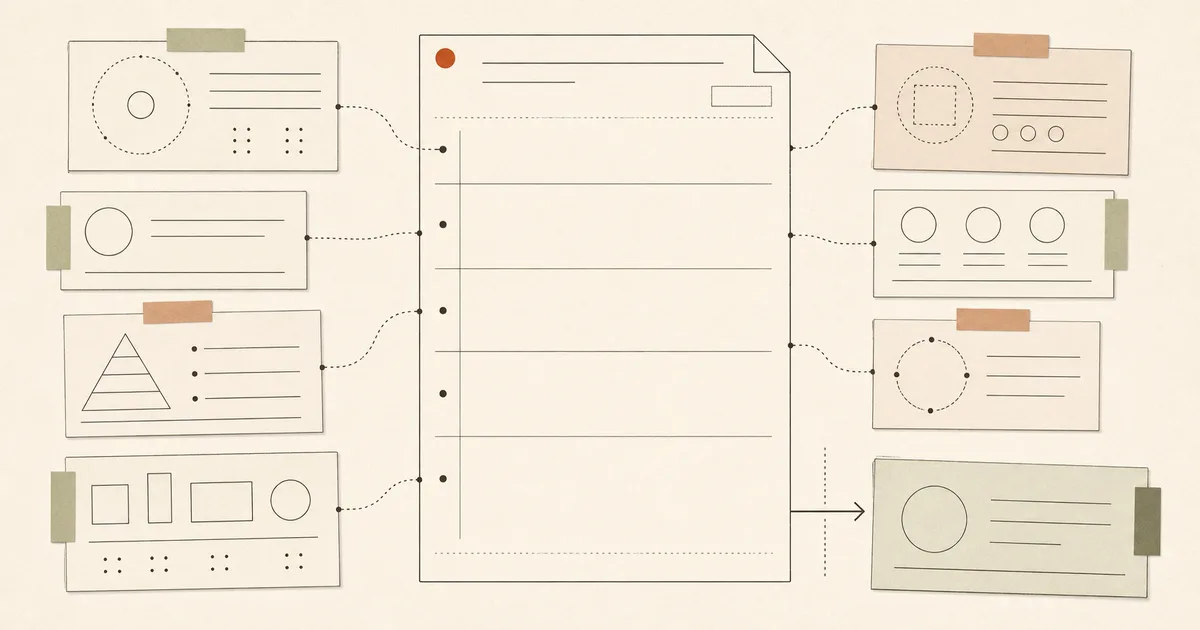
Turn the request into bounded creative direction
Start with the observable problem and audience evidence, then connect every direction to a source, assumption, requirement, reviewer, or external decision record.
State the business problem, user problem, and communication objective
Describe the observable business condition and the user barrier separately. Define what communication is intended to change or clarify, and make the measure reviewable without converting the objective into a guaranteed business result.
Sources: [brief-pack], [adobe-creative-brief], [gcs-oasis], [gcs-evaluation]
Build the audience from evidence and label the gaps
Record who the work is for, what they are trying to do, the barrier or need, and the source facts that support it. Treat unsupported stakeholder opinions as assumptions with a validation method, owner, due date, and state.
Sources: [brief-pack], [adobe-creative-brief], [gov-user-needs], [gcs-oasis]
Connect the message hierarchy to source facts
Write one primary takeaway, supporting statements with fact references, a requested next action, and a prohibited-claims list. Keep these as direction for the creative team rather than finished campaign copy.
Sources: [brief-pack], [adobe-creative-brief], [fhi-360-creative-brief]
Name deliverables, channels, and creative constraints
Specify each required deliverable, its purpose, audience, channel, required elements, format constraints, owner role, and non-final state. Reference governed brand guidance; do not reproduce a design system, production schedule, placement budget, or finished asset.
Sources: [brief-pack], [adobe-creative-brief], [fhi-360-creative-brief]
Make accessibility and rights requirements testable
Capture requirements for non-text alternatives, color-independent meaning, contrast review, provenance, permissions, attribution, territory, and expiry as the target format requires. Record rights status and next action; the brief does not certify accessibility or grant clearance.
Sources: [brief-pack], [fhi-360-creative-brief], [gcs-oasis], [wcag-22]
Separate creative review, feedback, and external approval
Use role identifiers for bounded review responsibilities, require feedback to identify the deliverable and brief revision, and consolidate it through one route. Point any legal, budget, production, or release decision to its accountable external record.
Sources: [brief-pack], [adobe-creative-brief], [fhi-360-creative-brief]
Define evaluation before production and preserve revisions
Describe what will be observed, the metric definition, baseline source, evaluation owner, evaluation window, and target type. Keep every revision in ascending order and validate the closed record before sharing it.
Sources: [brief-pack], [gcs-oasis], [gcs-evaluation], [json-schema-2020-12]
The creative brief boundary
Use this owner for bounded creative direction for a campaign or design deliverable. Keep authorization, delivery management, product behavior, production assets, and specialist approvals with their accountable records.
Included
- Business and user problem, evidence-backed audience, communication objective, message hierarchy, required deliverables and channels, creative constraints, source facts, assumptions, success-measure definitions, and revisions
- Brand-reference, accessibility, and rights requirements; explicit rights status; fictional reviewer roles; structured feedback; and a stable external approval handoff
- Editable Markdown, fictional JSON, closed Draft 2020-12 schema, dependency-free validator, mutation tests, and deterministic archive
Not included
- Project charter, project plan, schedule baseline, delivery commitment, resource allocation, or website-planning record; use the project-charter, software-project-plan, or website-planning owner as appropriate
- RFP, procurement decision, supplier proposal, statement of work, contract, media plan, placement budget, purchasing authority, or legal advice and approval
- PRD, acceptance criteria, technical requirements, design-system tokens or components, finished copy, final artwork, production files, accessibility certification, rights clearance, release authority, or outcome guarantee
DOWNLOADABLE RESOURCE
Download the creative brief template pack
Start with the Markdown worksheet, inspect the fictional structured example, then replace every fact, assumption, role, reserved URL, requirement, and handoff with reviewed project information.
Creative brief template pack
A bounded creative-direction pack for audience evidence, objectives, messages, deliverables, constraints, rights, reviews, feedback, approval handoff, success measures, and revisions.
Format: Markdown, JSON, JSON Schema, validator, and tests in one reproducible ZIP archive
Locally reproduced August 1, 2026. SHA-256: d44f174343ef21fd44c7ad87c89d101447369a76e4bcd5fa7be38a3c25caa9c2
Included
- Editable Markdown worksheet and fictional completed Markdown example
- Fictional JSON record with reserved sources, role identifiers, rights status, and false authority boundaries
- Closed Draft 2020-12 JSON Schema and dependency-free semantic validator
- Deterministic mutation tests and exact-allowlist archive builder
Verification boundary
Validated the fictional record, ran 81 deterministic positive and negative tests, checked closed object shapes and cross-record references, copied an exact flat-file allowlist, stripped volatile archive metadata, and reproduced the same ZIP bytes across consecutive builds and time zones.
Four bounded creative brief patterns
Keep the evidence, message, deliverable, constraint, review, and handoff contract stable while adapting the level of detail to the creative job.
Campaign landing page direction
Use when: A creative team needs one evidence-backed page objective, message hierarchy, content blocks, accessibility requirements, and review route before design exploration.
Connect the audience barrier to one communication objective, map support messages to source facts, and specify the page deliverable without writing final copy or defining the site project plan.
Structure
- Separate user need, communication objective, and page deliverable
- Hand site structure, milestones, dependencies, and launch planning to the website-planning owner
Watch for: A creative brief does not replace information architecture, acceptance criteria, accessibility testing, content approval, or release authorization.
Sources: [brief-pack], [adobe-creative-brief], [gov-user-needs], [wcag-22]
Short-video creative direction
Use when: A team needs purpose, audience, message order, duration and channel constraints, descriptive alternatives, source facts, and rights requirements before scripting or production.
Define the intended takeaway, supporting evidence, format boundary, required accessibility planning, proposed-source status, and external approval record.
Structure
- Keep script, storyboard, footage, music, and edit decisions outside the brief
- Record provenance and permission requirements before any proposed asset advances
Watch for: A reviewed brief does not clear footage or music, certify captions, approve spend, or promise reach, recall, or behavior change.
Sources: [brief-pack], [adobe-creative-brief], [fhi-360-creative-brief], [wcag-22]
Event handout direction
Use when: A team needs a concise physical-deliverable brief with audience need, message hierarchy, required information, reading and format constraints, rights status, and review roles.
Define what the handout must help the audience understand and do, then route brand, accessibility, factual, rights, and production checks to accountable reviewers.
Structure
- Specify essential content and format constraints without laying out the final piece
- Separate creative feedback from print purchasing and production approval
Watch for: The brief does not select a supplier, authorize printing, prove readability in the final output, or grant permission for third-party images.
Sources: [brief-pack], [fhi-360-creative-brief], [gov-user-needs]
Email and owned-social variation
Use when: One reviewed message needs bounded adaptations across owned channels without inventing a new claim, audience, objective, media budget, or success promise.
Keep one source-linked hierarchy, list the required channel variations and constraints, and define how feedback and revisions are consolidated across deliverables.
Structure
- Reference the same facts and prohibited claims across variations
- Define evaluation terms without treating channel output as business impact
Watch for: A deliverable list is not a media plan, posting schedule, channel-access grant, moderation plan, or outcome forecast.
Sources: [brief-pack], [adobe-creative-brief], [gcs-oasis], [gcs-evaluation]
Decide what belongs in the brief
Keep direction that changes a creative decision. Move authority, finished work, delivery control, and specialist conclusions to their governed owners.
An audience statement has no research, source fact, or observed evidence.
Choose: Record it as an assumption with the evidence gap, validation method, role owner, due date, and state, or remove it from the direction.
Tradeoff: The brief exposes uncertainty instead of sounding complete, but the creative team can distinguish evidence from an internal guess.
A message or required element has no source fact or accountable reference.
Choose: Link the narrow support or mark it prohibited until a source owner reviews it. Do not turn the creative brief into a source of truth by repetition.
Tradeoff: Some creative options stay unavailable, but unsupported claims do not harden into finished work.
Feedback asks for a new objective, audience, claim, deliverable, budget, or approval.
Choose: Return it as a requested decision tied to the current brief revision, and route scope, budget, or authority to its external accountable record.
Tradeoff: The feedback loop adds a visible handoff, but revisions remain attributable and the brief does not self-authorize expansion.
The brief starts containing milestones, dependencies, acceptance criteria, design tokens, finished copy, or final assets.
Choose: Keep the creative requirement and stable reference here, then move detailed planning, product behavior, governed components, or production work to the correct owner.
Tradeoff: Readers use several linked records, but each record retains one maintenance and authority boundary.
START WITH REVIEWABLE DIRECTION
Download the creative brief pack and inspect every boundary
Replace the fictional facts, assumptions, roles, rights record, and reserved sources. Keep the message evidence-linked, the deliverables unproduced, and every approval or outcome outside the brief.
Download the creative brief template packThe ZIP is locally reproduced. Public availability and adapted source accuracy require separate verification.
Use the website-planning guide for the wider site recordThis creative-brief owner stops at creative direction. The website-planning owner handles the broader site purpose, content, structure, requirements, and delivery preparation.
What a validated creative brief cannot prove
A closed field model improves reviewability and reveals missing references. It cannot inspect the audience, source material, creative execution, or accountable decision systems.
- The validator checks structure, selected references, reserved hosts, safe paths, sensitive-value patterns, revisions, and false authority boundaries. It does not authenticate a source fact or judge creative quality.
- A source-linked audience statement may still be incomplete, biased, stale, or inapplicable. Research owners must review evidence and assumptions for the real audience.
- Accessibility requirements in a brief do not certify WCAG conformance. The final content, design, code, media, and target formats require appropriate review and testing.
- A rights record does not interpret a license or grant permission. Provenance, permitted uses, attribution, territory, expiry, and legal questions stay with accountable records and reviewers.
- An external approval reference does not prove that a decision exists, is current, or was made by someone with authority.
- Success-measure definitions make later evaluation possible; they do not guarantee attention, recall, behavior, conversion, revenue, or any other outcome.
- This ordinary informational article does not grant AI signup credits. The linked product page follows its own current eligibility rules.
Current primary sources and verification record
The same-release artifact is the direct source for its original fields, examples, validator, tests, and archive. Current official references support creative-brief content, evidence-led audience definition, campaign objectives and evaluation, bounded accessibility requirements, and closed schemas. No external template language was copied.
[brief-pack] Playcode:Creative brief fictional example
Checked August 1, 2026. Supports: The locally reviewed field model, fictional example, reserved sources, role-based review, rights and approval boundaries, validator behavior, mutation tests, and reproducible archive. Public availability remains unverified until deployment.
[adobe-creative-brief] Adobe for Business:Creative briefs: how to write, examples, and templates
Checked August 1, 2026. Supports: Current guidance to define project context and objective, target audience, message, deliverables and formats, stakeholders, collaboration, data, review, and creative latitude rather than prescribing concepts.
[fhi-360-creative-brief] FHI 360:Creative brief template
Checked August 1, 2026. Supports: Official template coverage for communication objectives, audience, tone, key-message hierarchy, requested action, channels, language and reading considerations, style, layout, logos, and approval requirements.
[gcs-oasis] UK Government Communication Service:Guide to campaign planning: OASIS
Checked August 1, 2026. Supports: Current campaign-planning boundaries across objectives, audience and insight, strategy and ideas, implementation, and scoring and evaluation, including measurable outcome-focused objectives and accessibility and inclusion during planning.
[gcs-evaluation] UK Government Communication Service:GCS Evaluation Cycle
Checked August 1, 2026. Supports: Planning evaluation from the beginning and distinguishing inputs, outputs, outtakes, outcomes, impact, and learning instead of treating a produced deliverable as proof of the intended result.
[gov-user-needs] UK Government Digital Service:Learning about users and their needs
Checked August 1, 2026. Supports: Evidence-led understanding of who users are, what they are trying to do, their problems and frustrations, and the requirement to treat unsupported opinions as assumptions and focus on problems rather than proposed solutions.
[wcag-22] World Wide Web Consortium:Web Content Accessibility Guidelines 2.2
Checked August 1, 2026. Supports: Bounded requirements for non-text alternatives, color-independent meaning, contrast, and other testable success criteria relevant to the final target content. This page does not claim conformance.
[json-schema-2020-12] JSON Schema:JSON Schema Draft 2020-12
Checked August 1, 2026. Supports: The current specification family declared by the bundled closed schema. Cross-record references, reserved-host checks, revision parity, and false-authority rules remain in the dependency-free semantic validator.
Creative brief template questions
What is a creative brief?
A creative brief is a bounded direction record for creative work. It connects the business and user problem, evidence-backed audience, communication objective, message hierarchy, deliverables, channels, constraints, reviewers, feedback, and evaluation definition before production. It should leave useful room for creative exploration.
Who should write a creative brief?
A role accountable for creative direction should consolidate it with the request owner and relevant evidence, brand, accessibility, rights, and channel reviewers. Use role identifiers rather than personal contact details in the portable record, and keep external approval with the accountable decision owner.
How long should a creative brief be?
Use the shortest record that preserves the decision-changing facts, assumptions, message hierarchy, deliverables, constraints, review route, and handoffs. A familiar adaptation may need less context than a new campaign, but brevity should not hide missing evidence, rights status, or authority boundaries.
Is a creative brief the same as a project plan?
No. The brief owns creative direction. A project plan owns work breakdown, dependencies, milestones, resources, delivery controls, releases, and rollback. Link the records when needed, but do not turn deliverable direction into a schedule commitment or project authorization.
Should a creative brief include finished copy or design?
No. It can specify message hierarchy, required elements, tone or brand references, format constraints, and prohibited claims. Finished copy, artwork, components, production files, and final quality decisions belong to the creative and production workflow that follows the reviewed brief.
Does a reviewed creative brief approve rights or accessibility?
No. It can record testable accessibility requirements, proposed-source provenance, rights status, reviewer roles, and an external decision reference. Final assets and target formats still need appropriate review and testing; the brief cannot certify conformance, interpret a license, or grant legal clearance.
Can Playcode help turn a creative brief into a website?
Playcode can help build and iterate a website from reviewed direction, content, assets, and requirements. Keep site planning, factual approval, rights, accessibility testing, release authority, and target-environment verification with their accountable owners, and review the actual output rather than treating the brief as proof of completion.
BUILD FROM REVIEWED DIRECTION
Turn the accepted brief into a website you can inspect
Give Playcode the reviewed problem, audience evidence, objective, message hierarchy, content, cleared assets, format requirements, constraints, and feedback. Verify the actual site, accessibility, rights, facts, access, and release state before publishing.
Build and review your websiteThis ordinary informational article does not grant AI signup credits. No approval, accessibility conformance, rights clearance, launch, ranking, conversion, revenue, or other outcome is guaranteed.