QUICK ANSWER
What should a software project plan template include?
A software project plan template should connect an approved, version-controlled scope baseline to a work breakdown, dependency graph, milestone dates, accountable owners, acceptance evidence, risks, release gates, and rollback. Validate dates, foreign keys, cycles, schedule order, and gate completeness. Keep behavior in the PRD and capacity or staffing decisions in a separate resource plan.
A useful software project plan connects the delivery record from an approved, version-controlled scope baseline to release and recovery. Work items, dependencies, milestones, owners, acceptance evidence, risks, release gates, and rollback need stable IDs and strict dates so a reviewer can follow every decision without treating a schedule as a promise.
This downloadable pack uses one fictional checkout-recovery release to show those connections in XLSX, CSV, JSON, and Markdown. The plan links to accepted product behavior but does not redefine it, and it names accountable owners without estimating capacity, assigning people automatically, or making a staffing decision.
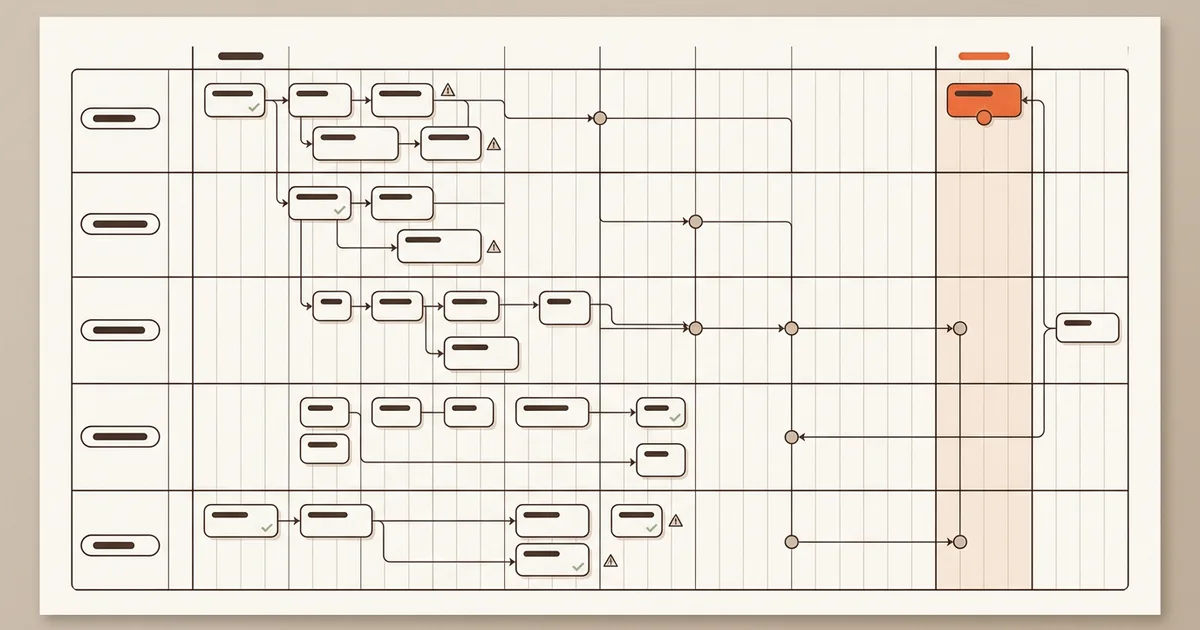
Build one traceable software delivery plan
Start from accepted records, then make sequence, evidence, decisions, and recovery explicit. A strict plan should fail closed when a link, date, dependency, owner, gate, or rollback contract stops matching the current version.
Freeze the owner, version, window, and scope links
Give the plan a stable ID, version, baseline date, delivery window, time zone, and accountable owner. Link the approved project scope statement revision plus accepted product requirements and exclusions instead of copying them into the schedule. A changed scope or behavior record should trigger a visible rebaseline, not a silent plan edit.
Sources: [software-plan-pack], [pmi-scheduling]
Create the work breakdown and dependency graph
Give every work item a stable ID, workstream, owner, status, planned start and end, milestone, acceptance links, risk links, and release. Add explicit predecessor and successor records with rationale and lag. Reject self-links, unknown IDs, duplicate edges, dependency cycles, and schedules that violate their own order.
Sources: [software-plan-pack], [pmi-scheduling]
Bind milestones to acceptance evidence and risks
A milestone should name the linked work, acceptance records, target date, accountable owner, and exit decision. Acceptance evidence uses reserved fictional links in the example. Risks keep probability, impact, trigger, response, mitigation, contingency, review date, and owner separate from an optimistic status label.
Sources: [software-plan-pack], [nist-ssdf]
Require complete release and rollback gates
A ready release must link the exact work set, current milestone, accepted evidence, and required acceptance, security, deployment, and rollback gates. The rollback plan names a trigger, owner, bounded steps, verification, and recovery window. A pending, blocked, missing, or stale gate makes the release invalid.
Sources: [software-plan-pack], [nist-ssdf], [nist-contingency]
Rebuild the exports and review the decision boundary
Generate XLSX, CSV, JSON, and Markdown from one model, compare CSV rows with JSON, scan the workbook for formulas, run negative tests, and lock the ZIP hash. Then have named owners review requirement links, evidence, risks, release authorization, monitoring, and rollback in the real environment.
Sources: [software-plan-pack], [nist-contingency]
The software delivery plan boundary
This owner covers a versioned delivery map from an approved scope baseline through work, dependencies, evidence, release, and rollback. It does not replace the records that define detailed scope, behavior, capacity, authorization, or operational truth.
Included
- Plan ID, version, owner, time zone, baseline, delivery window, and explicit status
- Work breakdown, predecessor-successor dependencies, milestones, owners, and strict dates
- Acceptance links, risk register entries, release gates, release record, and rollback plan
- Deterministic XLSX, CSV, JSON, and Markdown generated from one fictional model
- Closed record shapes, foreign-key checks, cycle detection, schedule order, export parity, and formula rejection
Not included
- Product requirements, user stories, feature behavior, requirement approval, or changes to the PRD owner
- Capacity, staffing, headcount, availability, utilization, workload allocation, employment decisions, or resource-plan behavior
- Budget approval, contract or statement-of-work terms, procurement, invoices, or legal advice
- Automatic prioritization, person selection, assignment, release authorization, deployment, monitoring, or rollback execution
- Proof that dates are feasible, evidence is authentic, risks are complete, a release is safe, or recovery will meet an objective
DOWNLOADABLE RESOURCE
Download the software project plan template pack
Use the workbook for review, the seven CSV tables for narrow imports, the JSON model for automation, and the Markdown version for decisions. The dependency-free validator checks the complete record graph before the ZIP is rebuilt.
Software project plan template pack
A fictional software delivery plan connecting accepted scope, work breakdown, dependencies, milestones, owners, acceptance evidence, risks, release gates, one release, and rollback.
Format: XLSX, CSV, JSON, Markdown, validator, and tests in one reproducible ZIP archive
Locally reproduced August 1, 2026. SHA-256: d5b0ea43283eb7e1783554bb0930027455d6180f74ac439e6fa42b37c86f9ee7
Included
- Eight-sheet XLSX workbook plus seven focused CSV exports
- Canonical JSON plan and a generated Markdown review copy
- Five work items, five dependencies, four milestones, seven acceptance records, and five risks
- Acceptance, security, deployment, and rollback release gates with exact foreign keys
- Dependency-free validator, 27 deterministic tests, and reproducible ZIP builder
Verification boundary
The source allowlist, generated bytes, clean extraction, workbook sheets and no-formula rule, CSV and JSON parity, strict record shapes, stable IDs, owners, real calendar dates, dependency and parent cycles, schedule order, milestone and acceptance parity, risks, release gates, rollback ownership, unsafe values, and time-zone-independent ZIP hash were checked locally.
Three software project planning patterns
The record model stays consistent while the release shape changes. Each example keeps product behavior, delivery sequencing, capacity decisions, and authorization in their distinct owner systems.
Bounded feature release
Use when: One accepted feature moves through implementation, integration evidence, release review, and a reversible deployment.
Link the requirement version, split interface and backend work, join them at a verified milestone, and require current acceptance, security, deployment, and rollback evidence before the release can be ready.
Structure
- Stable dependency IDs make parallel work and the join point reviewable
- The rollback trigger and verification stay attached to the exact release record
Watch for: A complete plan does not prove that the requirement is correct, the environment matches, the release is authorized, or rollback will succeed.
Sources: [software-plan-pack], [nist-ssdf], [nist-contingency]
Migration with a cutover gate
Use when: A schema or data change needs trial runs, compatibility work, reconciliation, a cutover decision, and rollback.
Create explicit preparation, trial, compatibility, reconciliation, cutover, and verification work with a dependency graph. Keep data mapping and migration balances in their dedicated migration plan, then link only accepted evidence here.
Structure
- The release gate links the exact trial and reconciliation evidence
- The rollback record names compatible artifacts, data boundaries, trigger, and verification
Watch for: Do not compress source-to-target mapping, retention, privacy, reconciliation, or irreversible data decisions into a project-plan checkbox.
Sources: [software-plan-pack], [nist-contingency]
Multi-stream software launch
Use when: Application, documentation, support, and operations work converge on one reviewed release decision.
Keep each workstream and owner explicit, use milestones for real convergence points, and require acceptance evidence from every required stream. The release record points to one exact artifact and rollback owner.
Structure
- Dependencies expose the critical handoffs without implying every date is certain
- Risk triggers and contingencies remain visible beside the release gates
Watch for: Owner fields express accountability for records and decisions. They do not allocate capacity, assign people automatically, or make an employment decision.
Sources: [software-plan-pack], [pmi-scheduling], [nist-ssdf]
Decide whether the software project plan is reviewable
A reviewable plan has one connected, current record graph. Passing structural validation is necessary, but named owners still decide whether evidence, risks, authorization, and recovery are sufficient for the real release.
A work item has an unknown owner, milestone, acceptance, risk, or release ID
Choose: Reject the plan version and repair the source record instead of deleting the broken link from an export.
Tradeoff: The review stops, but the plan cannot hide an orphaned decision or silently drop required evidence.
The dependency graph contains a cycle or violates date and lag order
Choose: Resolve the sequence or split the work and decision boundary before publishing a schedule.
Tradeoff: Dates may move, but reviewers get an executable order instead of a circular or impossible plan.
A required release gate is pending, blocked, missing, stale, or lacks an owner and evidence link
Choose: Keep the release invalid and record the exact unresolved gate and accountable decision owner.
Tradeoff: Authorization waits, but a spreadsheet status cannot substitute for accepted evidence or recovery readiness.
The plan starts describing product behavior or person-level capacity and allocation
Choose: Move product behavior to the PRD and capacity or staffing decisions to the resource plan, then link only the accepted version IDs.
Tradeoff: The delivery plan carries less detail, but requirements and staffing owners remain authoritative and independently reviewable.
START WITH THE CONNECTED PLAN
Download the project plan and inspect every link
Open the workbook, JSON, CSV, and Markdown views; trace scope to work, dependencies, milestones, acceptance, risks, release gates, and rollback; then run the included validator before adapting the fictional records.
Download the software project plan packThe ZIP is reproduced locally. Public availability and adapted source accuracy require separate verification.
Define product behavior in the PRD templateUse the PRD owner for behavior and acceptance meaning. This page owns delivery sequencing and release planning only.
What the project plan cannot prove
The template makes delivery relationships visible and machine-checkable. It cannot manufacture accurate requirements, feasible estimates, accepted evidence, release authority, safe operations, or reliable recovery.
- Dates and dependency order are planning inputs, not delivery promises, service levels, quotes, or guarantees.
- An owner ID records accountability for a work or decision record; it does not prove availability, capacity, consent, assignment, qualification, or performance.
- The pack does not implement requirement approval, source control, CI, access control, test execution, deployment, monitoring, incident response, audit storage, or rollback.
- A real release requires current target-environment evidence, authorized owners, privacy and security review, monitoring, recovery rehearsal, retention, export, and post-release decisions.
- This ordinary informational article does not grant AI signup credits. The linked product page follows its own current eligibility rules.
Sources and verification record
The same-release artifact is the direct source for the example records and deterministic checks. Current primary professional and U.S. government references support scheduling structure, secure delivery practices, and contingency planning without certifying this template or a real release.
[software-plan-pack] Playcode:Software project plan fictional example
Checked August 1, 2026. Supports: The locally reviewed five work items, five dependencies, four milestones, seven acceptance criteria, five risks, four required release gates, one release, one rollback plan, exports, and deterministic validation. Public availability remains unverified until deployment.
[pmi-scheduling] Project Management Institute:Practice Standard for Scheduling, Second Edition
Checked August 1, 2026. Supports: Schedule-model concepts including IDs and versions, activity definition and sequencing, calendars, milestones, update cycles, baselines, approved changes, communication, and maintained records. It does not prescribe this pack.
[nist-ssdf] National Institute of Standards and Technology:Secure Software Development Framework 1.1
Checked August 1, 2026. Supports: Role, task, evidence, release-integrity, vulnerability, provenance, and response practices for secure software development. Structural validation of this pack does not establish SSDF conformance.
[nist-contingency] National Institute of Standards and Technology:Contingency Planning Guide for Federal Information Systems
Checked August 1, 2026. Supports: Contingency roles, activation criteria, recovery procedures, testing, maintenance, and restoration verification as planning references. It does not prove that this fictional rollback will work.
Software project plan template questions
What is the difference between a software project plan and a PRD?
The PRD owns the product problem, scope, behavior, requirements, exclusions, and acceptance meaning. The software project plan owns how accepted records move through work, dependencies, milestones, evidence, risks, release gates, and rollback. Link versioned PRD and acceptance IDs; do not copy or silently reinterpret them in the schedule.
Is a software project plan the same as resource planning?
No. This plan names accountable owners and delivery sequence. Resource planning owns capacity, demand, calendars, proposals, approvals, assignments, and staffing boundaries. An owner field does not prove that a person is available, assigned, qualified, or able to meet a date, and the project plan must not auto-allocate people.
How should dependencies be represented?
Use stable predecessor and successor work-item IDs, one allowed dependency type, an explicit lag, and a rationale. Reject self-links, unknown IDs, duplicate edges, cycles, and a successor date that violates the predecessor finish plus lag. Keep the dependency graph separate from visual row order so exports cannot silently change sequence.
What makes a release gate complete?
A required gate needs a stable ID, declared type, named owner, current evidence link, required flag, and ready status. This example requires acceptance, security, deployment, and rollback gates and rejects pending, blocked, missing, duplicate, or optional substitutes. A ready record still requires explicit release authorization in the real workflow.
What should a rollback plan include?
Name the exact release, accountable owner, activation trigger, bounded ordered steps, verification, and expected recovery window. Rehearse it against the release candidate and known fixture in the target environment. A written rollback plan or spreadsheet checkbox cannot prove compatibility, data restoration, authorization, or recovery performance.
Can Playcode turn this project plan into a working delivery tool?
Playcode can help build a bounded workflow around reviewed plan, work, dependency, milestone, evidence, risk, release, and rollback records. The operational system still needs server-side authorization, concurrent-write handling, audit, integrations, source-control and CI evidence, monitoring, recovery rehearsal, and target-environment verification before a team relies on it.
BUILD THE REVIEWED DELIVERY FLOW
Turn the accepted plan into a bounded software workflow
Give Playcode the reviewed record model, IDs, owners, dates, dependencies, evidence, gates, and rollback boundary. Verify authorization, concurrency, integrations, audit, monitoring, recovery, and the target environment before operational use.
Build and verify the delivery workflowThis informational article does not grant AI signup credits. No requirement, staffing, schedule, release, security, compliance, recovery, or delivery outcome is guaranteed.