QUICK ANSWER
What should a customer journey map template include?
A customer journey map template should define one user group, task, trigger, start, and end, then organize evidence-linked stages, touchpoints, channels, user actions, needs, service responses, reported states, friction, exceptions, and recovery. It should separate observations, inferences, assumptions, hypotheses, owners, review dates, and proposed measurements so a polished diagram cannot imply research coverage or outcomes it does not have.
A customer journey map should show how one evidence-backed user group experiences a bounded task over time: the trigger, stages, touchpoints, channels, actions, needs, reported state, friction, exceptions, recovery, and unresolved questions. It should preserve where evidence ends instead of decorating a smooth path with invented emotions or outcomes.
The downloadable pack includes an editable Markdown template, fictional evidence-linked JSON, a strict JSON Schema, and a dependency-free validator with thirty tests. This page owns the journey over time. A user persona owns the aggregate group, a website content plan owns page inventory, and a client onboarding process owns the post-signed-scope service handoff.
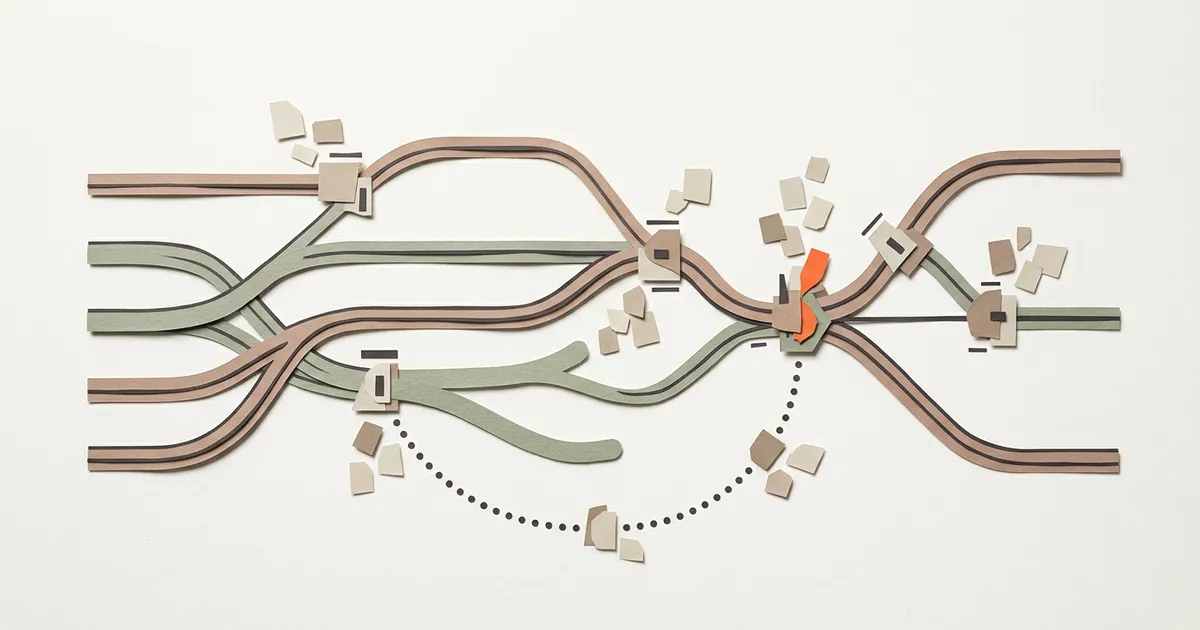
Map the current experience from evidence to review
Build a revisable synthesis around one bounded task and one task-relevant group. Keep raw research in its authorized system and keep future possibilities visibly separate from current-state evidence.
Set the trigger, task, start, end, and user group
GOV.UK describes an experience map as a visual representation of an experience over time and recommends using stages or steps as the spine. State the wider problem, online and offline context, and explicit exclusions before drawing. Use a separate map when research shows materially different groups or paths.
Sources: [journey-pack], [gov-experience-map], [gov-whole-problem]
Register aggregate evidence before touchpoints
Give each aggregate interview synthesis, observation summary, support theme, analytics summary, or document review a stable ID, observed period, count and unit, owner, safe repository reference, summary, and review status. Start with actual or likely users; treat internal opinion as an assumption rather than user evidence.
Sources: [journey-pack], [gov-user-needs], [ico-data-minimisation]
Separate action, need, response, and reported state
For each touchpoint, record what the user does, what they need, what the service presents, the channel, and the supporting source IDs. GOV.UK experience-map guidance includes touchpoints, channels, needs, and reported emotional highs or lows. Do not invent a reported state when the evidence does not contain one.
Sources: [journey-pack], [gov-experience-map]
Preserve friction, exceptions, and recovery
A map of the whole problem includes the steps before and after a narrow service and may cross online and offline touchpoints. Record breakdowns and recovery needs rather than presenting only the happy path. Keep backend process detail in a separately owned service blueprint or workflow.
Sources: [journey-pack], [gov-whole-problem]
Label future ideas as hypotheses and review the map
Link every opportunity to evidenced friction, list the evidence still needed, assign an owner and review date, and keep proposed measurements explicit about what they do not prove. JSON Schema can check representation; the packaged validator adds cross-reference and boundary rules, but neither can establish research truth or service outcomes.
Sources: [journey-pack], [gov-user-needs], [json-schema-2020-12]
What this customer journey map owns
This page owns one evidence-backed experience over time from a defined trigger to a defined end. Adjacent templates retain their own group, content, handoff, workflow, and implementation decisions.
Included
- One journey ID, revision, current-state or future-state-hypothesis label, user group, trigger, task, start, end, included context, and explicit exclusions
- Aggregate source register with observed periods, counts and units, owners, safe references, summaries, review states, and no-personal-data flags
- Ordered stages and touchpoints with channels, user actions, needs, service responses, evidence status, confidence, source references, reported states, friction, support contexts, owners, and review dates
- Breakpoints, recovery needs, linked hypotheses, evidence-needed lists, proposed measurements, maintenance history, and explicit no-outcome boundaries
- Editable Markdown, fictional JSON, strict Draft 2020-12 schema, dependency-free validator, thirty deterministic tests, and reproducible allowlisted ZIP
Not included
- An individual or aggregate user profile owned by `/blog/user-persona-template`; this map references a group but does not replace its evidence record
- Page purpose, audience question, message, claim, evidence, CTA, rights, owner, and freshness inventory owned by `/blog/website-content-plan`
- The post-signed-scope professional-service handoff, dependencies, kickoff, first delivery, and ongoing-service transition owned by `/blog/client-onboarding-process`
- A workflow, standard operating procedure, backend process map, service blueprint, system architecture, implementation plan, backlog decision, or launch approval
- Raw notes, recordings, transcripts, participant names, contact details, identifiers, quotes, credentials, private access references, or another portable research repository
- A claim of complete journey coverage, representativeness, accessibility, privacy, legal compliance, customer satisfaction, conversion, retention, revenue, or product outcome
DOWNLOADABLE RESOURCE
Download the customer journey map evidence pack
The ZIP contains the editable worksheet and the exact fictional record, schema, validator, and tests used to demonstrate aggregate evidence, cross-channel touchpoints, breakdown recovery, hypotheses, maintenance, and explicit status boundaries.
Customer journey map evidence pack
A current-state research-synthesis record for stages, touchpoints, evidence, reported states, friction, recovery, hypotheses, owners, and review.
Format: Markdown, JSON, JSON Schema, and dependency-free Node.js validator/tests in one ZIP
Locally reproduced August 1, 2026. SHA-256: 80f482a3d4675634707f8715f6e0c8ac477336b2cfdcdab68bf697c1f3792ffb
Included
- Editable seven-section Markdown worksheet with persona, content-plan, onboarding, workflow, service-blueprint, implementation, and outcome boundaries
- Completed fictional Alder Lantern Tool Library renewal map with four stages, four touchpoints, three aggregate sources, two open breakpoints, two hypotheses, and one proposed measurement
- Strict Draft 2020-12 JSON Schema plus dependency-free validator and thirty positive and negative tests for shape, references, dates, evidence, privacy, status, and maintenance boundaries
Verification boundary
The seven-file allowlist was built twice with fixed UTC archive timestamps, extracted, byte-compared with canonical sources, and tested locally. This proves reproducible artifact bytes and internal consistency, not public availability before deployment, research quality, representativeness, privacy, legal or accessibility approval, journey coverage, satisfaction, implementation, or outcome.
Three bounded customer journey map examples
Use the same evidence contract for different research stages, but do not merge distinct groups or let a future-state idea masquerade as an observed current experience.
Current-state service journey
Use when: Research supports how one task-relevant group moves from a trigger through several service touchpoints to a bounded end.
The fictional pack follows a tool-library renewal from reminder through requirements, submission, and confirmation or recovery. Every reported state and breakpoint references aggregate evidence, while an inferred touchpoint keeps its state not observed.
Structure
- Task and group boundary, aggregate source register, ordered stages, channels, actions, needs, service responses, evidence states, confidence, and reported states
- Open breakdowns, recovery needs, hypotheses, evidence-needed lists, proposed signal, accountable roles, dates, and revision history
Watch for: The fictional path demonstrates the record contract. It does not represent real members, establish prevalence, cover every route, or show that a service change worked.
Sources: [journey-pack], [gov-experience-map], [gov-user-needs]
Cross-channel exception and recovery journey
Use when: A task crosses reminders, a website, a form, and assisted support, and the breakdown path matters as much as the expected path.
Map the wider problem before, during, and after the narrow digital interaction. Record where the channel changes, what prior work remains, what evidence supports the breakdown, and what recovery the user needs without converting staff workflow into journey evidence.
Structure
- Online and offline touchpoints with one continuous task boundary and evidence-linked channel transitions
- Breakpoint symptom, accepted evidence, recovery need, owner, open status, and separately owned service-operation questions
Watch for: A journey map describes the user experience. A service blueprint or workflow must separately define people, systems, controls, provider behavior, and operational implementation.
Sources: [journey-pack], [gov-whole-problem], [ico-data-minimisation]
Early-discovery hypothesis map
Use when: The team needs a visible starting model but current research leaves material stages, touchpoints, or states unresolved.
Label the artifact future-state-hypothesis or keep uncertain current touchpoints inferred, assumed, or not observed. Use low confidence for assumptions, list evidence needed, and date the next research review instead of completing the picture with plausible fiction.
Structure
- Known evidence and explicit gaps separated from internal opinions, proposed paths, and future-state hypotheses
- Research-needed decisions, proposed measurements with does-not-prove statements, owners, review dates, and revision triggers
Watch for: A hypothesis map is a research and design prompt. It is not a current-state finding, implementation approval, prioritization decision, launch plan, or predicted outcome.
Sources: [journey-pack], [gov-user-needs], [json-schema-2020-12]
Decide whether the journey is ready for review
A reviewable map exposes the line from aggregate source to touchpoint, state, friction, and hypothesis. When that line is missing, keep the gap visible and collect evidence.
The trigger, primary task, start, end, or user group is ambiguous.
Choose: Keep the map in draft, narrow the boundary, and split materially different groups or tasks into separate maps.
Tradeoff: More maps require maintenance, but one smooth diagram no longer hides distinct experiences and unsupported transitions.
A touchpoint or reported state has no accepted aggregate source.
Choose: Mark it inferred, assumed, or not observed, reduce confidence, remove the reported-state claim where necessary, and assign a research question.
Tradeoff: The map looks less complete, but visual polish cannot turn team opinion into user evidence.
The map includes only the expected path while research shows failures or support contacts.
Choose: Add the breakpoint and recovery route, including what prior work is preserved, the evidence references, owner, and open status.
Tradeoff: The diagram becomes more complex, but it reflects the experience that needs investigation rather than only the designed sequence.
An opportunity is being treated as an approved feature or expected outcome.
Choose: Keep it labelled as a hypothesis, link it to evidenced friction, state the evidence needed, and route implementation or prioritization to the authorized owner.
Tradeoff: Delivery waits for a decision, but the research artifact does not silently become a roadmap or outcome promise.
The service, source evidence, group definition, or unresolved contradiction changes.
Choose: Create a new revision, update affected confidence and references, preserve the change summary, and set the next review date.
Tradeoff: Maintenance is ongoing work, but readers can distinguish current synthesis from stale historical assumptions.
When evidence becomes a maintained workflow
Build a review workspace around the approved boundary
Describe the aggregate source register, stage review, breakpoint queue, hypothesis gates, revision history, and role-based handoffs your team needs to maintain.
Explore internal toolsThis downloadable template and ordinary informational article do not grant signup AI credits.
Define the aggregate user group with the user persona templateThe persona owns the task-relevant group evidence; this map owns how that group experiences a bounded task over time.
Limits of a customer journey map
A structured map can make evidence, uncertainty, and maintenance visible. It cannot establish that the research or every interpretation is correct, sufficient, representative, safe, lawful, accessible, or effective.
- The fictional organization, group, counts, findings, touchpoints, states, friction, dates, and hypotheses are teaching fixtures, not real research, benchmarks, recommended deadlines, or product evidence.
- The validator checks strict shapes, stable IDs, references, aggregate-source states, dates, privacy flags, hypothesis boundaries, and status consistency. It does not validate research methods, consent, truth, representativeness, causality, accessibility, privacy, legality, or service quality.
- GOV.UK, the ICO, and JSON Schema provide source guidance. They did not review, approve, certify, endorse, or test this Playcode artifact.
- Keep participant identities, contact details, screening responses, raw notes, recordings, transcripts, quotations, credentials, private links, and protected evidence outside the portable pack.
- A reported state is a bounded synthesis of what participants reported. It is not a clinical assessment, sentiment score, satisfaction metric, or universal emotional curve.
- A current-state map can still omit groups, channels, exceptions, or context. A future-state map remains a hypothesis until research supports what actually happens.
- A journey map does not own the individual persona, website content inventory, client onboarding handoff, service blueprint, workflow, implementation plan, backlog, launch, or product outcome.
- Applicable research, data-protection, accessibility, sector, and legal duties depend on the people, data, service, systems, location, and jurisdiction. Authorized reviewers must decide them using current facts.
Sources used for the journey and evidence boundary
These sources support experience-map structure, whole-problem scope, user-evidence practice, data minimisation, and structural validation. The downloadable synthesis contract is Playcode editorial work and carries no source endorsement.
[journey-pack] Playcode:Customer journey map evidence pack
Checked August 1, 2026. Supports: The exact editable worksheet, fictional evidence-linked example, schema, dependency-free validator, thirty tests, explicit boundaries, and reproducible archive described by this article.
[gov-experience-map] GOV.UK Service Manual:Creating an experience map
Checked August 1, 2026. Supports: Experience maps as visual representations over time, stages or steps as the spine, evidence from several users, touchpoints, channels, user needs, reported emotional highs and lows, separate maps for meaningfully different groups, and iterative review.
[gov-whole-problem] GOV.UK Service Manual:Map a user's whole problem
Checked August 1, 2026. Supports: Mapping the wider task across online and offline touchpoints, including context before and after a narrow service, while keeping service-landscape and future-state design work distinct from current user evidence.
[gov-user-needs] GOV.UK Service Manual:Start by learning user needs
Checked August 1, 2026. Supports: Starting with evidence from actual or likely users, treating internal opinions as assumptions, learning throughout the service lifecycle, and revising understanding as evidence changes.
[ico-data-minimisation] Information Commissioner's Office:Principle (c): Data minimisation
Checked August 1, 2026. Supports: Current guidance that personal data should be adequate, relevant, and limited to what is necessary, and that opinion should be distinguished from fact. It is guidance, not legal advice or a compliance decision.
[json-schema-2020-12] JSON Schema:JSON Schema Draft 2020-12 validation specification
Checked August 1, 2026. Supports: The Draft 2020-12 validation vocabulary and the boundary that structural or format validation does not establish semantic truth, resource existence, or a service outcome.
Customer journey map template questions
What files are included in the customer journey map template?
The ZIP includes an editable Markdown worksheet, completed fictional JSON example, strict Draft 2020-12 JSON Schema, dependency-free validator, thirty positive and negative tests, README, and package commands. The archive is built from an exact seven-file allowlist with fixed timestamps.
What is the difference between a customer journey map and a user persona?
A user persona describes one aggregate, task-relevant user group through evidence-backed needs, behaviors, contexts, constraints, confidence, and gaps. A customer journey map references that group and organizes its experience over time through stages, touchpoints, channels, actions, needs, reported states, friction, and recovery.
How is this different from a website content plan?
A website content plan inventories pages and records each page purpose, audience question, message, claim, evidence, CTA, owner, rights, status, and freshness. A journey map follows one bounded user task across time and channels. A page may be one touchpoint, but it is not the journey owner.
How is this different from a client onboarding process?
The client onboarding process owns a professional-service handoff after signed scope, including dependencies, readiness, kickoff, first delivery, and transition. This journey template owns evidence about a user group experiencing a bounded task. It does not define service operations or SaaS customer adoption.
Is a customer journey map the same as a service blueprint?
No. A journey map centers the evidence-backed user experience across time. A service blueprint separately connects that visible experience to people, systems, controls, provider actions, and backstage operations. The two may reference each other, but one does not prove or implement the other.
Should every touchpoint include an emotion or satisfaction score?
No. Include a reported state only when accepted research supports what users reported in that bounded context. Mark it not observed when it is absent. Do not invent a universal emotion curve or treat a qualitative label as a satisfaction score, clinical assessment, or outcome metric.
Can participant notes or contact details go in the map?
No. Keep identities, contact values, screening answers, raw notes, recordings, transcripts, quotes, credentials, and protected evidence in an authorized research system. The portable pack carries aggregate summaries and safe references only, and its validator rejects contact and credential-like values.
Does validation prove that the journey is complete or correct?
No. The schema and validator check structure, references, states, dates, and explicit boundaries. They cannot prove research quality, consent, representativeness, truth, privacy, accessibility, legality, complete journey coverage, customer satisfaction, causality, implementation readiness, or product outcome. This ordinary article does not grant signup AI credits.
Maintain the evidence without losing its limits
Build the internal tool around your reviewed journey contract
Start with the fictional pack, replace it with authorized aggregate references, then describe the source review, map revisions, exception queue, role permissions, and human decision gates you want Playcode to build.
Build an internal toolNamed humans still own research, participant privacy, evidence interpretation, accessibility, legal review, journey coverage, implementation, and every real outcome. This article does not grant signup AI credits.