QUICK ANSWER
What should a website content plan include?
For each page or content item, record its job, audience, audience question, primary message, claim or fact, evidence source and status, format, content owner, review owner, rights status, workflow status, primary call to action, destination, locale, review date, freshness trigger, and notes. Treat unresolved evidence, rights, ownership, and approval as visible blockers.
A website content plan should say more than which pages need copy. It should connect each page to an audience question, message, claim, evidence source, content owner, primary action, approval state, rights decision, and freshness trigger. That makes missing facts and decisions visible before they become polished but unsupported copy.
The downloadable ledger gives those decisions one reviewable home. Its ten fictional starter rows show how a service business might plan homepage, service, case-study, pricing, team, FAQ, contact, policy, and resource content without treating the example claims as facts about a real organization.
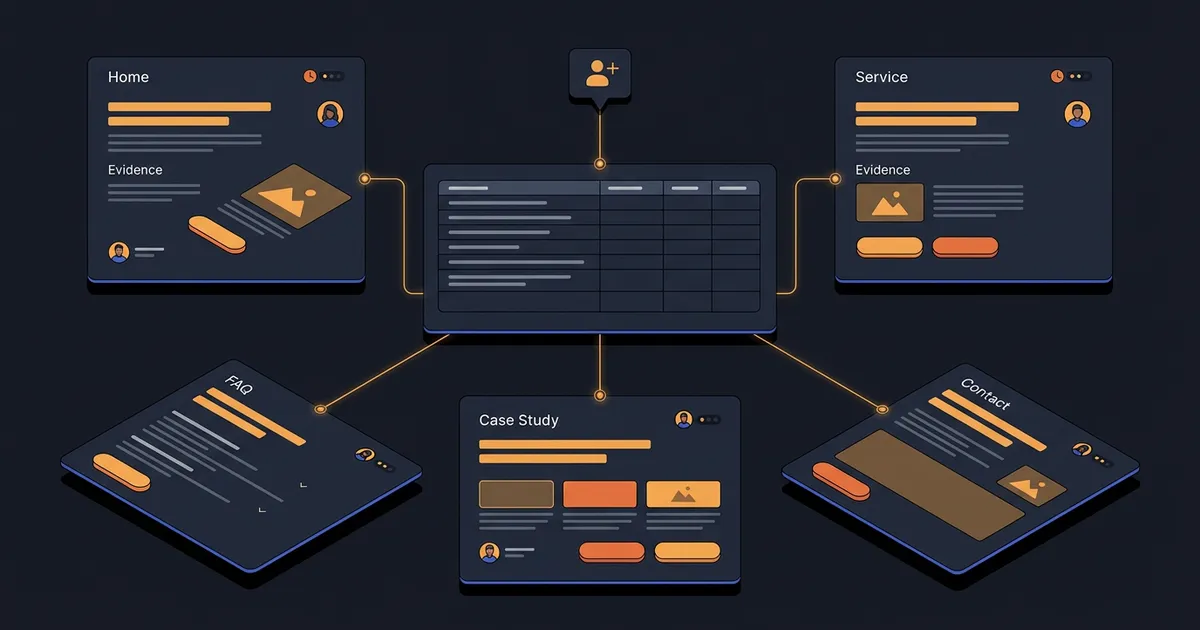
Plan content as accountable decisions
Use four passes. Start with what a specific audience needs to understand or do, then connect that need to a page job, support every consequential claim, and assign a review rule that survives launch.
Name the audience question and page job
Write the situation and question that bring the intended visitor to the page. Give the page one primary job such as explain a service boundary, establish evidence, resolve an objection, help a buyer compare, or collect a qualified request. If two rows serve materially different questions or outcomes, plan separate sections or pages instead of forcing both into generic copy.
Sources: [gov-publishing-user-needs], [google-helpful-content]
Separate the message, claim, and evidence
The message is what the audience should understand. A claim or fact is the specific statement that may require support. Record the underlying source, evidence status, accountable reviewer, and expiry condition before drafting stronger language. Do not turn an aspiration, unsupported testimonial, sample result, or generated sentence into a published fact.
Assign the content, rights, and review workflow
Name the person responsible for preparing the content and the person authorized to approve its claim, policy, price, image, testimonial, or regulated meaning. Record whether text and media are owned, licensed, permissioned, restricted, or unresolved. Give draft, review, approved, published, archived, and blocked states clear entry and exit conditions.
Sources: [digital-gov-content-goals], [w3c-accessibility-plan], [ftc-advertising-faq]
Connect the action and freshness trigger
State the page action, destination, durable success boundary, locale, review date, and event that makes the row stale. A plan should identify when pricing, service scope, staff, policy, provider, evidence, rights, or workflow changes require review. After launch, verify the rendered link, destination, form behavior, permissions, and public artifact separately.
What this content ledger owns
Use the worksheet after the audience and website job are understood and before unfinished claims disappear inside design files or implementation tickets.
Included
- Page purpose, audience, audience question, primary message, content format, and call-to-action destination
- Claim or fact, evidence source, evidence status, content owner, and accountable review owner
- Text, image, video, logo, testimonial, case evidence, policy, pricing, biography, form introduction, and download records
- Rights status, workflow status, locale, review date, freshness trigger, and publication notes
- Fictional starter rows that show relationships between fields without asserting facts about a real organization
Not included
- The site hierarchy and URL relationships owned by a sitemap or the screen-level arrangement owned by a wireframe
- The broader audience, journey, functional requirement, provider, launch, and acceptance brief owned by a website plan
- Publication cadence, campaign scheduling, social posts, and channel planning owned by an editorial or content calendar
- Finished copy, visual design, legal advice, accessibility conformance, advertising approval, security review, or production testing
- A promise of rankings, traffic, leads, conversion, revenue, accessibility, compliance, approval, or content performance
- A replacement for direct user research, subject-matter review, rights verification, licensed review, or accountable organizational decisions
DOWNLOADABLE RESOURCE
Download the Website Content Plan
The CSV opens in spreadsheet tools and keeps one row per content item. The included example.test rows are fictional and deliberately mix approved, draft, review, permission-pending, and evidence-pending states. Replace them with reviewed facts, real owners, controlled source links, and your own workflow before using the file as a publication record.
Website content plan ledger
A 20-column content ledger with ten fictional starter rows spanning homepage, service, diagram, case study, pricing, team, FAQ, contact, policy, and downloadable-resource content.
Format: CSV
Locally reproduced August 1, 2026. SHA-256: 1938a192c301211d33870da6331c403c1f952fb64c208d03b563b5c498768393
Included
- Page job, audience question, message, claim or fact, evidence source, and evidence status
- Content format, content owner, review owner, rights status, and workflow status
- Primary call to action, destination, locale, review date, freshness trigger, and notes
- Reserved example.test rows with mixed states that expose unresolved evidence and permission rather than hiding it
Verification boundary
Parsed locally on 2026-08-01 as UTF-8 CSV: one 20-field header, ten unique content IDs, ten equal-width rows, reserved example.test URLs, allowed evidence, rights, and workflow states, ISO review dates, and no spreadsheet-formula prefixes. Public HTTP and content-type verification remain pending deployment.
Three useful content-plan configurations
These configurations change the row mix and review roles while preserving the same question, message, evidence, action, ownership, rights, and freshness fields. They are planning examples, not completed strategies or outcome claims.
Service website content plan
Use when: A buyer needs to understand services, fit, proof, process, constraints, pricing logic, and the next step before submitting a request.
Plan one row per homepage promise, service fact, qualification rule, process step, case claim, testimonial, pricing assumption, FAQ answer, form explanation, policy statement, and contact outcome. Give every material claim a source and review owner.
Structure
- Decision content: audience question, service boundary, message, claim, evidence, limitation, and next step
- Trust content: author or team role, case method, testimonial permission, pricing assumptions, policy owner, and review date
- Conversion content: form purpose, minimum fields, privacy explanation, validation, durable result, confirmation, destination, and failure path
Watch for: A polished case study or testimonial does not establish a typical outcome. Verify permission, context, measurement method, current accuracy, and the support required for every objective claim.
Product website content plan
Use when: Visitors compare capabilities, workflows, pricing meters, limitations, integrations, security boundaries, deployment, and exit paths.
Create separate rows for capability, current status, user role, input, output, error state, provider dependency, pricing meter, evidence, limitation, and CTA. Keep roadmap ideas, prototypes, examples, and generally available behavior visibly different.
Structure
- Capability record: user, job, input, output, verified environment, evidence, limitation, owner, and review trigger
- Commercial record: plan, meter, included quantity, overage, provider cost, currency, tax boundary, effective date, and source
- Operational record: access, data path, provider, monitoring, failure, retry, export, deletion, recovery, and accountable owner
Watch for: A local fixture, screenshot, design, or roadmap item is not proof that a capability is available to customers in production. Label each evidence boundary directly.
Article and resource library plan
Use when: The website publishes articles, templates, examples, reports, documentation, or other content with repeated ownership and freshness needs.
Give each item a distinct audience job, canonical owner, original payload, source record, author or reviewer, update rule, related destination, and archive or redirect decision. Treat search demand as evidence of a question, not permission to publish interchangeable pages.
Structure
- Owner record: primary question, canonical URL, neighboring owners, unique payload, audience outcome, and conversion handoff
- Evidence record: sources, checked date, expiry, method, artifact, limitations, author, and qualified reviewer
- Lifecycle record: draft, review, approved, published, monitor, refresh, consolidate, archive, redirect, and deletion decision
Watch for: Publishing many thin variants can confuse visitors and search ownership. Consolidate wording variants when they serve the same job and require a distinct artifact or decision value before opening another owner.
Sources: [digital-gov-content-goals], [gov-publishing-user-needs], [google-helpful-content]
Turn unresolved rows into explicit decisions
A red cell is useful when it names the missing decision and accountable owner. Do not improve the wording until the underlying fact, permission, boundary, or action is real.
The row has no audience question or the page job is only “tell people about us.”
Choose: Return to audience evidence and name the decision, task, anxiety, or next step the content must support. Merge or remove rows that cannot justify a distinct visitor job.
Tradeoff: The page list may shrink, but the remaining content has a clearer reason to exist.
A claim is consequential but its source is missing, expired, indirect, or weaker than the wording.
Choose: Block approval, narrow the wording to what the evidence supports, or obtain current first-party evidence and an accountable reviewer.
Tradeoff: The copy may sound less dramatic, but it is reviewable and less likely to mislead.
An image, logo, quotation, testimonial, customer identity, or case result has unresolved rights or permission.
Choose: Keep the item out of the publishable set until its allowed use, attribution, duration, territory, edits, and removal path are recorded by the responsible owner.
Tradeoff: A proof block may launch later, but publication does not depend on assumed permission.
Several pages repeat the same audience question, message, proof, and action with only keyword wording changed.
Choose: Choose one canonical owner, fold useful material into it, and use links or redirects where needed. Open another page only when it serves a distinct job with a distinct payload.
Tradeoff: There are fewer URLs, but ownership, maintenance, and visitor choice are clearer.
An approved row has no date or event that would make it stale.
Choose: Set a review date and trigger tied to the fact: pricing change, service change, provider change, staff change, policy change, evidence expiry, rights expiry, or customer withdrawal.
Tradeoff: The plan creates recurring work, but outdated claims become detectable before they silently remain live.
Turn the plan into a website
Build from reviewed content, not placeholders
Bring your page jobs, approved messages, proof, actions, and boundaries to Playcode. Describe the first complete visitor journey and review the generated implementation in the browser.
Start building with PlaycodeGenerated output still needs your content, rights, accessibility, privacy, provider, and production review.
Plan the broader website brief firstUse the website-planning guide for audience, journeys, page structure, functional requirements, launch scope, and acceptance checks.
What the worksheet cannot decide for you
A structured ledger improves coordination and review. It does not make the inputs true, the decisions authorized, the experience accessible, or the published result effective.
- The starter rows are fictional examples and must not be presented as claims, permissions, policies, prices, measurements, or customers of a real organization.
- A listed source can still be outdated, incomplete, misinterpreted, inaccessible, or weaker than the final wording. Review the source and the exact claim together.
- A rights status field is not a license, release, contract, privacy review, or legal opinion. Preserve the actual governing record and qualified review path.
- The ledger does not replace user research, content design, copywriting, information architecture, visual design, accessibility evaluation, localization review, analytics, or production testing.
- Search-oriented fields do not guarantee crawling, indexing, canonical selection, visibility, rankings, traffic, leads, conversion, revenue, or business fit.
- A published CTA still requires rendered-link, destination, validation, permission, provider, durable-result, error-state, analytics, and cleanup verification where those boundaries apply.
Guidance used for the planning method
These primary sources support specific ownership, evidence, accessibility-planning, and advertising-claim boundaries. They do not turn the worksheet into approval from Google, GOV.UK, W3C, or the FTC.
[google-helpful-content] Google Search Central:Creating Helpful, Reliable, People-First Content
Checked August 1, 2026. Supports: Audience usefulness, original value, descriptive page purpose, clear sourcing, authorship, production-method transparency, and avoiding search-first mass production.
[digital-gov-content-goals] Digital.gov:Content Goals
Checked August 1, 2026. Supports: Content inventories with URLs, authors, accountable owners, update timing, user-task flows, and decisions about gaps, duplicate material, outdated content, and content purpose.
[gov-publishing-user-needs] GOV.UK Publishing Service:Identify User Needs
Checked August 1, 2026. Supports: Evidenced user tasks, acceptance criteria, recording supporting evidence, and assigning the publishing organization responsibility for maintaining the user-need record.
[w3c-accessibility-plan] W3C Web Accessibility Initiative:Plan Web Accessibility
Checked August 1, 2026. Supports: Defining scope, roles, responsibilities, content processes, review, reporting, monitoring, and escalation as continuing organizational work.
[ftc-advertising-faq] US Federal Trade Commission:Advertising FAQs: A Guide for Small Business
Checked August 1, 2026. Supports: Truthful and non-deceptive advertising, evidence as a reasonable basis for objective claims, and the need to hold support before a claim is published.
Website content plan questions
Is a website content plan the same as a sitemap?
No. A sitemap owns page hierarchy, relationships, URL intent, and navigation paths. A content plan owns what each page or content item must communicate, the claim and evidence behind it, its action, owners, status, rights, and freshness rule. The two artifacts should reference each other without duplicating ownership.
Is a content plan the same as a wireframe?
No. A wireframe explores screen-level hierarchy, sequence, layout, and interaction. The content ledger records the message, evidence, content state, rights, action, and accountable owners before or alongside layout work. A wireframe may point to content IDs so missing or unapproved material remains visible.
Is a website content plan the same as a content calendar?
No. A content calendar schedules publication across dates, campaigns, and channels. A website content plan records the durable job, message, evidence, action, owners, rights, state, and freshness rule for each page or content item. A calendar can reference approved content IDs when publication timing is a separate decision.
Should every sentence have its own row?
Usually not. Use one row for a reviewable content item such as a page message, service claim, testimonial, case result, image, pricing statement, FAQ answer, policy statement, form introduction, or download. Split a row when its source, owner, rights, status, destination, or review trigger differs.
Who should own the website content plan?
Assign one content-plan coordinator, then name the accountable reviewer for each fact or risk. Product, operations, finance, customer, privacy, legal, accessibility, security, and localization decisions may need different reviewers. A writer can coordinate the wording without being authorized to approve every underlying claim.
How often should website content be reviewed?
Set review timing from the fact, not a universal cadence. Pricing, availability, staff, policy, provider, customer permission, evidence, and regulated content may need event-driven review. Stable explanatory content can use a longer date, while high-risk or fast-changing claims need shorter review windows and clear escalation.
Does a content plan improve SEO?
It can help a team publish clearer, better-supported pages with distinct jobs and maintained ownership. It does not guarantee indexing, ranking, traffic, clicks, or conversion. Search demand is one input; audience usefulness, original value, evidence, technical accessibility, crawl paths, competition, and production quality still matter.
Build the first complete journey
Move from content decisions to a working page
Start with one audience question, its supporting evidence, and one primary action. Use Playcode to build and inspect the page, then verify the real content and destination before publishing.
Build with PlaycodePlaycode does not approve your claims, permissions, legal obligations, or content strategy.