QUICK ANSWER
What should a data migration plan template include?
A data migration plan template should identify source and target owners, map every moved field, version transformations, define privacy and retention decisions, record trial runs and failures, reconcile source exclusions with target counts and before/after balances, sequence cutover checks, name the go/no-go owner, and specify measurable rollback triggers and changed-data handling.
A data migration plan should make every record movement reviewable before a live cutover. It needs stable source and target ownership, field-level mappings, versioned transformations, privacy and retention decisions, repeatable trial runs, exact reconciliation, named go/no-go authority, and a rollback path that accounts for writes made after the switch.
The downloadable pack includes a multi-sheet XLSX workbook, a CSV mapping ledger, a completed fictional JSON plan, a closed JSON Schema, and a dependency-free validator with mutation tests. It owns data-record mapping, cutover, and reconciliation only. Website content, domains, redirects, analytics, SEO relocation, ongoing synchronization, and native migration-service claims remain outside this article.
Control the record boundary before choosing a cutover date
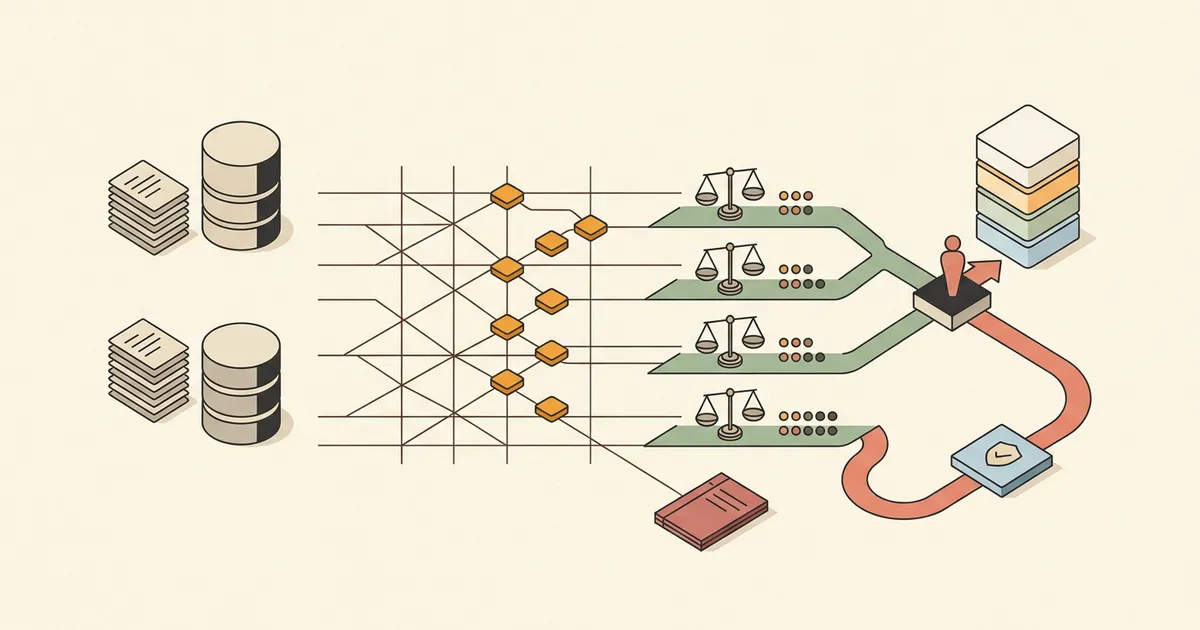
A useful plan starts with what is moving and why, then closes the transformations, reconciliation, privacy, failure, and recovery contracts before a human makes the live decision.
Inventory the datasets, systems, owners, and exclusions
Give every source, target, dataset, person, and exception a stable ID. State the purpose and the exact record boundary. Keep website content, domain and redirect work, analytics and SEO relocation, ongoing synchronization, and any provider-native service claim in separate owners and plans.
Sources: [migration-pack], [aws-cutover]
Map fields and version every transformation
For each moved field, record the source and target names, transformation kind, deterministic expression, version, owner, privacy classification, purpose, retention action, and edge-case tests. A direct copy is still an explicit transformation contract; a lookup or date conversion needs invalid and boundary cases.
Sources: [migration-pack], [aws-validation]
Reconcile counts, checksums, relationships, and balances
Prove source count minus approved exclusions equals the expected target count, then prove actual target count minus expected target count equals the recorded delta. Reconcile monetary or quantity balances separately, retain checksums and relationship checks, and log mismatched or suspended records rather than treating a matching row count as completion.
Sources: [migration-pack], [aws-validation]
Minimize retained data and assign disposal decisions
Record the purpose, classification, source and target retention dates, disposition, access owner, and review date for personal or confidential mappings. Keep production exports, credentials, medical data, payment secrets, and unrelated personal records out of the planning pack; use separately authorized systems and controls for the real data.
Sources: [migration-pack], [nist-privacy]
Rehearse failure, then sequence cutover and rollback
Keep every failed trial run and its durable failure record, even after a correction passes. Sequence write freeze, final snapshot, import, reconciliation, readiness checks, human decision, connection change, and observation. Define rollback triggers, changed-data quarantine, restore, smoke checks, and manual replay review before cutover begins.
Sources: [migration-pack], [aws-cutover], [aws-validation]
What this data migration plan pack owns
Use the pack for one bounded migration of structured records between named systems. Keep adjacent publishing, synchronization, provider, legal, security, and operating work with its accountable owner.
Included
- Controlled plan identity, versions, status, migration owner, decision owner, source and target systems, datasets, and explicit exclusions
- Field-level CSV and JSON mappings with transformation kind, expression, version, owner, privacy classification, purpose, retention action, and test cases
- Source, excluded, expected-target, and actual-target counts; SHA-256 references; relationship checks; and before/after balance equations with zero-tolerance examples
- Privacy and retention records, approved exceptions, two fictional trial runs, a retained failure log, cutover steps, go/no-go record, rollback triggers, changed-data strategy, and recovery steps
- Multi-sheet XLSX, CSV, editable Markdown, completed fictional JSON, closed JSON Schema, strict validator, seventy-seven mutation tests, README, and reproducible ZIP build
Not included
- Website copy, media, files, domain transfer, DNS, redirects, canonical URLs, analytics, Search Console, rankings, or SEO migration, which remain with the website-migration owner
- Ongoing synchronization, replication, change data capture, dual writes, conflict resolution, streaming, or a live source-of-truth architecture
- A native or one-click migration service, provider credentials, database connector, production export, hosted migration, or verified live source-to-target flow
- Authentication, authorization, encryption, key management, backup, restore, monitoring, incident response, legal approval, privacy assessment, security review, or compliance certification
- Automatic go-live, rollback, data deletion, source retirement, exception approval, financial approval, or a guarantee of completeness, accuracy, recovery, timing, or outcome
DOWNLOADABLE RESOURCE
Download the data migration plan template pack
The ZIP packages one deterministic workbook and mapping ledger with the completed fictional plan, schema, validator, tests, and editable outline. Rebuild it locally to verify the exact allowlist and archive bytes.
Data migration plan template pack
A versioned, provider-neutral record-migration plan for mappings, transformations, privacy, retention, trial runs, reconciliation, cutover, rollback, exceptions, and failures.
Format: XLSX, CSV, Markdown, JSON, JSON Schema, and dependency-free Node.js validator/tests in one ZIP
Locally reproduced August 1, 2026. SHA-256: 5a872407a3ddd0f21c97df01f5102738294b3486f9c6d2b2c1ac5beccb78cb3f
Included
- Ten-sheet XLSX workbook covering plan control, ten field mappings, count reconciliation, two balance checks, three privacy-retention records, two trial runs, eight cutover steps, five rollback steps, two rollback triggers, one retained failure, and approved exceptions
- CSV and JSON mapping parity with deterministic transformations, edge and invalid cases, source and target owners, count and balance equations, SHA-256 references, cutover evidence, and changed-data rollback handling
- Closed Draft 2020-12 schema plus seventy-seven dependency-free tests for unknown fields, dates, IDs, references, privacy, retention, counts, balances, exceptions, failures, cutover, rollback, boundaries, secrets, and CSV formula injection
Verification boundary
The allowlisted files were reproduced twice, extracted, byte-compared, and validated locally. The XLSX workbook and ZIP use fixed UTC timestamps and ordered entries. This proves deterministic artifact structure and internal consistency, not real-source accuracy, migration execution, recoverability, authorization, compliance, or public availability before deployment.
Three bounded data-migration plan shapes
Change the mappings, evidence, cutover sequence, and rollback decision for the system at hand. Do not turn a one-time migration plan into an unstated synchronization or website-relocation contract.
Offline record cutover
Use when: A bounded maintenance window can stop source writes while one final snapshot, import, reconciliation, and human decision occur.
Freeze writes, capture the final source position, transform and import the approved records, reconcile counts and balances, run access and functional checks, then switch the application connection only after a named go decision.
Structure
- Stable dataset and mapping IDs with exact exclusions and before/after balance checks
- Final snapshot, ordered cutover evidence, measurable rollback triggers, and a changed-data quarantine path
Watch for: A validated plan does not prove the maintenance window, snapshot, restore time, application compatibility, source truth, or authorization to stop writes.
Sources: [migration-pack], [aws-cutover], [aws-validation]
Phased dataset cutover
Use when: Dataset groups can move behind independent gates, and relationships across a phase boundary are explicitly understood and tested.
Reserve one mapping and reconciliation set per phase, keep cross-dataset dependencies visible, preserve a rollback unit for each approved phase, and do not call phased import ongoing synchronization.
Structure
- Phase-specific trial run, counts, balances, failure log, decision owner, and observation evidence
- Explicit cross-phase relationship checks and a hold when a required parent or reference is not yet authoritative
Watch for: A phased cutover may reduce one blast radius while increasing dependency, coordination, and changed-data complexity. It requires a separate design if both systems accept writes.
Sources: [migration-pack], [aws-cutover]
Privacy-minimized active and archive split
Use when: Only minimum-purpose active records belong in the target while excluded or archived records require a separate approved retention and disposition decision.
Map active fields to the target, reconcile approved exclusions by count and balance, record source and target retention dates, and route archive or deletion decisions to the named privacy and record owners.
Structure
- Field-level classification, purpose, minimum access owner, retention dates, dispositions, and review date
- Approved exception ledger whose record and balance totals exactly reconcile to each dataset exclusion
Watch for: A retention date in a template is not a legal basis, deletion proof, access control, privacy assessment, or compliance determination. Qualified owners must set the real policy.
Sources: [migration-pack], [nist-privacy]
Decide whether the plan is ready for human approval
The template is structurally ready only when every equation, reference, transformation, privacy decision, failed run, cutover gate, and rollback trigger is reviewable. The validator never makes the live decision.
A source field has no target owner, versioned transformation, privacy purpose, retention action, or edge-case test.
Choose: Keep the plan in draft and close the mapping contract before another trial run.
Tradeoff: The schedule waits, but ambiguous field behavior cannot silently become target data.
Source minus exclusions does not equal the expected target, actual target differs from expected, or a before/after balance exceeds tolerance.
Choose: Record a failure, stop the gate, identify the record set or transformation, and rerun reconciliation after the correction.
Tradeoff: Cutover may move, but a matching headline count cannot hide missing records, unsupported exclusions, or balance drift.
A high or critical failure remains open, the latest trial run failed, or restore and changed-data handling were not rehearsed.
Choose: Hold go-live until the named owners review corrective and recovery evidence in an authorized environment.
Tradeoff: Readiness takes longer, but the decision is based on evidence instead of an optimistic runbook.
The work also includes website content or SEO relocation, ongoing synchronization, dual writes, or a provider-native migration service.
Choose: Keep this plan bounded to record migration and create or use the separate canonical owner and technical design for the adjacent job.
Tradeoff: There are more explicit records, but ownership, test evidence, rollback units, and search intent do not blur together.
Make the migration reviewable
Turn mappings and gates into a controlled internal tool
Describe the approval workflow, mapping ledger, exception queue, reconciliation evidence, and decision roles you need. Playcode can build the internal software around that process without claiming a native migration connector or automatic go-live.
Explore internal toolsThe downloadable template and this informational article do not grant AI signup credits.
Use the website migration checklist for content, domain, redirect, analytics, and SEO movesData-record migration and website relocation remain separate canonical jobs.
What this template cannot prove
The pack catches inconsistent structure and arithmetic in a fictional plan. It cannot observe a real source, target, organization, legal requirement, or live migration.
- Matching counts, checksums, and balances do not prove semantic equivalence, complete relationships, correct permissions, valid history, acceptable performance, or business acceptance.
- The example does not test a database engine, provider, connector, network, source freeze, export, import, backup, restore, application connection, monitoring system, or production environment.
- Privacy classification, purpose, access owner, retention date, and disposition are review fields, not a legal basis, privacy assessment, security control, deletion record, or compliance certification.
- Rollback can lose or duplicate post-cutover changes if changed-data handling is incomplete. A real recovery point and restore procedure must be tested in an authorized environment.
- The article does not own website content, domain, redirect, analytics, or SEO relocation; ongoing synchronization; or native migration-service capability.
- This ordinary informational article does not grant AI signup credits. Eligibility, if any, belongs to separately qualified commercial entry pages.
Sources and verification record
The same-release artifact is the direct source for its files, fictional records, equations, and tests. Current primary guidance supports record validation, cutover and rollback planning, and privacy-risk ownership without prescribing this exact template.
[migration-pack] Playcode:Data migration plan fictional example
Checked August 1, 2026. Supports: The locally reviewed two datasets, ten mappings, three retention records, two count reconciliations, two before/after balance checks, two trial runs, eight cutover steps, five rollback steps, two triggers, one retained failure, seventy-seven tests, and exact artifact hash. Public availability remains unverified until deployment.
[aws-validation] Amazon Web Services:AWS DMS data validation
Checked August 1, 2026. Supports: Current first-party guidance that validation compares source and target rows, reports mismatches, tracks pending, suspended, and failed records, and consumes separate source, target, time, and network capacity. It supports the validation and failure-log concepts, not a claim that this pack uses AWS DMS.
[aws-cutover] AWS Prescriptive Guidance:Cutover stage and rollback guidance
Checked August 1, 2026. Supports: Current first-party guidance for ingestion freeze, final backup, data synchronization, validation before completion, defined rollback checkpoints, a decision contact, and explicit changed-data handling. It does not prove that a specific cutover or rollback will succeed.
[nist-privacy] National Institute of Standards and Technology:NIST Privacy Framework
Checked August 1, 2026. Supports: Voluntary privacy-risk framing for identifying purpose, data processing, responsibilities, access, retention, disclosure, and disposal. It does not prescribe this template or establish legal compliance.
Data migration plan template questions
What files are included in the data migration plan template?
The ZIP includes a ten-sheet XLSX workbook, CSV mapping ledger, editable Markdown outline, completed fictional JSON plan, closed Draft 2020-12 JSON Schema, dependency-free validator, seventy-seven mutation tests, README, and deterministic build script.
How does the template reconcile migrated records?
Each dataset proves source count minus approved exclusions equals expected target count, then actual target count minus expected target count equals the delta. Separate balance records prove before minus excluded plus approved adjustment equals expected after, then compare actual after against that result. Checksums, field tests, relationships, and failure records remain separate evidence.
Why does the pack keep a failed trial run?
A later passing run should not erase what failed, which transformation changed, who owned it, or what evidence closed it. The example retains a failed date conversion, its resolution, and the later passing run so reviewers can reconstruct the decision trail.
Does the rollback plan handle writes made after cutover?
The example stops target writes, quarantines post-cutover deltas, restores and verifies the approved source recovery point, reconnects the application, and requires human review before any replay. That is a planning contract only; a real team must test recovery and changed-data handling in its authorized environment.
Is this also a website migration or SEO migration checklist?
No. This owner covers structured data-record mapping, transformations, reconciliation, cutover, and rollback. Website copy, media, domains, DNS, redirects, canonical URLs, analytics, Search Console, rankings, and SEO-preservation work remain with the website migration checklist.
Does Playcode provide a native data migration service through this template?
No. The pack is provider-neutral editorial guidance and a deterministic fictional artifact. It does not include credentials, a native connector, a hosted migration, production data, a verified source-to-target run, automatic go-live, or AI signup credits.
Build the workflow around the plan
Create the tool your team uses to map, review, reconcile, and decide
Start with the fictional pack, replace it with your approved minimum-purpose fields and owners, then describe the internal workflow you want Playcode to build and run.
Build an internal toolA named human still owns source truth, access, privacy, recovery, retention, and every live migration decision.