QUICK ANSWER
What should a test plan template include?
A test plan template should apply an approved test strategy to one exact product version, then bind release scope, owners, environments, synthetic data, entry and exit gates, suites, test inventory, traceability, execution evidence, defects, retests, recovery checks, and ordered production smoke. Keep durable strategy, UAT business acceptance, specialist security and accessibility reviews, operations, and release authorization with their separate owners.
A useful test plan applies an approved testing strategy to one exact release or product version. It names the release scope, environments, synthetic data, entry and exit gates, suites, tests, traceability, evidence, defects, retests, recovery checks, and production smoke order before a team treats a green result as meaningful.
This downloadable pack uses one fictional service-request release to connect those execution records in JSON, Markdown, and CSV. The test strategy keeps durable objectives, risk, coverage-selection, automation, environment, data, evidence, and governance policy. UAT, security, accessibility, operations, and release owners keep their separate evidence and decisions.
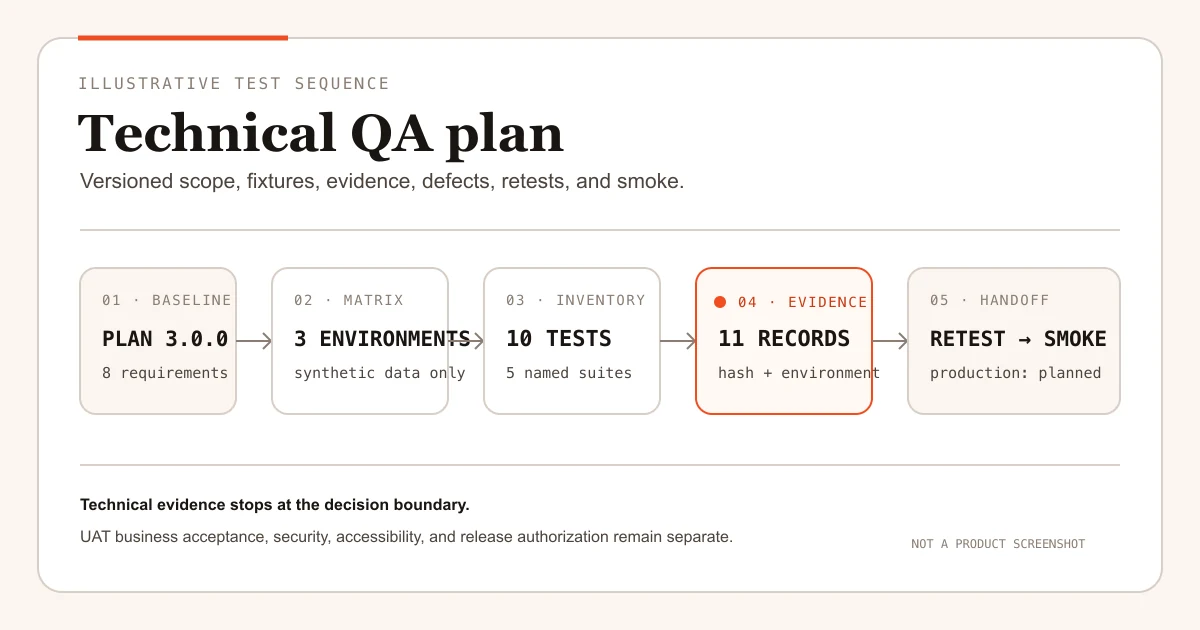
Build one versioned release test plan
Start from the approved durable test strategy and the exact release boundary, then connect targets, fixtures, tests, observations, corrections, and smoke without letting one green checkbox stand in for every quality or business decision.
Freeze the plan, product version, owners, and boundaries
Give the plan a stable ID and semantic version. Record the exact product version, baseline date, quality owner, included behavior, and explicit exclusions under the approved strategy. State that this release plan does not redefine durable strategy, make the UAT business-acceptance decision, certify security or accessibility, authorize release, or prove production recovery.
Sources: [test-plan-pack], [istqb-ctfl-401], [govuk-quality-assurance]
Name every environment and synthetic data contract
For each environment, record its tier, reserved URL, version, owner, data policy, and readiness state. Give every fixture an ID, version, classification, reset method, and owner. Keep ordinary execution outside production and reserve production for bounded, non-mutating smoke checks with an explicit stop condition.
Sources: [test-plan-pack], [istqb-ctfl-401]
Connect gates, suites, tests, and requirements
Separate entry from exit gates, then give every suite an objective, owner, allowed targets, fixture IDs, and required gates. Each test should name its suite, requirements, priority, kind, automation state, precondition, action, expected result, and recovery step. Reject unknown or stale references instead of silently dropping them from an export.
Sources: [test-plan-pack], [istqb-ctfl-401]
Record observations before interpreting quality
Bind evidence to one run, plan version, product version, environment, data version, test, timestamp, runner version, result, observed outcome, artifact URL, and hash. Preserve failed evidence when a defect is opened. A fixed defect needs a resolution version and a passed retest that points back to the same test and current evidence.
Sources: [test-plan-pack], [istqb-ctfl-401], [govuk-quality-assurance]
Keep production smoke ordered and decision-limited
List the smallest health, read-only behavior, and release-marker checks in execution order. Mark them planned until the exact target and release are authorized, stop on the first mismatch, preserve observed evidence, and hand recovery to operations. Closing technical gates still does not sign off UAT or authorize launch.
Sources: [test-plan-pack], [govuk-quality-assurance]
The technical test-plan boundary
Use this owner to execute technical QA for one named product version under an approved test strategy. Link durable policy, specialist evidence, and business decisions, but do not rewrite or absorb them into the release plan.
Included
- Plan and product versions, accountable owners, baseline date, release scope, execution approach, and recovery policy
- Environment and synthetic-data matrices with reserved targets, versions, reset rules, restrictions, and owners
- Entry and exit gates, suites, technical test inventory, requirement traceability, runs, and hashed evidence
- Defect severity and state, failed evidence, resolution version, version-bound retest, and recovery rehearsal evidence
- Ordered, read-only, stop-on-failure production smoke checks that remain planned until target authorization
- Deterministic JSON, Markdown, and CSV exports plus a strict dependency-free validator and tests
Not included
- Durable cross-release quality objectives, risk and coverage-selection policy, automation portfolio policy, environment and data policy, evidence policy, governance, or strategy exceptions
- UAT business acceptance, representative-user selection, business sign-off, product approval, or accept-with-known-risk decisions
- Security assessment, threat modeling, penetration testing, privacy review, compliance opinion, or security certification
- Accessibility evaluation, assistive-technology coverage, WCAG conformance claim, legal advice, or accessibility certification
- Website launch orchestration, deployment execution, operational acceptance, incident response, or launch or release authorization
- Proof that a production smoke ran, every defect was found, coverage is complete, an environment matches production, or recovery will succeed
- A guarantee of reliability, performance, security, accessibility, compliance, customer acceptance, release safety, or business outcome
DOWNLOADABLE RESOURCE
Download the test plan template pack
Use the Markdown copy for review, the JSON graph for automation, and the ten CSV views for environments, data, gates, suites, tests, traceability, evidence, defects, retests, and smoke. Run the included validator before adapting any fictional record.
Technical test plan template pack
A fictional release QA plan connecting one versioned service-request release to environments, synthetic data, gates, suites, tests, requirements, evidence, defects, retests, recovery, and planned production smoke.
Format: JSON, Markdown, CSV, validator, and tests in one reproducible ZIP archive
Locally reproduced August 1, 2026. SHA-256: b34f9bc12660d9301a885f07de4cfe0896db63d689d0765486bfb1ebedff902c
Included
- Canonical JSON plan plus an editable Markdown review copy
- Ten focused CSV views for environment, data, gates, suites, tests, traceability, evidence, defects, retests, and smoke
- Three environments, three synthetic or reserved fixture records, five gates, five suites, and ten tests
- Eleven hashed evidence records, one failed observation, one closed defect, and one passed version-bound retest
- Three ordered read-only production smoke checks that remain planned and stop on failure
- Dependency-free validator, 32 deterministic tests, README, package command, and reproducible ZIP builder
Verification boundary
Rebuilt in UTC and Pacific/Auckland time zones with fixed source timestamps and stripped ZIP metadata. Verified the exact seventeen-file allowlist and byte parity, parsed the canonical JSON and every CSV, checked closed record shapes, stable IDs, semantic versions, real calendar dates, UTC timestamps, reference parity, reserved URLs, synthetic-data rules, gate phases, suite and test targets, requirement coverage, run and evidence binding, hashes, defect and retest closure, production restrictions, smoke ordering, formula and credential rejection, and the time-zone-independent archive hash.
Three technical test-plan patterns
The record graph stays consistent while the technical risk changes. Each pattern keeps observed QA evidence separate from business acceptance, specialist assurance, and release authority.
Request and review state workflow
Use when: A record moves through validation, durable creation, human review, return, resubmission, and a final stored decision.
Create contract, invalid-input, duplicate, current-version transition, audit, and recovery tests. Bind every observation to a synthetic fixture and named environment, then use UAT separately to decide whether representative users accept the business journey.
Structure
- Contract and invalid-input suites prove record creation and no-write failure boundaries
- State and retry suites cover actor, version, idempotency, audit, partial failure, and reconciliation
- Preview evidence proves the observed technical path, while UAT retains representative-user sign-off
Watch for: Passing system tests cannot prove that the business accepts the wording, process, exceptions, or outcome. Keep those criteria and sign-off in the UAT plan.
Sources: [test-plan-pack], [istqb-ctfl-401], [govuk-quality-assurance]
Retry-safe provider handoff
Use when: A technical workflow calls an external provider and must preserve one business record through timeout, retry, duplicate, and recovery paths.
Record one request identity and body fingerprint, simulate the first provider failure, and confirm the retry preserves one durable decision while recording both attempts. Keep real provider credentials, policy, pricing, delivery, and production behavior outside the fictional fixture.
Structure
- Integration test binds retry identity, provider fixture, result, side-effect count, and audit evidence
- A failed observation opens one defect; a later product version and evidence record close it through retest
- Provider production smoke remains a separate authorized target check with an operations stop condition
Watch for: A provider fixture does not prove real account setup, authentication, rate limits, policy compliance, delivery, billing, or outage behavior.
Sources: [test-plan-pack], [istqb-ctfl-401]
Recovery rehearsal and production smoke handoff
Use when: A release needs non-production restore evidence plus the smallest ordered production checks after authorization.
Change a reserved preview fixture, restore it, compare count and digest, and retain the evidence. Then list health, read-only marker, and exact version checks as planned production smoke, with stop-on-failure behavior and a named recovery owner.
Structure
- Preview rehearsal records snapshot version, action, restored count, restored digest, evidence, and remaining limits
- Production smoke performs no fixture write and stops before the next check when any value differs
- Operations owns recovery and release decisions; the test plan owns only the proposed checks and recorded observations
Watch for: A preview recovery rehearsal and written smoke pack do not prove production recovery, authorize release, or replace monitoring, incident, and rollback decisions.
Sources: [test-plan-pack], [govuk-quality-assurance]
Decide whether the technical plan is reviewable
A structurally valid plan connects one current record graph. Named owners still decide whether the real scope, environments, observations, specialist reviews, business acceptance, and release evidence are sufficient.
A suite or test references an unknown requirement, environment, fixture, gate, run, evidence record, defect, or retest.
Choose: Reject the plan version and repair the source graph instead of deleting the orphaned reference from one export.
Tradeoff: The review stops, but the release plan cannot silently lose coverage, evidence, or a correction history.
A required exit gate is marked met without current evidence, or a closed defect has no failed observation, resolution version, and passed retest.
Choose: Keep the gate unmet or the defect open until the exact linked evidence supports the recorded state.
Tradeoff: The technical checkpoint waits, but a status label cannot replace an observed result and correction trail.
A normal test targets production, uses personal data, performs an unbounded write, or lacks a stop and recovery owner.
Choose: Move execution to an isolated environment, replace the fixture with synthetic data, and narrow production activity to authorized non-mutating smoke.
Tradeoff: The plan may prove less in production, but it avoids turning verification into an uncontrolled change or privacy risk.
The plan starts treating technical pass evidence as UAT acceptance, security or accessibility certification, release approval, or proof of recovery.
Choose: Restore the explicit boundary and link the current evidence from the qualified business, security, accessibility, operations, and release owners.
Tradeoff: One document no longer claims a universal verdict, but every decision remains reviewable in its real scope.
START WITH THE EVIDENCE GRAPH
Download the test plan and trace every result
Open the JSON, Markdown, and CSV views; trace product requirements through suites, tests, runs, evidence, defects, retests, recovery, and smoke; then run the included validator before adapting the fictional records.
Download the test plan template packThe ZIP is reproduced locally. Public availability and adapted source accuracy require separate verification.
Keep durable policy in the test strategyUse the test strategy for cross-release objectives, risk, coverage selection, automation, environment, data, evidence, and governance policy. Use this page to execute that policy for one named product version.
What a technical test plan cannot prove
A strict plan improves traceability and makes false status easier to detect. Its conclusion is still limited by the requirements, environment fidelity, fixtures, test design, observability, execution, evidence, and adjacent decision systems.
- A requirement-to-test link shows planned coverage, not that the requirement is correct, complete, accepted, secure, accessible, or valuable.
- Synthetic data avoids personal-data risk but can miss scale, distribution, history, permissions, locale, provider, and migration behavior found in real systems.
- A passing automated or manual case proves the recorded observation for its version and target, not comprehensive defect absence or universal reliability.
- A closed defect and passed retest do not prove that every regression, interaction, concurrent path, or production condition was exercised.
- A preview recovery check cannot establish a production recovery objective, restored-data completeness, operator readiness, or rollback authorization.
- A planned production smoke pack is not evidence that smoke ran, the release is safe, monitoring works, or an operations owner approved launch.
- Technical QA does not replace UAT business acceptance, security verification, accessibility evaluation, privacy review, legal review, or launch governance.
- This ordinary informational article does not grant AI signup credits. The linked product page follows its own current eligibility rules.
Sources and verification record
The same-release artifact is the direct source for the fictional records and deterministic checks. Current testing and government guidance support test planning, traceability, defect work, and the boundary between technical QA and other quality activities without certifying this pack.
[test-plan-pack] Playcode:Technical test plan fictional example
Checked August 1, 2026. Supports: The locally reviewed three environments, three synthetic fixture records, five gates, five suites, ten tests, eight requirements, eleven evidence records, one defect, one retest, three planned smoke checks, exports, and deterministic validation. Public availability remains unverified until deployment.
[istqb-ctfl-401] International Software Testing Qualifications Board:Certified Tester Foundation Level Syllabus v4.0.1
Checked August 1, 2026. Supports: Current foundation-level test planning, test basis, traceability, risk, execution, defect, confirmation testing, regression, and completion concepts. It does not prescribe or certify this pack.
[govuk-quality-assurance] GOV.UK Service Manual:Quality assurance: testing your service regularly
Checked August 1, 2026. Supports: Whole-team quality responsibility and the separate roles of functional, exploratory, security, accessibility, and performance testing. It does not make a release or business-acceptance decision for this pack.
Test plan template questions
What is the difference between a test plan and a UAT plan?
This test plan owns technical execution for one product version: exact scope, environments, data, gates, suites, tests, traceability, runs, evidence, defects, retests, recovery checks, and smoke. The test strategy owns durable policy across releases. A UAT plan asks whether representative business users accept agreed outcomes on the exact version. Technical pass evidence can support UAT, but it cannot make the business decision.
Should a test plan include security and accessibility?
It should name specialist security and accessibility handoffs, evidence dependencies, owners, versions, and unresolved gates when they affect release quality. It should not relabel ordinary functional tests as a security assessment or accessibility evaluation. Qualified owners need their own methods, coverage, evidence, limitations, and decisions.
What belongs in an environment and test-data matrix?
Record each environment ID, tier, reserved target, version, owner, data policy, readiness, allowed suites, and production restrictions. Record each fixture ID, classification, version, owner, reset method, and personal-data boundary. Tests and evidence should reference those stable IDs instead of repeating vague labels such as staging or sample data.
How should defects and retests be recorded?
A defect should point to the failed evidence, test, environment, severity, owner, opened time, current status, and resolution version. A passed retest should point back to that defect, the same test, a current run, current evidence, execution time, and product version. Preserve the failed observation after closure.
What should a production smoke pack contain?
Keep it small, ordered, non-mutating, and stop-on-failure. Name the exact target and release, expected health, one safe read-only behavior, release marker, evidence to capture, and recovery owner. Mark checks planned until the target is authorized. A smoke pass does not replace monitoring, rollback, security, accessibility, UAT, or release decisions.
Can Playcode turn this template into a QA workflow?
Playcode can help build a bounded workflow around reviewed plan, environment, fixture, suite, test, evidence, defect, retest, and smoke records. Before operational use, verify server-side authorization, concurrent writes, audit, provider boundaries, retention, export, target environments, monitoring, recovery, specialist reviews, UAT, and release ownership.
BUILD THE TESTABLE WORKFLOW
Turn the reviewed QA records into a bounded app
Give Playcode the accepted record model, roles, versions, targets, fixtures, evidence, and decision boundaries. Verify access, concurrency, audit, integrations, retention, monitoring, recovery, specialist reviews, UAT, and release control before operational use.
Build and verify the QA workflowThis informational article does not grant AI signup credits. No coverage, defect absence, security, accessibility, acceptance, release, recovery, reliability, compliance, or business outcome is guaranteed.