QUICK ANSWER
What should a product backlog template include?
A product backlog template should keep a uniquely ordered list of potential work with a stable item ID, source evidence, external outcome reference, value rationale, readiness state, relative estimate and estimator, dependencies, acceptance links, owner, and refinement history. It should remain changeable and should not treat a ready item as selected for a Sprint or committed to delivery.
A useful product backlog is an emergent, ordered inventory of possible product work. Each item should expose why it exists, what value it may create, how ready it is for planning, who estimated it, and which dependencies or external acceptance records affect it.
This guide includes an editable Markdown template, a machine-readable JSON record, a closed JSON Schema, a fictional completed example, and a dependency-free validator. It deliberately stops before roadmap horizons, strategic outcome ownership, PRD prioritization authority, detailed user stories, Sprint selection, and delivery schedules.
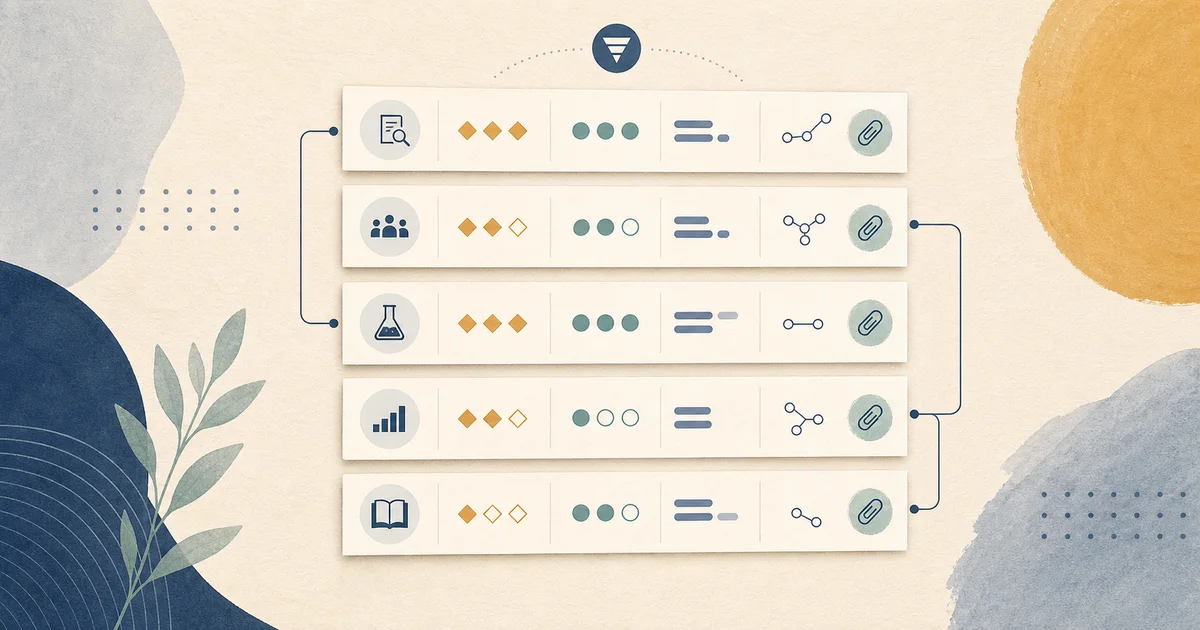
Build an ordered backlog from source to refinement
The model makes the inventory inspectable without confusing an item’s relative order or readiness with a Sprint commitment.
Name the product, owner, and ordering method
Record one accountable product owner, a maintainer, the external Product Goal reference, the evidence cutoff, the next refinement date, and the method used to order work. State the method’s limitations so order is open to challenge.
Sources: [scrum-guide], [gov-priorities], [backlog-pack]
Trace every item to current evidence
Give each source an observed date, owner, safe reference, finding, and limitation. Backlog items can represent features, research, support, technical debt, accessibility, or other improvement work, not only stakeholder feature requests.
Sources: [gov-priorities], [backlog-pack]
Order work by value and transparent tradeoffs
Connect each item to an externally owned outcome and add a concise value rationale. Use a clear recurring process that considers evidence, risk, dependencies, and team input while leaving roadmap and PRD authority with their owners.
Sources: [scrum-guide], [gov-priorities], [backlog-pack]
Refine near-term items to an explicit readiness state
As work approaches possible selection, make it smaller and more precise, record readiness evidence and unresolved questions, and add a relative estimate with the accountable estimator. Ready means eligible for Sprint Planning discussion, not selected.
Sources: [scrum-guide], [gov-planning], [backlog-pack]
Keep dependencies, acceptance links, and review history aligned
Represent dependency direction in one closed graph, link to acceptance material without copying it, and preserve dated refinement decisions. Validate IDs and boundaries after every edit instead of silently rewriting why an item moved.
Sources: [gov-planning], [json-schema-2020-12], [backlog-pack]
The product backlog ownership boundary
This record owns an ordered and refined inventory. It links to strategy, requirements, acceptance, and delivery systems without inheriting their authority.
Included
- Backlog identity, product owner, maintainer, evidence cutoff, refinement cadence, and ordering method
- Dated source evidence with owner, safe reference, finding, and limitation
- Stable work-item IDs, unique order, type, external outcome link, and value rationale
- Readiness state and evidence, unresolved questions, relative estimate, and estimator
- Dependency direction, external acceptance links, item owner, and last-refined date
- Refinement history, stable cross-references, closed record shapes, and false commitment flags
Not included
- Roadmap horizons, strategic outcome approval, product strategy, portfolio funding, and roadmap sequencing
- PRD prioritization authority, requirements, acceptance criteria, detailed user stories, and test ownership
- Sprint Goal, Sprint selection, Sprint Backlog, tasks, developer plan, or commitment to complete work
- Project-plan milestones, delivery schedules, release dates, staffing, budget, and production authorization
- A guarantee that evidence is representative, order is correct, estimates are accurate, or value will be delivered
DOWNLOADABLE RESOURCE
Download the reproducible product backlog pack
The archive keeps the editable review surface and machine-readable record together. Its validator rejects broken source links, duplicate order, incoherent readiness, dependency drift, unsafe references, hidden owner fields, and true commitment flags.
Product backlog template pack
A reproducible starter pack for an ordered product backlog with source, value, readiness, estimate, dependency, and acceptance-link traceability.
Format: ZIP with Markdown, JSON, JSON Schema, and Node.js validation scripts
Locally reproduced August 1, 2026. SHA-256: afb450a43979035fe2a8fdf1620735f2288c75f2f7ccfc2184865f4d402c281f
Included
- Editable Markdown template and fictional completed Markdown example
- Machine-readable JSON example and closed Draft 2020-12 JSON Schema
- Five ordered work items spanning product, research, maintenance, and accessibility work
- Dependency-free validator with mutation, cross-reference, boundary, and secret-safety tests
- Deterministic nine-file ZIP builder with fixed timestamps and an exact allowlist
Verification boundary
Run npm test and npm run validate after extraction. Rebuild with node build-pack.mjs, inspect the exact archive allowlist, and compare its SHA-256 with the value shown here.
Three backlog patterns that preserve the boundary
The same record can support different product contexts when order stays emergent and readiness remains separate from Sprint selection.
Ordered product backlog for a Scrum Team
Use when: One product owner needs a transparent, changing source of potential work for a team that uses Scrum.
Keep one ordered inventory tied to the Product Goal, progressively refine likely near-term items, and let the people doing the work own sizing.
Structure
- Stable order and evidence make Product Owner decisions visible
- Readiness records precision and unresolved questions without claiming selection
- Relative estimate records the value and accountable estimator, not a date
Watch for: The Product Backlog is distinct from the Sprint Backlog. A ready item is not part of a Sprint until selected through Sprint Planning.
Sources: [scrum-guide], [backlog-pack]
Mixed improvement backlog
Use when: Feature work competes with research, support, technical debt, reliability, or accessibility work.
Normalize every work type around source evidence, intended value, readiness, and transparent ordering instead of giving feature requests an automatic advantage.
Structure
- Source types preserve the reason each item entered the inventory
- Value rationales support comparable discussion across different work types
- Limitations keep weak or narrow evidence visible during prioritization
Watch for: A common record shape does not make unlike evidence equally strong. Reviewers still judge risk, urgency, and evidence quality.
Sources: [gov-priorities], [backlog-pack]
Dependency-aware refinement backlog
Use when: Several items rely on research, policy, platform, or cross-team work that can change their practical order.
Model the blocked item, prerequisite, owner, and state once; mirror its stable dependency ID on the blocked item; and review it before selection.
Structure
- Directional dependency records prevent ambiguous “related to” links
- An accountable owner and state make the unresolved constraint visible
- External acceptance links preserve handoffs without duplicating requirements
Watch for: Dependency visibility is not a delivery schedule. Cross-team commitments and dates still require an accountable plan.
Sources: [gov-planning], [backlog-pack]
Decide whether a backlog item is reviewable
An item earns a place and readiness state through traceable evidence and enough shared understanding, not by sounding urgent.
An item has no source evidence, external outcome reference, or value rationale
Choose: Keep it as an unranked intake note until the source, intended value, and accountable owner are recorded.
Tradeoff: The ordered backlog stays smaller, while unsupported requests remain visible in the correct intake system.
A ready item still has unresolved questions or no external acceptance link
Choose: Return it to refining and record the question, owner, and next review point.
Tradeoff: Sprint Planning gets fewer candidates, but readiness has a consistent inspectable meaning.
The record contains detailed requirements, user stories, or acceptance criteria
Choose: Move the detail to the PRD, story, or test owner and retain only a stable acceptance link.
Tradeoff: Readers follow a link for detail, while backlog order and requirement authority remain independently reviewable.
A dependency changes the practical order or estimate
Choose: Update the directional dependency record, revisit readiness and estimate ownership, then log the refinement decision.
Tradeoff: The record grows slightly, but the order changes for an explicit reason instead of through an unexplained drag action.
Someone treats item order or readiness as a Sprint commitment
Choose: Point Sprint selection, Sprint Goal, task plan, and forecast to Sprint Planning and the Sprint Backlog.
Tradeoff: Stakeholders receive less false certainty, while the delivery team retains the correct planning authority.
Editable artifact
Start with the ordered work ledger
Download the pack, replace the fictional Cedar Relay record, and run its validator before refinement.
Download the backlog packThe validator checks record consistency. It cannot order work or select a Sprint for your team.
Keep strategic horizons in the product roadmap templateThe roadmap owns strategic intent and horizons. The backlog owns the ordered, refined inventory of potential work.
What this backlog cannot prove
Structure and traceability improve refinement, but they cannot turn fictional observations into product evidence or a ready item into a delivery commitment.
- The included Cedar Relay product, people, findings, links, estimates, and decisions are fictional and must not be presented as research or operational data.
- A valid record does not prove that evidence is representative, the Product Goal is correct, value is accurately assessed, or order is optimal.
- Relative estimates are contextual inputs from accountable estimators, not hours, dates, guarantees, or transferable productivity measures.
- Ready means sufficiently understood for possible Sprint Planning selection in the team’s context; it does not mean selected, committed, scheduled, or approved for release.
- Source guidance and organization practices can change after the checked date; recheck the authoritative pages before relying on them.
Authoritative source map
These primary sources and the same-release artifact were checked on 2026-08-01. Each entry names the limited claim it supports; none endorses this template or Playcode.
[backlog-pack] Playcode:Product backlog example JSON
Checked August 1, 2026. Supports: The same-release fictional record, closed shape, source and dependency graph, boundary flags, native validation result, and reproducible archive described on this page.
[scrum-guide] Ken Schwaber and Jeff Sutherland:The 2020 Scrum Guide
Checked August 1, 2026. Supports: The Product Backlog is emergent and ordered; the Product Owner is accountable for its management; refinement adds precision, order, and size; ready items become eligible for Sprint Planning selection.
[gov-priorities] GOV.UK Service Manual:Deciding on priorities
Checked August 1, 2026. Supports: Prioritization should be repeated, use a clear method, involve the team and stakeholders, draw on performance analysis and user research, and include work beyond new features.
[gov-planning] GOV.UK Service Manual:Planning in agile
Checked August 1, 2026. Supports: Agile planning becomes more detailed near the work, stays visible, changes with learning, and uses team planning to surface approaches, issues, and dependencies.
[json-schema-2020-12] JSON Schema:JSON Schema Draft 2020-12
Checked August 1, 2026. Supports: Draft 2020-12 is the published JSON Schema vocabulary used to describe the machine-readable backlog record in the pack.
Product backlog template questions
What is the difference between a product backlog and a roadmap?
A roadmap communicates strategic intent, outcomes, and uncertainty over a broader horizon. A product backlog is an emergent, ordered inventory of potential work for a product. Link their stable references without copying horizons or strategic approval into backlog items.
What is the difference between a product backlog and a Sprint Backlog?
The product backlog contains ordered potential work. The Sprint Backlog contains the Sprint Goal, selected Product Backlog items, and the Developers’ actionable plan for the Sprint. This template deliberately does not select or commit items.
When is a Product Backlog item ready?
In the cited Scrum Guide, items that can be completed within one Sprint are considered ready for selection at Sprint Planning and usually gain that transparency through refinement. Teams still need context-specific shared understanding; ready does not mean selected.
Should a backlog contain technical debt and research?
Yes when that work is needed to improve the product. The cited GOV.UK guidance says prioritization should include more than new features, such as support work and technical debt. This pack also models research, maintenance, and accessibility work.
Can the validator prioritize or estimate backlog items?
No. It verifies closed shapes, order, IDs, evidence cutoffs, readiness consistency, dependency direction, safe example values, and false commitment flags. Named reviewers and estimators still judge value, evidence, uncertainty, and size.
Does this article or template grant AI credits?
No. This is ordinary informational content with a downloadable artifact. The page is AI-credit-ineligible and does not grant signup AI credits; product eligibility and plan limits are separate.
From refined item to working evidence
Prototype a bounded backlog item in Playcode
After Sprint Planning selects a bounded item, use Playcode to build a working app or prototype and gather evidence for the next refinement decision.
Open the AI app builderThis informational article is AI-credit-ineligible and does not grant signup AI credits. Product eligibility and plan limits are separate.