QUICK ANSWER
What should a product requirements document template include?
A product requirements document template should include document version and owners, the user problem and evidence, intended outcome and measurement rule, in-scope work, non-goals, record lifecycles, stable requirement IDs, testable acceptance criteria, experience states, dependencies, security and privacy boundaries, release gates, risks, open questions, and a decision log.
DOWNSTREAM HANDOFF
Turn gathered requirements into implementation-ready product behavior
After business discovery, move only reviewed product needs into the PRD. Give each product requirement a stable ID and define actors, records, states, observable behavior, failure handling, acceptance criteria, dependencies, risks, and release evidence. Keep interview notes, raw observations, stakeholder opinions, and unresolved discovery questions in the gathering record or BRD, not in this implementation-ready product contract.
A product requirements document should turn a product decision into a reviewable build contract. It connects one user problem to scope, non-goals, records, observable requirements, acceptance criteria, experience states, dependencies, risks, open questions, and release gates without pretending that the document guarantees delivery or demand.
This downloadable pack keeps Markdown and JSON versions aligned, includes a completed fictional request-tracker example, and maps every acceptance criterion to a requirement, test, and release gate. It is a product handoff artifact. Business justification, budget ownership, procurement, and portfolio approval belong in a separate business requirements document.
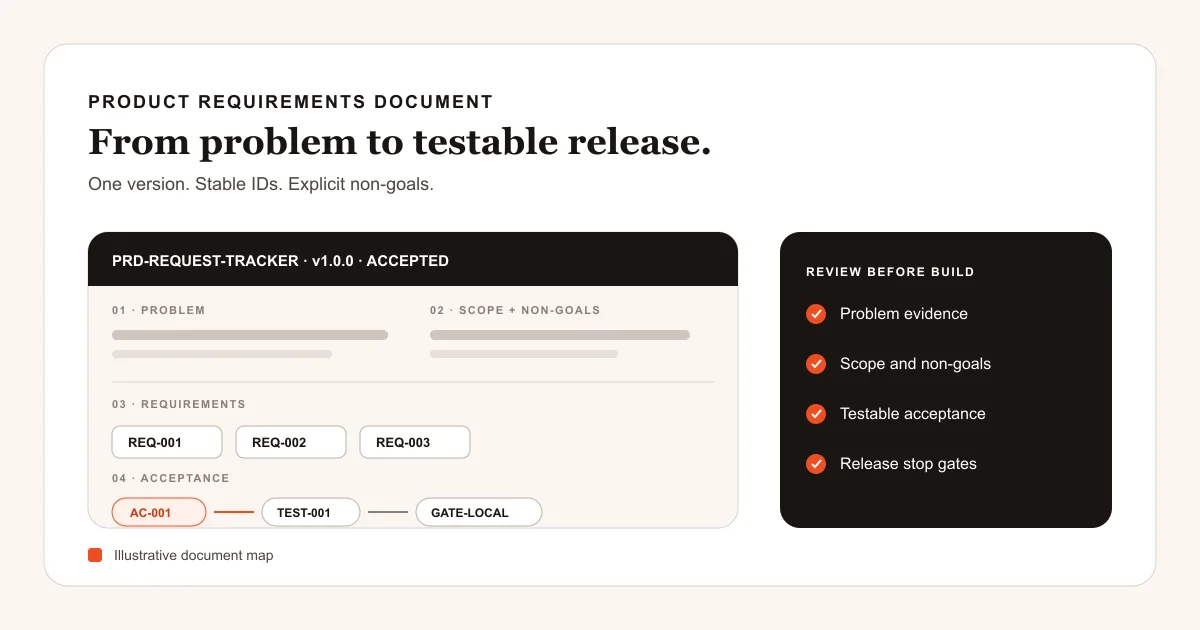
How to complete the PRD without hiding decisions
Fill the template in decision order, not screen order. Each pass narrows uncertainty and gives reviewers a stable place to disagree before the build absorbs an assumption as behavior.
Write the problem and missing evidence
Name the user, situation, current workaround, observed problem, available evidence, and evidence still missing. Keep a hoped-for outcome separate from a measured fact, then decide what the pilot must teach before the team expands scope.
Sources: [prd-pack], [digital-services-playbook]
Freeze scope and non-goals
List the smallest user outcome in scope and at least three tempting jobs that are not part of this release. A non-goal is useful when it prevents a reviewer or builder from silently adding behavior, providers, platforms, or automation.
Sources: [prd-pack], [digital-services-playbook]
Define records before screens
For each durable record, name its stable ID, required fields, states, owner, version behavior, retention, and relationships. Add loading, empty, validation, read-error, write-error, conflict, partial-failure, success, and recovery states before wireframes imply only a happy path.
Sources: [prd-pack], [owasp-authorization]
Trace requirements to acceptance and tests
Give each requirement, acceptance criterion, and test a stable ID. Write one observable behavior per requirement and map every criterion to its requirement and test. Use the JSON Schema to catch shape drift, while keeping semantic product review with people.
Sources: [prd-pack], [json-schema-core]
Set release gates and decision ownership
Name local checks, policy review, target smoke, observation window, stop or rollback conditions, evidence, and owners. Record accepted changes in the decision log and increment the PRD version when behavior or scope changes.
Sources: [prd-pack], [digital-services-playbook]
The product handoff this template covers
Use this PRD after the team has enough business context to decide that a product change deserves definition. It controls product behavior and verification, not the upstream investment case.
Included
- Copyable Markdown and machine-readable JSON PRD templates
- A completed fictional internal request-tracker example
- JSON Schema plus requirement-to-test acceptance matrix
- Problem evidence, outcome signal, scope, non-goals, records, and experience states
- Dependencies, access boundaries, operations, release gates, risks, questions, and decisions
Not included
- Business case, funding approval, procurement, vendor selection, or portfolio priority
- Guaranteed delivery time, product-market fit, adoption, revenue, or stakeholder approval
- A universal product process or a substitute for design, engineering, security, privacy, legal, or accessibility review
- Native provider integrations, credentials, production deployment, or real-user evidence
DOWNLOADABLE RESOURCE
Download the PRD template pack
Choose Markdown for collaborative review or JSON for a structured planning system. The completed example and CSV acceptance matrix show what traceability looks like when every product claim needs an owner and test.
Product requirements document template pack
A versioned blank PRD, completed fictional example, acceptance matrix, schema, and deterministic validation suite for a testable product handoff.
Format: Markdown, JSON, JSON Schema, CSV, and Node.js tests in one ZIP archive
Locally reproduced September 6, 2026. SHA-256: dc1f7982303249d459c3fef898b2cdd8ed5c8db2d436dacf12f1a435a0d0574f
Included
- Blank Markdown PRD template
- Blank machine-readable JSON PRD
- JSON Schema Draft 2020-12 document
- Completed fictional Markdown and JSON example
- Requirement-to-test acceptance matrix CSV
- Dependency-free validator and negative tests
Verification boundary
The archive allowlist, file bytes, closed object shapes, calendar dates, IDs, requirement-to-acceptance links, test-to-release-gate references, decision references, record and dependency structure, experience states, scope boundary, and malformed negative cases were checked locally. Public availability and the correctness of an adapted PRD remain separate gates.
Five PRD patterns for different product risks
The same template works when the risk is lifecycle, access, public intake, data integrity, or an external provider. What changes is the first record, the failure boundary, and the evidence required before release.
Internal request tracker PRD
Use when: Requests lose ownership, state, or follow-up history across spreadsheets and messages.
The completed example defines Request, AuditEvent, and NotificationAttempt records with workspace access, state versions, retries, partial failure, export, and a controlled pilot.
Structure
- Six observable requirements map to eight acceptance criteria and test IDs
- Four gates cover local tests, policy review, private smoke, and observation
Watch for: The example does not prove the workflow fits a real team. Replace the fictional walkthrough with observed evidence and named policy owners.
Sources: [prd-pack], [owasp-authorization]
Client portal document-request PRD
Use when: Signed-in clients need to receive, answer, upload, and track document requests.
Start with ClientMembership, DocumentRequest, FileMetadata, StoredObject, and AuditEvent rather than a generic upload screen. Test list, detail, upload, download, and export across two ordinary client accounts.
Structure
- Problem and scope distinguish document request from file storage and notification delivery
- Acceptance covers file validation, incomplete upload, account isolation, retention, and recovery
Watch for: A public or provider file URL is not permission, and a hidden client path is not server authorization.
Sources: [prd-pack], [owasp-authorization]
Public lead-form PRD
Use when: A public form must save one durable inquiry before optional email or CRM delivery.
Define the submission ID, form version, server validation, consent purpose, retention, operator access, idempotent submit, and notification outbox before choosing fields or styling success.
Structure
- Acceptance separates durable save from delivery and human duplicate review
- Release gates cover invalid input, abuse limits, partial failure, private operator access, and published smoke
Watch for: Do not show success before a durable save or imply that notification, CRM delivery, qualification, or follow-up happened.
Sources: [prd-pack], [digital-services-playbook]
Data import PRD
Use when: Users map, preview, validate, commit, and reconcile a batch of source rows.
Define Batch, MappingVersion, SourceRow, RowResult, and ImportSummary, then require accepted, rejected, ambiguous, completed, and resumable states to reconcile.
Structure
- Requirements cover preview parity, stable source-row identity, retry, cancellation, and export
- Acceptance proves a worker resume skips completed rows and preserves row-level results
Watch for: Never auto-merge ambiguous people or companies on a shared name, email, or phone without an explicit uniqueness rule.
Sources: [prd-pack], [json-schema-core]
Provider-backed notification PRD
Use when: A durable business record triggers email, chat, SMS, push, or another external delivery attempt.
Keep the provider account, server credential, outbox identity, attempt state, provider response, retry policy, reconciliation, and fallback outside the core business result.
Structure
- Requirements name minimum provider access, secret storage, rotation, rate limit, and degraded behavior
- Acceptance proves business save, duplicate delivery, provider outage, dead letter, and target smoke separately
Watch for: Do not claim native or one-click integration, guaranteed delivery, provider approval, or production evidence until the exact path is reproduced.
Sources: [prd-pack], [digital-services-playbook]
Decide when the PRD is ready for a build handoff
A PRD is ready when a builder can implement the intended behavior without inventing product policy. Open questions may remain, but every blocking one needs an owner and gate.
The team cannot name one user problem and missing evidence
Choose: Keep the document in draft and run observation or a smaller prototype before expanding requirements.
Tradeoff: You delay implementation, but avoid polishing a solution around an unverified problem.
Requirements describe screens but not records, states, or failure behavior
Choose: Return to the record model and experience-state sections before estimating or assigning implementation.
Tradeoff: The PRD becomes longer, but loading, conflict, partial failure, access, retry, and recovery stop being late surprises.
Every must-have requirement has acceptance and a test identity
Choose: Move to technical review and use the acceptance matrix as the implementation and release traceability contract.
Tradeoff: Stable IDs require maintenance when scope changes, but reviewers can see exactly what evidence supports each release decision.
A provider or regulated-data boundary is still vague
Choose: Hold that slice until the account, plan, credentials, minimum access, policy, failure behavior, retention, and manual review owner are explicit.
Tradeoff: The first release may exclude automation, but its claims and risk boundary remain truthful.
START WITH THE BLANK TEMPLATE
Write the problem, non-goals, and first testable requirement
Download the pack and complete the smallest product slice before adding screens. Use the fictional example to test traceability, not to copy its policy into your business.
Download the PRD templateThe ZIP is locally reproduced. Public availability must be verified after deployment.
Compare an MVP with a prototypeUse the comparison to choose whether the next artifact should test an interface or operate a real workflow.
What a PRD cannot decide by itself
The document creates traceability, not certainty. Review these boundaries again when the product, provider, policy, evidence, or target environment changes.
- A PRD does not establish the business case, budget, procurement path, vendor choice, or portfolio priority; those belong in the upstream business decision.
- Passing structural validation does not prove the requirements solve a real user problem, the design is usable, or the implementation is correct.
- A local artifact does not prove authentication, authorization, concurrency, provider delivery, migration, monitoring, recovery, accessibility, or target-environment behavior.
- The template is not legal, security, privacy, compliance, medical, financial, employment, or other professional approval.
Sources and verification record
The completed same-release artifact is the direct source for the template fields and traceability counts. Primary public references support iterative delivery, JSON Schema mechanics, and server authorization boundaries.
[prd-pack] Playcode:Completed PRD machine-readable example
Checked September 6, 2026. Supports: The locally reviewed document structure, six requirements, eight acceptance criteria, eight tests, four release gates, risks, questions, and decisions. Public availability remains unverified until deployment.
[digital-services-playbook] United States DOGE Service:Digital Services Playbook
Checked September 6, 2026. Supports: Primary public guidance to understand user needs, address security and privacy, deploy in increments, test end to end, and assign ownership. It does not prescribe this PRD template.
[json-schema-core] JSON Schema:JSON Schema Core Draft 2020-12
Checked September 6, 2026. Supports: The JSON Schema vocabulary used by the packaged schema. Schema validation checks document shape, not whether a product decision is wise or complete.
Product requirements document questions
What is a product requirements document?
A PRD is a versioned product handoff that defines the user problem, intended outcome, scope, non-goals, records, product behavior, acceptance, dependencies, risks, questions, and release gates. It gives product, design, engineering, security, privacy, operations, and reviewers one traceable decision surface.
Does a PRD replace a requirements gathering template?
No. Requirements gathering preserves business-discovery sources, observations, assumptions, conflicts, and unresolved questions. The PRD starts after review and owns implementation-ready product behavior: stable requirement IDs, actors, records, states, failure handling, acceptance criteria, tests, risks, and release gates. Link the exact source and BRD revisions instead of copying raw research notes into the product contract.
What is the difference between a PRD and a BRD?
This pack owns the product-requirements artifact. Use the BRD vs PRD comparison for the full selection boundary, then link exact revisions when both business and product decisions need separate approval.
How detailed should a PRD be?
It should be detailed enough that a builder does not need to invent product policy. Include observable requirements, stable IDs, records, states, failure behavior, access, acceptance, owners, and non-goals. Avoid specifying implementation internals unless a verified constraint makes them part of the product decision.
Who should own and review the PRD?
Name one product owner and one technical owner. Add only reviewers whose decision changes the release, such as design, operations, security, privacy, legal, accessibility, provider, or domain owners. Record blocking questions and accepted decisions rather than collecting vague acknowledgements.
When is a PRD ready for development?
It is ready when the problem and first outcome are bounded, non-goals prevent silent expansion, records and experience states are explicit, every must-have requirement maps to acceptance and a test, dependencies and risks have owners, and the release gates state what stops or rolls back the slice.
Can Playcode build an app from a PRD?
Playcode can build and run a web app from a reviewed PRD in plain language. A strong handoff includes the record model, user roles, states, acceptance tests, provider boundaries, and release gates. Real credentials, policy approval, target smokes, and business validation remain separate work.
HAND OFF THE REVIEWED PRODUCT
Give Playcode the PRD and build the bounded web app
Paste the accepted product brief into Playcode. Keep the first release centered on the records, roles, acceptance, and stop gates you reviewed, then test the real target before expanding scope.
Explore the AI app builderNo delivery-time, approval, product-success, or native provider-integration guarantee is claimed.