QUICK ANSWER
Should you use REST or GraphQL?
REST is a strong default when resource operations, standard HTTP semantics, intermediary caching, and a broad client contract matter. GraphQL fits when owned clients need changing, graph-shaped reads and the team can support schema governance, field authorization, batching, and query-cost controls. Neither is universally faster, safer, or simpler; choose from measured client jobs and operating constraints, and coexist when different surfaces benefit.
REST and GraphQL are not two wire protocols at the same layer. REST is an architectural style built from constraints such as stateless interaction, cacheability, a uniform interface, and layered components. GraphQL specifies a type system, operations, validation, execution, and response shape. A GraphQL service can use HTTP, so the useful decision is how clients express work and how the team governs execution.
This guide uses REST API as the common shorthand for a resource-oriented HTTP API. That does not mean every JSON CRUD endpoint satisfies the full REST constraints. It also does not assume GraphQL always uses one endpoint, always avoids extra fetching, or cannot use HTTP caching. Compare the actual contract, clients, cache policy, authorization, backend work, errors, and operating evidence.
The paired example uses https://api.meridian.example.test, a reserved fictional domain. It contrasts one account-dashboard screen through resource requests and a named GraphQL operation. Neither version is executable product proof, a live provider connection, or a benchmark.
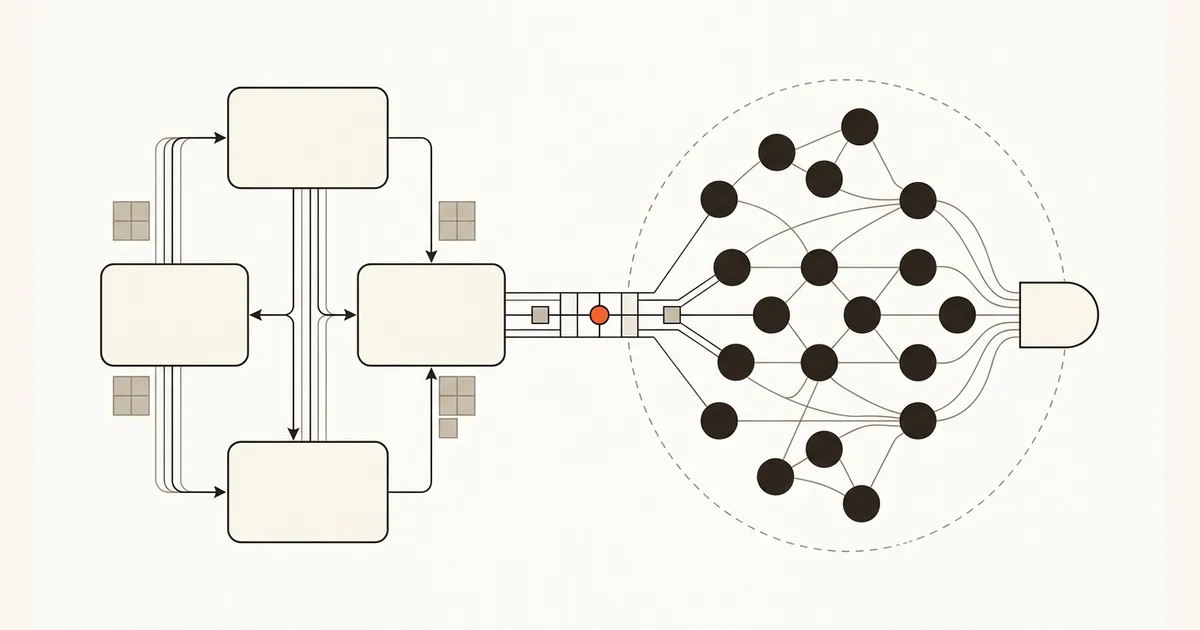
Choose from observed client jobs, not architecture slogans
Run the same bounded reads and writes through both candidate contracts. Make the decision from consumer compatibility, authorization, cache behavior, backend execution, failure semantics, governance, and measured operating evidence.
Inventory clients and freeze representative jobs
List public integrations, owned web and mobile clients, batch consumers, cacheable resources, graph-shaped screens, write workflows, and compatibility promises. Freeze a small fixture set and the exact visible fields, identity, tenant, latency objective, freshness boundary, and failure behavior for each job.
Sources: [fielding-rest], [rfc9110], [graphql-spec]
Model both contracts without hiding their layer
For the resource-oriented option, define resource identifiers, representations, methods, statuses, validators, links, and cache directives. For GraphQL, define the schema, named operations, selection sets, nullability, pagination, errors, deprecations, and transport profile. Keep shared domain policy below both adapters.
Sources: [fielding-rest], [rfc9110], [rfc9111], [openapi-3-2], [graphql-spec], [graphql-http-draft]
Exercise authorization and demand boundaries
Test another tenant, forbidden objects and fields, invalid input, excessive pages, deep or broad operations, repeated aliases, timeouts, and sensitive-cache behavior. Schema typing and route shape do not authorize a request. Centralize the business decision and apply it consistently from both API adapters.
Sources: [graphql-authorization], [graphql-security], [owasp-api-security], [rfc9111]
Measure client and backend work separately
Record client requests, bytes, cache hits, latency distribution, server work, database and service calls, resolver fan-out, retries, timeouts, partial results, and cost-budget rejections. A single GraphQL operation can still create many backend calls, while a REST facade can expose a reviewed composite resource.
Sources: [rfc9111], [graphql-performance], [graphql-security]
Apply Playcode’s coexistence recommendation before migration
Playcode’s engineering recommendation, inferred from the standards’ separation of concerns and security boundaries, is to keep one domain and authorization layer, add the second adapter for selected read jobs, contract-test both against the same fixture, shadow reads, and compare results and errors. Move clients one at a time with telemetry and rollback. Avoid dual-writing until idempotency, reconciliation, and ambiguous outcomes are explicitly designed.
Sources: [fielding-rest], [graphql-caching], [graphql-spec], [owasp-api-security]
The architecture-selection boundary
This page owns the choice between two API contract and execution shapes. It assumes the team still has to design, document, implement, test, deploy, and operate whichever shape it selects.
Included
- Resource-oriented HTTP contracts, GraphQL schemas and operations, client data shapes, round trips, backend fan-out, and coexistence
- Evolution, deprecation, caching, errors, tooling, authorization, demand controls, observability, team fit, and migration gates
- The paired fictional account-dashboard example at https://api.meridian.example.test, including negative authorization, cost, cache, and dependency checks
- A visible terminology boundary: REST is an architectural style, GraphQL is a query language and execution specification, and both can use HTTP
Not included
- REST API handler construction, storage, tests, deployment, or monitoring implementation, which belongs to /blog/how-to-build-a-rest-api-with-ai
- GraphQL playground, GraphiQL, IDE, or tool setup, usage, pricing, product comparison, and rankings
- Direct API versus SDK access for consuming an existing service, which belongs to /blog/api-vs-sdk
- A downloadable API documentation pack or OpenAPI reference, which belongs to /blog/api-documentation-template
- Third-party provider consumption patterns, which belong to /blog/api-integration-examples
- A universal winner, score, benchmark, production migration, native Playcode connector, or guarantee of speed, cost, security, scalability, compatibility, or business outcome
Twelve criteria for a REST vs GraphQL decision
Apply every row to the same clients, identity, fixture, and operation mix. Different surfaces may reach different answers, and coexistence is a valid architecture when ownership stays explicit.
Contract shape
Separates resource representations and uniform HTTP semantics from a typed graph whose operations select fields.
Fetching and client shape
Tests whether clients share stable resource needs or require materially different graph-shaped views.
Versioning and evolution
Makes compatibility, deprecation, consumer observation, and breaking-change ownership explicit.
Caching
Distinguishes HTTP cache keys and validators from GraphQL transport and normalized-client cache design.
Errors and partial results
Prevents clients and operators from treating status codes, response bodies, and partial data as interchangeable signals.
Tooling and documentation
Clarifies what a machine-readable contract or introspectable schema provides and what narrative documentation still owns.
Authorization surface
Checks object, action, field, and tenant decisions independently of schema types, routes, and authentication.
Performance and cost controls
Moves the decision from syntax to measured bytes, calls, resolver fan-out, cache behavior, latency, and resource budgets.
Observability
Requires request, operation, field, dependency, and business-outcome signals that explain failures and cost.
Team and client fit
Tests whether client autonomy justifies the schema, governance, and execution surface the team must operate.
Migration and coexistence
Keeps a protocol rewrite from duplicating business policy or forcing distinct client surfaces into one interface.
Paired account-dashboard example
Compares the same authorized fictional screen without presenting client request count as backend efficiency proof.
Resource-Oriented HTTP API vs GraphQL Matrix
The table describes operating consequences, not a winner. Resource-oriented HTTP and GraphQL can share the same domain services, authorization rules, data stores, and transport infrastructure.
Resource-oriented HTTP API
Best for: Stable resource and action jobs, broad or third-party consumers, explicit HTTP semantics, cacheable representations, and teams that want a smaller query-governance surface.
Clients interact with identified resources through representations and a uniform HTTP interface. Methods, target URIs, statuses, headers, validators, cache directives, and links expose much of the request and response contract to clients and intermediaries.
| Criterion | Finding |
|---|---|
| Contract shape | Models identified resources and transfers representations through a uniform interface. Strict REST also includes statelessness, cache constraints, layered components, self-descriptive messages, and hypermedia; JSON routes alone do not prove those constraints. Sources: [fielding-rest], [rfc9110] |
| Fetching and client shape | A resource representation has a server-defined shape. Clients can combine resources, use query parameters or content negotiation, or call a reviewed composite resource, but each variation becomes part of the HTTP contract. Sources: [fielding-rest], [rfc9110] |
| Versioning and evolution | HTTP supplies extensible methods, fields, media types, and identifiers but does not choose an API version policy. Evolve compatible representations deliberately and observe consumers before changing or retiring a path, field, media type, or behavior. Sources: [rfc9110], [openapi-3-2] |
| Caching | GET responses can participate directly in HTTP freshness, validation, Vary, private and shared-cache rules when the method, target URI, status, directives, validators, authorization, and representation permit reuse. REST does not mean every response is cached. Sources: [rfc9110], [rfc9111], [fielding-rest] |
| Errors and partial results | Uses HTTP statuses and representation metadata as protocol signals, with an application error body where needed. Clients must still define retryability, validation detail, partial multi-resource behavior, and ambiguous outcomes. Sources: [rfc9110] |
| Tooling and documentation | HTTP semantics are standardized, while a machine-readable API description is a separate choice. OpenAPI can describe operations and data shapes for documentation, testing, and client generation, but the deployed behavior remains the authority. Sources: [rfc9110], [openapi-3-2] |
| Authorization surface | Authorize the identity for the target object, action, returned properties, and tenant on the server. A route, method, opaque identifier, or successful authentication does not establish those permissions. Sources: [owasp-api-security], [rfc9110] |
| Performance and cost controls | Bound work per operation with page limits, payload limits, deadlines, rate limits, cache policy, and dependency budgets. Stable cacheable reads can benefit from intermediaries, while several resource calls or oversized fixed representations may add client work. Sources: [rfc9110], [rfc9111], [owasp-api-security] |
| Observability | Method, target, status, cache result, request identity, latency, and dependency traces are visible at familiar HTTP boundaries. Add application outcome and authorization decision signals because protocol telemetry alone cannot explain business correctness. Sources: [rfc9110], [rfc9111] |
| Team and client fit | Fits public and heterogeneous clients that benefit from stable resource contracts and standard HTTP behavior, especially when the provider cannot coordinate frequent query changes with every consumer. Sources: [fielding-rest], [rfc9110] |
| Migration and coexistence | Playcode’s engineering recommendation, inferred from the cited architecture and authorization principles, is to let this remain the public or integration contract while a GraphQL adapter serves selected owned-client reads. Keep identifiers, domain policy, authorization, and evidence shared instead of duplicating them in both adapters. Sources: [fielding-rest], [graphql-caching], [graphql-authorization] |
| Paired account-dashboard example | The resource-oriented HTTP version requests GET /v1/accounts/acct_demo and GET /v1/accounts/acct_demo/orders?limit=5. Each response has its own authorization, status, representation, validator, and cache policy. Two requests illustrate this model, not a REST requirement; a reviewed composite resource could serve the screen in one request. Sources: [rfc9110], [rfc9111] |
Tradeoffs
- Shared HTTP semantics can make gateways, caches, logs, and broad client support straightforward, but a fixed representation may over-fetch one screen or require several requests for a composed view.
- The execution surface can be easier to bound per operation, while many endpoints, versions, and client-specific composite resources still require contract governance and documentation.
GraphQL schema and operations
Best for: Owned clients with materially different or changing graph-shaped reads when the team can operate schema ownership, field authorization, resolver batching, demand controls, and operation-level observability.
The service publishes a typed schema and executes client operations that select fields. Clients can request a screen-shaped result, while the server takes on schema governance, validation, resolver execution, partial-result semantics, query-cost control, and field-level operating evidence.
| Criterion | Finding |
|---|---|
| Contract shape | Publishes a typed schema with a query root type and optional mutation and subscription root types. A client operation selects fields and the executor validates and resolves that operation. GraphQL is transport-agnostic and can run over HTTP. Sources: [graphql-spec], [graphql-http-draft] |
| Fetching and client shape | Clients select the fields and nested relationships needed for one operation. This can fit changing screens and several owned clients, but the requested response shape says nothing by itself about backend call count or execution efficiency. Sources: [graphql-spec], [graphql-performance] |
| Versioning and evolution | The schema can add fields and mark fields, arguments, input fields, and enum values deprecated with reasons. Deprecation keeps old selections legal for a period; it does not remove the need for consumer observation, compatibility review, and a removal plan. Sources: [graphql-spec] |
| Caching | Can use object identifiers for normalized client caches and can support HTTP caching for suitable query operations, including persisted documents. Cache safety still depends on identity, variables, operation, response headers, sensitivity, and the current transport implementation. Sources: [graphql-caching], [graphql-performance], [rfc9111] |
| Errors and partial results | Distinguishes request errors from execution errors and can return partial data with an errors list and response paths. HTTP media-type and status mapping is a separate transport concern; the current GraphQL-over-HTTP document is still a Stage 2 draft. Sources: [graphql-spec], [graphql-http-draft] |
| Tooling and documentation | Schema introspection exposes types, fields, descriptions, directives, and deprecation metadata to clients and tools. Narrative docs are still needed for authentication, authorization, examples, limits, lifecycle, failure recovery, and support expectations. Sources: [graphql-spec], [graphql-security] |
| Authorization surface | Authenticate before execution, then authorize access to every included object and field through a shared business-logic source of truth. Schema typing, introspection, one URL, and resolver presence are not permission checks. Sources: [graphql-authorization], [graphql-security], [owasp-api-security] |
| Performance and cost controls | Paginate lists and control document trust, depth, breadth, aliases, batches, weighted complexity, rate limits, deadlines, and resolver fan-out. Batch backend loads where appropriate and measure the operation rather than assuming one client request is cheaper. Sources: [graphql-security], [graphql-performance], [owasp-api-security] |
| Observability | Record named operation, client identity, variables safely, selected fields, validation and cost outcome, partial errors, resolver latency, backend call count, cache behavior, and dependency traces. A single endpoint otherwise collapses distinct jobs in coarse HTTP metrics. Sources: [graphql-spec], [graphql-performance], [graphql-http-draft] |
| Team and client fit | Fits coordinated clients that gain real value from distinct response shapes and rapid schema evolution, provided a team owns schema review, resolvers, compatibility, authorization, demand controls, and production diagnosis. Sources: [graphql-spec], [graphql-security], [graphql-performance] |
| Migration and coexistence | Playcode’s engineering recommendation, inferred from the cited schema, caching, and authorization principles, is to begin as a read facade over existing domain services for a few composite screens. Preserve legacy identifiers where coexistence needs them, compare both contracts against the same fixtures, and migrate clients only with telemetry and rollback. Sources: [graphql-caching], [graphql-spec], [graphql-authorization] |
| Paired account-dashboard example | The GraphQL version sends one named AccountDashboard operation selecting the account name, plan, and orders(first: 5). One client operation does not prove one backend call, lower latency, or lower cost. The service still needs account and field authorization, a maximum page size, cost limits, batching, and resolver telemetry. Sources: [graphql-spec], [graphql-security], [graphql-performance] |
Tradeoffs
- Selection sets can reduce client-visible under-fetching and over-fetching, but flexible operations can create expensive depth, breadth, list, alias, or resolver fan-out without deliberate controls.
- One typed graph can coordinate several owned clients, while schema ownership, deprecation, client awareness, authorization, batching, caching, and field telemetry become continuing platform work.
Choose the smallest operating surface that fits
Architecture choice is reversible only when domain policy, identifiers, tests, and evidence stay independent from the API adapter. Start from the strongest repeated client job rather than replacing an interface for fashion or syntax.
Consumers share stable resource and action jobs, include third parties, or benefit from explicit HTTP methods, statuses, validators, and intermediary caching.
Choose: Playcode’s engineering recommendation: prefer a resource-oriented HTTP API as the default contract.
Tradeoff: Clients may need several calls or server-owned composite resources for screen-shaped data, while the query-governance surface stays more bounded.
Several owned clients need materially different and frequently changing graph-shaped reads, and the team can operate schema governance and resolver execution.
Choose: Playcode’s engineering recommendation: pilot GraphQL on two or three representative read jobs.
Tradeoff: Clients gain response-shape control while the platform takes on field authorization, batching, cost limits, schema lifecycle, and operation telemetry.
Public integrations need a stable resource contract while owned applications have a few expensive composition problems.
Choose: Playcode’s engineering recommendation: keep REST for the public surface and add a GraphQL facade for selected owned-client reads.
Tradeoff: Coexistence preserves fit by audience, but both adapters need one domain-policy source, stable identifiers, contract tests, and explicit ownership.
The proposal is based mainly on fewer lines of client code, one endpoint, or a claim that one approach is always faster.
Choose: Playcode’s engineering recommendation: keep the current architecture and measure representative jobs first.
Tradeoff: A short pilot delays migration, but it exposes cache hits, bytes, backend fan-out, authorization gaps, errors, and operating cost before commitment.
A migration must include writes before read equivalence, authorization, and error behavior are proven.
Choose: Playcode’s engineering recommendation: stop at read shadowing until idempotency, reconciliation, and ambiguous-outcome recovery are explicit.
Tradeoff: The transition takes longer, but it avoids duplicated or divergent user actions across two API adapters.
FROM DECISION TO CONTRACT
Build the selected API around one measured client job
Bring the client fields, identity, authorization rules, cache boundary, errors, cost limits, fixtures, telemetry, and recovery requirements. Keep the architecture decision tied to evidence.
Start BuildingThis comparison does not create a production API, authorize access, or prove latency, cost, security, or migration safety.
Use the API documentation template for the separate consumer contractAn HTTP description or introspectable schema does not replace narrative usage, limits, errors, lifecycle, and support guidance.
Limits of this REST vs GraphQL comparison
This guide supplies an architecture decision frame, not a benchmark or implementation certification. Actual results depend on schemas, representations, clients, data sources, traffic, cache policy, authorization, libraries, infrastructure, and team practice.
- REST is an architectural style, GraphQL is a query language and execution specification, and GraphQL commonly uses HTTP. Treating them as equivalent wire protocols hides important design choices.
- Neither approach is universally faster, safer, simpler, cheaper, more scalable, or easier to evolve. Measure the same workload and operating boundary.
- GraphQL selection sets can change client-visible fetching without reducing database or service work. Resolver batching, cost control, and telemetry remain implementation responsibilities.
- HTTP caching can support both approaches. Cacheability depends on methods, keys, directives, validators, variables, authorization, sensitivity, and transport behavior, not the architecture label.
- The GraphQL-over-HTTP source used here is a Stage 2 working draft as checked August 1, 2026. Do not treat its current media-type or status guidance as a final standard.
- The fictional paired example performs no request and proves no provider connection, production authorization, compatibility, security, latency, cost, migration safety, or business outcome.
Primary architecture and protocol sources
These sources were checked August 1, 2026. The GraphQL-over-HTTP item is deliberately labeled as a draft; the released GraphQL specification and current HTTP RFCs remain the normative anchors for their respective layers.
[fielding-rest] Roy T. Fielding, University of California, Irvine:Chapter 5: Representational State Transfer
Checked August 1, 2026. Supports: REST as an architectural style with client-server, stateless, cache, uniform-interface, layered-system, and optional code-on-demand constraints, plus their induced tradeoffs.
[rfc9110] RFC Editor and IETF:RFC 9110: HTTP Semantics
Checked August 1, 2026. Supports: Current HTTP resource, representation, method, status, field, content-negotiation, validator, conditional-request, authentication, and intermediary semantics.
[rfc9111] RFC Editor and IETF:RFC 9111: HTTP Caching
Checked August 1, 2026. Supports: HTTP cache storage and reuse, freshness, validation, Vary, private and shared caches, authenticated-response constraints, and invalidation behavior.
[openapi-3-2] OpenAPI Initiative:OpenAPI Specification v3.2.0
Checked August 1, 2026. Supports: A language-agnostic description format for HTTP API operations and data models used by documentation, testing, server, and client tooling.
[graphql-spec] GraphQL Foundation:GraphQL Specification, September 2025
Checked August 1, 2026. Supports: The released GraphQL type system, operations, selection sets, validation, execution, introspection, deprecation, nullability, and partial data plus error semantics.
[graphql-http-draft] GraphQL over HTTP Working Group:GraphQL over HTTP Stage 2 Draft
Checked August 1, 2026. Supports: The non-final working draft for GraphQL GET, POST, media type, response, status, intermediary, authentication, and observability behavior over HTTP.
[graphql-caching] GraphQL Foundation:Caching
Checked August 1, 2026. Supports: Globally unique object identifiers for normalized client caching and compatibility considerations while an existing API coexists.
[graphql-performance] GraphQL Foundation:Performance
Checked August 1, 2026. Supports: HTTP caching and persisted documents, N+1 risk, backend batching, demand control, compression, and metrics, logs, and traces for GraphQL execution.
[graphql-security] GraphQL Foundation:Security
Checked August 1, 2026. Supports: Transport protection, private caching, trusted documents, pagination, depth, breadth, alias and batch limits, rate limiting, complexity analysis, input handling, and safe error detail.
[owasp-api-security] OWASP Foundation:OWASP API Security Top 10 - 2023
Checked August 1, 2026. Supports: Object, property, and function authorization risks plus unrestricted resource consumption and other API controls that apply regardless of contract style.
REST and GraphQL architecture questions
Is GraphQL a replacement for REST?
No. They can coexist and serve different surfaces. A public or partner API may benefit from stable resource-oriented HTTP semantics, while an owned application uses GraphQL for selected graph-shaped reads. Replace an existing contract only when measured client and operating evidence justifies the migration.
Is GraphQL always faster than REST?
No. Selection sets can reduce unwanted response fields and one operation can compose a screen, but resolver fan-out, N+1 loads, parsing, authorization, cache behavior, payload size, and dependencies determine actual latency and cost. Measure client requests and backend work separately against the same fixture.
Does REST always cache better than GraphQL?
No. Resource GET responses align naturally with HTTP cache keys, freshness, validators, and intermediary reuse, but only when their directives and authorization allow it. GraphQL queries can use normalized client caching and suitable HTTP caching, including persisted documents. Both require explicit private-data rules.
Does GraphQL always use one endpoint?
No. One endpoint is common, but GraphQL itself is transport-agnostic and a system may expose more than one schema or URL. Even one client operation can trigger many resolver, database, or service calls, so endpoint count is not an efficiency or security metric.
How do REST and GraphQL errors differ?
A resource-oriented HTTP API commonly uses HTTP statuses plus an application error representation. GraphQL distinguishes request errors from execution errors and may return partial data with an errors list and response paths. GraphQL-over-HTTP status and media-type rules are still in a Stage 2 draft.
Does a GraphQL schema handle authorization?
Not by itself. Authenticate the caller, then enforce object, action, field, property, and tenant authorization in a shared business-logic layer. Type checking and introspection describe what can be requested; they do not prove that a particular identity is allowed to receive or change it.
Can REST and GraphQL share the same backend?
Yes. Playcode’s engineering recommendation is to keep domain rules, authorization, records, and services below both API adapters. Contract-test the same identity and fixture through each surface, observe results and errors, and avoid duplicating business policy in routes and resolvers. That separation also makes rollback and coexistence safer.
When should a team migrate from REST to GraphQL?
Migrate when repeated owned-client jobs show a material response-shape or composition problem and the team can operate schema lifecycle, field authorization, batching, cost controls, and operation telemetry. Playcode’s engineering recommendation is to pilot reads, shadow results, move clients individually, and retain REST where its consumers still benefit.
KEEP THE BOUNDARY EXPLICIT
Turn client jobs into an API surface your team can operate
Describe the chosen contract, client operations, domain rules, authorization, data sources, cache policy, demand controls, tests, deployment, monitoring, and recovery. Playcode can help build the application around that reviewed brief.
Start BuildingNo credit card required. AI credits are included to start. This is not a native GraphQL connector, automatic migration, benchmark, or production-readiness claim.