QUICK ANSWER
What should an API documentation template include?
An API documentation template should include purpose and boundaries, base URLs and versions, authentication and least-privilege scopes, operations and stable IDs, parameters, request and response schemas, valid examples, error media types and codes, pagination, idempotency behavior, operation links, compatibility rules, deprecation dates, a changelog, and tests that resolve references and validate every example.
An API documentation template should let a consumer decide what to call, which credential and scope to use, what to send, what can return, how errors behave, and whether a change remains compatible. A readable reference without a machine-checked contract leaves those decisions open to interpretation.
This downloadable pack keeps an OpenAPI 3.1.2 YAML description, JSON mirror, narrative reference, authentication scopes, RFC 9457 problem examples, operation links, versions, and changelog aligned with dependency-free tests. It documents a consumer contract. Building a REST API and consuming a third-party API inside an app remain separate jobs.
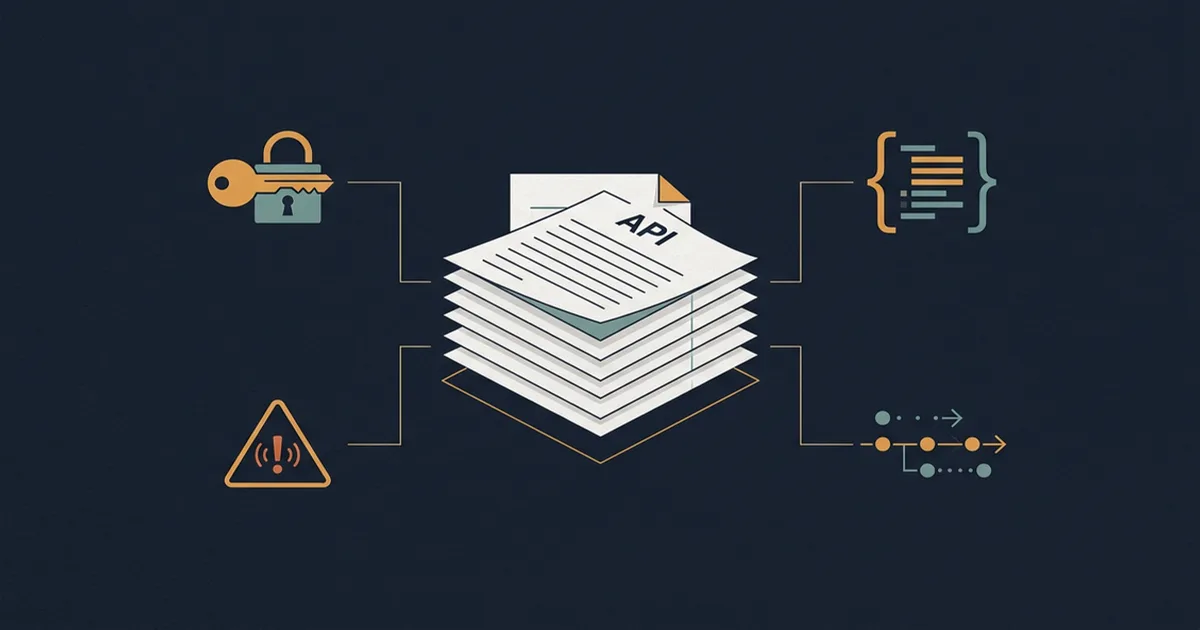
Build the documentation around consumer decisions
Start with the consumer job and its trust boundary. Add a machine-readable contract only after the operation, identity, failure, and change decisions are explicit enough to review.
Separate documentation from implementation and consumption tutorials
Define the audience as an API consumer reviewing a contract. Keep server architecture, database design, handler construction, deployment, and third-party integration code in their own guides. This page owns the reference package and its validation boundary, not either adjacent job.
Sources: [api-doc-pack], [openapi-3-2]
Give every operation a stable identity and least-privilege scope
Name one consumer outcome per operation, use a unique operationId, document parameters and media types, then require only the OAuth scope the job needs. A valid token does not replace tenant and record authorization on every request.
Sources: [api-doc-pack], [oauth-client-credentials]
Close schemas with valid request and response examples
Attach a JSON Schema to each documented media type and validate the exact example against it. Keep fictional values in reserved domains, reject unknown fields where the contract promises a closed shape, and test missing, malformed, duplicate, and out-of-range input.
Sources: [api-doc-pack], [openapi-3-1]
Document errors, retry, idempotency, and reconciliation together
Use stable problem codes alongside HTTP status and application/problem+json. Treat Idempotency-Key as an application convention: define key scope, request fingerprint, concurrent first write, retention, replay, conflict, expiry, and downstream reconciliation instead of implying a header makes POST safe by itself.
Sources: [api-doc-pack], [rfc-9457], [rfc-9110]
Version the API, description, examples, and changelog as one review unit
Distinguish the OpenAPI specification version, API contract version, URL major version, and exact artifact hash. Update operation links, scopes, schemas, examples, errors, narrative references, deprecation windows, and client tests before calling a change compatible.
Sources: [api-doc-pack], [openapi-3-2], [openapi-3-1]
What this API documentation template owns
Use the pack to publish one consumer-facing HTTP API contract whose machine-readable and narrative surfaces can be reviewed together. Keep implementation and consumer application work with their own owners and tests.
Included
- OpenAPI 3.1.2 YAML and JSON descriptions for three fictional work-order operations
- OAuth client-credentials scopes, server-side secret boundary, and authentication failure guidance
- Closed request, response, collection, validation-detail, and RFC 9457 problem schemas with examples
- Application-level idempotency scope, fingerprint, concurrency, retention, replay, conflict, expiry, and reconciliation rules
- Narrative operation reference, API and documentation version policy, changelog, validator, negative tests, and reproducible ZIP
Not included
- REST API handler construction, storage architecture, deployment, monitoring, or server implementation
- Third-party API consumption, SDK setup, client application code, provider credentials, or integration examples
- A live OAuth provider, endpoint, token, tenant, work order, request ID, side effect, or target-environment smoke
- Security, privacy, legal, accessibility, compliance, uptime, compatibility, approval, or delivery certification
- Automatic client generation quality, real consumer migration, or proof that an implementation matches the description
DOWNLOADABLE RESOURCE
Download the API documentation template pack
The archive keeps the machine-readable contract, narrative reference, authentication, errors, versions, examples, validator, and tests on one exact reviewed revision.
API documentation template pack
A fictional consumer-facing work-orders API contract with strict reference, schema-example, scope, operation-link, narrative-link, version, and archive checks.
Format: OpenAPI 3.1.2 YAML and JSON, Markdown reference files, JSON examples, and dependency-free Node.js validator/tests in one ZIP
Locally reproduced August 1, 2026. SHA-256: f0cd3893a03b3b76e5b41f72a550b186b02b5aa7cccd608ba9e8fc3447cf3bc1
Included
- Equivalent OpenAPI 3.1.2 YAML and JSON descriptions plus a narrative operation reference
- Authentication scope matrix, RFC 9457 problem catalog, versioning policy, changelog, and portable examples
- Dependency-free validator and sixteen positive and negative tests for structure, schemas, examples, references, security scopes, operation links, malformed example JSON, Markdown links, reserved identities, and archive reproducibility
Verification boundary
The allowlisted archive was rebuilt to identical bytes from UTC and Pacific/Auckland process time zones, extracted, byte-compared, and validated locally. OpenAPI YAML is generated exactly from the JSON source. The checks cover three operations, 33 local references, 16 schema examples, one operation link, two auth scopes, and five narrative links. They do not prove a live API, full standards conformance, authorization, concurrency, idempotency storage, client compatibility, or production behavior.
Four documentation shapes for different consumer risks
Reuse the review sequence, not the fictional work-order policy. Each API needs its own operations, trust boundary, schemas, examples, errors, change window, and evidence.
Partner write API documentation
Use when: An authenticated server client creates durable business records and may retry after a timeout.
Document client identity, write scope, required fields, durable resource ID, application-level idempotency behavior, conflict response, request correlation, and downstream reconciliation before showing a success example.
Structure
- Unique operationId, write scope, closed request schema, 201 response, Location header, and stable response ID
- Key scope, request fingerprint, concurrent first write, retention, replay, conflict, expiry, and reconciliation
Watch for: A documented header does not enforce idempotency, authorization, or downstream exactly-once behavior. Those need implementation and target tests.
Sources: [api-doc-pack], [rfc-9110], [rfc-9457]
Read and collection API documentation
Use when: Consumers list and fetch records by stable identity under account or tenant visibility rules.
Define opaque pagination, limits, empty results, resource IDs, conditional-response headers, not-found privacy behavior, and the difference between absent and unauthorized data.
Structure
- Read scope, cursor and limit parameters, collection schema, nullable next cursor, and empty-list behavior
- Stable path ID, ETag meaning, 404 privacy boundary, request correlation, and operation link from create
Watch for: Examples cannot prove tenant isolation or stable ordering. Test ordinary accounts against one another in the implemented service.
Sources: [api-doc-pack], [openapi-3-1]
Webhook-adjacent API documentation
Use when: An API creates subscriptions while asynchronous events arrive through a separate signed delivery channel.
Keep subscription operations, callback verification, signature input bytes, event identities, acknowledgement, redelivery, ordering, retention, and reconciliation as distinct documented contracts.
Structure
- API operation schemas and scopes remain separate from webhook signature and event schemas
- Examples distinguish accepted subscription state from real delivery and provider approval
Watch for: Do not infer live event delivery, provider setup, signed requests, or native integration from an API description alone.
Sources: [openapi-3-2], [rfc-9457]
Internal service API documentation
Use when: Several owned services exchange records but still need explicit identity, authorization, failure, and compatibility contracts.
Document the same consumer concerns as a public API: authenticated workload identity, least privilege, request and response schemas, bounded errors, retries, versions, ownership, and deprecation windows.
Structure
- Service owner, consumer inventory, environment boundary, scopes, operations, schemas, examples, and failure policy
- Compatibility tests, rollout order, observation window, rollback condition, and retirement evidence
Watch for: An internal network is not an authorization boundary, and a shared repository does not replace a versioned consumer contract.
Sources: [api-doc-pack], [oauth-client-credentials], [openapi-3-1]
Decide whether the API documentation is ready to publish
Publish when a consumer can implement against the contract without inventing identity, schema, failure, retry, or compatibility policy. Keep unresolved behavior explicit instead of hiding it in prose.
The implementation behavior is still changing daily.
Choose: Keep the description in draft, identify the first stable consumer job, and test the implementation against that smallest contract before publishing a broad reference.
Tradeoff: Consumers wait longer, but the documentation stops advertising behavior the service does not keep.
Examples exist but schemas, errors, or scopes are missing.
Choose: Hold publication and convert each example into a schema-validated request or response attached to the exact operation and media type.
Tradeoff: The reference takes more work, but consumers no longer treat one happy payload as the complete contract.
A POST may be retried after timeout or client reconnect.
Choose: Document the application idempotency key and fingerprint contract plus reconciliation before recommending automatic retries.
Tradeoff: Clients retain more state, but duplicate and ambiguous writes have a reviewable recovery path.
A change removes fields, narrows enums, changes errors, or alters authorization.
Choose: Treat it as a breaking-change candidate, inventory consumers, define a new major or negotiated transition, and keep both contracts tested during the window.
Tradeoff: The service carries a transition temporarily, but clients get an explicit migration and rollback boundary.
The OpenAPI description passes locally but no server conformance test exists.
Choose: Label the artifact locally validated and keep publication or production claims blocked until representative requests match the target implementation.
Tradeoff: The evidence statement is narrower, but the description is not mistaken for proof of server behavior.
START WITH THE CONSUMER CONTRACT
Download the API documentation pack and replace the fictional policy
Adapt the operations, scopes, schemas, examples, errors, links, versions, and changelog to the API your accountable owners can test. Keep the validator until every machine-readable and narrative surface agrees.
Download the API documentation packThe ZIP is locally reproduced. Public availability and target API behavior remain unverified until deployment and environment checks.
Read the separate REST API construction guideUse it when the next job is to design, implement, test, and deploy the service rather than document its consumer contract.
Limits to review before adopting the pack
Strict local validation can expose internal contract drift. It cannot prove that an implementation, identity provider, client, network, or operator behaves as documented.
- The pack targets OpenAPI 3.1.2 for 3.1-compatible tooling even though OpenAPI 3.2.0 is the latest published minor version as of 2026-08-01. Revalidate against the toolchain you actually use.
- The dependency-free validator checks a bounded OpenAPI subset and editorial contracts. It does not replace the normative specification or a complete standards validator.
- All hosts, identities, operations, work orders, credentials, scopes, responses, and outcomes are fictional reserved-domain examples. No service or provider was contacted.
- Schema-valid examples do not prove business rules, authentication, authorization, tenant isolation, idempotency concurrency, database transactions, downstream reconciliation, rate limits, observability, recovery, or uptime.
- A locally reproducible archive does not prove the public download, API implementation, generated client, or target environment. Run exact environment and consumer compatibility tests separately.
- The template is not legal, security, privacy, compliance, accessibility, reliability, or architecture approval.
Primary sources and artifact record
The exact same-release pack supports its operation, schema, example, scope, link, and archive counts. Official OpenAPI, IETF, and OAuth sources support the bounded specification and HTTP semantics.
[api-doc-pack] Playcode:Completed fictional API documentation source
Checked August 1, 2026. Supports: The locally reviewed three-operation OpenAPI description, examples, scopes, operation link, idempotency extension, changelog, validator, and test counts. Public availability and API behavior remain unverified.
[openapi-3-2] OpenAPI Initiative:OpenAPI Specification 3.2.0
Checked August 1, 2026. Supports: The current published OpenAPI minor version and versioning model. The pack deliberately targets the prior 3.1 feature set for its stated compatibility boundary.
[openapi-3-1] OpenAPI Initiative:OpenAPI Specification 3.1.2
Checked August 1, 2026. Supports: The OpenAPI 3.1 description structure, local references, schemas, examples, security requirements, operation IDs, links, and YAML or JSON formats used by the pack.
[rfc-9457] RFC Editor:RFC 9457: Problem Details for HTTP APIs
Checked August 1, 2026. Supports: Using application/problem+json and stable problem members for machine-readable HTTP API errors. It does not prescribe the fictional extension codes or retry policy.
[rfc-9110] RFC Editor:RFC 9110: HTTP Semantics
Checked August 1, 2026. Supports: HTTP method and idempotency semantics. POST is not inherently idempotent; the pack documents its key as an application convention rather than an HTTP guarantee.
[oauth-client-credentials] RFC Editor:RFC 6749 Section 4.4: Client Credentials Grant
Checked August 1, 2026. Supports: The bounded server-to-server client-credentials example. It does not prove a real authorization server, token, client, scope grant, or provider setup.
API documentation template questions
What is an API documentation template?
It is a reusable structure for explaining a consumer-facing API contract. A useful template aligns machine-readable operations, parameters, schemas, examples, authentication, errors, links, and versions with narrative guidance, change policy, and verification evidence.
Why does this pack use OpenAPI 3.1.2 instead of 3.2.0?
OpenAPI 3.2.0 is the latest published minor version as of 2026-08-01. This pack deliberately targets OpenAPI 3.1.2 for existing 3.1-compatible tooling while stating that boundary openly. Revalidate and migrate when your selected generators, validators, documentation renderer, and clients support the newer feature set.
Should API documentation include request and response examples?
Yes, but each example should be attached to the exact operation, status, media type, and schema and should pass validation. An example alone is not the contract: it may omit optional fields, alternate errors, pagination, authorization, concurrency, and recovery behavior.
How should API errors be documented?
Document HTTP status, media type, stable machine code, safe detail, request correlation, field-level errors where appropriate, retry decision, and recovery action. This pack uses RFC 9457-style problem details and tests that each numeric problem status matches its HTTP response.
Is Idempotency-Key an HTTP standard?
This pack treats it as an application convention, not an HTTP standard. A useful contract defines the key scope, normalized request fingerprint, concurrent first write, retention and expiry, replayed response, changed-request conflict, and downstream side-effect reconciliation. The header by itself does not make a mutation safe.
Does a valid OpenAPI file prove that the API works?
No. Local validation proves only the reviewed description and examples. A release still needs implementation conformance, authentication and authorization tests, ordinary-account isolation, concurrency and retry tests, client compatibility, target-environment smoke, monitoring, and recovery evidence.
How is this different from REST API and integration examples guides?
This page owns the consumer documentation contract. The REST API guide owns service design, implementation, tests, and deployment. The API integration examples guide owns how an application consumes third-party APIs. Keeping the jobs separate prevents one page from competing for three different search intents.
BUILD FROM A REVIEWED CONTRACT
Turn the accepted API boundary into a working web app
Give Playcode the reviewed operations, roles, records, scopes, schemas, examples, errors, and acceptance checks. Keep real credentials server-side and verify the implementation against the target API before launch.
Explore the AI app builderThis informational page is credit-ineligible. No API delivery, provider integration, client compatibility, approval, uptime, or production outcome is guaranteed.