QUICK ANSWER
What should a test case template include?
A test case template should give one reusable technical check a stable ID and revision, objective, requirement references, applicability, setup, controlled fixture, preconditions, ordered actions with expected results, postconditions, cleanup, priority, type, and automation status. Record each run separately with its environment, version, actual result, verdict, sanitized evidence, and linked defect when the observed behavior fails.
A useful test case defines one reusable technical check before anyone records a run. It keeps a stable case ID and revision, a narrow objective, requirement references, controlled setup, preconditions, ordered actions with expected observations, postconditions, cleanup, applicability, priority, test type, and automation status together.
Execution is a separate layer: the tester records the actual result, verdict, time, role, sanitized evidence, and any linked defect for one version and environment. This pack does not replace a test plan, user acceptance decision, requirements traceability matrix, bug report, security assessment, or accessibility evaluation.
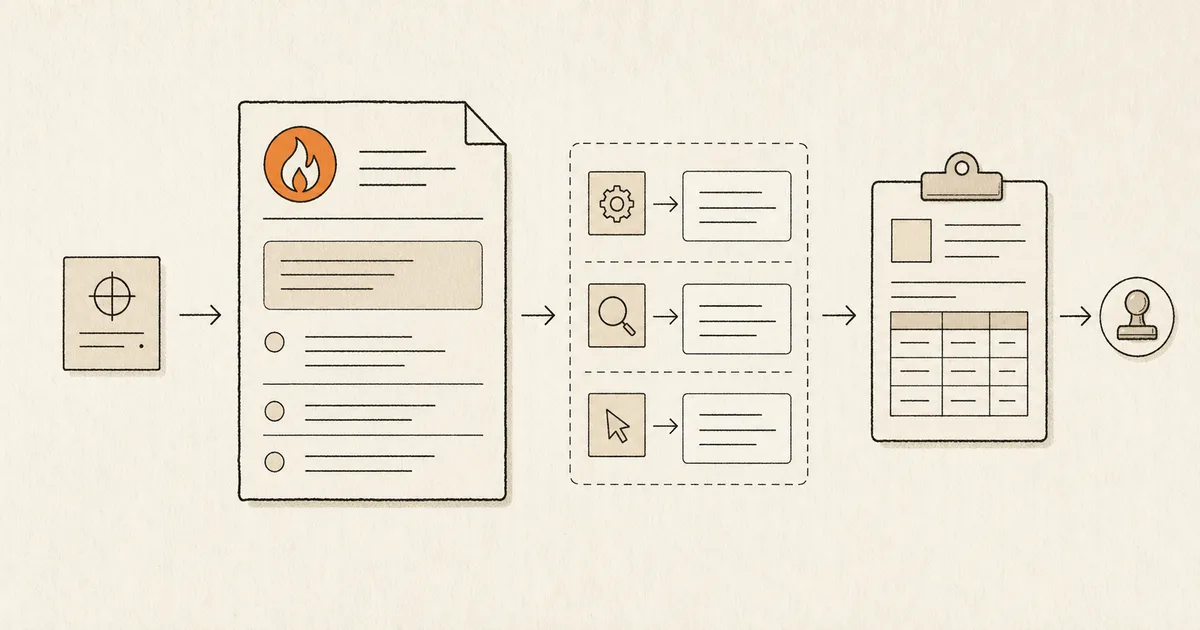
Write one reusable test case, then record one run
Keep the stable case definition separate from execution evidence. A reviewer should be able to understand what to check before seeing whether a particular run passed, failed, was blocked, or was not run.
Give one technical check a stable identity and purpose
Use one case ID and revision for one narrow objective. Reference the approved requirement and acceptance criterion without copying an entire specification. ISO/IEC/IEEE 29119-3 publicly establishes that test documentation templates can support different organizations, projects, activities, and lifecycle models, but its public abstract does not mandate this pack's exact fields.
Sources: [test-case-pack], [iso-29119-3-2021], [istqb-test-analyst-v4]
Control setup, fixture, preconditions, and cleanup
Name the environment and application version, use a reserved fictional target, define the smallest fabricated fixture, and state the preconditions, postconditions, and cleanup. Remove credentials and personal data. Synthetic or fabricated data still needs privacy review because generated data is not automatically private.
Sources: [test-case-pack], [istqb-test-analyst-v4], [nist-dp-synthetic-data], [rfc-2606]
Pair every ordered action with an observable expected result
Write actions in the order a tester or automation will perform them, and pair each action with a specific observable result. Avoid vague expectations such as works correctly. Concrete preconditions, input data, actions, expected results, and postconditions make the case repeatable without turning it into a test strategy.
Sources: [test-case-pack], [istqb-test-analyst-v4]
Keep actual result, verdict, and evidence in the execution record
For one run, record the version, environment, execution time, tester role, actual observation, Pass, Fail, Blocked, or Not run state, and sanitized evidence references. A blocked environment is different from wrong product behavior. If the behavior fails, link a separate defect record rather than converting the stable case into a bug report.
Sources: [test-case-pack], [istqb-foundation-v4-0-1], [nasa-swe-071-revd]
Preserve the owners around the test case
Let the test strategy own durable quality objectives, risk and coverage selection, automation policy, environment and data policy, evidence requirements, and governance. Let the test plan own one release version's exact scope, environments, suites, gates, runs, evidence, defects, retests, recovery, and smoke. UAT owns representative-user business acceptance and sign-off, the RTM owns lifecycle coverage and change impact, and the bug report owns observed-defect reproduction and triage. Automated accessibility tools can support a test case, but no tool alone determines conformance and sampled evaluation does not establish whole-product accessibility.
Sources: [test-case-pack], [istqb-foundation-v4-0-1], [nasa-swe-071-revd], [w3c-evaluation-tools], [w3c-wcag-em-2]
Validate the portable record without overstating the schema
Use the closed Draft 2020-12 schema for portable field shape, then run the dependency-free validator for cross-field state, chronology, reserved targets, redaction flags, and ownership boundaries that JSON Schema alone does not express for this pack.
Sources: [test-case-pack], [json-schema-2020-12]
What this test case template owns
The pack owns one reusable executable technical check and one separate example execution. Adjacent records may reference its stable IDs, but they retain their own purpose, evidence, review, and decision authority.
Included
- One stable case ID, revision, title, objective, lifecycle status, applicability, priority, test type, and automation status
- Requirement and acceptance-criterion references, plus optional references to the owning test plan, UAT scenario, and RTM relationship
- Environment, application version, reserved target, controlled fabricated fixture, data classification, preconditions, postconditions, and cleanup
- Two to twenty contiguous ordered steps, each with one action and one observable expected result
- One separate execution record with run ID, time, tester role, actual result, Pass, Fail, Blocked, or Not run state, sanitized evidence, and linked defect IDs
- Markdown, JSON, JSON Schema, three CSV views, three fictional examples, a dependency-free validator, deterministic tests, and a reproducible ZIP builder
Not included
- Test-strategy objectives, risk model, coverage-selection rules, automation policy, environment and data policy, evidence policy, governance, or cross-release exceptions
- Test-plan release scope, suite inventory, exact environments, entry or exit gates, runs, evidence, defects, retests, recovery, smoke, or release authorization
- UAT business acceptance, representative-user evaluation, known-risk acceptance, business sign-off, or a launch decision
- RTM lifecycle coverage, bidirectional traceability governance, orphan detection, change-impact analysis, baseline control, or completeness claims
- Bug-report reproduction intake, severity, duplicate search, triage, root-cause analysis, remediation priority, fix approval, or defect closure
- Security assessment, penetration testing, privacy approval, accessibility evaluation, WCAG conformance, performance qualification, legal review, or compliance certification
- Real credentials, personal data, private URLs, customer records, production access, live evidence, monitoring, operations, recovery, or service-level commitments
DOWNLOADABLE RESOURCE
Download the deterministic test case pack
Start with the readable worksheet or valid JSON starter, compare the three fictional cases across JSON and CSV, then run the bundled validator and tests before adapting the closed record to your own reviewed process.
Test case template and examples pack
A deterministic, dependency-free pack for one reusable technical test case and a separate execution record, with three fictional patterns and cross-format parity.
Format: Markdown, JSON, JSON Schema, CSV, and dependency-free Node.js validator/tests in one ZIP
Locally reproduced August 1, 2026. SHA-256: 821572e1aea0830fd6c0c6a57f0b8dfea742b0cad0502577557fe0fa24246491
Included
- Editable Markdown worksheet and a valid ready-but-not-run JSON starter
- Closed Draft 2020-12 JSON Schema and three completed fictional JSON examples
- Case, step, and execution CSV views with three cases, nine ordered steps, and three execution rows
- Dependency-free validator and deterministic Node.js tests for structure, cross-field state, chronology, safe data, evidence, and owner boundaries
- Deterministic ZIP builder with fixed timestamps, stripped metadata, exact allowlist, byte-parity checks, and clean-extraction verification
Verification boundary
Rebuilt the exact 12-file archive from page-local sources with fixed timestamps and stripped ZIP metadata. Verified three examples, nine contiguous action-and-expected-result steps, three separate executions, closed object keys, semantic versions, UTC timestamps, reserved fictional targets, fabricated fixtures, no personal or secret-like values, result-state consistency, evidence hashes and redaction flags, review chronology, CSV safety, clean extraction, source/public/archive parity, and all-false ownership boundaries.
Three test case patterns with separate executions
Each fictional example keeps the reusable definition stable and records one version-bound run separately. Together they cover a successful path, rejected input with no write, and an idempotent retry boundary.
Successful service-request creation
Use when: A valid fabricated request should create one record and return an observable confirmation for the defined preview version.
The reusable case names the requirement, fixture, preconditions, ordered entry and submission actions, expected confirmation, stored-record check, cleanup, priority, functional type, and automation status. Its separate fictional execution records the actual result, Pass verdict, timestamp, tester role, and sanitized evidence.
Structure
- Stable case ID and revision remain separate from the version-bound execution run ID
- Three action-and-expected-result pairs cover input, submission, and one stored-record observation
- The passing execution cites redacted evidence captured after the run without claiming broader coverage
Watch for: One passing run proves only the recorded result for this fixture, environment, version, and case. It does not establish total coverage, business acceptance, production readiness, or defect absence.
Sources: [test-case-pack], [istqb-test-analyst-v4], [istqb-foundation-v4-0-1], [json-schema-2020-12], [rfc-2606]
Invalid input rejected without a write
Use when: A bounded invalid value should produce a specific validation observation and leave the fabricated record set unchanged.
The case defines the invalid fixture and initial record count, pairs the field action with a precise validation message, blocks submission, and checks that no record was created. The separate fictional execution records what actually happened and keeps evidence references sanitized.
Structure
- The objective tests one rejection boundary instead of a broad claim that all validation works
- The expected result includes both visible feedback and the absence of the prohibited write
- Preconditions and cleanup keep the fabricated fixture repeatable across later runs
Watch for: This functional case does not establish input-security coverage, accessibility of the error, every invalid partition, privacy approval, or a complete negative-testing strategy.
Sources: [test-case-pack], [istqb-test-analyst-v4], [nist-dp-synthetic-data], [w3c-evaluation-tools]
Duplicate retry remains idempotent
Use when: Repeating the same fabricated request after an uncertain response should not create a second record for the same key.
The reusable case fixes one request key and initial state, performs the original request and retry, and expects one durable record with a stable reference. Its separate execution preserves the observed result and evidence without becoming a failure-rate study or defect report.
Structure
- One controlled request key and fixture isolate the retry behavior
- Ordered steps distinguish the original submission, uncertain response, and bounded retry
- The final expected result checks one durable record rather than inferring internal implementation
Watch for: A passing fictional retry case does not prove every concurrency, timeout, provider, crash-recovery, load, or distributed-systems boundary, and it does not authorize release.
Sources: [test-case-pack], [nasa-swe-071-revd]
Decide whether a test case is ready to run
Schema validity is only a documentation gate. A reviewer still decides whether the objective, requirement, setup, oracle, data, evidence plan, and adjacent owner handoffs are suitable for the intended risk.
The case has several objectives, unrelated requirements, conditional paths, or expected outcomes that can fail independently.
Choose: Split it into one stable case per independently reviewable technical check and link the related IDs through the test plan or RTM.
Tradeoff: There are more records to maintain, but each execution can produce one unambiguous result and one focused defect handoff.
A step says verify, behaves correctly, or works as expected without naming an observable state, value, message, or absence of a write.
Choose: Rewrite the expected result as a specific observation available to the tester or automation at that point in the sequence.
Tradeoff: The case takes longer to author, but verdicts depend less on hidden assumptions and reviewer interpretation.
The fixture contains personal data, credentials, a private URL, an unexplained production copy, or generated data assumed to be private by default.
Choose: Stop the run, replace it with the smallest reviewed fabricated fixture, and follow the qualified privacy or security process for any exposure.
Tradeoff: The test may lose some production realism, but it avoids turning an ordinary case or evidence file into an unauthorized data store.
An execution is marked Pass without an actual result and evidence, or Fail without a separate defect reference for triage.
Choose: Keep the stable case unchanged, complete the version-bound execution record, and link the observed failure to its own bug report.
Tradeoff: Reporting takes another step, but reusable intent remains separate from observation, defect triage, and later retest history.
The case is being used to approve a release, sign off UAT, certify accessibility or security, or claim complete lifecycle coverage.
Choose: Return that decision to the test-plan, UAT, specialist-review, release, or RTM owner and use this case only as bounded supporting evidence.
Tradeoff: No single record gives a universal answer, but each accountable owner retains the evidence, method, limitations, and authority their decision requires.
START WITH ONE OBSERVABLE CHECK
Download the test case template pack
Open the readable worksheet, valid starter, three fictional examples, and CSV views. Review each action-and-expected-result pair, then run the dependency-free validator and tests before adapting the record.
Download the test case packThe ZIP is reproduced locally. Public availability and adapted record accuracy require separate verification.
Keep durable policy in the test strategyUse this page for one reusable technical check. Use the test strategy for durable quality policy and the test plan for one exact release version's environments, suites, gates, runs, evidence, defects, retests, recovery, and smoke.
What a test case cannot prove
A structured case reduces ambiguity around one technical check. Its result is still bounded by the requirement, test design, oracle, fixture, environment, version, execution, evidence, and reviewer judgment.
- One case or one passing execution does not establish total requirement coverage, regression completeness, defect absence, production reliability, or release readiness.
- Requirement IDs improve local traceability but do not replace an RTM that owns lifecycle coverage, bidirectional links, orphan detection, baseline change, and change impact.
- Technical evidence can support UAT, but it cannot replace representative-user business acceptance, known-risk review, business sign-off, or a launch decision.
- A failed execution can reference a defect ID, but the test case does not replace the bug report that owns the observed behavior, reproduction intake, severity, duplicate search, triage, remediation, and closure.
- Automated accessibility checks and sampled evaluation can find issues, but no tool alone determines conformance and a bounded sample does not establish whole-product accessibility.
- A functional test is not a security assessment, penetration test, privacy approval, performance qualification, legal opinion, compliance certification, or operational recovery exercise.
- Fabricated or synthetic data reduces direct exposure only when reviewed and controlled; generated data is not automatically private and can still leak or resemble sensitive records.
- Evidence references, timestamps, hashes, and redaction flags improve reviewability but do not independently authenticate origin, completeness, integrity, or chain of custody.
- The downloadable examples are fictional, the public download requires deployment verification, and an adapted workflow needs its own authorization, concurrency, audit, retention, integration, monitoring, and recovery review.
- This ordinary informational article does not grant AI signup credits. The linked product page follows its own current eligibility rules.
Sources and verification record
The same-release pack directly supports its fictional examples and deterministic validation claims. Official primary sources support the documented testing, evidence, accessibility, privacy, schema, and reserved-domain principles without certifying this pack or prescribing every field.
[test-case-pack] Playcode:Test case template fictional examples
Checked August 1, 2026. Supports: The locally reviewed three-case example set, nine ordered steps, three separate execution records, reserved targets, validator behavior, tests, exact allowlist, and reproducible archive. Public availability remains unverified until deployment.
[iso-29119-3-2021] International Organization for Standardization:ISO/IEC/IEEE 29119-3:2021 Software testing - Test documentation
Checked August 1, 2026. Supports: The public abstract states that test documentation templates apply across organizations, projects, testing activities, and lifecycle models. It does not publicly expose field-level mandates or certify this pack.
[istqb-test-analyst-v4] International Software Testing Qualifications Board:Certified Tester Advanced Level Test Analyst Syllabus v4.0
Checked August 1, 2026. Supports: Current test-analysis guidance that concrete cases identify preconditions, input data, actions, expected results, and postconditions, plus quality criteria and safe test-data considerations. It does not prescribe this schema.
[istqb-foundation-v4-0-1] International Software Testing Qualifications Board:Certified Tester Foundation Level Syllabus v4.0.1
Checked August 1, 2026. Supports: Current foundation-level concepts for actual-versus-expected comparison, execution logging, traceability, defect reporting, and acceptance testing. It does not make a result, defect, or UAT decision for this pack.
[nasa-swe-071-revd] NASA Software Engineering Handbook:SWE-071 - Update Test Plans and Procedures
Checked August 1, 2026. Supports: A public engineering pattern that keeps test plans, procedures, cases, traceability, results, and evidence distinguishable and reviewable. It does not impose NASA requirements on this fictional pack.
[w3c-evaluation-tools] World Wide Web Consortium:Selecting Web Accessibility Evaluation Tools
Checked August 1, 2026. Supports: Current guidance that evaluation tools can help but cannot determine accessibility on their own, because knowledgeable human evaluation is required. It does not evaluate this page or pack.
[w3c-wcag-em-2] World Wide Web Consortium:Website Accessibility Conformance Evaluation Methodology 2.0
Checked August 1, 2026. Supports: The current five-stage accessibility evaluation methodology and the limitation that sampled evaluation usually cannot establish whole-product conformance. It does not certify this page or pack.
[nist-dp-synthetic-data] National Institute of Standards and Technology:Differentially Private Synthetic Data
Checked August 1, 2026. Supports: The privacy limitation that synthetic data can leak sensitive information unless the generation method provides suitable protections. It does not review or approve any bundled fixture.
[json-schema-2020-12] JSON Schema:JSON Schema specification
Checked August 1, 2026. Supports: Draft 2020-12 as the current released JSON Schema version used by the bundled closed schema. The dependency-free validator separately enforces pack-specific cross-field rules.
[rfc-2606] RFC Editor:Reserved Top Level DNS Names
Checked August 1, 2026. Supports: The reservation of .test for testing examples, which is why fictional targets avoid real customer, internal, or production domains. A reserved name is not automatically private or secure.
Test case template questions
What is the difference between a test case and a test plan?
A test case defines one reusable technical check: objective, setup, fixture, preconditions, ordered actions, expected results, postconditions, cleanup, and execution fields. A test plan applies the approved strategy to one release or product version with exact scope, environments, suites, gates, runs, evidence, defects, retests, recovery, and smoke. Durable objectives, risk, coverage-selection, automation, data, evidence, and governance policy belong in the test strategy.
How detailed should an expected result be?
Make each expected result observable at the point where its action finishes. Name the exact state, value, message, response class, count, or absence of a write that a tester or automation can inspect. Avoid works correctly or matches requirements. Keep implementation details out unless the approved requirement explicitly makes them observable behavior.
What is the difference between a test case and a bug report?
The test case defines reusable intent before execution. A run records what actually happened for one version and environment. If that observation fails, link a separate bug report that owns the defect description, reproduction intake, environment, evidence, severity, duplicate search, human triage, remediation state, and version-bound retest. Do not rewrite the expected result to match the failure.
Can a test case replace a UAT scenario or sign-off?
No. A technical case can support a UAT scenario with bounded evidence, but UAT owns representative users, business process outcomes, agreed acceptance criteria, known-risk decisions, and business sign-off on the exact release. A technical Pass verdict cannot make that business decision, and a UAT decision should reference rather than overwrite the reusable case.
Do requirement references make a test case a traceability matrix?
No. Requirement and acceptance-criterion IDs explain why one case exists and let adjacent records link to it. An RTM separately owns lifecycle coverage, bidirectional requirement-to-design-to-implementation-to-test-to-evidence relationships, orphan detection, baseline status, change-impact analysis, and completeness limits. A local reference is useful traceability, not a full coverage claim.
Can Playcode automate this test case or certify accessibility?
Playcode can help build a bounded workflow around reviewed case definitions, executions, evidence, and defect links. Verify authorization, concurrency, audit, retention, integrations, environments, monitoring, recovery, and human review before operational use. Automation can repeat observable checks, but it does not certify security or accessibility, replace specialist evaluation, sign off UAT, or authorize release.
BUILD THE TESTABLE WORKFLOW
Turn reviewed test records into a bounded app
Give Playcode the accepted case, execution, evidence, and defect-link model. Verify roles, authorization, concurrency, audit, integrations, retention, target environments, monitoring, recovery, specialist reviews, UAT, and release control before operational use.
Build and verify the test workflowThis informational article does not grant AI signup credits. No coverage, defect absence, security, accessibility, acceptance, release, recovery, reliability, compliance, or business outcome is guaranteed.