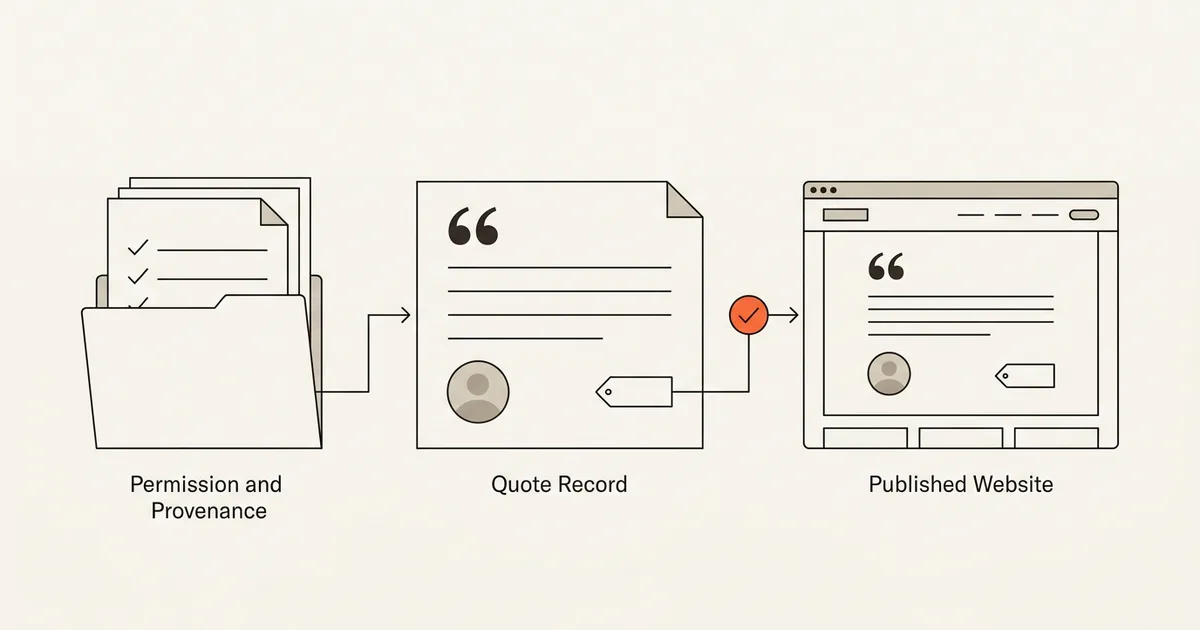
A testimonial can shorten a buying decision only when a visitor can trust where it came from. Treat every quote as a governed evidence record: retain the source, permission, exact approved wording, identity, material connection, placement, review date, and revocation path before the card reaches a public page.
This is a docs-backed publishing guide for site owners, marketers, and designers. It applies the FTC Endorsement Guides FAQ, current federal guidance, Google schema rules, and WCAG references. No testimonial collection flow, consent workflow, or published customer-testimonial implementation was tested for this article.
QUICK ANSWER
How should testimonials appear on a website?
Use only statements from real customers about experiences they actually had. Keep the original source, written publication permission, approved wording and attribution, any incentive or insider disclosure, and evidence for implied outcome claims. Place each quote beside the claim or objection it supports, make the component accessible, test the placement as a hypothesis, and keep a review and removal process.
Prepare the evidence before designing the card
A polished layout cannot repair missing permission or an untraceable quote. Collect the minimum records below and stop publication when any required field is unknown.
- An authoritative source and publication permission: Keep the original email, interview recording, survey response, support message, or review URL under an authorized evidence owner. Record what may be quoted, where it may appear, how long permission lasts, whether a portrait or company name is included, and how the person can revoke permission.
- Approved wording and identity fields: Store the exact source text separately from the approved public excerpt. Confirm the display name, role, organization, product or service used, date of experience, and any edits with the person or authorized organization representative. Never infer an identity from an email domain or public profile.
- A material-connection and result review: Check employment, family or personal relationships, payment, discounts, free access, affiliate arrangements, early access, contest entries, or other benefits. 16 CFR Part 255 says an unexpected connection that could affect weight or credibility needs a clear and conspicuous disclosure, and a testimonial cannot carry a claim the advertiser could not make directly.
- A named publication and revocation owner: Assign one person to approve placement, recheck the source and current product context, receive withdrawal requests, remove a testimonial from every location, and retain the audit record. Set a next-review date based on product changes and the sensitivity of the claim.
Choose the proof format before designing the section
Format changes discoverability, depth, provider exposure, and accessibility. Every option still needs one governed evidence ledger and a complete placement index.
| Approach | Best for | Tradeoff |
|---|---|---|
| Static contextual quote | One real statement that answers a nearby buyer objection or supports a nearby product claim. | It is easy to scan, attribute, test, and remove, but it carries little context and still needs a source and review owner. |
| Dedicated story or testimonial page | Several longer stories, proof details, or distinct buyer segments that need more context than one quote. | It provides depth, but many visitors will not open it, so relevant decision pages still need bounded contextual excerpts. |
| Verified third-party review widget | A maintained review stream whose provider terms, privacy, moderation, performance, and removal behavior are understood. | It adds external scripts, transferred data, availability, styling, moderation, and self-serving schema limits that need separate review. |
| Controlled carousel | A strictly constrained space with several approved records and no simpler layout. | It can hide content and create motion, focus, announcement, and keyboard problems; it needs pause controls and coherent panel behavior. |
Recommended:Default to one static contextual quote beside the claim or objection it actually supports. Use a dedicated page as depth or archive, a provider widget only after provider and privacy review, and a carousel only when its tradeoffs are accepted. Keep one private evidence ledger record per testimonial regardless of format.
Publish a trustworthy testimonial on a website
Move one real customer statement from its source through permission, approval, placement, accessible HTML, restrained schema, testing, publication, and ongoing review.
STEP 01
Name the buyer question and proof need
Map one objection or product claim to one proposed proof placement instead of asking for social proof everywhere.
Write the buyer question, the nearby product statement, what evidence would help, and what the testimonial must not imply. A statement about setup clarity should not be presented as proof of revenue, typical results, reliability, or universal product fit.
The FTC Endorsement Guides FAQ explains that endorsements must be honest, not misleading, and cannot carry a claim the marketer could not legally make directly. Treat the net impression around the quote as part of the proof review.
Reject a brief that starts with a fixed section number, universal testimonial count, or promised conversion lift. Placement is a hypothesis to test against one page and audience.
Expected result: The brief names one buyer question, one supported product claim, one proposed placement, and the unsupported implications the testimonial must avoid.
Verify it: Remove the planned testimonial and identify the precise decision evidence that disappears. If nothing changes, it is decoration; narrow the job or omit the block.
STEP 02
Create the evidence ledger and request permission
Create one traceable record before treating a private message or public review as advertising material.
Give the candidate a stable record ID and preserve the original source. Show the person the proposed excerpt, display identity, role or organization, portrait if any, material-connection disclosure, pages and channels, edit policy, review date, and withdrawal contact. Preserve the final response with the ledger.
Before asking for a review, follow the FTC's solicitation guide: do not ask only people expected to be positive, do not condition a benefit on positive sentiment, and check the destination platform's terms. No live solicitation or incentive flow was tested for this guide.
Permission, privacy, publicity, contract, and platform rules are separate. For EU personal-data processing, GDPR Articles 6 and 7 require a lawful basis, and when consent is used it must be demonstrable and as easy to withdraw as to give. Confirm applicability and the correct basis for the people and jurisdictions involved instead of treating one form as universal legal approval.
TESTIMONIAL EVIDENCE LEDGER

Record ID:
Status: proposed | verification | approved | published | paused | retired
Product or service actually experienced:
Experience date or period:
Original source URL or protected record:
Original wording:
Approved excerpt:
Edit log: exact quote | omissions marked | paraphrase approved

Publication permission record:
Approved channels and pages:
Approved name, role, company, photo, logo, and link:
Anonymity or minimization choice:
Permission date:
Withdrawal or removal contact:

Material connection or incentive:
Required disclosure copy and placement:
Outcome or performance claim implied:
Substantiation owner and evidence:
Typical-result review:

Buyer objection or claim this supports:
Page and proposed placement:
Format: static quote | story | video | third-party widget | carousel
Accessibility: quote text | attribution | alt | captions | transcript | controls
Experiment hypothesis and primary measure:

Published version and date:
Next review date:
Change, complaint, or removal trigger:
Owner:
Expected result: The ledger preserves the source, permission decision, approved public fields, connection and claim reviews, placement hypothesis, review date, and removal owner.
Verify it: Open the source and permission record, compare every ledger field, and block publication if the source, permission decision, connection answer, claim review, or removal path is missing.
STEP 03
Verify the experience, identity, connection, and claims
Confirm the person and represented experience are real, then review what the complete placement would imply.
Use 16 CFR Part 465 as a current boundary against fake or false testimonials, sentiment-conditioned incentives, undisclosed insider relationships, and deceptive suppression. Confirm the person exists and actually had the experience represented.
Under 16 CFR Part 255, an endorsement must reflect honest experience, the advertiser remains responsible for implied claims and substantiation, and an unexpected material connection that can affect weight or credibility must be disclosed clearly and conspicuously.
Review the whole presentation, not only the sentence. A real quote can imply a typical outcome, comparative claim, expert status, or current feature that the testimonial alone does not substantiate. Narrow or remove unsupported implications rather than treating the customer statement as proof of them.
Expected result: The ledger identifies a real source and experience, approved identity, connection and disclosure decision, and substantiation owner for every implied outcome or performance claim.
Verify it: Ask a reviewer to trace identity and experience to the source, inspect the surrounding page for implied claims, and locate the connection disclosure without a click, hover, or private explanation.
STEP 04
Edit without changing the meaning
Keep the source, edit log, approved excerpt, attribution, and final pixels in one review chain.
Under 16 CFR 255.1, quotation marks represent exact words, and an endorsement cannot be presented out of context or reworded to distort the endorser's opinion or experience. Preserve the original, mark omissions, label an approved paraphrase as a paraphrase, and re-approve the final excerpt.
Publish only approved identity fields. More identity is not automatically better. Never infer a full name, current role, company, customer category, logo, portrait, or avatar from an email domain or public profile, and do not pair the quote with an unrelated stock person.
Review the final card as pixels and text. Line breaks, headings, nearby statistics, emphasis, portrait choice, or an omitted qualifier can change the meaning even when the stored excerpt remains unchanged.
Expected result: The public excerpt stays faithful to the original experience, every change is logged, identity fields are authorized, and the final presentation is approved in context.
Verify it: Compare the original wording, edit log, approved excerpt, attribution, disclosure, and final rendered card character by character and visually. Restore or re-approve any changed meaning.
STEP 05
Match the format and placement to the decision
Use a testimonial as contextual evidence, not as a decorative wall of praise or a substitute for substantiation.
Map each approved statement to one specific buyer question, such as setup clarity, collaboration, or support experience. Place it after the product explanation it supports and before the next decision or CTA. Keep broad or sensitive result statements out unless the underlying claim and expected-results context are substantiated.
A dedicated testimonial page can serve as an inventory, but it should not be the only place visitors can understand relevant proof. A carousel can save space, but every panel, control, attribution, and disclosure must remain reachable by keyboard and readable without timing pressure.
The W3C WAI carousel tutorial warns that carousels can be hard to discover and use, and teaches semantic structure, keyboard access, pause controls, announcements, and focus behavior. Prefer static proof when space permits; never auto-rotate without accessible controls.
Do not label a hand-picked quotation as most helpful, representative, typical, verified, or independent unless the evidence and selection method support that label. Keep a balanced review-hosting program separate from selected advertising testimonials.
Expected result: Each placement has a named purpose, nearby context, approved attribution and disclosure, and no unsupported typicality or independence signal.
Verify it: Remove the testimonial temporarily and identify the exact decision evidence that disappears. If nothing changes, the card is decoration; move or omit it. Then read the surrounding page to check the quote does not create a broader implied claim.
STEP 06
Build semantic, accessible testimonial HTML
Keep the quotation, attribution, disclosure, and portrait meaning available without depending on visual card styling.
The HTML Standard defines blockquote as quoted content from another source and keeps attribution outside the quotation. Use figure and figcaption when the quote and attribution form one self-contained unit; do not rely on the cite attribute as the only visible source or attribution.
WCAG 2.2 Non-text Content calls for a text alternative that serves the equivalent purpose. Give an informative portrait an alt description approved for publication, or use an empty alt when it is purely decorative and the visible attribution already identifies the person.
WCAG 2.2 Reflow expects vertically scrolling content to work at a width equivalent to 320 CSS pixels without two-dimensional scrolling, except where a two-dimensional layout is necessary. Let quote text, attribution, disclosure, and controls wrap instead of fixing card widths.
For interactive formats, check WCAG keyboard operation, pause, stop, and hide behavior, and minimum text contrast. These individual references do not certify overall WCAG conformance; include disabled users and assistive-technology paths in the broader review.
<!-- Replace every bracketed token from one approved evidence record. -->
<figure class="testimonial" data-testimonial-id="[stable-record-id]">
  <blockquote cite="[approved-source-url-if-public]">
    <p>[exact-approved-customer-words]</p>
  </blockquote>
  <figcaption>
    <span>[approved-display-name]</span>
    <span>[approved-role-or-context]</span>
    <span>[material-connection-disclosure-if-required]</span>
  </figcaption>
</figure>
Expected result: The DOM exposes a quotation and its attribution in reading order, while identity, disclosure, and any meaningful image remain understandable with CSS or images unavailable.
Verify it: Inspect the accessibility tree, navigate every carousel control by keyboard if one exists, disable images and CSS, and test at 320 CSS pixels or an equivalent 400% zoom. Confirm the page has no horizontal document overflow and no hidden disclosure.
STEP 07
Test source, meaning, accessibility, schema, and the hypothesis
Exercise the controls that fail quietly: copied wording, hidden disclosures, broken reflow, duplicate placements, stale permission, and schema drift.
Use a controlled, explicitly non-customer fixture record in staging. Confirm that missing source, permission, identity approval, material-connection decision, owner, or review date blocks publication. Do not turn that fixture into public testimonial copy.
For an approved real record, compare source text, approved excerpt, visible quotation, attribution, connection disclosure, portrait rights, alt text, placement list, and schema. Test keyboard order, screen-reader output, 320 CSS pixel reflow, link targets, reduced motion where applicable, and a removal preview.
Google's review snippet documentation says pages controlled by a LocalBusiness or Organization about itself are ineligible for the star review feature when that entity controls the reviews, including embedded third-party widgets. Do not add Review or AggregateRating JSON-LD merely because selected testimonials are visible.
Google's general structured-data guidelines require markup to represent visible page content and prohibit fake, irrelevant, or misleading data. Parse every JSON-LD script and compare Article, HowTo, FAQPage, and BreadcrumbList fields with the visible guide.
Treat placement as an open research question. The GOV.UK user-research planning guide recommends testing important assumptions and including disabled users when the service targets a broad audience. Verify allocation, measurement, and guardrails before calling an experiment stable; do not publish a conversion-lift claim from a small or unstable result.
Expected result: Only approved records render, every field matches its ledger, the card remains accessible, the experiment remains bounded, and the schema graph contains no Review, AggregateRating, Product, LocalBusiness, or Organization review node.
Verify it: Save a signed checklist with the testimonial ID, page URLs, reviewer, test date, asset and copy revision, JSON-LD types, accessibility results, hypothesis status, and removal result. Keep source content out of routine logs and analytics.
STEP 08
Publish, monitor, and retire safely
Treat publication as the start of an owned record lifecycle, not permanent permission to reuse the quote.
Publish one reviewed placement first. Open the canonical URL on desktop and a phone, inspect the visible quote, attribution, disclosure, link and image behavior, and parse the live JSON-LD. Verify the testimonial does not become a rating or review-rich-result claim.
Record the release, testimonial ID, canonical page, public asset URLs, reviewer, next review date, and rollback or removal procedure. Review immediately after a product, pricing, role, company, relationship, source, identity, or expected-results change.
Pause the placement while a material question is unresolved. When permission is revoked or the quote is stale, remove it from every enumerated page, campaign, image, cache, and structured-data source without erasing the protected audit trail required by the applicable policy and law.
Do not call the collection, permission, identity-verification, publication, or placement workflow tested unless that exact production flow was independently exercised. Prefer bounded record correction or retirement over restoring the whole site.
Expected result: The live placement matches the approved ledger, has a current owner and review date, emits only the intended article schema, and can be paused, corrected, or retired from every indexed location.
Verify it: Compare production with the ledger and staging capture, test at 390 and 320 CSS pixels, inspect the accessibility tree and JSON-LD, then run the due, changed-context, and revoked-record report and rehearse one controlled removal preview.
Minimum testimonial release tests
These checks validate the publishing boundary, not the truth of a customer result beyond the retained source and substantiation review. A missing approval is a release stop, not a warning.
| Test | Scenario | Expected result |
|---|---|---|
| happy path | A real approved source record has exact public wording, authorized identity, a completed material-connection decision, one contextual placement, a review date, and a revocation owner. | The page displays the approved quotation and attribution once, shows any required disclosure beside it, preserves accessible reading order and reflow, and lists the placement under the same testimonial ID. |
| invalid input | The proposed card lacks its source, permission, approved identity, material-connection decision, result substantiation, review date, or revocation owner. | Publication is blocked and no placeholder identity, quote, portrait, outcome, rating, or disclosure is invented to complete the card. |
| retry | A publishing job repeats for the same testimonial ID and page placement after a timeout, or an editor saves the unchanged record twice. | The existing placement is returned or updated without duplicating the card, source record, disclosure, schema item, or review deadline. |
| production smoke | An authorized reviewer opens the published page on a phone and desktop, checks the approved record, uses keyboard and screen-reader paths, and parses the live JSON-LD. | Copy, identity, context, disclosure, source link when public, alt behavior, reflow, and removal ownership match the approval; Review and AggregateRating are absent from the schema graph. |
Common testimonial failures and exact fixes
Most failures are governance defects disguised as copy or layout defects. Fix the record and publication path, not only the card styling.
| Symptom | Likely cause | Check | Fix |
|---|---|---|---|
| Nobody can locate the original words or permission. | The quote was copied from a message, slide, screenshot, or prior site without a stable source record. | Search the placement inventory by testimonial ID and ask the evidence owner to open the original source and approval. | Unpublish the testimonial until a valid source and permission boundary are restored. Do not reconstruct either from memory. |
| The rendered quote is more specific or positive than the source. | Editing removed context, changed meaning, or combined statements from different moments. | Compare source, approved excerpt, and rendered text character by character, then read the surrounding product claim. | Restore the exact approved excerpt or obtain approval for a new faithful edit; remove unsupported result implications. |
| The disclosure exists only after a click, hover, or carousel action. | The material connection was treated as legal footer copy instead of part of the endorsement context. | Open the page at mobile width and locate the connection without interacting beyond normal reading. | Move the plain-language disclosure beside the quote and attribution with sufficient contrast and wrapping. |
| A portrait, title, or company makes the identity look more specific than approved. | An editor inferred public identity fields or substituted a stock image, avatar, or current job title. | Compare every visible identity field and asset with the permission record and current review state. | Remove the inferred fields or seek explicit updated approval. Never replace a real person with an invented identity. |
| The testimonial card widens the page or loses content at zoom. | Fixed widths, no wrapping, clipped carousel panels, or attribution and disclosure laid out on one rigid line. | Test at 320 CSS pixels or equivalent 400% zoom and compare document scroll width with client width. | Allow text and metadata to wrap, stack the panel into one column, and confine necessary horizontal scrolling to its own component. |
| Google review or rating schema appears on the business's own testimonial page. | Visible testimonials were automatically converted into Review or AggregateRating markup. | Parse each application/ld+json script and list every type, rating value, review count, and reviewed entity. | Remove self-serving review and rating markup; keep only structured data that truthfully describes the page and visible content. |
| A withdrawn or stale testimonial remains on one campaign or cached page. | Placements were copied without a central index or the review and revocation owner is inactive. | Enumerate all placements, generated images, campaign variants, caches, and structured-data sources for the stable testimonial ID. | Pause or remove every placement, purge the relevant cache, verify public absence, and assign a current owner before reuse. |
Publish and operate testimonials as evidence
Deploy
Release one bounded placement with its approved testimonial ID, canonical page, copy revision, identity fields, disclosure, asset rights, schema types, reviewer, and removal procedure recorded together.
Verify the public page over HTTPS at desktop and mobile widths. Compare it with the approval record, parse JSON-LD, check image MIME and alt behavior, and confirm no disclosure is hidden by responsive layout or interaction.
Monitor
Track due review dates, missing or unreachable sources, product-context changes, revoked permissions, disclosure presence, accessibility regressions, duplicate placements, and unexpected Review or AggregateRating schema without logging private source content.
Give withdrawal and correction requests a documented response owner. Recheck immediately after material product, pricing, relationship, identity, or typical-results changes rather than waiting for the scheduled review.
Recover
Pause a questionable testimonial first, then repair its source, approval, identity, context, disclosure, or placement. Restore only the reviewed record after the blocking question is resolved.
Use the placement index and version history for bounded removal or rollback. Do not restore the whole website merely to correct one quote, and never republish a revoked version from a stale cache or branch.
Permission, privacy, and editorial controls
A testimonial record can contain private correspondence and personal data. Separate evidence access from public display and collect only what the publication decision needs.
- Restrict raw messages, recordings, contracts, contact details, and approval history to the people who need to verify or administer the testimonial.
- Keep public display fields separate from the private source record; never expose private source URLs, tokens, account IDs, or internal notes in HTML, assets, analytics, or logs.
- Obtain and record the rights needed for each quote, name, role, company reference, portrait, logo, audio clip, and channel. Permission for one item does not imply permission for the others.
- Use a stable internal testimonial ID, record version, publication actor, review date, and placement index so changes and removals remain attributable and repeatable.
- Never fabricate, composite, translate, or generate a customer identity, quotation, rating, result, portrait, or endorsement. Treat a translated quote as a separately approved public version.
- Minimize retention and define the authorized audit record after public removal. Apply the privacy, advertising, employment, publicity-rights, and consumer-protection rules relevant to the people and jurisdictions involved.
- Keep disclosures adjacent, understandable, and available in every language and format carrying the endorsement; do not rely on color, a badge, a legal link, or hidden metadata alone.
Website testimonial questions
Can I copy a Google, Yelp, or social-media review onto my website?
Do not assume a public post is permission for every advertising use. Check the platform terms and source rights, make the publication decision your context requires, preserve the original, and remember that featuring a review in your marketing can make it a testimonial under FTC guidance.
Can AI write customer testimonials for me?
No. AI can create a section shell, neutral request questions, a ledger, or a clearly marked non-public placeholder. It cannot invent a customer, experience, quote, face, company, rating, or result. The truthful empty state is to omit the block until real, permissioned evidence exists.
Where should testimonials go on a website?
Place each testimonial near the specific decision it helps a visitor evaluate, such as a workflow explanation, plan comparison, or CTA. Keep the approved context, attribution, and any material-connection disclosure together. A testimonial archive can support discovery, but a decorative wall of praise is less useful than contextual evidence.
Can I edit a customer testimonial?
Keep the exact source wording, document every omission or edit, and obtain approval for the displayed excerpt. If quotation marks imply exact words, the rendered quote should match the approved exact excerpt. Never reword or remove context in a way that distorts the person's opinion, experience, limitations, or result.
Can I publish an anonymous testimonial?
A limited identity may be appropriate when it is truthful, permitted, and not misleading, but do not invent a name, role, company, avatar, or customer category to make it look more specific. Keep enough private provenance for an authorized reviewer to verify that the person and represented experience are real.
Do I need permission to put a testimonial on my website?
Treat permission as a publication gate. Quote use, name and likeness, private messages, public reviews, logos, platform terms, and privacy obligations can have different rules. Record the approved wording, identity, assets, placements, duration, and withdrawal path, and get qualified legal advice for the applicable jurisdiction when uncertain.
Can I offer an incentive for a testimonial or review?
Do not condition compensation or another benefit on positive sentiment, and do not assume disclosure makes every incentive acceptable. Check the destination platform rules and applicable law, invite candid experience, record the relationship, and place any required disclosure clearly with the resulting endorsement. This guide does not verify a live incentive or collection flow.
Should testimonials use Review or AggregateRating schema?
Not automatically. Google says LocalBusiness or Organization pages are ineligible for its star review feature when the reviewed entity controls reviews about itself, including through embedded widgets. A selected testimonial on your own site is not permission to invent review, rating, score, count, or aggregate markup.
Should I use a testimonial carousel?
Prefer static, discoverable proof when space permits. If a carousel is necessary, give it semantic structure, pause and resume controls for qualifying movement, keyboard operation, coherent focus, and understandable announcements. Test every panel and disclosure at mobile width and zoom; do not auto-rotate inaccessible content.
Is a disclosure such as “results not typical” enough?
Not necessarily. Outcome testimonials can imply what people generally achieve, and generic atypical-results wording may fail to change the overall impression. Review the claim, substantiation, expected-results context, placement, and complete presentation. Narrow or remove the claim when the evidence does not support it.
How do I make a testimonial accessible?
Use semantic quotation and attribution markup, visible text for the quote and disclosure, meaningful alt text for an informative image, empty alt for a purely decorative portrait, keyboard-operable controls, sufficient contrast, and layouts that reflow at 320 CSS pixels without page-level horizontal scrolling.
How often should I review website testimonials?
Set a named review date based on the claim and product-change risk, then recheck sooner after material product, pricing, plan, employment, relationship, identity, or expected-results changes. Pause a quote when its source, permission, context, or owner is uncertain. A historic date can help context, but it does not cure a misleading current placement.
What should happen when someone withdraws a testimonial?
Pause or remove every indexed placement, campaign copy, generated image, cache, and structured-data source covered by the withdrawal. Verify public absence, record the action, and retain only the bounded evidence required by policy and law. Do not replace the person with an invented identity or silently reuse the old quote elsewhere.
BUILD THE SITE AROUND REAL EVIDENCE
Create the page, then add only the proof you can stand behind.
Describe the website you need in Playcode. Keep testimonial collection and approval as a separate governed workflow, then add the approved content with the context, accessibility, and removal path this guide defines.
Build My WebsiteNo credit card required to start. This CTA does not claim that Playcode collected, verified, or approved any testimonial.