QUICK ANSWER
What is the best community platform in 2026?
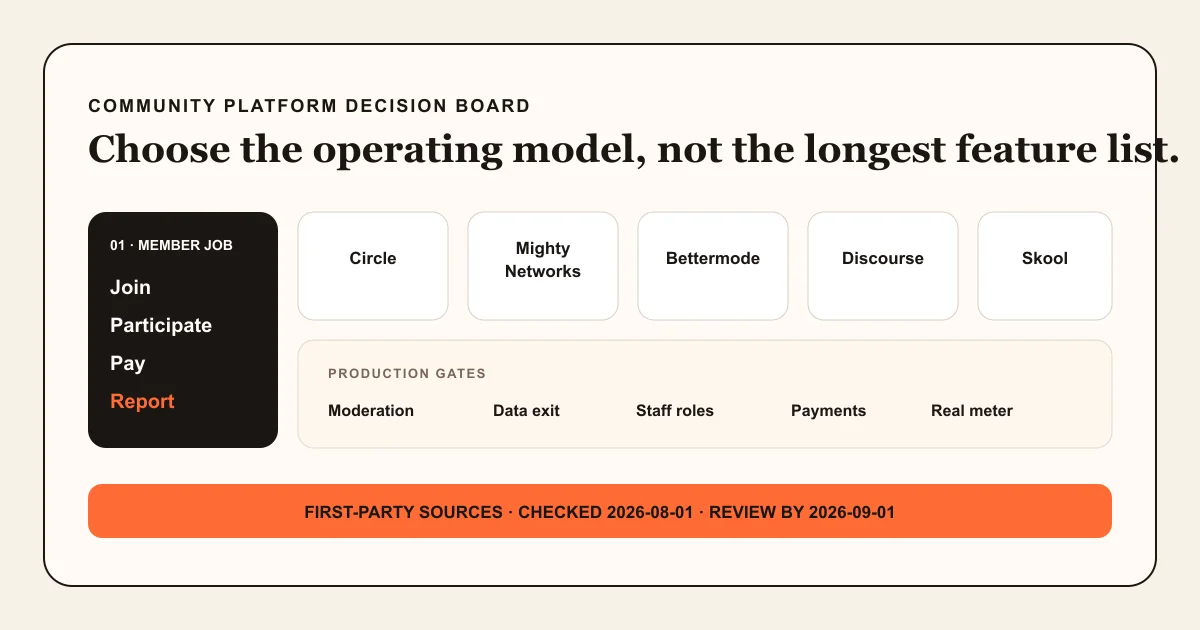
Choose Circle for an integrated branded membership business, Mighty Networks for community-led courses and events, Bettermode for a high-scale branded customer community, Discourse for structured long-form discussion with a portable open-source path, or Skool for a deliberately simple paid learning community. The best fit depends on moderation operations, member experience, data exit, integrations, and the full production meter.
The best community platform is the one your team can operate safely after launch. Member conversations, courses, events, payments, reports, moderation queues, exports, and support obligations matter more than a polished trial homepage.
This guide compares five hosted or managed options using current first-party documentation. It does not invent scores or collapse different operating models into one ranking. Use the same member journey, moderation drill, and production-month model in every finalist before committing.
How we compared community platforms
A useful comparison tests the operating system around a representative member journey. Feature counts do not prove that a team can moderate incidents, explain a billing change, export authoritative records, or recover after an administrator mistake.
Freeze one member and moderator journey
Use the same journey in every finalist: apply or join, enter the right space, publish a post, attend an event, buy or receive access, report a violation, receive a moderation decision, and leave with the expected data and billing outcome.
Sources: [circle-pricing], [mighty-pricing], [bettermode-pricing], [discourse-pricing], [skool-pricing]
Run a safety and moderation tabletop
Test spam, harassment, a report against a moderator, an urgent threat, an appeal, repeat abuse, and a mistaken removal. Record which actions are platform-enforced, which need human judgment, what evidence remains, and who owns response outside business hours.
Sources: [circle-moderation], [mighty-moderation], [bettermode-moderation], [discourse-moderation], [skool-moderation]
Price the real production month
Include the subscription, admins or collaborators, members, transaction fees, storage, live-event capacity, API usage, automations, branded apps, add-ons, and payment-processor charges. Verify the selected billing interval and checkout instead of copying a starting price.
Sources: [circle-pricing], [mighty-pricing], [bettermode-pricing], [discourse-pricing], [skool-pricing]
Rehearse exit and recovery
Export the member list and the content or site backup the vendor actually documents. Inspect what is missing, including private messages, analytics, payments, automations, themes, files, and credentials. A member CSV is not a complete community migration.
Sources: [circle-members], [mighty-export], [bettermode-export], [discourse-backup], [skool-roles]
What this community-platform comparison owns
This is a commercial-research owner for teams choosing a hosted or managed home for member interaction. It compares the production boundary, not popularity, affiliate payouts, or an imagined all-purpose winner.
Included
- Member spaces, posts, chat, courses, events, payments, discovery, and branded experience where documented.
- Administrator and moderator roles, reports, spam controls, removals, bans, and the human operating boundary.
- Documented integrations, APIs, analytics, member exports, backups, and portability limits.
- Current public plan prices plus the actual members, staff, transactions, usage, and add-ons that move cost.
Not included
- A ranking of generic forum software, social networks, chat apps, customer-support suites, or learning-management systems.
- A claim that automated moderation prevents harm, replaces trained people, or proves legal or policy compliance.
- Hands-on performance, deliverability, accessibility, uptime, migration, or moderation-effectiveness measurements we did not run.
- A custom community-app builder comparison. Build-versus-buy becomes a separate decision only after packaged products fail a named requirement.
Seven criteria that change the platform decision
Apply these criteria to one written community brief. Give each finding a pass, fail, or needs-proof result based on the exact plan and trial, not a generic feature checklist.
Community model
Long-form discussion, live cohorts, customer support, paid courses, and high-volume chat create different information architecture and member habits.
Membership and program journey
Applications, invitations, spaces, courses, events, access plans, and payments must produce an understandable state for members and staff.
Moderation and safety operations
Reports, evidence, role limits, removal, bans, appeals, escalation, and urgent-response ownership determine whether the community is operable.
Integrations and customization
APIs, webhooks, SSO, custom domains, branding, and external systems define how much of the member journey can remain coherent.
Analytics and administration
A team needs stable definitions for members, activity, revenue, moderation work, and administrative changes before metrics can guide decisions.
Data exit and recovery
Member exports, content backups, configuration, payment history, files, and credentials move through different paths and may not be equally portable.
Production pricing meter
The meaningful cost can include staff, transactions, members, storage, streaming, API calls, branded apps, automations, and add-ons beyond the base plan.
Five community platforms, compared by fit
The summaries below are editorial fit judgments derived from the cited product boundaries. They are not scores, awards, or performance results.
Circle
Best for: A branded membership business that wants discussions, courses, events, live sessions, payments, and a member directory in one hosted product.
Circle offers a broad creator-community stack with unlimited members on its current public plans, while staff, spaces, transactions, storage, live capacity, APIs, and optional email or branded-app features remain important production limits.
| Criterion | Finding |
|---|---|
| Community model | Professional includes discussions, courses, events, live streams and rooms, paid memberships, member profiles, directory, gamification, and a custom domain. Sources: [circle-pricing] |
| Membership and program journey | Spaces, events, courses, profiles, memberships, and paywalls support an integrated journey; current plan limits distinguish admins, moderators, spaces, live capacity, and storage. Sources: [circle-pricing] |
| Moderation and safety operations | Circle documents deactivation, deletion, and banning, with different content and account consequences. Administrators must understand that a ban can erase member content and is not an infallible identity control. Sources: [circle-moderation] |
| Integrations and customization | Custom domains and branding are present on Professional; Business adds workflows, member and admin APIs, branded notifications, and removal of Circle branding. Branded mobile apps remain a custom-price path. Sources: [circle-pricing] |
| Analytics and administration | Professional includes reporting and analytics. Business adds activity scores and filtering, while staff counts and bulk actions are plan-bound. Sources: [circle-pricing], [circle-members] |
| Data exit and recovery | Circle documents filtered member-list export and separate migration services. Verify post, comment, message, course, event, file, payment, automation, and configuration export in the trial because a member CSV is not the full community. Sources: [circle-members], [circle-pricing] |
| Production pricing meter | Checked 2026-09-05: Professional is $89 per month and Business $199 per month. Cost also moves with transaction fees, staff and spaces, live capacity, AI or API usage, Email Hub, branded apps, and other add-ons. Sources: [circle-pricing] |
Tradeoffs
- Professional charges a documented 2% Circle transaction fee and Business 1%, in addition to payment-processor fees.
- A member-list export and migration services do not by themselves prove a complete portable export of every post, message, automation, and payment record.
- Moderation tools assist administrators, but a team still needs its own policy, staffing, escalation, appeal, and evidence-retention process.
Mighty Networks
Best for: A community-led course, challenge, event, or paid membership where spaces, mobile access, gamification, and member relationships are central.
Mighty Networks combines community, courses, events, subscriptions, one-time payments, spaces, and mobile apps. Its public purchase table now lists Launch, Scale, Growth, and Mighty Pro, and official help content details the Growth and Mighty Pro boundaries.
| Criterion | Finding |
|---|---|
| Community model | Launch and Scale include spaces, courses, events, feeds, chat, badges, gamification, landing pages, and web plus shared iOS and Android access; branded apps are a Mighty Pro path. Sources: [mighty-pricing] |
| Membership and program journey | Hosts can sell network or space access through subscriptions and one-time payments, run events and courses, and organize members into spaces and plans. Sources: [mighty-pricing] |
| Moderation and safety operations | Members can report people or content; hosts review reports and can clear, remove, or ban. Two reports hide ordinary member content pending review, while host-authored content remains visible. Sources: [mighty-moderation] |
| Integrations and customization | Scale adds API and MCP access plus more integrations and automation; custom domains are documented, while SSO and some advanced paths are higher-plan boundaries. Sources: [mighty-pricing] |
| Analytics and administration | Mighty Insights is documented on paid plans with a 24-hour data delay and role-specific access. Teams should preserve metric definitions because hosts are excluded from several engagement counts. Sources: [mighty-insights] |
| Data exit and recovery | Launch and higher plans document an Excel member export with identity, profile, space, plan, and payment-status fields. That is useful ownership evidence but not a complete content or configuration backup. Sources: [mighty-export] |
| Production pricing meter | Checked 2026-09-05: Launch is $79 per month, Scale $179, and Growth $354 on the public pricing table, with 2%, 1%, and 0.5% transaction fees. Storage, streaming, API requests, integrations, and Mighty Pro can change cost. Sources: [mighty-pricing], [mighty-growth] |
Tradeoffs
- The pricing table lists Growth at $354 per month while help documentation calls that an annual-billing rate, so verify the plan name, billing interval, included limits, transaction fee, and checkout before purchase.
- Member exports are documented, but the exit drill must separately account for posts, comments, messages, course content, files, payments, automations, and branded-app obligations.
- Reported content and members still need trained human review, consistent decisions, appeals, urgent escalation, and moderator support.
Bettermode
Best for: A SaaS or enterprise customer community that needs a deeply branded destination, large published member limits, structured Q&A, and business integrations.
Bettermode is positioned around branded customer communities rather than a small creator membership. Its current public plans are materially more expensive, with member, collaborator, API, environment, audit, and enterprise-support boundaries that suit a larger program.
| Criterion | Finding |
|---|---|
| Community model | Starter includes member profiles, directory, private spaces, Q&A, discussions, events, polls, chat, notifications, search, SEO, analytics, and a custom domain for a branded customer community. Sources: [bettermode-pricing] |
| Membership and program journey | The core model supports up to 10,000 members on Starter and 25,000 on Growth, with spaces, content types, social login, messaging, and event participation. Sources: [bettermode-pricing] |
| Moderation and safety operations | Bettermode documents pre-publication review, keyword block lists, monitored content, account-age rules, member watchlists, reports, and third-party spam checks that send specified request data to the selected service. Sources: [bettermode-moderation] |
| Integrations and customization | Starter lists common analytics and automation integrations. Growth adds API, webhooks, sandbox, federated search, sender customization, and removal of Bettermode branding; Premium adds more enterprise integrations. Sources: [bettermode-pricing] |
| Analytics and administration | Basic analytics are on Starter, while Growth expands search and integration paths and Premium documents a 90-day audit log. Bettermode notes that reports are not directly exportable even though their data can be queried through an API. Sources: [bettermode-pricing], [bettermode-reports] |
| Data exit and recovery | Administrators can export filtered member fields as CSV. Verify complete content, file, message, app, configuration, and analytics extraction separately before treating that member export as a migration package. Sources: [bettermode-export] |
| Production pricing meter | Checked 2026-09-05: annual billing lists Starter at $399 per month and Growth at $1,500 per month; monthly billing is higher. Members, collaborators, premium overages, APIs, environments, integrations, and support shape production cost. Sources: [bettermode-pricing] |
Tradeoffs
- Starter begins at a much higher subscription level than the creator-focused products in this guide.
- The official member export is clear, but the full-community export boundary for posts, spaces, messages, apps, and configuration is not established by that document.
- AI-assisted spam detection supports moderation; it does not prove accuracy, coverage, response time, or safety outcomes.
Discourse
Best for: A durable forum or knowledge community that values structured long-form discussion, strong moderation workflows, open-source software, and a credible self-hosted or portable exit path.
Discourse is the most forum-shaped option in this roster. It supports categories, tags, groups, chat, trust and moderation workflows, APIs, webhooks, plugins, and browser-downloadable backups, with managed hosting or a self-hosted open-source path.
| Criterion | Finding |
|---|---|
| Community model | Managed plans support public and private categories, tags, member groups, chat, themes, domains, plugins, and a mobile app; Business adds events, automation, gamification, and reporting. Sources: [discourse-pricing] |
| Membership and program journey | The product is centered on topics, posts, categories, tags, groups, search, notifications, chat, and trust-based participation rather than a bundled creator checkout and course funnel. Sources: [discourse-pricing] |
| Moderation and safety operations | Discourse documents flags, a review queue, topic and post actions, content approval, user management, and de-escalation guidance for moderators. Configure these controls to a written policy and staffed response model. Sources: [discourse-moderation] |
| Integrations and customization | Pro includes APIs, webhooks, community themes, and a documented plugin set. Business expands plugins and SSO; self-hosting permits deeper technical control with additional operating responsibility. Sources: [discourse-pricing] |
| Analytics and administration | Business adds advanced reporting and analytics, while staff-seat, email, storage, page-view, and AI-credit limits are visible on managed hosting plans. Sources: [discourse-pricing] |
| Data exit and recovery | Administrators can create, download, and restore a database backup containing users, groups, settings, topics, posts, and themes, with uploads included when selected. Discourse also supports moving between managed and self-hosted instances. Sources: [discourse-backup], [discourse-pricing] |
| Production pricing meter | Checked 2026-09-05: managed Pro is $100 per month and Business $500 per month. Staff seats, emails, storage, page views, AI credits, plugins, support, and extra capacity matter; self-hosting replaces the fee with infrastructure and operator work. Sources: [discourse-pricing] |
Tradeoffs
- Its discussion-first model is less naturally packaged as a creator course-and-membership business than Circle, Mighty Networks, or Skool.
- Self-hosting transfers upgrades, email delivery, storage, security, monitoring, backups, moderation capacity, and incident response to the operator.
- A technically portable backup does not remove privacy, data-retention, migration, plugin, theme, DNS, email, and operational planning.
Skool
Best for: A creator who wants a deliberately simple community, classroom, calendar, calls, leaderboards, affiliates, and paid access without assembling many modules.
Skool has the simplest public pricing and product story in this roster: unlimited members, courses, videos, and live calls on two plans, with the transaction-fee rate as the major commercial difference. That simplicity also means deeper governance and exit requirements deserve explicit trial proof.
| Criterion | Finding |
|---|---|
| Community model | Both plans advertise unlimited members, courses, videos, and live calls, with community, classroom, calendar, leaderboards, affiliates, and a custom URL as the core experience. Sources: [skool-pricing] |
| Membership and program journey | The product supports free or paid membership, course access, scheduled calls, community posts, levels, and affiliates in a compact group model. Sources: [skool-pricing], [skool-roles] |
| Moderation and safety operations | Skool documents member reports, moderator roles, removal and bans, membership questions, approval controls, posting and chat level gates, AutoMod risk flags, and deletion of recent spam activity. Sources: [skool-moderation], [skool-roles] |
| Integrations and customization | The public plans emphasize one standardized group, course, event, and affiliate experience. Verify required SSO, API, webhook, branding, analytics, and external-system paths in the trial rather than assuming them. Sources: [skool-pricing] |
| Analytics and administration | Owner, billing-manager, administrator, and moderator roles have different controls; moderators can approve members and remove reported content but cannot manage classroom or calendar settings. Sources: [skool-roles] |
| Data exit and recovery | This official-source pass did not establish a full administrator export for posts, comments, classroom content, calls, billing, and group configuration. Treat exit as needs-proof and request a documented sample before migration. Sources: [skool-roles], [skool-pricing] |
| Production pricing meter | Checked 2026-09-05: Hobby is $9 per month with a 10% transaction fee and Pro is $99 per month with a 2.9% transaction fee. Model transaction volume before choosing on subscription price alone. Sources: [skool-pricing] |
Tradeoffs
- The low-cost Hobby plan takes a 10% transaction fee, while Pro lowers the platform fee to 2.9%. Payment-processor and tax obligations still need checkout confirmation.
- Official help documents roles, removal, bans, and spam controls, but this source pass did not establish a complete administrator export for community content and configuration.
- A compact feature set can be a strength for a focused learning community and a limit for complex customer-community governance, integrations, or information architecture.
Choose from the operating constraint
Start with the condition that would make a platform unsafe or uneconomic. A long feature list cannot rescue a failed moderation, export, or billing boundary.
You sell a branded membership with courses, events, and live programming
Choose: Trial Circle and Mighty Networks first, using the same paid-member journey and actual monthly transaction volume.
Tradeoff: Circle exposes detailed limits and add-ons; Mighty emphasizes spaces, courses, relationships, and mobile participation. Both retain platform-specific operating and exit boundaries.
You operate a large SaaS customer or support community
Choose: Shortlist Bettermode and Discourse, then test search, Q&A, moderation load, integrations, analytics definitions, and staff permissions with representative data.
Tradeoff: Bettermode is a managed branded customer-community product with higher public prices. Discourse offers a more portable discussion system but can shift technical operations to your team.
You want the simplest paid learning-community loop
Choose: Trial Skool against the exact group, classroom, event, leaderboards, moderator, and payment path before adding broader products.
Tradeoff: The compact model reduces configuration, while transaction fees and needs-proof integration, governance, and exit requirements can dominate later.
The community includes minors, sensitive support, health, financial, or high-conflict topics
Choose: Do not select from marketing pages alone. Require a written safety case, privacy and legal review, trained moderators, escalation coverage, appeals, evidence controls, and a provider trial using fictional incidents.
Tradeoff: No product feature or AI moderation label can establish safety, accuracy, compliance, response time, or an appropriate decision.
No packaged platform can satisfy a named workflow or ownership requirement
Choose: Write the unmet requirement and compare a custom web application as a separate build-versus-buy decision. Keep this community-platform roster as the packaged baseline.
Tradeoff: Custom software can match the workflow, but your team owns identity, permissions, moderation tooling, abuse operations, notifications, payments, data lifecycle, monitoring, and recovery.
PROVE THE OPERATING MODEL
Run the same community trial in every finalist
Use fictional members to test joining, spaces, content, events, payments, reports, moderator actions, export, and cancellation. Keep the custom-build decision separate until a packaged product fails a named requirement.
Plan a membership workflowA trial proves product fit more honestly than a feature count. Never use real sensitive incidents for the evaluation.
See Playcode for the separate custom-app pathPlaycode is not a hosted community-platform substitute by default. A custom build carries its own safety and operating obligations.
What this comparison cannot prove
A first-party source corpus establishes documented product boundaries, not real-world outcomes. The following questions remain for a controlled trial and vendor review.
- We did not benchmark page speed, notification delivery, live-event quality, search relevance, accessibility, uptime, or support response.
- We did not test false-positive or false-negative moderation rates, urgent escalation, abuse-team response, appeals, evidence retention, or moderator wellbeing.
- Public prices exclude taxes, processor fees, negotiated contracts, migration work, staff labor, and provider changes after 2026-09-05.
- An export feature does not prove that another product can import every record, relationship, permission, file, payment, message, automation, or identifier.
- Playcode is the publisher. It is not included in the hosted-platform roster, and the custom-build CTA is not evidence that custom software is the right default.
First-party community-platform sources
Every product finding cites official pages checked on 2026-09-05. Pricing and volatile product facts expire on 2026-10-06 and must be refreshed before publication after that date.
[circle-pricing] Circle:Circle pricing and plan comparison
Checked September 5, 2026. Supports: Current Professional, Business, and Circle Plus prices, member and staff limits, transaction fees, storage, live capacity, APIs, AI usage, add-ons, and branded-app boundaries.
[circle-moderation] Circle Knowledge Base:Deactivate, delete, or ban members
Checked September 5, 2026. Supports: Administrator removal options, content consequences, activity logging, payment cancellation, ban behavior, and limits of IP-based blocking.
[circle-members] Circle Knowledge Base:View and manage community members
Checked September 5, 2026. Supports: Member roles, filters, bulk administration, and the documented member-management boundary used in the exit and administration analysis.
[mighty-pricing] Mighty Networks:Mighty Networks pricing
Checked September 5, 2026. Supports: Launch, Scale, and Mighty Pro prices, product capabilities, staff and storage limits, transaction fees, APIs, events, courses, and payment features.
[mighty-growth] Mighty Networks Documentation:Mighty Networks Growth plan
Checked September 5, 2026. Supports: The separately documented Growth plan, its annual-billing price, storage and staff limits, and the Mighty Pro branded-app boundary.
[mighty-moderation] Mighty Networks Documentation:Content and moderation tools
Checked September 5, 2026. Supports: Member and content reporting, report review, automatic hiding after reports, removal and ban actions, and role boundaries.
[mighty-export] Mighty Networks Documentation:Download member data
Checked September 5, 2026. Supports: Launch-and-higher member-list downloads and the identity, profile, space, plan, payment, and screening fields described in the export.
[mighty-insights] Mighty Networks Documentation:Mighty Insights definitions and timing
Checked September 5, 2026. Supports: Paid-plan analytics availability, 24-hour data delay, role access, exclusions of hosts from several metrics, and downloadable reports.
[bettermode-pricing] Bettermode:Bettermode pricing
Checked September 5, 2026. Supports: Starter, Growth, and Premium prices, member and collaborator limits, community features, APIs, sandbox, audit log, integrations, and support boundaries.
[bettermode-moderation] Bettermode Hub:Configuring moderation settings
Checked September 5, 2026. Supports: Pre-publication review, block lists, monitored content, account-age rules, member watchlists, reports, and third-party spam-check data sharing.
[bettermode-export] Bettermode Hub:Exporting a list of members
Checked September 5, 2026. Supports: Filtered member-list CSV export, selected or complete displayed fields, and the email-delivery requirement.
[bettermode-reports] Bettermode Hub:Bettermode Reports overview
Checked September 5, 2026. Supports: Report definitions, known count behavior, the current lack of direct report export, and API access to report data.
[discourse-pricing] Discourse:Discourse hosting pricing
Checked September 5, 2026. Supports: Managed plan prices, staff, email, storage, page-view and AI limits, included features and plugins, open-source self-hosting, and migration options.
[discourse-moderation] Discourse Meta:Discourse moderation guide: managing content
Checked September 5, 2026. Supports: Moderator topic and post actions, flags, review queue, content approval, and the documented moderation workflow.
[discourse-backup] Discourse Meta:Create, download, and restore a Discourse backup
Checked September 5, 2026. Supports: Administrator backup creation, database contents, optional uploads, download formats, and restoration to a Discourse forum.
[skool-pricing] Skool:Skool pricing
Checked September 5, 2026. Supports: Hobby and Pro prices, transaction fees, and unlimited member, course, video, and live-call claims.
[skool-moderation] Skool Help Center:Manage spam with AutoMod
Checked September 5, 2026. Supports: AutoMod risk flags, membership approval, questions, level gates, reports, bans, chat blocks, and deletion of recent spam activity.
[skool-roles] Skool Help Center:Member roles in Skool
Checked September 5, 2026. Supports: Owner, billing-manager, administrator, and moderator boundaries, including membership approval and reported-content actions.
Community-platform selection questions
Which community platform is best for paid memberships?
Start with Circle, Mighty Networks, or Skool and price the same paid-member journey. Include the base plan, platform and processor transaction fees, refunds, staff, courses, events, live capacity, storage, email, branded apps, and support work. The lowest subscription is not always the lowest production cost.
Which community platform has the best moderation?
This source review cannot rank moderation effectiveness. Each product documents different reporting, filtering, review, removal, or ban controls. Run a tabletop with fictional incidents, measure role access and evidence, and verify staffing, escalation, appeals, urgent response, privacy, and retention before choosing.
Is Discourse only forum software?
Discourse is discussion-first, but managed plans also document chat, groups, private categories, APIs, webhooks, themes, plugins, mobile access, and higher-plan events, automation, analytics, and gamification. It remains a different operating model from a bundled creator course and membership business.
Can I export my community and move later?
Export depth varies. Circle, Mighty Networks, and Bettermode document member-list exports; Discourse documents a restorable site backup. This source pass did not establish a complete Skool administrator export. Always inspect posts, messages, courses, events, files, payments, permissions, automations, identifiers, and configuration separately.
Does AI moderation make a community safe?
No. Automated filters and risk signals can reduce some review work, but they can miss harm and flag legitimate activity. A community still needs clear rules, trained people, consistent decisions, appeals, urgent escalation, evidence controls, privacy boundaries, and support for moderators.
When should I build a custom community app?
Only after a packaged-platform trial fails a named requirement that matters enough to own. A custom app transfers identity, authorization, abuse controls, moderation queues, messaging, payments, notifications, data lifecycle, audit, monitoring, recovery, and ongoing policy operations to your team.
How often should this comparison be refreshed?
Recheck volatile prices and plan limits by 2026-10-06, and sooner if a checkout or help page disagrees with this guide. Revalidate moderation, export, API, transaction-fee, branded-app, and migration claims before a purchase or public recommendation.
WHEN PACKAGED SOFTWARE FAILS
Build only the custom community workflow you can operate
Describe the member roles, records, spaces, access rules, moderation states, appeals, notifications, exports, and recovery path. Playcode can build and run the web application, while your team remains responsible for policy and operations.
Build a custom web appNo safety, moderation, compliance, growth, or revenue outcome is guaranteed. Provider and payment integrations require supported APIs and credentials.