A convincing prototype and a narrow MVP can look almost identical in a demo. The useful distinction appears after the click: who uses the artifact, which assumption it tests, whether the data and outcome are real, and who carries the cost when the workflow fails.
This guide treats proof of concept, prototype, and minimum viable product as practical decision heuristics, not universal stages. It gives founders a comparison matrix, planning-estimate boundary, experiment ledger, stop rules, and a graduation gate for moving from controlled learning to a real operated product.
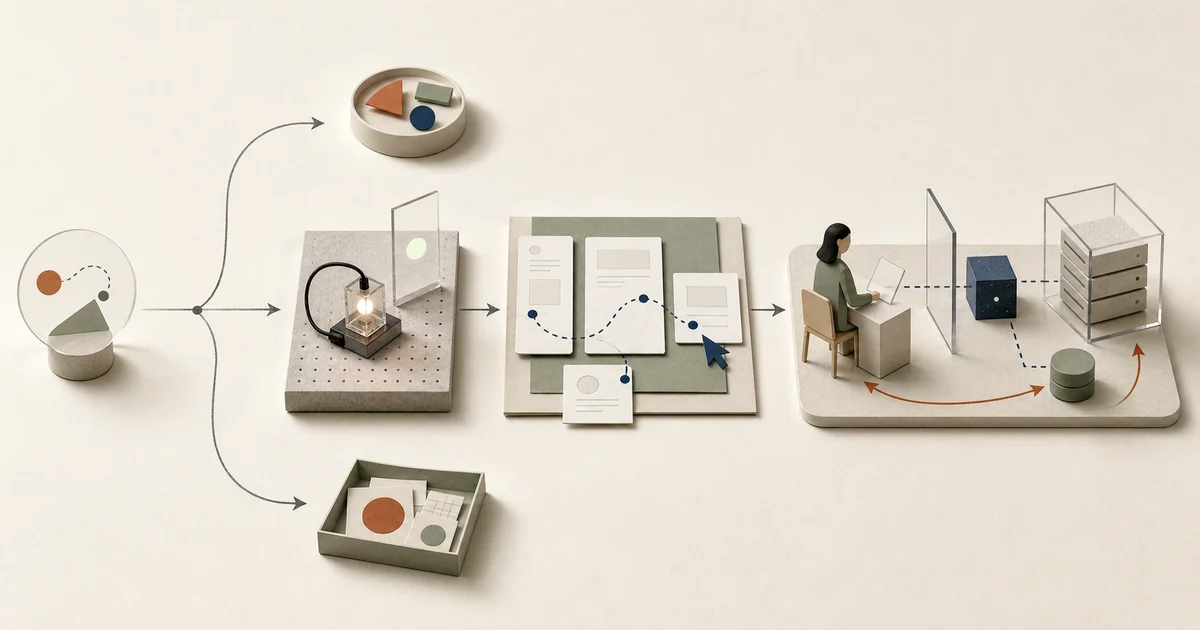
QUICK ANSWER
What is the difference between an MVP and a prototype?
A prototype is a learning artifact used to test a concept, interaction, or workflow before real operation. An MVP is the smallest real product release that delivers one core outcome to intended users and measures behavior. Either can use working code. The practical difference is the evidence required, the audience, and the operational responsibility behind it.
Name the decision before choosing the artifact
Prepare a one-page experiment boundary. If the team cannot name the uncertainty, intended user, observable evidence, and failure cost, choosing between prototype and MVP will only turn an undefined question into more software. Record the release boundary with a product requirements document template before implementation begins.
- One decision and one riskiest assumption: Write the decision this experiment must unlock and the assumption most likely to make the proposed product fail. Separate problem uncertainty, interaction uncertainty, technical feasibility, demand, and operational viability.
- Intended participant and real context: Name who will interact with the artifact, how closely they match the intended user, whether the session is moderated, and which real constraints such as time pressure, devices, collaboration, or support must be represented.
- Evidence and predeclared threshold: Define what observation could support, weaken, or reject the assumption before seeing results. A usability completion, interview statement, technical benchmark, signup, repeated task, and paid outcome answer different questions.
- Data, access, and consequence boundary: List any personal, financial, health, identity, location, uploaded, customer, or regulated data. Decide whether fictional or minimized data is enough, who may access it, and what harm a wrong, delayed, leaked, or duplicated outcome could cause.
- Time, cash, and operating owners: Name the people available, their loaded planning rate, participant incentives, provider and infrastructure cash, calendar constraints, and who owns support, monitoring, recovery, privacy, security, and the final continue, pivot, repeat, or stop decision.
Three artifacts for three different questions
Choose the smallest artifact that can produce credible evidence for the current decision. Fidelity should be high around the risk being tested and deliberately low elsewhere. Working code, polish, and elapsed time do not define the category.
| Approach | Best for | Tradeoff |
|---|---|---|
| Proof of concept: can the mechanism work? | Testing technical feasibility such as an integration, model quality, latency, throughput, data availability, architecture constraint, or cost envelope with engineers or domain experts. | It can isolate a technical showstopper quickly, but a successful mechanism does not prove that users understand the workflow, value the outcome, or can be served safely in real operation. |
| Prototype: will people understand or use the idea? | Testing comprehension, interaction, workflow, usability, desirability, or stakeholder alignment with likely users in a controlled research setting. | It may use paper, linked screens, code, simulated providers, curated data, or a person behind the interface. That realism can support learning, but it must not be presented as proof of demand, reliability, or production readiness. |
| MVP: can real users obtain the minimum outcome? | Testing actual adoption, repeated behavior, willingness to use, support load, reliability, or another decision that requires a truthful end-to-end release for a bounded early cohort. | The feature surface may be small, but real exposure makes authorization, data handling, accessibility, provider failure, support, monitoring, rollback, and recovery part of the experiment rather than optional polish. |
Recommended:Use a PoC for a technical feasibility question, a prototype for a user-understanding question, and an MVP only when the next decision requires real operation. These labels are heuristics, not mandatory stages. Official AWS guidance similarly frames a PoC as a disciplined feasibility experiment, while Eric Ries describes an MVP as a vehicle for validated learning with the least effort. If an interview, workflow observation, manual concierge test, calculation, sales conversation, or policy review can answer the question more directly, build neither artifact yet.
How to decide whether to test a prototype or release an MVP
Define the decision, classify the uncertainty, choose the minimum truthful fidelity, estimate the experiment, build the narrow artifact, test it, record evidence, apply stop rules, and graduate only with an explicit operational boundary.
STEP 01
Write the learning goal as a decision
Start with what the team will decide, not with an artifact that someone already wants to build.
Write: We need to decide whether to continue, change, or stop this direction. The riskiest assumption is this. We will test it with these people in this context. This evidence, collected by this date, will change the decision.
Classify the uncertainty. A mechanism or integration question points to a PoC. Comprehension, flow, or usability points to a prototype. Actual use, repeated outcomes, support burden, or operational economics may require an MVP.
Do not turn the broad question “Will this startup work?” into one experiment. Split problem, audience, workflow, technical, channel, economic, legal, safety, and operating assumptions so each artifact has one primary learning job.
Expected result: The team has one decision, one riskiest assumption, one intended participant group, and evidence that could genuinely change the next investment.
Verify it: Hide the proposed artifact name and ask a reviewer what uncertainty is being reduced. If they answer with a feature list or “validation” in general, rewrite the decision.
STEP 02
Choose PoC, prototype, MVP, or neither
Match the artifact to the evidence burden instead of following an assumed sequence.
Choose a PoC when failure would mean the mechanism cannot meet a technical, data, latency, quality, integration, or cost constraint. Keep it isolated and explicit about what it cannot establish.
Choose a prototype when the team needs to observe whether intended users understand a concept, navigate a workflow, trust the explanation, or complete a representative task. Simulate only what is outside that question and disclose the simulation. If that is your current branch, use the Playcode AI prototyping path without presenting the artifact as a real operated release.
Choose an MVP when the core direction is understood and the decision now depends on real users receiving one truthful outcome under realistic constraints. Choose neither when interviews, observation, a manual concierge service, an existing dataset, a technical calculation, or a policy decision can answer the uncertainty first.
Expected result: The selected artifact is the least expensive credible way to answer the named question, including an explicit neither option.
Verify it: Ask what new evidence extra fidelity would produce. If it produces no evidence for this decision, remove that fidelity, feature, provider, or deployment requirement.
STEP 03
Set fidelity, data, and exposure independently
Make only the tested boundary realistic and label every shortcut that could change participant behavior or operational risk.
Set interface fidelity, business-logic fidelity, data fidelity, provider fidelity, and operating fidelity separately. A coded prototype can use hard-coded records; an MVP can use careful manual operations behind one real user path.
For prototypes, prefer fictional or minimized data, access protection, an explicit research label, and no production credentials. A realistic screen does not justify collecting real personal data or sharing a link publicly.
For an MVP, identify the authoritative record, server validation, authentication and record-level authorization, retention, deletion, provider source of truth, retry behavior, monitoring, support, rollback, and recovery required by the failure cost.
Decision to unlock:
Riskiest assumption:
Artifact: PoC / prototype / MVP / neither
Participant and context:

Interface fidelity:
Logic fidelity:
Data: fictional / sampled / real
Provider: simulated / sandbox / live
Access: private / invited cohort / public
Reliability and recovery:
Support owner:
Security and privacy owner:

What is intentionally simulated:
What participants will be told:
Evidence this artifact cannot produce:
Expected result: The brief separates what must be realistic from what can remain simulated and names every shortcut that affects interpretation or safety.
Verify it: Trace one participant action through interface, logic, data, provider, visible result, support, and recovery. Mark each boundary real, simulated, or absent and confirm the label is visible to the team and participant where relevant.
STEP 04
Make a planning estimate with assumptions attached
Use ranges to plan the experiment, never to redefine the artifact or promise a delivery date.
Illustrative planning estimate, not a benchmark or Playcode delivery promise: a focused technical PoC may take 2-10 working days, a low-fidelity prototype 2-5 working days, a coded high-fidelity prototype 1-3 weeks, and a narrow web MVP 4-12 weeks.
Those illustrative ranges assume one product lead or designer, one or two engineers, one web journey, one core record type, an existing design and deployment path, available participants, and no regulated data, model training, native-store review, complex payments, multi-tenancy, offline or realtime requirement, or enterprise procurement.
Estimate cash as role-hours multiplied by the team’s own loaded planning rates, plus participant incentives, vendors, infrastructure, review, and contingency. Re-estimate when adding sensitive data, multiple roles or tenants, external approvals, payment reconciliation, migrations, formal accessibility or security review, uptime commitments, new infrastructure, unavailable participants, or another core workflow.
Expected result: The experiment has a calendar range, role-hour budget, explicit cash inputs, assumptions, exclusions, and re-estimation triggers without presenting the range as a universal benchmark.
Verify it: Change one major assumption, such as real payments or regulated data. The estimate and operating boundary should visibly change; if they do not, the estimate is too generic to govern the experiment.
STEP 05
Build the smallest representative artifact
Implement only the path and states needed to expose the current uncertainty honestly.
For a PoC, isolate the risky mechanism and use a representative evaluation set. Capture latency, quality, failure, data, integration, and cost behavior relevant to the predeclared threshold; a polished surrounding interface adds no feasibility evidence.
For a prototype, build the minimum sequence participants need to understand and attempt the task. Include the content, choices, errors, and transitions that affect the research question. Clearly identify simulated results, human-in-the-loop behavior, and inaccessible paths.
For an MVP, build one truthful outcome end to end. Include the minimum loading, empty, invalid, denied, retry, provider-failure, success, support, and recovery states required for the invited cohort. Keep additional workflows out unless removing them would invalidate the decision.
Expected result: One bounded artifact represents the tested mechanism, interaction, or real outcome without unrelated polish or hidden simulation.
Verify it: For every component and step, finish the sentence: Removing this would prevent us from observing this named evidence or would make the exposure unsafe. Remove items that fail that test.
STEP 06
Open an experiment ledger before testing
Freeze the question, thresholds, scope, and known limitations before results can rewrite the story.
Record the experiment ID, date, owner, artifact version, decision, riskiest assumption, target user and context, artifact classification, fidelity choices, method, and participant or sample rationale.
Set success, stop, and safety thresholds before exposure. Record observations, quantitative results where appropriate, unexpected effects, limitations, confounders, and every change from the prior experiment.
End each record with continue, pivot, repeat, kill, or advance; the evidence still missing; the next review date; and the reason the next investment answers a distinct question. Keep negative and stopped experiments instead of editing history.
Experiment ID / date / owner / version:
Decision this should unlock:
Riskiest assumption:
Target user and context:
Artifact: PoC / prototype / MVP / neither
Interface / logic / data / operations fidelity:
Method and sample rationale:
Success threshold set before test:
Stop threshold set before test:
Safety threshold set before test:

Observations and results:
Unexpected effects / limitations / confounders:
Changes since prior experiment:
Decision: continue / pivot / repeat / kill / advance
Evidence still missing:
Next review date and owner:
Expected result: The experiment has an auditable question, version, method, predeclared thresholds, result fields, and decision vocabulary before the first participant or real user arrives.
Verify it: Ask someone outside the experiment to identify what result would stop the work and what the artifact cannot prove. If the ledger does not answer both, it is not ready.
STEP 07
Test the evidence, including the failure path
Observe the artifact in the context required by the decision and keep evidence claims within that boundary.
Use likely participants for prototype research and actual invited users for MVP behavior. A stakeholder reaction can reveal alignment; it cannot substitute for intended-user evidence. A completed prototype task can support comprehension; it cannot prove demand or willingness to pay.
Test the defining happy path and the most informative failure. For an MVP, also test invalid input, signed-out and cross-account denial, a repeated action, controlled provider failure, session expiry, support escalation, and recovery with fictional or safely removable data before wider exposure.
Capture direct observations separately from interpretation. Do not change thresholds after seeing the result, combine incompatible participant groups, or report a simulated provider receipt as a real outcome.
Expected result: The team has bounded observations for the intended question plus evidence about the failure mode most likely to invalidate or harm the experiment.
Verify it: Map every conclusion back to a predeclared question, participant, context, and observation. Downgrade or remove any claim that depends on a different audience, simulated boundary, or post-hoc metric.
STEP 08
Apply continue, pivot, repeat, and kill gates
Make the decision the experiment was designed to unlock instead of treating every result as permission to build more.
Continue when the predeclared threshold is met in the intended context, no safety stop is triggered, and the next investment answers a distinct uncertainty. Pivot when the problem remains credible but the mechanism, workflow, segment, or channel fails.
Repeat or reframe when evidence is confounded, the participants are wrong, the artifact failed to represent the tested question, or the sample supports learning but not the proposed conclusion. Fix the method instead of averaging weak evidence into confidence.
Kill when a critical assumption fails, economics or failure cost exceeds the chosen limit, a hard legal, safety, or privacy constraint has no credible mitigation, or the necessary capability is infeasible. Record the negative result and stop the exposed workflow safely.
Expected result: The ledger contains a defensible continue, pivot, repeat, kill, or advance decision tied to the original threshold and safety boundary.
Verify it: Compare the final decision with the threshold recorded before testing. If the standard changed only after the result, restore the original interpretation and schedule a separately defined experiment if needed.
STEP 09
Graduate to an MVP only across an explicit gate
Move from controlled representation to real operation only when the next question requires it and the minimum safety and support contract exists.
Graduate a prototype when the target user, problem, and task are stable enough to name; the chosen comprehension or usability criteria pass; misleading simulations and known failures are documented; and the next decision genuinely requires real behavior.
Before releasing an MVP, replace or explicitly retain every shortcut. Assign owners for authoritative data, server validation, authentication, record-level authorization, privacy, retention, deletion, provider failures, retries, monitoring, support, rollback, and recovery. Resolve technical showstoppers through a focused PoC.
Deploy to a bounded invited cohort over HTTPS, identify the release, minimize real data, and state the product boundary honestly. An MVP is not a waiver from accessibility, security, privacy, legal, or safety obligations; controls rise with the consequence of failure.
Expected result: The MVP exposes one truthful outcome to an intentional cohort with named data, access, support, monitoring, rollback, and recovery owners.
Verify it: In a fresh browser, complete one authorized outcome, attempt signed-out and cross-account access, repeat the action, trigger one controlled dependency failure, inspect the durable result and redacted monitoring evidence, recover, and remove test data through the documented path.
STEP 10
Broaden exposure only for a new decision
Treat each wider cohort or workflow as a new risk and evidence boundary, not as automatic momentum after launch.
Review whether intended users repeatedly complete the minimum outcome, the evidence meets the precommitted threshold, and support, reliability, security, accessibility, and operating economics remain acceptable for the proposed exposure.
Track product evidence separately from service health. Adoption and qualitative value guide the product decision; authorization denials, invalid requests, retry outcomes, dependency health, support load, data integrity, and recovery guide the operating decision.
Reopen discovery, a prototype, or a PoC when the next uncertainty changes. Do not keep expanding an MVP simply because the team already has code or because a stakeholder prefers a larger launch.
Expected result: Every expansion names the new decision, new exposure, new failure cost, and evidence required before the scope grows.
Verify it: For each proposed feature or cohort, name the new uncertainty it resolves and the operating control it adds. Defer work that does neither.
Test cases that prevent stage theater
These scenarios check whether the classification follows the learning question and whether a realistic artifact is prevented from silently becoming an unsafe product.
| Test | Scenario | Expected result |
|---|---|---|
| happy path | Likely users can attempt one representative flow with curated data, while the team needs to learn whether the sequence and language make sense. | The artifact remains a clearly disclosed prototype; observed task behavior supports a comprehension or usability decision without being reported as demand or production evidence. |
| invalid input | The brief asks to “validate the startup” but names no decision, audience, evidence threshold, data boundary, or consequence of failure. | The process returns to discovery and chooses neither artifact until the broad claim is split into a testable assumption and decision. |
| retry | A coded prototype uses a simulated provider, then a repeated action appears successful and someone proposes sharing it with real customers. | The graduation gate blocks the release until simulation is disclosed or replaced, duplicate behavior is defined, records and authority are real, and support and recovery have owners. |
| production smoke | An invited early user completes the MVP’s single core outcome with fictional or removable data, while the operator inspects access, provider, monitoring, and recovery evidence. | The live outcome occurs once for the authorized user, unauthorized access is denied, failures are diagnosable, support and rollback are ready, and the result maps to the predeclared MVP decision. |
Common prototype and MVP category failures
The most expensive mistakes happen when visual fidelity is mistaken for evidence or when a research artifact acquires real users without an operating contract.
| Symptom | Likely cause | Check | Fix |
|---|---|---|---|
| A coded prototype is relabeled MVP and shared with real users | Implementation fidelity was mistaken for operational readiness, while simulated records, shared access, or missing failure paths stayed hidden. | Trace persistence, server validation, authentication, cross-account authorization, invalid input, retries, privacy, monitoring, support, rollback, and recovery. | Keep it labeled and access-controlled as a prototype, or complete a bounded graduation gate before real exposure. |
| A simulated AI, payment, or provider result is reported as product validation | The evidence question changed after testing and a plausible mock outcome was treated as a real downstream result. | Refresh the workflow and inspect the authoritative record, provider receipt, repeated action, failure path, and the disclosure participants received. | Report only the interaction evidence, label the simulation, and test one real end-to-end boundary separately when that evidence becomes necessary. |
| Prototype task completion is presented as demand or willingness-to-pay evidence | A usability observation was generalized beyond the participant, context, and predeclared hypothesis. | Compare the final claim with the original decision, participant type, method, threshold, and actual observed behavior. | Limit the conclusion to comprehension or usability, then design a separate behavioral experiment with a real commitment appropriate to the decision. |
| The MVP expands into a broad v1 and never reaches its intended cohort | The team has no single core outcome, stop rule, or decision that each feature must support. | Ask whether removing each feature changes the one validation decision or only makes the release feel more complete. | Cut to one real loop plus the minimum safety and operation required for its failure cost; move other questions into later experiments. |
| A prototype quietly stores real personal data or becomes a permanent internal tool | The word prototype was treated as an exemption from access, privacy, retention, security, and incident ownership. | Inventory accounts, records, analytics, credentials, access, retention, deletion, backups, users, and how long the artifact has operated. | Stop unsafe collection, remove or migrate data through an accountable path, then add proportionate authorization, privacy, retention, monitoring, and recovery before continued use. |
Operate the evidence boundary, not the label
Deploy
Keep PoCs and prototypes isolated, access-controlled, visibly labeled, free of production credentials, and disposable unless their scope explicitly requires a reviewed exception. Release an MVP as an identified HTTPS build to an intentional cohort with data, access, provider, monitoring, support, rollback, and recovery owners.
Monitor
Track decision evidence separately from service health. Record intended-user outcomes, repeated behavior, qualitative findings, and economics alongside authorization denials, invalid requests, retry results, dependency failures, data integrity, support load, and recovery signals.
Recover
Stop an unsafe experiment first, preserve bounded evidence, revoke exposed credentials, and remove or migrate collected data through a documented owner. For an MVP incident, contain unsafe writes, restore the known good release or data boundary, reconcile affected records, notify where required, and rerun access and outcome checks.
Minimum does not mean exempt
Security and privacy follow exposure and consequence, not artifact names. NIST’s Secure Software Development Framework recommends integrating secure practices into the development lifecycle rather than postponing them until after release.
- Use fictional, synthetic, or minimized data for PoCs and prototypes whenever it can answer the question. Never place production secrets in browser code, shared prototype links, generated assets, screenshots, URLs, analytics, or routine logs.
- For MVP state, validate untrusted input on the server, enforce authentication and record-level authorization, separate environments, use least-privilege credentials, define retention and deletion, make retries safe, and test signed-out and cross-account denial.
- Match access, review, monitoring, incident ownership, backup, recovery, accessibility, legal, and privacy controls to the real harm a wrong result can cause. A narrow feature set does not lower mandatory safety obligations.
- Disclose simulations and human-in-the-loop behavior when they affect participant interpretation. Do not collect real credentials, financial data, or sensitive personal information merely to make a prototype feel realistic.
MVP and prototype questions
Can a prototype use real code?
Yes. A prototype may be paper, linked screens, a coded interface, or a nearly realistic flow. Code does not make it an MVP. If the artifact still uses simulated state, controlled participants, or no real operating contract, call it a prototype and state what evidence it can and cannot produce.
Can a prototype become an MVP?
Sometimes, but graduation is a requirements decision, not a rename. Review every shortcut, then establish authoritative data, server validation, authentication, authorization, privacy, provider behavior, retries, accessibility, support, monitoring, rollback, and recovery for the intended cohort. Throwing away the prototype can be safer than preserving hidden assumptions.
Which comes first, a prototype or an MVP?
Neither sequence is mandatory. Use the smallest credible test for the riskiest current assumption. A technical PoC and interaction prototype may run in parallel. If interviews, observation, or a concierge test can answer the question, use neither. Release an MVP when the next decision genuinely requires real operation.
Does an MVP need real users?
Under this article’s practical heuristic, yes: an MVP is a real but bounded release used by intended early users to obtain one truthful outcome. If only researchers or stakeholders interact with simulated behavior, the artifact is better described as a prototype. The labels are not universal standards, so document your definition.
Does an MVP need payments?
Only when a real payment or financial commitment is necessary to answer the decision. Adding payments introduces provider rules, reconciliation, refunds, duplicate protection, security, support, and legal obligations. A waitlist, interview, letter of intent, deposit handled through an established provider, or concierge test may answer an earlier question more safely.
Can a landing page be an MVP?
A landing page can be a useful demand or message experiment, but it is not an MVP for a product whose core value requires users to complete a real workflow. Name the evidence honestly: visits, signups, interviews, or commitments can reduce market uncertainty without proving that the eventual product delivers its outcome.
How do I know a prototype is ready to become an MVP?
The target user, problem, and task should be stable enough to name; the predefined prototype criteria should pass; simulations and known failures should be documented; and the next decision should require real behavior. Before exposure, assign owners for data, access, support, monitoring, security, privacy, rollback, and recovery.
Is an MVP the same as a beta?
Not necessarily. MVP describes the minimum real product used to learn about a core outcome, while beta often describes a controlled release stage. Teams use both labels differently. Define the audience, access, data, support, reliability, and exit criteria instead of relying on the label to communicate readiness.
READY FOR REAL OPERATION?
Build the one outcome your MVP must prove
Bring the user, core outcome, real data boundary, access rules, and stop criteria. Use Playcode to build the smallest truthful web product that can answer your next decision.
Start building my MVPIf the flow or interface is still the main uncertainty, start with the AI prototyping path and keep simulated behavior clearly disclosed.