QUICK ANSWER
What should a process documentation template include?
A process documentation template should identify whether the map is current-state or target-state, then record its trigger, boundary, actors, activities, decision branches, handoffs, inputs, outputs, systems, records, exceptions, measures, owner, and review date. Use stable IDs and an accessible text equivalent so reviewers can find missing references without treating structural validation as proof that the process works.
Process documentation maps how work crosses functions: the trigger, actors, activities, decisions, handoffs, inputs, outputs, systems, records, exceptions, measures, and accountable review. It may describe the current process as observed or a target process proposed for review, but it should never blend those perspectives or imply that a diagram proves execution.
This owner is deliberately broader than a single-task SOP and narrower than executable workflow software. The download provides one original fictional cross-functional model, editable Markdown, handoff and measure tables, Mermaid source, a closed machine-readable schema, and dependency-free validation. It documents the operating boundary without certifying policy, training, security, accessibility, legal, or compliance outcomes.
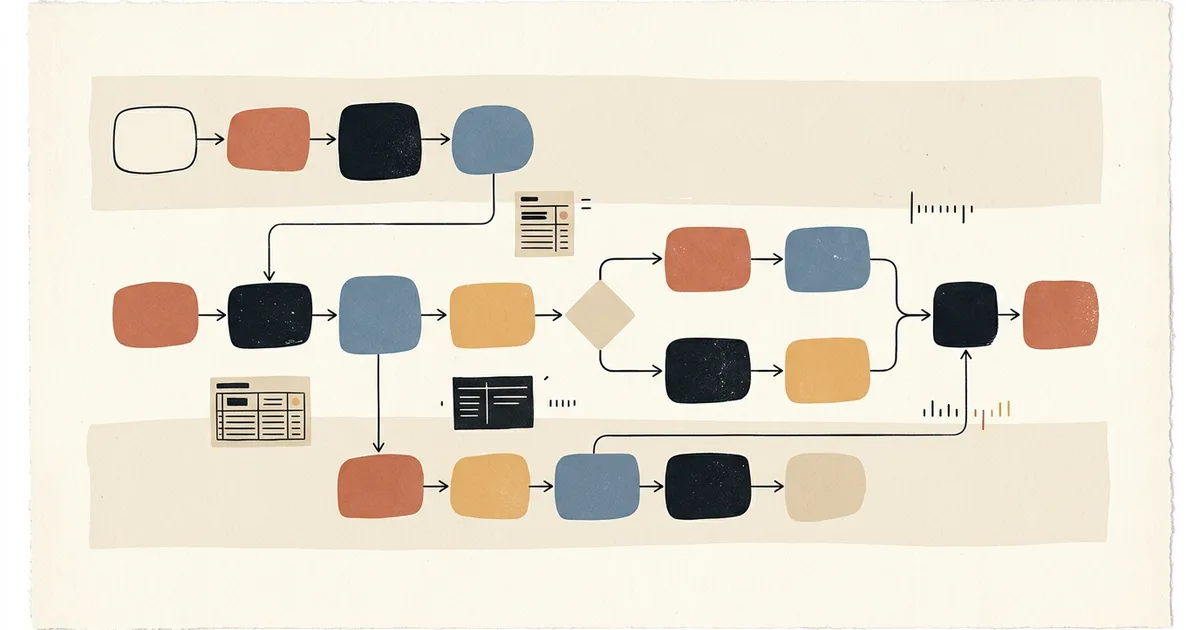
Document the process from boundary to review evidence
Keep observation, design intent, machine validation, and human acceptance separate. A complete map makes cross-functional assumptions visible; it does not turn the assumptions into operating truth.
Choose current-state or target-state before drawing
State whether the document records work as currently observed or proposes a future process. Name the trigger, first included event, final included outcomes, accountable owner, participants, exclusions, and review date. If current and target behavior both matter, preserve two versioned maps and a separate change record rather than overwriting observation with intent.
Sources: [process-documentation-pack], [iso-process-approach]
Map actors, activities, and every cross-role handoff
Use stable role and node IDs. Connect events, activities, and decision points with directional edges, then create one handoff row whenever consecutive actor roles differ. Name the record crossing the boundary and what the receiving role checks. A handoff description does not implement delivery, authorization, acknowledgement, retry, or escalation.
Sources: [process-documentation-pack], [bpmn-2020-2]
Connect inputs, outputs, systems, and authoritative records
Identify the records each activity consumes or creates, which role owns each record, and which system is the documented location. Keep tools separate from records so a vendor change does not erase process meaning. Do not place credentials, secret values, or real personal data in a downloadable map, and do not treat the document as an access-control implementation.
Sources: [process-documentation-pack], [iso-process-approach], [nist-csf-2]
Label decision destinations, loops, and exceptions
Give every decision at least two understandable outgoing labels and a known destination. Mark a cycle explicitly as a loop, name the exception trigger and owner, preserve the relevant record, and state where work resumes or stops. Keep business-process description separate from an approval engine, workflow-state implementation, or automation claim.
Sources: [process-documentation-pack], [bpmn-2020-2]
Define measures without inventing observed outcomes
For each useful measure, record its definition, owner, collection method, review cadence, and interpretation boundary. A target needs a separately reviewed basis, and an observed result needs dated evidence from the real process. The included CSV contains definitions only, so its counts cannot be presented as performance, quality, security, or compliance results.
Sources: [process-documentation-pack], [iso-process-approach], [nist-csf-2]
Keep the visual map and text model equivalent
Pair the diagram with structured text that conveys its sequence, branches, relationships, inputs, outputs, and ownership. Validate the JSON structure and cross-references, but retain human review for meaning, visual accessibility, current process truth, and organizational decisions. A closed Draft 2020-12 schema rejects extra fields without establishing conformity or effectiveness.
Sources: [process-documentation-pack], [wcag22], [json-schema-2020-12]
The process-documentation owner boundary
Use this template for a current or target cross-functional process map. It owns the coordination record across people, work, records, and systems, not the implementation or certification of that work.
Included
- Current-state or target-state purpose, trigger, boundary, owner, review date, actors, activities, and end outcomes
- Cross-role handoffs, decision destinations, explicit loops, exceptions, inputs, outputs, systems, and authoritative records
- Measure definitions with owner, collection method, cadence, and interpretation boundary, without invented targets or observations
- Editable Markdown and Mermaid plus a fictional JSON model, handoff and measure CSVs, closed schema, dependency-free validator, tests, and deterministic ZIP
Not included
- A single repeatable ordered task or procedure with prerequisites, instructions, and step-level verification; that belongs to the standard operating procedure template
- Workflow software, application-state patterns, runtime transition enforcement, queues, retries, jobs, automation proof, deployment, monitoring, or target-environment smoke
- Approval-engine authority, approver assignment, policy waiver, access-control implementation, identity proof, or authorization decisions
- Training content, policy or legal advice, regulatory interpretation, compliance evaluation, certification, conformity, audit opinion, or measured outcome claims
DOWNLOADABLE RESOURCE
Download the process documentation template pack
Use the Markdown file for facilitated review, the JSON and CSV records for deterministic cross-reference checks, and the Mermaid source as an editable visual companion. The completed model is fictional and must be replaced with observed or reviewed facts.
Process documentation template pack
An original provider-neutral pack for documenting one current-state or target-state cross-functional process with actors, handoffs, records, decisions, exceptions, measures, ownership, review dates, and explicit assurance limits.
Format: Editable Markdown, fictional process JSON, handoff and measure CSVs, Mermaid map, closed JSON Schema, dependency-free validator, and tests in one ZIP
Locally reproduced August 1, 2026. SHA-256: afb6f69bc619773657adedf5447a78f9b28391ebb43d272cb81301ea4e6d34f9
Included
- Exact ten-file ZIP with README, package manifest, editable Markdown, completed fictional process-model JSON, handoff CSV, measure CSV, Mermaid map, closed Draft 2020-12 schema, validator, and tests
- Completed fictional model with 5 roles, 7 records, 13 nodes, 15 edges, 10 cross-role handoffs, 3 decisions, 3 exceptions, and 4 unobserved measure definitions
- Dependency-free validator and 44 positive and mutation tests for closed shapes, unique IDs, references, reachability, branch labels, explicit loops, orphan nodes, CSV parity, dates, reserved contacts, secrets, personal-data fields, real provider brands, diagram text, and assurance limits
- Deterministic builder with fixed metadata, exact allowlist, source-to-public-to-ZIP byte parity, two-build identity, clean extraction, and archive hash locking
Verification boundary
The exact ten-file allowlist, source and ZIP byte parity, clean extraction, two consecutive builds, locked archive bytes, closed schema objects, stable IDs, actor, activity, record, system, exception, measure, handoff, and edge references, forward and terminal reachability, decision branch labels, explicit loop edges, orphan rejection, revision and review dates, CSV and model parity, reserved example.test contacts, selected credential and personal-data patterns, provider-brand rejection, diagram node text, Markdown sections, and not-evaluated assurance boundary were checked locally.
Four cross-functional process documentation examples
The examples show when the same documentation shape is useful. They are not ranked patterns, implementation recipes, performance evidence, or permission to reuse the fictional roles and controls without observation.
Content change coordination across request, review, and publishing
Use when: A public-content change crosses request ownership, editing, subject review, publishing, and public-output inspection.
Map the request and source records, scope decision, draft and review handoffs, publication boundary, public observation, mismatch branch, bounded artifact restore, close record, and unobserved measure definitions. This is the completed fictional pack example.
Structure
- Five actor roles linked by ten handoffs across one target-state graph with three labeled decisions
- Seven versioned records, three generic systems, three exceptions, and four measure definitions with explicit interpretation limits
Watch for: The example does not prove publication, recovery, accessibility, authorization, source accuracy, or content performance, and its artifact restore is not database recovery.
Sources: [process-documentation-pack], [bpmn-2020-2], [iso-process-approach]
Inventory replenishment across planning, purchasing, and receiving
Use when: A team needs to understand how a stock signal becomes a reviewed purchase record, received quantity, discrepancy record, and updated inventory record across several functions.
Document the trigger and authoritative stock record, planner-to-buyer and buyer-to-receiving handoffs, supplier-response and discrepancy branches, system boundaries, exception owners, record outputs, and measure definitions without choosing procurement software or claiming savings.
Structure
- Current-state actor and system map with explicit request, order, receipt, discrepancy, and inventory record ownership
- Branch destinations for unavailable supply, quantity mismatch, damaged receipt, and unresolved record differences
Watch for: A process map does not authorize a purchase, set inventory policy, reconcile financial records, validate a supplier, or measure lead-time improvement.
Sources: [iso-process-approach], [bpmn-2020-2], [nist-csf-2]
Service incident communication across support, service, and communications
Use when: Support observations, technical investigation, customer-facing updates, and closure evidence cross several accountable roles.
Map the observed trigger, evidence records, handoff boundaries, decision points for update scope, known-information limits, correction loops, service and communication owners, and review measures. Keep operational automation and runtime incident state in separate systems.
Structure
- Observed current-state flow from report intake through evidence review, bounded communication, correction, and close record
- Explicit ownership for sensitive evidence, publication boundary, update cadence definition, and unresolved assumptions
Watch for: The map is not an incident-response plan, security control, monitoring system, notification guarantee, root-cause analysis, or proof of recovery.
Sources: [nist-csf-2], [bpmn-2020-2], [process-documentation-pack]
Accessible process-map review with a structured text equivalent
Use when: A visual map is useful in workshops but every reviewer also needs the sequence, branch, handoff, record, and ownership meaning in inspectable text.
Keep stable identifiers across the visual map, narrative template, JSON model, handoff table, and measure table. Provide a concise alternative for the image and a nearby structured description for its full relationships, then review both versions together.
Structure
- Short identifying alternative plus structured text for actors, activities, sequence, branches, inputs, outputs, systems, and exceptions
- Closed machine-readable structure and semantic reference checks kept separate from human accessibility and process-truth review
Watch for: Matching IDs and complete text help review, but this pack does not test assistive technology, visual contrast, reading order, organizational accessibility requirements, or WCAG conformance.
Sources: [wcag22], [json-schema-2020-12], [process-documentation-pack]
Choose the right documentation owner before adapting the pack
Use the cross-functional template only when the job is to understand coordination across actors, decisions, records, and systems. Route narrower or executable jobs to their own owners.
The work is one repeatable task performed through ordered instructions, prerequisites, and step-level verification.
Choose: Use the standard operating procedure template instead of expanding this process map into detailed task instructions.
Tradeoff: The process map stays readable across teams, while the SOP can hold the execution detail needed by one procedure owner.
The job requires executable application states, transitions, retries, timers, queues, permissions, or automation.
Choose: Use the process map as a reviewed input, then create a separate workflow and system design with implementation and environment evidence.
Tradeoff: Two records must stay synchronized, but documentation is not misrepresented as working software or automation proof.
Current-state observations and target-state intent disagree or are mixed in one diagram.
Choose: Split them into separately versioned maps, preserve evidence and disagreements, and define the decision that authorizes any transition work.
Tradeoff: Review takes longer, but the target proposal cannot silently replace what people currently do.
A decision has an unlabeled destination, a loop is implicit, or a node cannot reach a documented end.
Choose: Keep the model in draft and resolve the branch, loop, and terminal record with the accountable actors before using it downstream.
Tradeoff: The map remains incomplete, but reviewers do not infer a path that the owners never agreed.
A measure has no definition, source record, collection method, owner, cadence, or interpretation boundary.
Choose: Document it as an unresolved measure definition and do not publish a target, trend, or outcome until dated real evidence is reviewed.
Tradeoff: The page cannot claim improvement, but it avoids turning an attractive diagram into unsupported performance evidence.
Review requires legal, policy, training, security, privacy, accessibility, quality, compliance, certification, or audit judgment.
Choose: Preserve the question and evidence boundary, then route the decision to the qualified accountable owner rather than filling it from a generic template.
Tradeoff: The template does not close the decision, but it prevents a structural validation result from becoming a false assurance claim.
MAP THE CROSS-FUNCTIONAL BOUNDARY
Replace the fictional process with observed actors, records, and handoffs
Download the editable pack, choose current-state or target-state, and review every branch, handoff, record owner, measure definition, and unresolved assurance limit with the people who own the work.
Download the process documentation packThe ZIP is locally reproduced and structurally validated. Public availability and every real process, system, measure, policy, accessibility, security, legal, compliance, and certification decision remain unverified.
Limits of the template and its validator
The pack is designed to expose missing structure and cross-functional assumptions. It cannot observe real work, exercise systems, decide organizational obligations, or establish effectiveness.
- This is original editorial material informed by primary guidance. It does not reproduce another publisher's template, implement BPMN, or claim conformance with BPMN, ISO, NIST, WCAG, or JSON Schema beyond declaring the schema dialect.
- The validator checks the included fictional graph, references, CSV parity, closed object shapes, dates, selected unsafe content, and assurance constants. It cannot determine whether real actors follow the process or whether records are accurate and complete.
- The Mermaid file is editable source and the article image is illustrative. Human review is still required for a complete text equivalent, diagram comprehension, contrast, reading order, assistive-technology behavior, and accessibility requirements.
- Measure definitions are not targets or observations. The pack contains no real timing, volume, quality, security, cost, conversion, or performance result.
- A process document does not implement workflow states, approvals, authorization, delivery, retries, automation, monitoring, deployment, rollback, database recovery, or target-environment verification.
- This ordinary informational article does not grant AI signup credits. Any linked Playcode product page follows its own current eligibility policy and product evidence.
Primary guidance and same-release evidence
The original pack is the direct source for its fictional graph and test claims. Current OMG, ISO, NIST, W3C, and JSON Schema sources support bounded modeling, process, documentation, security-governance, accessibility, and structural guidance without endorsing this template.
[process-documentation-pack] Playcode:Process documentation template pack
Checked August 1, 2026. Supports: The exact same-release original archive containing the editable Markdown, completed fictional process JSON, handoff and measure CSVs, Mermaid map, closed schema, dependency-free validator, 44 tests, and deterministic bytes described on this page.
[bpmn-2020-2] Object Management Group:Business Process Model and Notation 2.0.2
Checked August 1, 2026. Supports: Normative modeling vocabulary and semantics for events, activities, gateways, participants, sequence flows, message flows, and process diagrams. This pack uses a narrower BPMN-inspired vocabulary and does not claim formal BPMN conformance.
[iso-process-approach] ISO/TC 176/SC 2:ISO 9001:2015 Guidance on the Process Approach
Checked August 1, 2026. Supports: Official guidance for intended results, inputs and outputs, process sequence and interactions, ownership and authority, activities, controls, resources, monitoring, measurement, and improvement. It does not make this template ISO conformant or certified.
[nist-csf-2] National Institute of Standards and Technology:The NIST Cybersecurity Framework 2.0
Checked August 1, 2026. Supports: A current outcomes taxonomy for governance, roles and responsibilities, risk management, asset understanding, protection, detection, response, and recovery. It does not make a process document a security control or assessment.
[wcag22] World Wide Web Consortium:Web Content Accessibility Guidelines 2.2
Checked August 1, 2026. Supports: Technology-independent accessibility requirements including text alternatives, programmatically determinable relationships, contrast, and robust content. A diagram plus text still requires implementation and human conformance review.
[json-schema-2020-12] JSON Schema:JSON Schema Draft 2020-12
Checked August 1, 2026. Supports: The declared schema dialect and structural validation vocabularies used by the included closed JSON Schema. Pack-specific graph, reference, CSV, date, content-safety, and assurance checks remain in the dependency-free validator.
Process documentation template questions
What is process documentation?
Process documentation is a reviewed record of how work crosses a defined boundary. It identifies whether the view is current or target, then connects triggers, actors, activities, decisions, handoffs, inputs, outputs, systems, records, exceptions, measures, ownership, and review dates without assuming the map proves execution.
What is the difference between process documentation and an SOP?
Process documentation maps coordination across roles, decisions, handoffs, records, and systems. An SOP documents one repeatable procedure through prerequisites, ordered instructions, exceptions, and step-level verification. Link them with stable activity or record IDs, but do not copy detailed task instructions into every cross-functional map.
Should a process map show current-state or target-state work?
It can show either, but the perspective must be explicit. A current-state map needs observation and actor review. A target-state map records proposed intent and unresolved assumptions. When they differ, keep two versioned records and a separate transition decision so the proposal cannot overwrite observed work.
What should be recorded for a process handoff?
Record the source and receiving role, the graph edge, the records crossing the boundary, the receiving check, and any exception or escalation owner. The documentation does not implement delivery, authorization, acknowledgement, retry, or timing, so those behaviors need separate system and environment evidence.
How should process measures be documented?
Name the measure, precise definition, source records, collection method, accountable owner, review cadence, and interpretation boundary. Keep targets and observed results separate. A definition in a CSV does not prove a baseline, trend, improvement, service level, quality result, security outcome, or compliance result.
Does the included validator prove that the documented process works?
No. It checks the included object shapes, IDs, references, graph reachability, decision branches, explicit loops, handoff and measure parity, dates, selected unsafe content, and assurance constants. It does not observe actors, execute systems, inspect real records, measure outcomes, assess controls, or certify anything.
How should a process diagram be made accessible?
Give the image a short identifying alternative and provide nearby structured text for the essential sequence, roles, branches, handoffs, inputs, outputs, records, systems, exceptions, and measures. Review reading order, contrast, zoom, reflow, and assistive-technology behavior in the delivered format rather than treating matching IDs as conformance proof.
Does this process documentation template grant Playcode AI credits?
No. This is an ordinary informational resource and does not grant AI signup credits. Downloading or adapting it also does not create a working process tool, inspect real systems, implement workflow or authorization, validate observed measures, approve policy, or certify accessibility, security, legal, or compliance outcomes.
MOVE FROM MAP TO REVIEWED IMPLEMENTATION
Use the accepted roles, records, and boundaries as implementation input
After accountable owners review the process, give Playcode the roles, records, states, exceptions, permissions, measures, and acceptance evidence needed for the first production-shaped slice.
Build the internal process toolThis informational article does not grant AI signup credits. Playcode does not observe, approve, certify, or guarantee your process, controls, accessibility, security, compliance, delivery, or business outcome.