QUICK ANSWER
What is the difference between an SOP and a work instruction?
An SOP controls a repeatable process at the level of sequence, roles, inputs, outputs, exceptions, and governance. A work instruction gives narrower role-, tool-, or task-level execution detail. Use both when the process needs stable coordination and one task needs precise instructions. This is a practical convention, not a universal hierarchy; define and control the terms your organization uses.
An SOP and a work instruction can describe connected work without being interchangeable. This guide uses a practical convention: the standard operating procedure controls a repeatable process at the level of purpose, roles, sequence, inputs, outputs, exceptions, evidence, and governance. The work instruction gives narrower execution detail for one role, tool, workstation, or bounded task.
That convention is useful, but it is not a universal document pyramid. ISO 10013 no longer prescribes a particular hierarchy, ISO 9000 defines a work instruction without requiring an SOP parent, and WHO guidance explicitly allows a work instruction to stand alone. EPA guidance is a counterexample too: an organization may call a highly detailed task document an SOP.
Choose from the work, not the label. Start with the process outcome and its control boundary. Add a separate work instruction only when a performer needs more task detail than the process document can carry clearly. Link and change-control both documents when they share roles, inputs, outputs, acceptance checks, exceptions, or evidence.
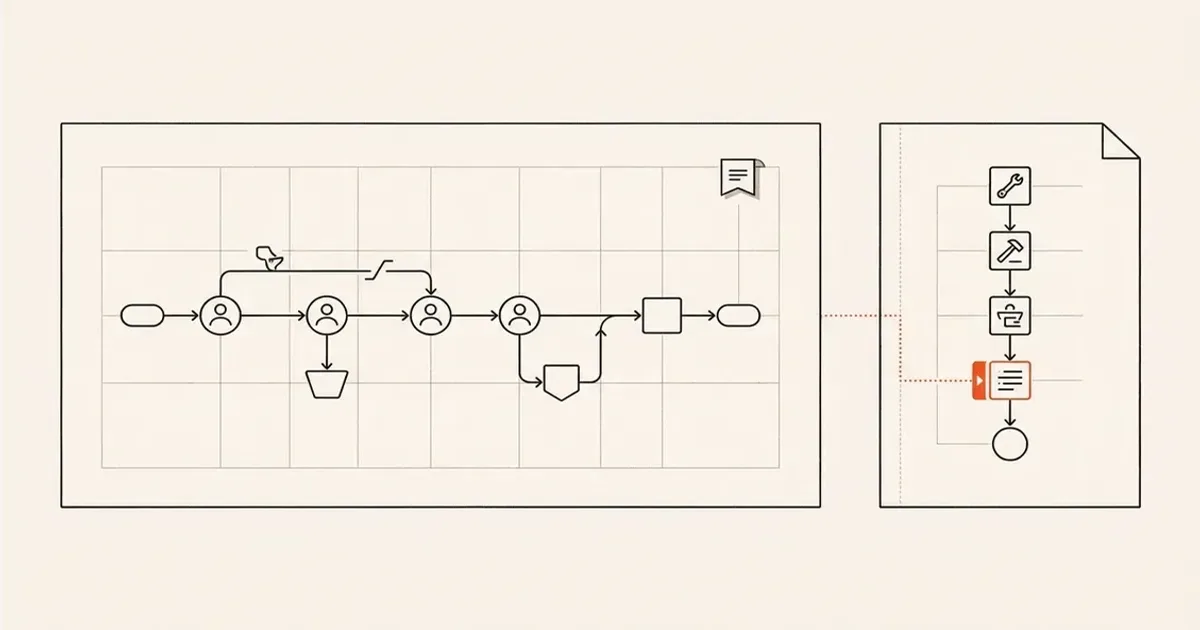
Choose the document boundary before choosing the label
Use one observed recurring process and one representative task. The decision becomes clearer when the team compares the level of coordination, execution detail, change, and evidence the work actually needs.
Freeze the repeatable process outcome
Name the trigger, intended result, process owner, participating roles, inputs, outputs, major sequence, decision boundaries, exceptions, retained records, and end condition. If those elements must stay consistent across people or teams, they form the process-level control surface this guide calls an SOP.
Sources: [who-sop-management], [epa-sop-guidance]
Find the task that needs a closer view
Ask whether a performer needs exact materials, equipment, tool settings, screen states, technique, acceptance criteria, or a shorter point-of-use sequence. ISO 9000:2026 places those details in the work-instruction concept. Do not create a second document when the competent audience can already execute the task safely and consistently from the process document.
Sources: [iso-9000-2026], [who-sop-management]
Set the link, ownership, and change contract
Assign stable document identities, accountable owners, current versions, review triggers, and the exact relationship between the process and task detail. Record which SOP step invokes the work instruction and which inputs, outputs, records, or acceptance checks cross the link. Keep the structure local because ISO guidance does not prescribe a universal hierarchy.
Sources: [iso-10013-2021], [who-sop-management], [who-documents-records]
Walk through both documents with intended users
Have representative readers follow a safe example and report missing context, ambiguous steps, wrong assumptions, mismatched references, unreachable exceptions, and evidence gaps. Revise the affected document, assess linked-document impact, replace obsolete copies, and preserve the change record under the organization's own control rules.
Sources: [who-sop-management], [who-documents-records], [epa-sop-guidance]
The SOP vs work instruction owner boundary
This page owns the choice and relationship between two documentation levels. It does not absorb the separate jobs of mapping a process, downloading a template, defining policy, recording checklist completion, or operating an incident runbook.
Included
- A practical process-level SOP and task-level work-instruction convention, with explicit vocabulary limits
- Audience, granularity, structure, ownership, approval, versioning, review, evidence, change impact, exceptions, escalation, and composition
- Decision rules for an SOP only, a work instruction only, or a linked pair
- Current primary and institutional source notes with review dates and scope limitations
Not included
- The downloadable SOP artifact owned by the standard operating procedure template article
- Cross-functional current-state or target-state mapping owned by the process documentation template
- Policy-versus-procedure governance, policy approval, legal interpretation, or a mandatory document pyramid
- Checklist, runbook, playbook, or generic instruction-template jobs and their reusable artifacts
- ISO, quality-system, regulatory, safety, legal, contractual, audit, certification, or compliance sufficiency
- Proof that a person used the current document, performed the task correctly, or achieved the intended outcome
Ten criteria that separate process control from task detail
Read across each row before deciding. The labels are less important than preserving one clear owner for the recurring process and enough usable detail for the person performing the task.
Purpose and operating boundary
Prevents a broad recurring process and one bounded execution task from being documented as though they were the same job.
Audience
Determines whether the reader needs shared process context, role coordination, or precise task guidance at the point of work.
Granularity
Sets the level of detail needed to repeat the work without burying governance in tool clicks or leaving execution ambiguous.
Structure
Shows which elements belong in the process record and which belong in the task-level execution path.
Ownership
Makes someone accountable for the process outcome and someone competent to keep the task detail accurate.
Approval, version, and review
Keeps current instructions distinguishable from drafts and obsolete copies without inventing one cadence for every organization.
Evidence and records
Separates what the document says should happen from the records showing what was actually observed or completed.
Change impact
Helps a team update the affected process and task documents together instead of allowing references, roles, or steps to drift.
Exceptions and escalation
Defines when a reader may continue, must stop, or must transfer a decision to an authorized owner.
When one or both are needed
Avoids both document sprawl and the opposite failure of forcing process governance and volatile task detail into one unreadable file.
SOP vs Work Instruction Comparison Matrix
The two documents can stand alone or work as a linked pair. These columns describe a useful operating convention, not an ISO-required hierarchy.
Standard operating procedure (SOP)
Best for: A repeatable process whose reliable outcome depends on shared scope, sequence, roles, inputs, outputs, controls, exceptions, records, and governance.
The SOP is the stable process-level owner in this guide. It explains what starts the recurring process, who participates, how the major sequence moves, what records cross each boundary, how exceptions are governed, and what evidence closes the process.
| Criterion | Finding |
|---|---|
| Purpose and operating boundary | Owns one routine or repeatable process, from an observable trigger through a defined result, including the process-level conditions and controls needed for consistency. Sources: [who-sop-management], [epa-sop-guidance] |
| Audience | Serves the roles that coordinate, perform, verify, support, or own the recurring process. It should give each role enough shared context to understand its handoff and authority boundary. Sources: [who-sop-management], [epa-sop-guidance] |
| Granularity | Describes the process-level sequence and responsibilities. Detail can be substantial, but this guide keeps volatile tool clicks and technique in a work instruction when separating them makes both records clearer. Sources: [who-sop-management], [epa-sop-guidance] |
| Structure | Typically names purpose, scope, roles, trigger, inputs, major steps or stages, outputs, linked documents, records, exceptions, escalation, approval, effective version, and change history. The exact format remains organization-specific. Sources: [who-sop-management], [epa-sop-guidance], [iso-10013-2021] |
| Ownership | Assigns an accountable process owner or team that can define and maintain the process, coordinate reviewers, and assess whether the document still matches the work. Sources: [iso-9000-2026], [who-sop-management] |
| Approval, version, and review | Uses the organization's authorized review, approval, release, distribution, version, replacement, and review-trigger rules. Risk and change should influence cadence; this guide does not prescribe annual, biennial, or three-year review. Sources: [who-sop-management], [who-documents-records], [iso-10013-2021] |
| Evidence and records | Identifies the records or outputs that demonstrate process activity and result, while keeping the instruction itself separate from completed evidence. A blank form is not proof until reviewed data are entered and retained. Sources: [iso-9000-2026], [who-documents-records] |
| Change impact | A change to roles, trigger, sequence, inputs, outputs, authority, process controls, exceptions, or closing evidence should prompt review of every linked task instruction whose context or acceptance boundary may have changed. Sources: [who-sop-management], [iso-10013-2021] |
| Exceptions and escalation | Owns process-level deviation conditions, decision authority, impact assessment, records, and destinations. It should not silently authorize a performer to extend a task beyond the reviewed process boundary. Sources: [epa-sop-guidance], [who-sop-management] |
| When one or both are needed | Use the SOP alone when process context and available detail are sufficient for the intended competent audience. Link a work instruction when one step needs a distinct point-of-use owner, medium, or level of precision. Sources: [who-sop-management], [iso-10013-2021] |
Tradeoffs
- Shared context and governance stay visible, but too much tool-level detail can make the process hard to scan and expensive to revise.
- One controlled process document can be enough for a competent audience, but it may underserve a task that depends on precise equipment, interface, or acceptance detail.
Work instruction (WI)
Best for: One role, tool, workstation, technique, or tightly bounded task that needs detailed point-of-use guidance, materials, equipment, states, or acceptance criteria.
The work instruction is the focused execution owner in this guide. It translates one bounded task into usable detail for the performer and states what to observe, record, stop, or escalate without taking over the wider process decision.
| Criterion | Finding |
|---|---|
| Purpose and operating boundary | Owns detailed performance of a bounded task. ISO 9000:2026 defines a work instruction as a detailed description of how to perform tasks and allows several media, including text, flowcharts, pictures, video, and checklists. Sources: [iso-9000-2026] |
| Audience | Targets the person performing the task at the point of use. Vocabulary, assumed competence, tools, materials, access, environment, and acceptance checks should fit that reader rather than every participant in the process. Sources: [iso-9000-2026], [who-sop-management] |
| Granularity | Provides role-, tool-, or task-level detail such as exact actions, sequence, materials, equipment, interface states, visual cues, tolerances, or acceptance criteria when those details are relevant. Sources: [iso-9000-2026], [who-sop-management] |
| Structure | Typically names the task, prerequisites, responsible role, materials or equipment, ordered actions, expected observations, acceptance criteria, records, stop conditions, escalation, owner, current version, and link to wider context when one exists. Sources: [iso-9000-2026], [who-sop-management] |
| Ownership | Assigns a task or tool owner with enough subject knowledge to keep execution detail accurate, while preserving the process owner's authority over shared inputs, outputs, roles, and outcomes when the WI is linked to an SOP. Sources: [iso-9000-2026], [who-sop-management] |
| Approval, version, and review | Follows the organization's control rules when the WI is controlled documentation. Review is triggered by risk, task change, equipment or software change, observed mismatch, linked-process change, or applicable requirements rather than one universal calendar. Sources: [who-sop-management], [who-documents-records], [iso-10013-2021] |
| Evidence and records | Names what the performer records or observes for the bounded task. A completed log, form, checklist, result, or other retained record can provide evidence; the WI alone only defines expected work. Sources: [iso-9000-2026], [who-documents-records] |
| Change impact | A tool, material, screen, technique, or acceptance-detail change can stay in the WI when the process contract is unchanged. The owner should still review the linked SOP when the change alters shared inputs, outputs, roles, authority, exceptions, or evidence. Sources: [who-sop-management], [iso-10013-2021] |
| Exceptions and escalation | Defines local stop conditions, unexpected observations, and the role or process branch that receives the exception. It should not invent a policy waiver or process-level decision beyond the task owner's reviewed authority. Sources: [who-sop-management], [epa-sop-guidance] |
| When one or both are needed | Use it alone for a self-contained local task when no parent process document is needed. Link it to an SOP when the task is one detailed step inside a recurring process whose coordination and governance must remain stable. Sources: [who-sop-management], [iso-10013-2021] |
Tradeoffs
- Precise task guidance is easier to use and update near the work, but it can lose purpose, authority, and downstream context when disconnected from the process it serves.
- A stand-alone work instruction can fit a local task, but creating one for every obvious action increases document count, link maintenance, and obsolete-copy risk.
Decide whether the work needs an SOP, a WI, or both
Use the smallest document set that keeps both coordination and execution usable. More files are not automatically more controlled, and one large file is not automatically simpler.
Several roles must repeat one process, but each role already knows how to perform its assigned task from training and existing references.
Choose: Use one SOP for the shared process boundary, roles, sequence, inputs, outputs, exceptions, records, and governance.
Tradeoff: The document set stays smaller, but the owner must confirm that assumed task competence is real and remains current.
One self-contained task needs exact materials, equipment, tool states, technique, or acceptance criteria and does not require a separate process-level owner.
Choose: Use a stand-alone work instruction and state its local purpose, owner, prerequisites, evidence, stop conditions, version, and review triggers.
Tradeoff: The instruction stays close to the task, but it must still expose enough context to prevent use outside its intended boundary.
A stable repeatable process contains one complex, safety-sensitive, frequently changing, or tool-specific task whose details would overwhelm the process view.
Choose: Use both: keep coordination and governance in the SOP, keep task execution in the WI, and link them with stable identities and a shared change-impact review.
Tradeoff: Each document becomes easier for its audience, but ownership, version compatibility, distribution, and obsolete-copy handling require active maintenance.
A task-detail change affects only the local tool, material, technique, or visual cue and leaves shared process inputs, outputs, roles, authority, exceptions, and evidence unchanged.
Choose: Update and review the WI, record the change, and document why the parent process contract remains unaffected.
Tradeoff: The SOP avoids unnecessary churn, but the impact decision must be visible rather than assumed.
A change affects the process trigger, sequence, role responsibility, shared input or output, decision authority, exception destination, or closing evidence.
Choose: Update the SOP and review every linked WI for affected prerequisites, actions, acceptance checks, records, and escalation paths before release.
Tradeoff: The change takes longer to coordinate, but readers do not inherit a task instruction built on an obsolete process contract.
A sector standard, contract, regulator, safety owner, customer requirement, or internal quality system defines different terminology or document controls.
Choose: Use the applicable local vocabulary and qualified review. Preserve the process-versus-task distinction only where it helps, and do not claim this guide satisfies the external requirement.
Tradeoff: The document model may differ from this matrix, but the organization avoids treating generic editorial guidance as compliance evidence.
BUILD THE WORKFLOW BEHIND THE DOCUMENTS
Turn the approved process boundary into a tool your team can use
Use Playcode to describe an internal workflow, knowledge base, approval view, or task interface after the accountable owners have defined the real roles, records, permissions, and exceptions.
Explore internal tools with PlaycodePlaycode can help build the software surface. Your organization remains responsible for document authority, training, access, evidence, applicable requirements, and review.
Limits of this SOP and work instruction comparison
Document names vary across organizations and sectors. Treat the matrix as a decision aid, then reconcile it with the terminology, risk model, contracts, and requirements that actually govern the work.
- ISO 9000:2026 defines a work instruction, but it does not define every SOP convention or require an SOP-above-WI hierarchy. ISO 10013 explicitly avoids prescribing one hierarchy.
- WHO and EPA materials provide useful institutional examples, not universal numbering, approval, training, review-frequency, deviation, or retention rules.
- A document review cannot prove that the described work is safe, effective, authorized, accessible, current, or performed as written. Observe and test the real work with qualified owners.
- This guide does not determine regulated, legal, quality, safety, privacy, security, contractual, audit, certification, or jurisdiction-specific sufficiency.
- A checklist, form, screenshot, diagram, or video can be part of a work instruction or linked record, but format alone does not decide the document's authority or scope.
- This ordinary informational article does not grant AI signup credits. Linked Playcode product pages follow their own current eligibility and product-evidence rules.
Primary and institutional sources
These sources support the bounded vocabulary, document-control, evidence, and hierarchy statements in this guide. Each has its own scope and none endorses this page or makes its matrix universally mandatory.
[iso-9000-2026] International Organization for Standardization:ISO 9000:2026 - Quality management fundamentals and vocabulary
Checked August 1, 2026. Supports: Current definitions for procedure, process owner, work instruction, record, form, and documented information. It defines a work instruction as detailed task-performance guidance that may include materials, equipment, media, and acceptance criteria. ISO 9000 is vocabulary, not certification, and does not require an SOP-to-WI hierarchy.
[iso-10013-2021] ISO/TC 176:Release of ISO 10013:2021 guidance for documented information
Checked August 1, 2026. Supports: Official explanation that documented information should suit the organization's needs and that ISO 10013 no longer prescribes a particular hierarchy. It is guidance, and sector-specific requirements may differ.
[who-sop-management] World Health Organization Special Programme for Research and Training in Tropical Diseases:SOP Management Example for National TB Surveys
Checked August 1, 2026. Supports: An institutional example in which SOPs describe process and responsibility, work instructions add detailed execution within an SOP or can stand alone, and controlled documents have owners, versions, review, approval, distribution, replacement, and change records. Its hierarchy and timing are examples for adaptation, not universal mandates.
[who-documents-records] World Health Organization:Pillar 5 - Documents and records
Checked August 1, 2026. Supports: Current testing-site guidance distinguishing controlled documents from records, with approval before use, review and revision, obsolete-copy removal, and retrievable records of activity or results. Its testing-site examples and review frequencies are not universal requirements.
[epa-sop-guidance] United States Environmental Protection Agency:Guidance for Preparing Standard Operating Procedures, EPA QA/G-6
Checked August 1, 2026. Supports: Current EPA quality-program access to guidance for routine and repetitive administrative or technical SOPs, including organization-specific detail, review, approval, revision, and documented departures. EPA's detailed SOP vocabulary is a counterexample to any universal SOP-versus-WI split.
SOP vs work instruction questions
What is the main difference between an SOP and a work instruction?
A useful convention is that an SOP owns the recurring process - purpose, roles, sequence, inputs, outputs, controls, exceptions, records, and governance - while a work instruction owns detailed performance of one bounded task. Terminology varies, so define the distinction your organization actually controls.
Can a work instruction exist without an SOP?
Yes. WHO/TDR guidance explicitly allows a stand-alone work instruction. That can fit a self-contained local task when its purpose, owner, prerequisites, evidence, stop conditions, version, and review triggers are clear. A parent SOP is useful when the task participates in a wider recurring process that needs shared coordination or governance.
Does ISO require an SOP and work instruction hierarchy?
No universal hierarchy is prescribed. ISO 10013:2021 explicitly no longer prescribes a particular hierarchy, and ISO 9000:2026 defines work instruction without requiring an SOP parent. Sector-specific standards, regulations, contracts, or internal systems may still impose their own documented-information requirements.
When should an SOP and work instruction be used together?
Use both when a stable repeatable process needs shared roles, sequence, inputs, outputs, exceptions, and evidence, while one task needs precise role-, tool-, material-, interface-, technique-, or acceptance-level detail. Link the documents by stable identity and review both when their shared contract changes.
Who should own an SOP and a work instruction?
In this convention, the accountable process owner maintains the SOP and its shared outcome boundary. A task or tool owner with subject knowledge maintains the work instruction. Organizations may combine or distribute these roles, but authority, review, approval, and change-impact responsibility should remain explicit.
Is a checklist the same as a work instruction?
Not necessarily. ISO 9000:2026 lists checklists as one possible work-instruction medium, while WHO guidance also uses tools and forms to record activity under an SOP. A checklist can prompt or record items, but it does not automatically provide purpose, task context, authority, exceptions, acceptance criteria, or escalation.
Is a work instruction the same as a runbook?
They can overlap in detailed steps, but this guide treats a work instruction as task-level operating detail. A runbook usually owns a triggered operational procedure with environment, prerequisites, expected observations, failure handling, escalation, and recovery. Use the term that matches the actual job and local control system.
FROM CONTROLLED DOCUMENTS TO A USABLE SYSTEM
Build the narrow internal tool your process actually needs
Once the accountable owners approve the real process and task boundaries, describe the workflow, records, views, permissions, and exception handling you want Playcode to help build and run.
Explore internal tools with PlaycodeThe article does not approve the process or determine compliance. Keep authority, training, evidence, access, qualified review, and applicable requirements with their real owners.