QUICK ANSWER
What should a technical documentation template include?
A technical documentation template should include a stable set ID, audience and job map, information types, entry point, document index, owners, versions, source paths, review dates, relationships, trace links, change history, verification checks, and explicit authority boundaries. Keep architecture, requirements, product priority, and API details in linked specialist documents.
A technical documentation template should help a reader find the right source, and help a maintainer prove who owns that source, which revision is current, what it supports, when it must be reviewed, and how it relates to the rest of the set. One giant document hides those decisions instead of resolving them.
This original pack provides a documentation-set index in Markdown and JSON, a closed JSON Schema, a fictional completed example, and a dependency-free validator with negative tests. It owns cross-document governance and traceability. Architecture, requirements, product priority, API contracts, security decisions, and production readiness stay with their specialist owners.
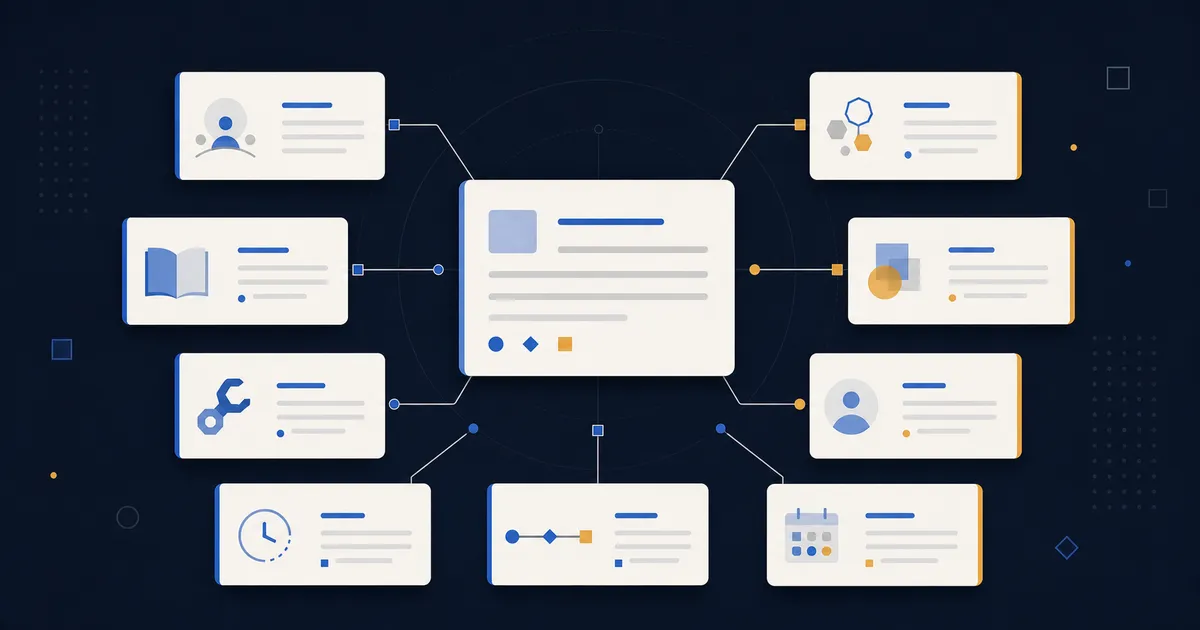
Build the documentation set around reader jobs and accountable sources
Start with the information need, then assign one durable source for each bounded job. The index coordinates those sources without absorbing the authority of the documents it links.
Inventory audiences, jobs, and evidence gaps
Name who must learn, perform, look up, understand, review, or operate something. Record the bounded job and what evidence is still missing before writing pages. ISO/IEC/IEEE 15289 frames lifecycle documentation as selected information items, while Diátaxis distinguishes tutorial, how-to, reference, and explanation needs.
Sources: [iso-15289], [diataxis]
Assign one information type and purpose to each document
Give each document one primary reader question and a stable type. OASIS DITA treats topics as reusable single-subject units and distinguishes task, concept, and reference information. The pack keeps a small compatible taxonomy without claiming DITA conformance.
Sources: [oasis-dita], [technical-doc-pack]
Create the owned index before expanding prose
Record a stable document ID, owner, audience, status, semantic version, safe source path, source revision, last review, next review, dependencies, related records, and trace IDs. NIST SSDF supports explicit roles, maintained requirements, provenance, and tracked security decisions; the same discipline helps expose documentation ownership without turning this index into security evidence.
Sources: [iso-15289], [nist-ssdf], [technical-doc-pack]
Keep specialist authority in specialist documents
Link rather than duplicate. Architecture descriptions belong to an architecture owner, requirements to requirements engineering, product prioritization to the PRD, and HTTP API consumer contracts to an API description. The documentation-set index states location, owner, revision, and relationship only.
Sources: [iso-42010], [iso-29148], [openapi-320]
Validate structure, navigation, accessibility, and review dates
Use a closed schema for allowed record shapes, then add cross-record checks for IDs, references, cycles, reachability, reciprocal traces, review roles, and authority boundaries. Use descriptive hierarchical headings and meaningful links. Structural validation catches drift; a human still reviews accuracy, usability, accessibility, and product truth.
Sources: [json-schema-2020-12], [google-headings], [w3c-accessible-writing], [technical-doc-pack]
What this technical documentation owner covers
Use this owner as the front door and control record for a multi-document technical set. It tells readers where authority lives; it does not replace that authority.
Included
- Audience and job map, information-type map, entry point, and document index
- Stable document IDs, owners, statuses, versions, source paths, source revisions, and review dates
- Dependencies, related documents, supersession, trace records, change history, review checks, and false authority flags
- Original Markdown and JSON examples, closed Draft 2020-12 schema, validator, negative tests, and reproducible ZIP
Not included
- Software architecture, component design, data design, deployment topology, trust model, and design approval owned by the software design document
- Functional and quality requirements, interfaces, constraints, acceptance traceability, and requirement approval owned by the SRS
- Product problem, evidence, prioritization, scope, non-goals, release gates, and roadmap decisions owned by the PRD
- HTTP API operations, authentication, schemas, examples, errors, compatibility, and changelog owned by the API documentation contract
- Security or compliance certification, production authorization, implementation proof, accessibility assurance, or guaranteed business outcomes
DOWNLOADABLE RESOURCE
Download the reproducible technical documentation pack
Use the Markdown file for review and the JSON record for deterministic checks. The fictional example shows a six-document set for a request-routing service at a reserved domain. Replace every fictional value and obtain the right specialist reviews before real use.
Technical documentation template pack
An original documentation-set index for audiences, information types, owners, versions, review dates, relationships, traceability, changes, and authority boundaries.
Format: Editable Markdown, fictional Markdown and JSON, closed JSON Schema, dependency-free validator, tests, and deterministic build script in one ZIP
Locally reproduced August 1, 2026. SHA-256: d8216c976a6767c0b1cd011797fa1ef1626ad3ddc7a83a509531cb36fedec1d6
Included
- Blank Markdown template and fictional completed Markdown example
- Machine-readable JSON example and closed Draft 2020-12 JSON Schema
- Dependency-free validator with thirty-five positive and negative contract tests
- Deterministic allowlisted ZIP builder with fixed timestamps and no dependencies or secrets
Verification boundary
Run npm test and npm run validate after extraction. Rebuild with node build-pack.mjs and compare the archive SHA-256. The checks cover the fictional record graph, allowlisted files, and archive bytes only; they do not validate the truth of adapted documentation or a target system.
Three bounded documentation-set patterns
These patterns change the index depth, not the authority boundary. Each specialist document remains a separate source with its own evidence and reviewer.
Small internal service set
Use when: One team owns a bounded workflow with a few operators and maintainers.
Use an overview as the entry point, then link one tutorial, two or three job-specific how-to guides, a record reference, a decision record, and a change history. Keep each page focused on one reader question.
Structure
- Audience and job map with one documentation owner and named subject owners
- Overview, tutorial, how-to, reference, lifecycle records, trace links, and review dates
Watch for: An internal label does not remove access, security, privacy, recovery, or accessibility review. The index is not an incident runbook or product approval.
Sources: [diataxis], [oasis-dita], [nist-ssdf]
Public API-enabled application set
Use when: Readers need product guidance beside a separately governed HTTP API contract.
Index the quickstart, goal-oriented guides, conceptual explanations, troubleshooting, release notes, and the API reference owner. Record the API document version and link, but keep operations, authentication, schemas, examples, errors, and compatibility in the API contract.
Structure
- Product documentation entry point with reader-job routes and current release notes
- Separate API consumer contract linked by stable document ID, owner, revision, and trace record
Watch for: A link to an API description does not prove that an implementation matches it, that authorization is correct, or that client compatibility was tested.
Sources: [openapi-320], [google-headings], [w3c-accessible-writing]
Multi-team platform set
Use when: Several teams publish documentation with different specialist owners and review cadences.
Use one controlled index for audiences, ownership, source revisions, review dates, dependencies, supersession, and trace links. Point architecture, requirements, product, security, operations, and API readers to their accountable sources without merging those decisions into one document.
Structure
- Versioned cross-team registry with one entry point, stable IDs, owner roles, source locations, and change history
- Explicit links to architecture, SRS, PRD, API, security, operations, release, and decision records under separate authority
Watch for: Central indexing can reveal gaps, but it does not make every source current, resolve conflicting decisions, or grant architecture, requirements, release, security, or compliance approval.
Sources: [iso-15289], [iso-42010], [iso-29148], [technical-doc-pack]
Choose the narrowest document owner that can answer the job
Start at the umbrella index, then move to a specialist owner when the decision changes product or system authority.
Readers cannot tell which document is current, who owns it, when it was reviewed, or where related sources live.
Choose: Use this technical documentation template as the documentation-set index and governance owner.
Tradeoff: The index adds maintenance work and must be updated with every source revision, move, split, supersession, or ownership change.
Reviewers need system boundaries, architecture views, components, interfaces, data ownership, deployment, trust, operations, or design tradeoffs.
Choose: Use the software design document template.
Tradeoff: A design document goes deeper on solution decisions and should not absorb the whole documentation catalog.
Reviewers need testable functional behavior, measurable quality targets, constraints, external interfaces, sources, and acceptance traceability.
Choose: Use the software requirements specification template.
Tradeoff: The SRS controls requirement detail and verification, not product priority, architecture, or documentation navigation.
A product team must decide the user problem, evidence, outcome, scope, non-goals, priorities, experience states, and release gates.
Choose: Use the product requirements document template.
Tradeoff: The PRD owns product intent and acceptance, while the documentation index only links its current source and review state.
API consumers need operations, authentication, parameters, schemas, examples, errors, versioning, compatibility, and a changelog.
Choose: Use the API documentation template.
Tradeoff: The API contract requires machine-readable and consumer-specific depth that would make an umbrella documentation index misleading and hard to maintain.
Move from documents to a build brief
Give Playcode the owned sources behind your app
Start with the problem, audience, accepted requirements, current design decisions, and the external services you control. Playcode can help turn that reviewed brief into a working app while you keep documentation authority explicit.
Explore the AI app builderA documentation template does not approve scope, architecture, implementation, or production release.
Start with the product requirements document templateUse the PRD owner when product evidence, priority, scope, non-goals, behavior, or release gates are still undecided.
What the template and validator cannot prove
A clean record graph is useful evidence of structure, not evidence that the underlying documentation or product is correct.
- The original example is fictional, uses reserved identities, and has no live product, service, repository, customer, or target-environment evidence.
- The dependency-free validator checks allowed fields, dates, IDs, references, cycles, reachability, trace reciprocity, review roles, and authority flags; it does not implement a complete JSON Schema engine.
- JSON Schema and deterministic tests cannot judge technical accuracy, sufficient explanation, search quality, accessibility, security, privacy, legal obligations, or specialist approval.
- ISO/IEC/IEEE 15289:2019 remains the current published edition after its 2025 confirmation, while ISO now marks a revision project in progress; recheck the source before claiming standards alignment.
- The pack is a provider-neutral starting point, not a certification checklist, universal lifecycle, content-management system, or guarantee that readers will find or understand every answer.
Primary sources and exact ownership boundaries
These current official or origin sources were checked on August 1, 2026. They informed the original field model and boundary; no external template text was copied.
[technical-doc-pack] Playcode:Same-release technical documentation template pack
Checked August 1, 2026. Supports: The exact original artifact fields, fictional example, validation boundary, tests, allowlist, reproduction steps, and authority exclusions described in this guide.
[iso-15289] International Organization for Standardization:ISO/IEC/IEEE 15289:2019 life-cycle information items
Checked August 1, 2026. Supports: The umbrella view of systems and software lifecycle documentation as selected information items that can be combined or subdivided for the project. ISO shows the 2019 edition as current and confirmed in 2025, with revision work now in progress.
[diataxis] Diátaxis project:Diátaxis documentation framework
Checked August 1, 2026. Supports: The distinction between tutorial, how-to, reference, and explanation documentation needs and the principle of organizing documentation around reader needs.
[oasis-dita] OASIS Open:DITA 1.3 technical-content topic architecture
Checked August 1, 2026. Supports: Topic-based, single-subject modular documentation and distinct task, concept, and reference information types. The pack borrows the separation principle and does not claim DITA conformance.
[google-headings] Google for Developers:Headings and titles in developer documentation
Checked August 1, 2026. Supports: Descriptive headings, one page purpose, logical hierarchy, and heading language that reflects whether content is task-based or conceptual.
[w3c-accessible-writing] W3C Web Accessibility Initiative:Writing for Web Accessibility
Checked August 1, 2026. Supports: Meaningful page titles, headings that convey structure, understandable instructions, and meaningful link text as accessibility starting points.
[nist-ssdf] National Institute of Standards and Technology:NIST SP 800-218 Secure Software Development Framework 1.1
Checked August 1, 2026. Supports: Explicit roles and responsibilities, maintained security requirements, provenance, and tracking security requirements, risks, and design decisions across the lifecycle. It does not turn this pack into security evidence.
[json-schema-2020-12] JSON Schema project:JSON Schema Draft 2020-12
Checked August 1, 2026. Supports: The schema dialect and structural validation vocabulary used by the pack, with explicit limits between record-shape validation and semantic truth.
[iso-42010] International Organization for Standardization:ISO/IEC/IEEE 42010:2022 architecture description
Checked August 1, 2026. Supports: Architecture-description structure and expression as a separate specialist information owner, establishing the boundary from a documentation-set index.
[iso-29148] International Organization for Standardization:ISO/IEC/IEEE 29148:2018 requirements engineering
Checked August 1, 2026. Supports: Requirements-engineering processes and requirements information items as a separate specialist owner, establishing the SRS boundary.
[openapi-320] OpenAPI Initiative:OpenAPI Specification 3.2.0
Checked August 1, 2026. Supports: A standard language-agnostic interface description for HTTP APIs, establishing why consumer API operations and contracts remain outside the umbrella documentation-set index.
Technical documentation template questions
What is a technical documentation template?
It is a reusable structure for organizing technical information. This version is specifically a documentation-set index: it records audiences, information types, document IDs, owners, versions, locations, review dates, relationships, trace links, changes, and authority boundaries. It coordinates specialist documents instead of replacing them.
Is technical documentation the same as a software design document?
No. Technical documentation is an umbrella set that can include tutorials, how-to guides, reference, explanations, runbooks, change records, requirements, and design links. A software design document owns architecture, components, interfaces, data, deployment, trust, operations, and design tradeoffs for a specific system.
Does this template replace an SRS or PRD?
No. The SRS owns testable functional behavior, measurable quality targets, interfaces, constraints, sources, and acceptance traceability. The PRD owns the product problem, evidence, priorities, scope, non-goals, experience states, and release gates. This index records where those current sources live and who owns them.
Should API documentation be inside the same file?
Usually not. Keep the API consumer contract as a dedicated, versioned source for operations, authentication, parameters, schemas, examples, errors, compatibility, and changes. The documentation-set index should record its stable ID, owner, version, source location, review date, and relationships.
Can the validator prove the documentation is correct?
No. It checks structure and cross-record consistency: allowed fields, dates, IDs, safe paths, references, cycles, reachability, reciprocal traces, review roles, and false authority flags. Human reviewers must still verify technical truth, usability, accessibility, security, privacy, legal duties, and specialist approval.
What should be reviewed when a document changes?
Update the source revision, semantic version, last-reviewed date, next-review date, change history, affected trace records, dependencies, related links, supersession state, and entry-point navigation. Re-run validation, then obtain the subject, documentation, accessibility, security, or other specialist review required by the change.
Is the downloadable example production-ready?
No. It is a fictional request-routing documentation set using reserved identities and paths. Its review approves only the internal consistency of the example. Architecture, requirements, product priority, API implementation, security, compliance, production authorization, accessibility, and business outcomes are explicitly unapproved.
Build from reviewed intent
Turn the right source into working software
Describe the outcome and attach the accountable source documents. Playcode builds and runs the app, while your team keeps product, design, requirements, security, and release decisions with their proper owners.
Build an app with AIThis ordinary informational article does not grant signup AI credits.