QUICK ANSWER
What should a standard operating procedure template include?
A standard operating procedure template should state its purpose, start and end boundaries, prerequisites, roles, ordered steps, input and output records, exceptions, escalation owners, verification checks, current revision, and change history. Stable IDs should connect each step to the records and evidence it uses so a missing reference or skipped check is visible before adoption.
A useful standard operating procedure turns one repeatable job into an executable record. It states what must be ready, who performs each action, which inputs become outputs, what evidence is retained, where work stops, and how the current revision differs from the last one.
This pack owns that one-procedure job. It is not a catalog of workflow states, an approval-workflow system, or evidence of regulatory compliance. The downloadable Markdown, CSV, JSON, schema, and dependency-free validator use stable references so broken sequence, roles, records, exception branches, verification coverage, and change history fail visibly.
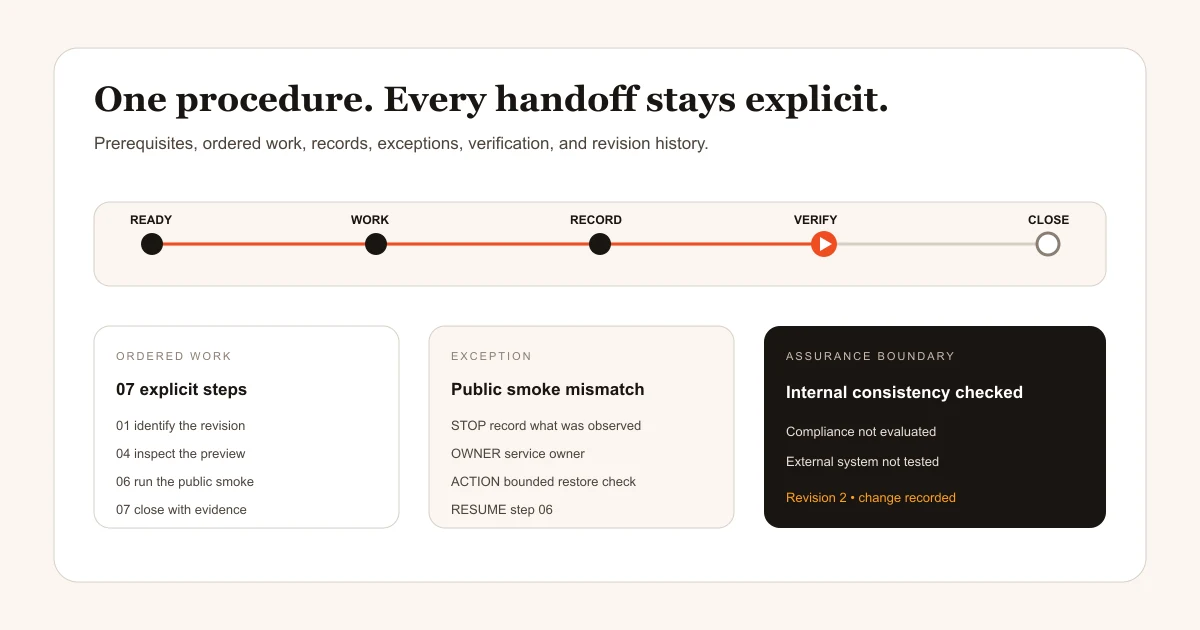
Design one procedure as a closed, reviewable record
Start with the observable operating boundary. Then add only the identities, records, branches, and evidence required to perform and review that one job repeatedly.
Define the start, end, and excluded work
Name the event or input that starts the procedure, the evidence that ends it, and the adjacent decisions that stay outside it. That keeps one SOP from becoming a hidden workflow engine, policy manual, approval system, or promise about an external provider.
Sources: [nist-csf-2]
Assign each action and record to a stable role
Use role IDs rather than personal names in the reusable template. Separate the procedure owner, operator, verification owner, and exception owner where the job needs it. A documented role helps review responsibility but does not prove authorization in a deployed system.
Sources: [nist-csf-2], [owasp-authorization]
Write ordered actions with explicit records and branches
Give every step a contiguous sequence, one observable instruction, named prerequisites, input records, output records, exception references, and verification references. An exception stops or resumes at a stated boundary; escalation transfers attention to a role without silently waiving evidence.
Sources: [nist-csf-2], [owasp-authorization]
Close with verification evidence and revision history
Record what was checked, the expected result, where the evidence lives, and which role owns the check. Keep revisions contiguous and link each change to a retained record. Minimize sensitive data and do not treat a validator pass as proof that the real operation succeeded.
Sources: [owasp-logging], [nist-csf-2]
What this SOP template pack owns
Use the pack to document one repeatable digital or operational procedure with enough structure to perform, stop, verify, revise, and recover it. Keep wider systems and domain obligations with their accountable owners.
Included
- Procedure identity, version, purpose, start boundary, exit evidence, excluded work, and effective date
- Stable roles, prerequisites, ordered work, inputs, outputs, retained records, exception branches, escalation levels, and verification checks
- Revision history, assurance boundary, completed fictional publishing example, JSON Schema, strict validator, and positive and negative tests
- Editable Markdown and CSV, machine-readable JSON, README, and deterministic same-release ZIP
Not included
- The cross-functional workflow-state patterns owned by the workflow examples guide
- Approval routing, decision authority, stale-decision handling, and audit behavior owned by the approval workflow guide
- Packaged process, workflow, document-control, training, provider, publication, or records-management software
- Legal advice, policy approval, regulatory compliance, certification, professional review, or jurisdiction-specific sufficiency
- Proof that a person followed the procedure or that an external system, notification, recovery path, or business outcome worked
DOWNLOADABLE RESOURCE
Download the standard operating procedure template pack
The ZIP keeps the editable template, portable ordered-step sheet, completed fictional record, schema, validator, and tests on one reviewed version.
Standard operating procedure template pack
A versioned SOP pack for prerequisites, roles, ordered work, records, exception branches, escalation, verification evidence, assurance boundaries, and change history.
Format: Markdown, CSV, JSON, JSON Schema, and dependency-free Node.js validator/tests in one ZIP
Locally reproduced August 1, 2026. SHA-256: 9ebf93e7c059c0fe48a0a54c836b2a53df69033d705eba1e10aaf229029b2a89
Included
- Editable Markdown SOP and CSV ordered-work sheet covering purpose, prerequisites, roles, steps, records, exceptions, escalation, verification, and revisions
- Completed fictional publishing procedure plus a strict JSON Schema with closed object boundaries
- Dependency-free validator and twenty tests for shape, global identities, sequence, dates, references, orphaned declarations, unsafe values, assurance states, schema parity, and revision history
Verification boundary
The allowlisted archive was built twice to identical bytes, extracted, byte-compared with its canonical source files, and tested locally. This verifies the pack structure and reference rules, not a real procedure execution, authority decision, external system, legal duty, compliance result, or certification.
Three bounded SOP shapes
Use the same record architecture for different repeatable jobs, but rewrite the purpose, roles, inputs, steps, evidence, branches, and change history for the operation actually performed.
Controlled content publication SOP
Use when: One reviewed content revision must move through preview, publication, public verification, and recorded closeout.
The included fictional example begins with a controlled draft and rights note, records preview and recovery readiness, publishes one revision, checks the public result, and keeps ambiguous publication or failed smoke checks on explicit exception branches.
Structure
- Procedure owner, operator, verification owner, and service owner roles
- Controlled draft, preview evidence, recovery evidence, release log, public smoke, exception, and change records
- Seven ordered steps, six exception branches, two escalation levels, seven verification checks, and two revisions
Watch for: The example uses fictional records and no provider. It does not prove rights, accessibility, security, legal sufficiency, publication success, or recovery.
Sources: [nist-csf-2], [owasp-authorization], [owasp-logging]
Recurring data import SOP
Use when: A named operator repeatedly receives one authorized file, validates its shape, imports it into a bounded staging area, and reconciles the result.
Define the authorized source, file identity, required columns, record owner, staging boundary, count and checksum evidence, invalid-row handling, duplicate-import behavior, reconciliation owner, exception path, and recovery record before any import touches an authoritative dataset.
Structure
- Source authorization, file identity, schema, staging, and recovery prerequisites
- Ordered validate, stage, reconcile, release, observe, and close instructions
- Records for input identity, invalid rows, counts, reconciliation, release, exceptions, and change history
Watch for: A generic SOP cannot decide privacy, retention, security, migration, financial-balance, provider, or regulatory requirements for the real dataset.
Sources: [nist-csf-2], [owasp-authorization], [owasp-logging]
Customer record correction SOP
Use when: An authorized operator must correct one bounded record while preserving the request, prior value reference, reason, evidence, verification, and recovery path.
Keep request identity, requester authorization, affected field allowlist, minimum evidence, operator role, version check, before-and-after references, verification owner, notification boundary, exception record, and change history explicit without copying unnecessary personal data into the SOP.
Structure
- Request, authorization, field allowlist, current-version, privacy, and recovery prerequisites
- Ordered inspect, edit, verify, notify where authorized, monitor, and close instructions
- Conflict, missing-authority, stale-version, notification-failure, and rollback exception branches
Watch for: Use qualified owners for sensitive records and applicable legal duties. This template does not establish identity, authority, lawful basis, retention, notification, or compliance.
Sources: [owasp-authorization], [owasp-logging], [nist-csf-2]
Decide how much structure the procedure needs
Start with the smallest record that makes the work repeatable and reviewable. Add separation, evidence, and recovery detail when the consequence of a mistake increases.
One person performs a low-risk job with one observable result.
Choose: Keep one owner, a short prerequisite list, contiguous steps, one exception boundary, one closeout check, and a revision record.
Tradeoff: The procedure stays easy to use, but it provides less separation between doing and checking the work.
The result needs independent evidence review before closeout.
Choose: Keep operator and verification-owner roles separate and give each step an expected result and evidence record.
Tradeoff: Review takes more time, but the record distinguishes performed work from observed evidence.
A failed step can leave an ambiguous or partially changed external state.
Choose: Add explicit exception branches, a current-state check, a named escalation owner, and a bounded resume or recovery point.
Tradeoff: The SOP becomes longer, but operators do not have to invent a retry rule during a failure.
Several teams exchange records and make decisions over time.
Choose: Keep this SOP focused on one procedure and use the workflow examples or approval workflow guide for the wider state and decision architecture.
Tradeoff: The operating documentation is split across clear owners instead of turning one template into an unmaintainable system description.
The operation carries regulated, legal, safety, financial, employment, or privacy duties.
Choose: Keep compliance status not evaluated and obtain qualified review for the real procedure, evidence, access, retention, training, and recovery requirements.
Tradeoff: Adoption takes accountable domain work, but a generic template does not masquerade as certification or advice.
TURN ONE PROCEDURE INTO A WORKING SURFACE
Build the interface around your reviewed SOP
Once the roles, records, steps, branches, evidence, and boundaries are approved by their real owners, use Playcode to build the internal surface your team needs.
Explore internal tool buildingStart with the pack. Keep external providers, credentials, legal duties, and automation claims outside the first brief unless they are separately proved.
Download the work order templateUse it when the repeated job needs one request record with assignment, acceptance evidence, retry handling, and audit history.
Limits to review before adopting the SOP
A strict record can expose missing structure. It cannot establish the authority, policy, training, system behavior, or domain obligations that make a real procedure safe and effective.
- The template is an editorial operating aid, not a policy, workflow engine, approval system, training program, legal opinion, regulated control, or certification.
- The dependency-free validator checks shape, references, sequence, dates, assurance states, and revision continuity. It does not perform the actions or verify people, external systems, evidence truth, authorization, recovery, or outcomes.
- The fictional publishing example uses no customer, production account, credential, native provider, or private endpoint. Replace it with an operation your accountable owners can actually test.
- NIST and OWASP guidance informs selected role, authorization, logging, and improvement boundaries. No standards body reviewed, approved, endorsed, or certified this artifact.
- Keep secrets, credentials, unnecessary personal data, protected records, and unreviewed regulated data outside the public template and archive.
- Revalidate the procedure after role, input, output, system, provider, policy, exception, recovery, or evidence requirements change.
Sources used for the operating boundary
These sources support the role, authorization, logging, and improvement design choices. The exact template, fictional procedure, schema, validator, tests, and examples are Playcode editorial work.
[nist-csf-2] National Institute of Standards and Technology:The NIST Cybersecurity Framework 2.0
Checked August 1, 2026. Supports: Using explicit organizational roles, responsibilities, policy boundaries, oversight, and improvement inputs. It does not make this generic SOP conformant or certified.
[owasp-logging] OWASP Cheat Sheet Series:Logging Cheat Sheet
Checked August 1, 2026. Supports: Recording when, where, who, and what for meaningful events while minimizing sensitive data and protecting logs.
Standard operating procedure template questions
What is a standard operating procedure template?
It is a reusable structure for documenting one repeatable job. A practical template names the operating boundary, prerequisites, roles, ordered actions, records, exceptions, escalation, verification evidence, current revision, and change history instead of relying on memory or chat.
How is an SOP different from workflow examples?
An SOP explains how to perform one repeatable procedure. Workflow examples show how records move between states across different jobs. Use the workflow guide to design state transitions; use this template to document the actions, evidence, and exception boundaries for one procedure.
Is an SOP the same as an approval workflow?
No. An SOP may name a verification owner or a human signoff boundary, but it does not define a complete multi-participant decision system. Use the approval workflow guide for requests, decision authority, version-bound decisions, stale writes, escalation, and audit behavior.
Why should SOP steps use stable IDs?
Stable IDs let steps reference prerequisites, records, exceptions, escalations, and verification checks without relying on mutable labels. They also make it possible for the included validator to reject missing, duplicate, or orphaned references.
How should exceptions and escalation be written?
Name the observable trigger, immediate stop or containment action, owner role, evidence record, escalation level, and explicit resume step or stop boundary. Escalation transfers attention; it should not silently approve, waive evidence, or infer success.
How often should an SOP be revised?
Revise it when the purpose, role, prerequisite, input, output, system, provider, ordered action, exception, recovery, verification, or policy boundary changes. Keep revision numbers contiguous and record the date, role, summary, and evidence reference for every controlled change.
Does a passing validator mean the SOP is compliant?
No. The validator checks only the fictional record shape, references, sequence, dates, assurance states, and revision history. Compliance remains not evaluated. Qualified owners must review the real procedure against applicable law, regulation, policy, contract, safety, privacy, retention, and training requirements.
BUILD FROM A REVIEWED OPERATING BOUNDARY
Create the internal tool that supports your procedure
Describe the approved roles, records, steps, exception paths, evidence, and recovery boundary. Keep the accountable owners in control while Playcode builds the working surface.
Build an internal toolThis informational article does not grant AI signup credits. Playcode helps build software, but the template does not activate providers or certify the resulting operation.