A website redesign can change the layout, code, navigation, content, and conversion path without changing the useful identity that search engines and visitors already know. The safest release treats each current URL, page purpose, search snippet, structured-data item, internal link, and user journey as a contract to preserve or change deliberately.
This guide is for an in-place redesign, not a domain move, broad platform migration, or redesign cost estimate. It shows how to freeze a baseline, build a URL and content parity ledger, test staging, launch a reversible release, and diagnose search changes without promising zero ranking movement.
QUICK ANSWER
How do you redesign a website without losing SEO?
Preserve useful URLs and page purpose where possible, freeze current search and content evidence, map every intentional change, keep visible content aligned with metadata and structured data, test the rendered staging site, launch with direct permanent redirects only where URLs change, then monitor pages and queries against written rollback and repair thresholds.
Freeze the evidence before you redesign
Do not judge preservation from a few screenshots. The release needs a current inventory, comparable search evidence, access to the systems that can change search signals, and one person authorized to pause or reverse the launch.
- A bounded redesign brief: Name what the release changes: visual system, templates, navigation, copy, rendering, CMS, URLs, forms, analytics, or hosting. Keep a domain move, major platform migration, and unrelated content rewrite out of the same release unless they are unavoidable and separately controlled.
- Current URL and search evidence: Export crawlable and indexed URLs, sitemap entries, internal inlinks, top search landing pages, queries, clicks, impressions, CTR, backlinks, and server-log demand. Normalize host, case, trailing slash, query, locale, and redirect variants before deciding which pages matter.
- Content and snippet evidence: Capture each important page purpose, visible heading, useful body sections, title, meta description, canonical, robots rules, structured-data types and fields, media, alternative text, language annotations, update date, and the primary visitor action.
- Staging, release, and rollback authority: Confirm protected staging access, production publishing access, Search Console access, analytics and log access, redirect configuration, sitemap generation, backups or snapshots, monitoring, and one release authority who can stop or reverse the launch.
- A clean comparison window: Record a comparable pre-launch window by page and query, not only a site-wide total. The current Search Console Performance report supports clicks, impressions, CTR, position, page, query, country, device, search appearance, and date comparisons. Note campaigns, seasonality, outages, and other changes that can distort the baseline.
Choose the redesign boundary before choosing the new design
SEO risk grows with the number of public identities and systems changed at once. Separate presentation changes from URL, domain, platform, and data moves so a later search change has a diagnosable cause and a bounded recovery path.
| Approach | Best for | Tradeoff |
|---|---|---|
| In-place redesign with stable URLs | A site whose page purposes and public addresses still make sense, but whose visual system, templates, accessibility, performance, or conversion path needs improvement. | This minimizes redirect and identity-transfer work, but the team must resist changing URLs merely to match a new navigation label or component name. |
| Selective URL changes inside the redesign | A bounded set of obsolete, duplicated, misleading, or consolidated pages whose new destinations have genuinely equivalent purpose and content. | Every changed URL needs a reviewed mapping, direct permanent redirect, updated canonical, internal links, sitemap entry, analytics annotation, and longer monitoring window. |
| Redesign plus domain or platform migration | A release where the current host, domain, CMS, rendering path, data model, or provider setup cannot remain in place. | This is a broader migration, not merely an SEO-safe redesign. It introduces DNS, provider, data, access, and restore paths that belong in a separate migration ledger and cutover plan. |
Recommended:Keep the domain and useful URLs stable for the redesign. Change a URL only when its page purpose truly changes, and map it directly to one relevant destination. If the release also moves a platform, domain, data, or providers, use the website migration checklist as the broader owner for that operational work.
Redesign a website without losing its search foundations
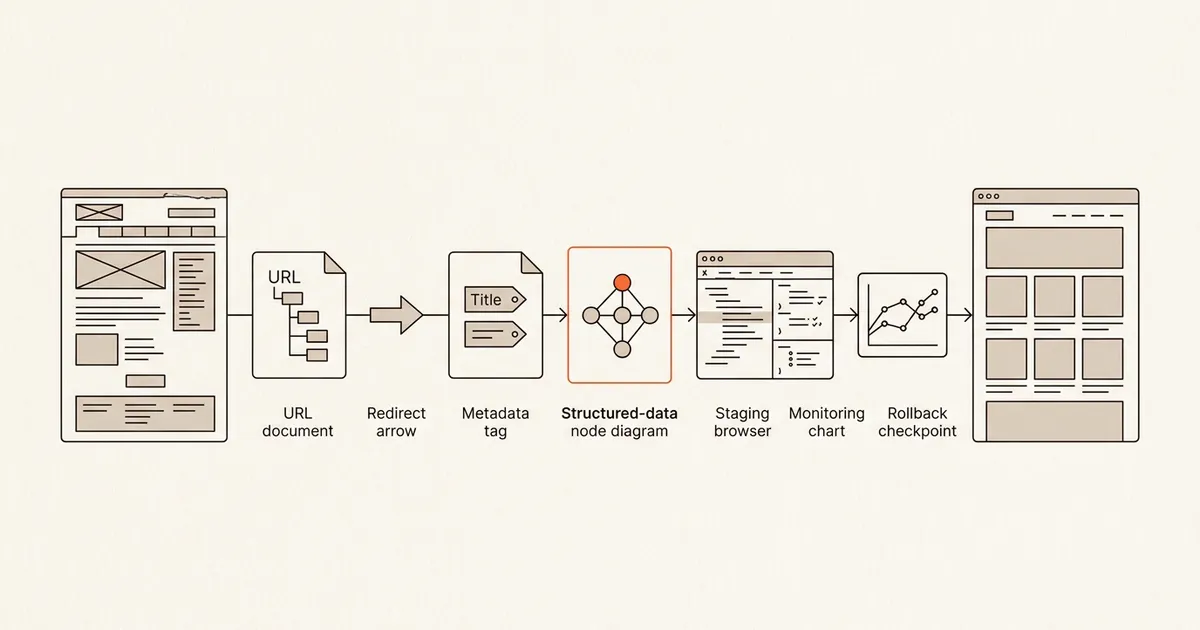
Freeze a baseline, preserve or map every useful page, rebuild visible and machine-readable signals together, prove staging parity, rehearse recovery, launch the identified release, and monitor by URL and query.
STEP 01
Freeze the redesign scope and comparison baseline
Write the release boundary and capture evidence before design or content work changes the source site.
List the exact templates, components, navigation, copy, media, rendering behavior, forms, analytics, URLs, and infrastructure that will change. Record explicit non-goals such as no domain move, no wholesale taxonomy rewrite, and no removal of useful long-tail pages merely to simplify the new menu.
Export page and query performance for a comparable period. Record clicks, impressions, CTR, position, device, country, search appearance, and the pages responsible for valuable queries. Keep raw exports and the time zone used so launch-day analysis does not depend on screenshots or memory.
Google recommends changing one major site dimension at a time and notes that significant changes can produce temporary ranking fluctuations while pages are recrawled and reindexed. Treat this as planning guidance, not a guaranteed timeline. See the current site-move guidance.
Define blocking conditions and repair or rollback thresholds before launch: missing top landing pages, broad redirect failure, accidental noindex, wrong canonical host, broken primary journeys, missing analytics, material server errors, or another site-specific condition approved by the release authority.
Expected result: The team can distinguish redesign changes from migration or content-strategy changes and has a timestamped page-level and query-level baseline for the exact release window.
Verify it: Review the scope and exports with design, SEO, content, engineering, analytics, and the release authority. Block work when a high-value page or measurement source has no owner.
STEP 02
Build one URL, content, and search-signal parity ledger
Give every important current URL an explicit destination, preservation decision, owner, and acceptance check.
Combine URLs from the current crawl, XML sitemaps, CMS or source export, Search Console pages, analytics landing pages, server logs, internal links, backlink exports, paid campaigns, profiles, and important bookmarks. Normalize variants before counting and keep image, PDF, and download URLs that receive links or search demand.
For each page, record current and planned URL, page purpose, disposition, primary query family, title, description, H1, useful sections, canonical, robots directives, structured-data type and key fields, internal inlinks, outbound links, media, hreflang where used, status code, owner, evidence, acceptance check, and rollback action.
Mark each row preserve, redirect, consolidate, retire, or blocked. Preserve is the default when the public identity and page purpose remain useful. A redesigned page can look completely different while keeping the URL and search job stable.
Required columns
ID | Current URL | Planned URL | Page purpose | Query family | Disposition | Title | Description | H1 | Required sections | Canonical | Robots | Schema | Internal inlinks | Status | Owner | Evidence | Acceptance check | Rollback action

Allowed disposition values
preserve | redirect | consolidate | retire | blocked

Fictional examples
PAGE-014 | /services/design | /services/design | Service overview | design service | preserve | retained | refined | retained | offer, process, proof, FAQ | self | index | Service + BreadcrumbList | header, /services, two guides | ready | Casey | baseline capture | rendered fields and business path pass | restore prior template
PAGE-027 | /old-audit | /services/audit | Audit service | website audit | redirect | target owns | target owns | target owns | equivalent service content | self on target | index | Service + BreadcrumbList | links updated | blocked | Morgan | URL map | one 301 to relevant 200 target | restore old route and rule
PAGE-031 | /spring-offer | none | Expired offer | seasonal offer | retire | none | none | none | none | none | none | none | campaign links removed | ready | Riley | expiry approval | intentional 410 and no sitemap entry | restore prior page if approval changes
Expected result: Every important source URL has one reviewed disposition, and every preserved page has a testable visible-content and search-signal contract for staging.
Verify it: Filter for blank purpose, disposition, owner, evidence, acceptance check, or rollback action. Reconcile high-value URL sets across crawl, sitemap, Search Console, analytics, logs, links, and campaigns.
STEP 03
Preserve useful URLs and map only necessary changes
Keep stable addresses stable; when a page must move, send the old address directly to one equivalent final destination.
Do not rename a URL simply because the redesigned navigation, component, or internal content model uses different words. Preserve addresses with backlinks, search demand, user bookmarks, campaign traffic, or a continuing page purpose unless a reviewed information-architecture decision outweighs the transfer cost.
For permanent changes, Google recommends a permanent server-side redirect where possible and identifies HTTP 301 and 308 as permanent signals. Its current redirect guidance also distinguishes temporary redirects, which should not be used to signal a permanent move.
Point each old URL directly to the final relevant destination. Avoid chains, loops, broad catch-all rules, and sending unrelated retired pages to the homepage. Return a deliberate 404 or 410 when no relevant replacement exists, and remove retired URLs from internal links and the canonical sitemap.
Update links in navigation, body copy, breadcrumbs, related content, hreflang, media, campaigns, profiles, and owned documents to the final URL. A redirect protects old entry paths; it is not a substitute for correcting the new site.
Expected result: Stable pages keep their public identities, and each changed URL has one direct, relevant, reviewed final destination or an intentional not-found response.
Verify it: Run every current URL through the planned rules. Assert expected status, no loop, one-hop final URL where redirected, final 200 or intentional 404/410, semantic relevance, and agreement with the ledger.
STEP 04
Rebuild each page around its existing purpose and useful content
Modernize presentation and conversion paths without silently deleting the material that made the current page useful.
Use the parity ledger as a content acceptance test. Preserve the questions answered, evidence, product or service details, locations, policies, media rights, trust signals, and internal relationships that still serve the page purpose. Improve stale or weak material deliberately and record the changed claim, source, owner, and date.
Do not treat word count as parity. A shorter page can preserve intent if it keeps the specific facts and decisions visitors need; a longer redesign can lose intent if it replaces useful sections with broad marketing language. Compare page purpose, entities, tasks, evidence, and query coverage instead of raw length.
Keep important content in rendered HTML that visitors and crawlers can reach. Verify headings, accordions, tabs, filters, lazy sections, pagination, and client-rendered content with JavaScript on and off where relevant. A visually complete browser screenshot does not prove that critical text or links exist in the delivered document.
Re-test primary journeys after layout changes: contact, search, login, checkout or provider handoff, download, consent, subscription, and operator follow-up where applicable. A redesign can preserve rankings yet still fail the business if forms or measurement disappear.
Expected result: Every redesigned page still fulfills its recorded search and visitor job, with purposeful content changes documented rather than hidden inside a visual rewrite.
Verify it: Diff the rendered staging page against required sections and primary journeys in the ledger. Have the content owner approve every intentional removal or consolidation on high-value pages.
STEP 05
Recreate metadata, canonicals, schema, and internal links from the visible page
Make search-facing signals describe the final rendered content and agree on one canonical identity.
Generate a unique title and meta description for the final page purpose, then confirm the visible H1 and opening content answer the same job. Preserve strong snippet language when it remains accurate; do not copy stale metadata merely because the old page ranked.
Set the intended canonical on every indexable page, remove staging hosts, remove accidental noindex or X-Robots-Tag rules at launch, and keep private, duplicate, filtered, or utility routes controlled deliberately. Ensure hreflang sets, if used, point to canonical localized equivalents and remain reciprocal.
Structured data must describe content visible on the page. Google recommends validating during development and monitoring after deployment because templates or serving behavior can break markup. Use the current structured-data guidance and the documentation for each supported type.
Restore contextual internal links, breadcrumbs, hub links, related articles, image links, and important external references. Link directly to final canonical URLs with descriptive anchors, and verify that the redesigned navigation does not orphan useful pages that were reachable before.
Expected result: Each indexable page has one intended identity, matching visible and machine-readable meaning, validated structured data, and a crawlable internal path from the rest of the site.
Verify it: Compare title, description, H1, canonical, robots rules, hreflang, structured data, internal inlinks, outbound links, and sitemap inclusion against the ledger for every template and high-value page.
STEP 06
Crawl and exercise staging as the rendered redesign
Test the output users and crawlers receive, not only source files, CMS previews, or component stories.
Protect staging from public indexing with authentication or an approved control, then crawl it through the same rendering path production will use. Replace staging hosts with expected production identities in the comparison logic without accidentally shipping staging canonicals, sitemap URLs, verification tags, analytics, or provider credentials.
Check status codes, canonical graph, robots rules, titles, descriptions, H1 counts, content requirements, structured-data validation, internal and external links, orphan pages, redirect rules, sitemap parity, hreflang, images, downloads, mobile layout, accessibility basics, and representative performance under recorded conditions.
Run browser tests for the highest-value user journeys with fictional or redacted data. Confirm validation, durable records where applicable, consent, authorization, provider handoff, analytics event identity, error handling, retry behavior, and operator visibility. Keep real secrets and personal data out of staging evidence.
Use the URL Inspection tool only after production is reachable. The live test can show rendered output and indexability signals, but Google notes that it cannot detect every indexing issue and a successful live test does not guarantee indexing.
Expected result: Staging passes the URL, visible-content, search-signal, link, schema, responsive, accessibility, and primary-journey contracts for the identified redesign release.
Verify it: Require zero unexplained missing high-value pages, redirect conflicts, staging canonicals, accidental noindex, broken internal targets, schema-content mismatches, orphaned preserved pages, or failed primary journeys.
STEP 07
Rehearse the launch, smoke checks, and recovery decision
Prove that the team can publish, observe, pause, repair, or restore the redesign before the real window begins.
Write the exact release order: backup or snapshot, identified build, redirects, application or template release, cache handling, sitemap, monitoring, browser smokes, URL samples, structured-data checks, analytics confirmation, and announcement. Assign an owner and expected evidence to each action.
Rehearse a representative rollback in a safe environment. Restore the previous identified site state and redirect rules, then verify URLs, content, forms, assets, measurement, and access. Document what rollback does not reverse, including records, provider events, DNS changes, cached responses, and data created after launch.
Choose stop, repair-forward, and rollback thresholds. A broad wrong canonical or noindex rule may justify immediate reversal; one isolated styling defect may be safer to repair forward. The release authority should not invent the rule while search traffic and customer actions are already affected.
Expected result: The launch has an executable order, named evidence, a tested restore path, and explicit decision thresholds for broad and isolated failures.
Verify it: Run the rehearsal with someone other than the author following the runbook. Record gaps, fix the procedure, and repeat until the restored state and smoke evidence match the approved checkpoint.
STEP 08
Launch one identified redesign release and verify production
Publish during a staffed window, keep unrelated changes out, and test the public site immediately by URL and journey.
Take the approved checkpoint, publish the exact reviewed release, activate only the reviewed redirect set, clear only intended caches, generate or publish the canonical sitemap, and record executor, timestamp, release identity, and observed result for each action.
A sitemap should list fully qualified canonical URLs that you want in search results. Google describes sitemap submission as a discovery signal, not an indexing or ranking guarantee. Review the current sitemap guidance before the release.
From clean mobile and desktop sessions, sample preserved pages, redirected pages, retired pages, high-value landing pages, deep pages, media, and primary journeys. Inspect response headers and rendered head, not only what the browser paints. Confirm production canonicals, robots, hreflang, schema, analytics, consent, and final internal links.
Test representative production URLs in Search Console after the public state is correct. Save the inspection time and observed canonical and indexability signals; do not interpret a request for indexing as proof that the page has entered or will remain in the index.
Expected result: The public site serves the identified redesign release with correct URL behavior, visible content, search signals, business journeys, measurement, and an available recovery path.
Verify it: Save timestamped HTTP, rendered-head, browser, schema, analytics, log, and Search Console evidence for the agreed sample. Stop the release when a written blocking condition appears.
STEP 09
Monitor by page and query, diagnose evidence, and recover narrowly
Treat launch as the start of observation, then separate technical breakage from expected fluctuation and external demand changes.
Watch availability, response errors, redirect loops and chains, crawl activity, indexability, selected canonicals, sitemap state, structured-data reports, performance, accessibility, primary journeys, analytics events, and support reports. Compare preserved and changed URL groups separately.
For search movement, compare clicks and impressions before assuming a ranking problem, then segment by page, query, country, device, and search appearance. Google's current traffic-drop debugging guide recommends checking longer context, comparable periods, site-wide versus page-group patterns, indexing, and seasonality.
Diagnose a persistent page loss against its parity row: response, redirect destination, canonical, robots, rendered content, title and snippet, structured data, internal inlinks, sitemap, speed, server logs, query demand, device, country, seasonality, and competing site changes. Correct the evidenced break rather than rewriting the whole redesign from a site-wide chart.
Repair the smallest bounded surface that restores the approved contract. Roll back the complete release only when a written broad threshold is met. Preserve failed-state evidence, reconcile user or provider records created after launch, and require a new release decision before attempting the redesign again.
Expected result: The team can explain search and business changes at page and query level, repair isolated regressions, and restore the approved checkpoint when a broad release failure crosses its threshold.
Verify it: At each agreed checkpoint, reconcile the parity ledger, Search Console, analytics, crawler, logs, structured-data reports, primary journeys, and support evidence. Close the release only when blocked and failed rows have owners and decisions.
Four redesign tests that catch the expensive mistakes
A redesigned homepage that looks correct does not prove URL parity, search-signal parity, repeatable release behavior, or a working public journey. Keep these cases in the release record.
| Test | Scenario | Expected result |
|---|---|---|
| happy path | A high-value service page keeps its URL and purpose while its layout, components, copy structure, media, and conversion path are redesigned. | The URL remains 200 and self-canonical; required content, metadata, schema, internal links, sitemap entry, mobile layout, primary journey, analytics event, and operator result match the approved parity row. |
| invalid input | A planned row has two destinations, a canonical pointing to staging, an unsupported schema field, a missing content owner, and a catch-all redirect to the homepage. | Validation reports each conflict, the row remains blocked, and the redirect and page cannot enter the production release until one relevant disposition and complete acceptance evidence exist. |
| retry | The redesign deployment or redirect update stops after a partial release, then the operator retries the same identified version while some caches and rules already changed. | The retry converges on one release without duplicate redirect rules, mixed template versions, staging canonicals, conflicting sitemaps, duplicated analytics events, or lost records; rollback still targets an identified checkpoint. |
| production smoke | A clean mobile and desktop browser opens preserved, redirected, deep, and retired URLs and completes the primary journey with fictional data after launch. | Statuses, final URLs, rendered content, canonicals, robots, schema, links, assets, consent, durable action where applicable, analytics, logs, and cleanup match the approved redesign release and ledger. |
Redesign failures and the evidence that separates them
Start with the affected URL, query, release, and timestamp. Broad explanations such as “Google needs time” are not a diagnosis when the redesigned site can show a specific broken signal.
| Symptom | Likely cause | Check | Fix |
|---|---|---|---|
| High-value pages disappear or many old URLs land on the homepage | The redesign simplified routes without a reconciled inventory, or a catch-all redirect replaced one-to-one and intentional retirement decisions. | Compare current, sitemap, Search Console, analytics, log, backlink, and campaign URL sets with the parity ledger; inspect redirect rule order and final page relevance. | Restore preserved routes and reviewed direct redirects, return deliberate 404/410 responses where no relevant target exists, and rerun the entire current-URL set before release continues. |
| Pages render for visitors but become ineligible for indexing | A staging noindex, robots rule, X-Robots-Tag, authentication control, non-production canonical, or wrong hreflang target survived the launch. | Inspect live response headers and rendered head as an unauthenticated client, compare sitemap and canonical targets, and use URL Inspection for representative affected pages. | Remove only the unintended production restriction, align canonical and language signals, preserve protection for private routes, and retest every affected template and URL class. |
| Search impressions remain but clicks fall after the redesign | The new title, description, visible answer, date, or structured-data eligibility changed the search appearance or no longer communicates the page purpose clearly. | Compare page and query impressions, clicks, CTR, search appearance, current snippets, title, description, visible content, schema reports, device, country, and competing result changes. | Restore or rewrite the snippet and visible answer around the same accurate page purpose, correct schema-content mismatches, and monitor the affected query and page rather than changing unrelated templates. |
| Only a group of pages loses search traffic | A shared redesigned template removed content, links, canonicals, schema, headings, pagination, rendering, or performance behavior for that page type. | Segment the loss by template and compare an affected page with an unaffected control using rendered HTML, crawl data, internal inlinks, logs, Search Console, and parity rows. | Repair or roll back the shared template, restore the missing contract, rerun every consumer of that template, and keep unaffected page groups out of the change. |
| Structured-data reports fail after an apparently clean staging test | Production rendering, escaping, conditional data, stale cache, or a redesigned component made markup invalid or inconsistent with visible content. | Parse the live JSON-LD and rendered page, compare it with the staging capture and current feature documentation, and inspect failures by template and required property. | Generate markup from the same reviewed content source as the visible page, remove unsupported or hidden claims, clear the bounded cache, and validate each affected page type again. |
| Primary journeys or analytics break while SEO checks stay green | The redesign changed form state, consent, client events, provider routing, durable storage, or operator visibility without including those paths in the parity ledger. | Trace one fictional action through browser validation, server result, durable record, provider attempt, operator access, analytics identity, logs, and cleanup. | Restore the reviewed business-path contract, separate durable record creation from optional delivery, deduplicate analytics, and rerun happy, invalid, retry, and production smoke cases. |
| Site-wide search declines with no obvious technical error | Possible causes include broad content-purpose change, internal-link redistribution, slower or failing rendering, algorithmic change, seasonality, demand change, manual action, security issue, or an unrelated outage. | Compare clicks and impressions over longer and year-over-year windows; segment pages, queries, countries, devices, and search appearances; inspect indexing, manual actions, security, logs, performance, release timing, and external trends. | Correct the evidenced technical or content break. Do not promise recovery or reverse useful design work solely from a short aggregate chart; use the approved broad threshold and preserve investigation evidence. |
Operate the redesign as a reversible search-sensitive release
Deploy
Publish one identified release after the parity ledger, URL decisions, redirects, rendered staging crawl, metadata, canonical graph, structured data, internal links, sitemap, primary journeys, monitoring, and rollback rehearsal pass review.
Choose a staffed window based on actual traffic and support coverage. Keep the prior identified release, redirect rules, publishing authority, and recovery evidence available while the redesign stabilizes.
Record every production action, executor, timestamp, expected result, observed result, and evidence link. Stop when a written blocking condition appears rather than granting an undocumented launch exception.
Monitor
Watch public availability, latency, 4xx and 5xx responses, redirect loops and chains, rendered content, crawl activity, indexability, selected canonicals, sitemaps, structured-data reports, search pages and queries, internal links, assets, primary journeys, analytics, and support contacts.
Compare preserved, redirected, consolidated, and retired pages as separate groups. Use daily checks for immediate technical faults, then longer comparable windows for search decisions so preliminary data and ordinary weekday or seasonal variance do not become false conclusions.
Keep permanent redirects for the supported transfer period. Google currently recommends generally at least one year for site moves and notes users may benefit from longer retention. Update owned links to final URLs and treat the duration as current guidance, not a guarantee of transfer or ranking.
Recover
Repair forward when an isolated page or template can be corrected inside the written threshold. Roll back when broad wrong canonicals, noindex, missing pages, broken redirects, unavailable primary journeys, data risk, or another approved condition affects the release beyond the safe repair window.
Restore the identified prior release and reviewed rules, then verify the restored public state. Reconcile actions and records created after launch before switching versions; never discard them merely to make rollback simpler.
Preserve failed-state HTTP, rendered-head, crawl, Search Console, analytics, log, screenshot, and release evidence. Rerun the affected tests and require a new authorized release decision before attempting the redesign again.
Keep the redesign evidence useful without exposing the site
SEO-preservation work touches production exports, analytics, logs, provider settings, staging environments, backups, and credentials. Limit access and evidence before the release multiplies their exposure.
- Keep CMS, repository, hosting, DNS, Search Console, analytics, database, provider, and publishing credentials in approved secret stores. Never place a token, personal payload, or private staging URL credential in the parity ledger, screenshots, code blocks, or tickets.
- Protect staging with authentication or another reviewed access control, not only robots.txt or noindex. Use fictional or redacted data, disable unintended production actions, and verify that preview hosts cannot become canonical or indexable.
- Minimize search, analytics, server-log, form, and user exports. Restrict access, record retention, encrypt transfer and storage where required, and delete temporary copies after reconciliation under the owner's policy.
- Apply least privilege and separate inventory, build, publish, redirect, Search Console, and rollback authority where practical. Revoke temporary accounts and rotate exposed credentials after stabilization.
- Validate redirects, canonical inputs, rendered metadata, imports, forms, and provider callbacks at their server boundaries. A redesign must not turn user-controlled input into an open redirect, script injection, data leak, or unauthorized action.
Website redesign and SEO questions
Can a website redesign hurt SEO?
Yes. A redesign can change URLs, page purpose, useful content, internal links, rendering, metadata, canonicals, robots rules, structured data, performance, and user journeys. Search visibility can also fluctuate during recrawling. Risk is lower when useful identities remain stable, changes are mapped and tested, and the team monitors page and query evidence without assuming zero movement.
Should URLs change during a website redesign?
Keep a URL when it still represents the same useful page purpose. A new layout or menu label is not, by itself, a reason to rename it. Change a URL when a reviewed information-architecture decision requires a new identity, then map the old address directly to one relevant destination and update canonical, links, sitemap, analytics, and monitoring.
Do 301 redirects preserve SEO?
Google currently recommends permanent server-side redirects such as 301 or 308 for permanent URL moves and says permanent redirects do not cause a loss of PageRank. That does not make every redirect safe: the destination must be relevant, direct, indexable, and internally linked, and no one can guarantee unchanged rankings or traffic.
What SEO elements should stay the same in a redesign?
Preserve the elements that still accurately express the page job: useful URL, purpose, visible answers, evidence, important entities, title and snippet intent, canonical identity, indexability, structured data supported by visible content, internal links, language relationships, media, and primary journey. Improve stale elements deliberately rather than copying them blindly.
Should the redesigned site keep exactly the same content?
No. Preserve useful meaning, coverage, evidence, and visitor decisions, not an arbitrary word count. Update stale claims, remove duplication, and improve clarity when owners approve the change. Record major removals and consolidations so a later traffic change can be traced to a decision instead of guessed from the new layout.
How long does SEO take to recover after a redesign?
There is no guaranteed recovery time. If URLs change, Google says a small to medium site move can take a few weeks for most pages to move in its index, while larger sites can take longer. An in-place redesign may behave differently. Diagnose response, canonical, indexability, content, links, demand, seasonality, and page groups rather than waiting on a generic deadline.
What is the difference between an SEO-safe redesign and a website migration?
An SEO-safe redesign focuses on changing presentation and conversion behavior while preserving useful public identities and search meaning. A migration changes where or how the site runs and may add domain, platform, DNS, data, provider, or access-transfer work. One release can contain both, but the broader migration needs its own inventory, cutover, restore, and provider controls.
Can Playcode guarantee a redesign will keep all rankings?
No. Playcode can help rebuild, preview, publish, test, and keep changing a website under current product limits. The site owner still needs to approve content and URL decisions, configure redirects and providers, verify metadata and search signals, test production, monitor Search Console and analytics, and decide repair or rollback. Rankings and traffic are not guaranteed.
Redesign the site
Build the new experience around an approved preservation map
Use Playcode to rebuild and preview the site, then bring the owned URLs, content decisions, redirects, search checks, production tests, and rollback plan that make the redesign operable.
Plan My Website RedesignNo credit card required. Search rankings, traffic, indexing, provider behavior, and recovery time are not guaranteed.