QUICK ANSWER
What is the difference between a runbook and a playbook?
A runbook is the execution artifact for a known repeatable task: prerequisites, ordered steps, expected results, stop conditions, and recovery. A playbook is the adaptive guide for a scenario: roles, investigation paths, decision authority, communication, and criteria for choosing actions. Names vary by organization and tool, so define them locally; a playbook often links to runbooks when a known procedure becomes appropriate.
Teams often use runbook and playbook interchangeably, and official operational guidance does not impose one universal dictionary. This guide adopts a practical local contract: a runbook executes a known procedure, while a playbook guides investigation, coordination, and decisions across a scenario. Record that contract in the library instead of assuming every reader shares it.
The distinction matters most at the handoff. A playbook can narrow an ambiguous service problem to a known condition, then link to the runbook that owns the approved procedure. The runbook returns observations and status to the playbook without taking over incident authority, stakeholder communication, or the larger response record.
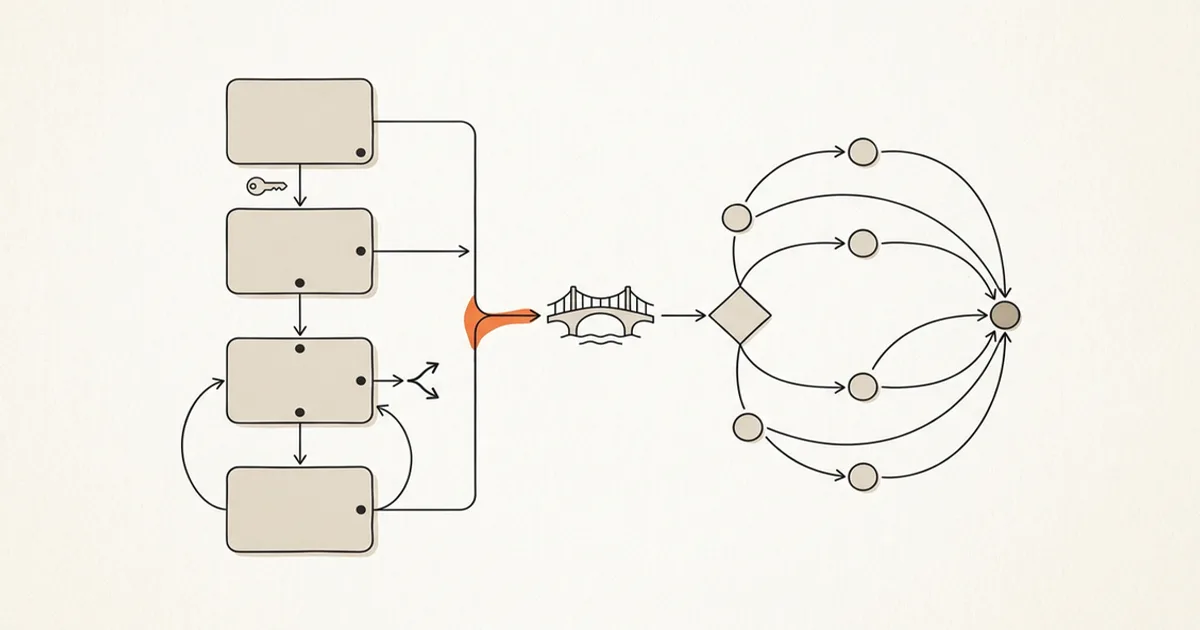
Classify the decision before naming the document
Use five sourced passes to decide whether the current owner is a runbook, playbook, or linked pair. The test is the decision and evidence boundary, not the number of pages or whether the file contains steps.
Name the trigger and uncertainty
Write the event that opens the document, what is already known, and what still must be learned. A stable trigger with a reviewed outcome and sequence points to a runbook. A category of events that still requires scoping, hypotheses, roles, and decisions points to a playbook.
Sources: [aws-runbooks], [aws-playbooks]
Assign authority before action
Record who may enter the procedure, who may approve a risky branch, who coordinates the scenario, who communicates, and when execution must stop. A document can describe an access boundary but cannot create authorization. Incident response plans remain the organizational owner for response authority and governance.
Sources: [aws-runbooks], [atlassian-playbook], [nist-incident]
Pair actions and decisions with evidence
In a runbook, pair every action with its expected observation, verification, stop condition, and recovery or escalation path. In a playbook, record the evidence used to choose a branch, the decision owner, open uncertainty, communications, and the linked procedure when a known path applies.
Sources: [aws-runbooks], [aws-playbooks], [google-incident]
Test the handoff, not only each file
Give a runbook to a qualified teammate who did not write it and observe where the ordered procedure becomes ambiguous. Exercise the playbook with a scenario that changes evidence or removes an expected branch. Confirm that the playbook points to the correct current runbook and that the runbook returns status to the coordinating record.
Sources: [aws-runbooks], [atlassian-playbook], [google-incident]
Revise from system and response evidence
Review after changes to systems, permissions, tools, contacts, policy, response roles, or linked documents, and after a walkthrough, exercise, or real event exposes drift. Keep an owner, review date, revision record, and archived superseded version so responders can identify the current document.
Sources: [aws-runbooks], [aws-playbooks], [atlassian-playbook], [epa-sop]
The owner boundary for this comparison
This page decides between two operational document shapes and explains how they link. Adjacent documentation still owns policy, detailed job control, and the wider process map.
Included
- Known repeatable operational procedures with prerequisites, ordered actions, expected observations, stops, escalation, and recovery
- Adaptive scenario guidance with roles, investigation branches, decision criteria, communications, evidence, and handoffs
- A paired service-latency example, maintenance triggers, cold walkthroughs, scenario exercises, automation boundaries, and governance
- A local vocabulary contract that acknowledges different organizations and tools use the terms differently
Not included
- A downloadable runbook pack or runbook-template query, which belongs to /blog/runbook-template
- An SOP for a wider routine or repetitive organizational activity, which belongs to /blog/standard-operating-procedure-template
- A work instruction for one role, workstation, tool, or tightly bounded task beneath a controlled procedure
- An incident response plan that establishes organizational scope, authority, policy, coordination, and governance, which belongs to /blog/incident-response-plan-template
- A cross-functional current-state or target-state map of actors, records, systems, decisions, and handoffs, which belongs to /blog/process-documentation-template
- Production authorization, executable automation, real commands, live incident proof, guaranteed recovery, compliance certification, or performance claims
Ten criteria for choosing runbook, playbook, or both
Apply every row to the same operational job. A document with numbered steps can still be a playbook when those steps guide investigation and decisions instead of executing one known procedure.
Problem shape
Separates a known repeatable operation from a scenario that still needs investigation, coordination, or judgment.
Instruction shape
Shows whether the document should prescribe an ordered path or guide branches, hypotheses, and decisions.
Authority and roles
Prevents a checklist from silently granting access or a scenario guide from leaving decisions unowned.
Evidence and output
Makes the operator record expected observations while the wider response preserves decisions and coordination evidence.
Failure and escalation
Defines what happens when the known path fails or the scenario does not match any prepared branch.
Testing and rehearsal
Distinguishes a cold procedural walkthrough from a scenario exercise that tests roles, judgment, and handoffs.
Maintenance trigger
Keeps instructions, contacts, permissions, branches, and linked documents current as systems and teams change.
Automation boundary
Separates repeatable executable steps from adaptive decisions that still need explicit authority and review.
Paired service-latency example
Shows the playbook-to-runbook handoff without pretending that one document should own an entire incident.
How the documents compose
Turns the naming debate into a usable link contract between scenario decisions and bounded procedures.
Runbook and playbook decision matrix
Neither option is universally better. Choose the owner that matches the current uncertainty, then link the documents when an adaptive scenario reaches a known repeatable procedure.
Runbook
Best for: A known operational task or failure mode with a reviewed sequence, expected observations, stop gates, escalation, and recovery.
Use a runbook to achieve one specific outcome through a bounded procedure. It reduces improvisation during execution while preserving explicit permissions, exception handling, verification, and escalation.
| Criterion | Finding |
|---|---|
| Problem shape | The trigger maps to a known outcome and a repeatable procedure. The operator should not have to invent the main path before beginning. Sources: [aws-runbooks] |
| Instruction shape | Use prerequisites, ordered actions, expected observations, verification, exception handling, stop conditions, escalation, and rollback or forward recovery. Sources: [aws-runbooks], [aws-automation] |
| Authority and roles | Name the operator, required tools and permissions, approval boundary, escalation owner, and actions the operator is not authorized to take. Sources: [aws-runbooks] |
| Evidence and output | Record expected and observed state for each material action, the verification result, deviations, stop decisions, recovery status, and the handoff back to the coordinating record. Sources: [aws-runbooks], [google-incident] |
| Failure and escalation | Stop when prerequisites fail, observations differ, the environment is uncertain, or the procedure reaches its reviewed limit. Escalate instead of extending the runbook during execution. Sources: [aws-runbooks] |
| Testing and rehearsal | Have a qualified teammate who did not author the procedure execute a safe walkthrough and report missing prerequisites, unclear steps, mismatched observations, and unreachable recovery paths. Sources: [aws-runbooks] |
| Maintenance trigger | Revise when the system, commands, tools, permissions, expected output, stop gate, recovery path, owner, or linked playbook changes. Preserve a visible current revision. Sources: [aws-runbooks], [epa-sop] |
| Automation boundary | Sequential actions can become reviewed automation, but automation still needs scoped permissions, inputs, failure behavior, observations, and a human escalation boundary. Sources: [aws-automation], [aws-runbooks] |
| Paired service-latency example | After a service-latency playbook confirms one known fictional worker failure at checkout-api.example.test, the linked runbook checks prerequisites, follows the approved mitigation sequence, verifies expected health signals, stops on mismatch, and reports status back. No real host or command is implied. Sources: [aws-runbooks], [google-incident] |
| How the documents compose | Expose a stable link from the playbook branch to the current runbook, and make the runbook return observations, result, uncertainty, and escalation status to the playbook or incident record. Sources: [aws-playbooks], [google-incident] |
Tradeoffs
- Specific ordered guidance is easier to validate and automate, but it becomes unsafe when the trigger, environment, or expected state no longer matches.
- A runbook can execute a technical handoff inside a response, but it should not absorb scenario command, communications, or policy authority.
Playbook
Best for: A category of events that needs investigation, role coordination, branching decisions, communication, and selection among possible actions.
Use a playbook to make an adaptive response consistent without pretending every scenario is predetermined. It supplies roles, discovery paths, decision criteria, evidence and communication records, escalation, and links to bounded runbooks.
| Criterion | Finding |
|---|---|
| Problem shape | The trigger opens an investigation or coordinated response. Scope, impact, cause, stakeholder needs, or the appropriate action is not yet fully known. Sources: [aws-playbooks], [atlassian-playbook] |
| Instruction shape | Use investigation stages, hypotheses, evidence checks, branch criteria, roles, communication points, escalation, and links to procedures. The path may loop as evidence changes. Sources: [aws-playbooks], [atlassian-playbook] |
| Authority and roles | Define the coordinating role, technical lead, communications owner, decision authority, supporting roles, and conditions for bringing in additional owners. Sources: [atlassian-playbook], [google-incident] |
| Evidence and output | Preserve the current impact, evidence, hypotheses, decisions, owners, communications, invoked runbooks, remaining uncertainty, and next checkpoint in one coordinating record. Sources: [google-incident], [atlassian-playbook] |
| Failure and escalation | Escalate when no branch fits, required expertise or authority is missing, impact expands, evidence conflicts, or the response crosses the scenario boundary. Sources: [aws-playbooks], [atlassian-playbook] |
| Testing and rehearsal | Run a scenario exercise that changes evidence, removes a contact, invalidates one assumption, and forces a handoff. Review role clarity, branch coverage, communication, and linked-runbook currency. Sources: [atlassian-playbook], [google-incident] |
| Maintenance trigger | Revise after exercises, events, post-incident findings, team or contact changes, policy changes, new scenarios, and any update that changes a linked runbook or decision boundary. Sources: [aws-playbooks], [atlassian-playbook] |
| Automation boundary | Discovery steps and evidence collection may be assisted or automated, but the playbook must keep consequential decision authority, uncertainty, permissions, and exception handling explicit. Sources: [aws-playbooks] |
| Paired service-latency example | For fictional latency at checkout-api.example.test, the playbook assigns coordination, scopes customer impact, compares evidence across dependencies, records hypotheses, decides whether a known worker-failure branch fits, communicates status, and invokes the current runbook only after that decision. Sources: [aws-playbooks], [atlassian-playbook], [google-incident] |
| How the documents compose | Treat the playbook as the scenario and decision owner. Link to runbooks for known execution paths, then ingest their observations without duplicating or silently forking procedure steps. Sources: [aws-playbooks], [atlassian-playbook] |
Tradeoffs
- Shared roles and branches reduce coordination ambiguity, but the guide must leave room for evidence and judgment when the prepared scenario does not match reality.
- A broad playbook can link many procedures, while that link graph, contact roster, decision authority, and scenario coverage require continuing rehearsal and maintenance.
Choose one owner, then add the handoff only when needed
Start with the smallest document that owns the real decision. A linked pair is useful only when the scenario genuinely contains both adaptive coordination and a known executable procedure.
The trigger, environment, authorized operator, expected state, ordered procedure, and recovery path are already known.
Choose: Use a runbook and test it with a cold walkthrough.
Tradeoff: Execution becomes more consistent, but the runbook must stop rather than improvise when reality no longer matches its reviewed boundary.
The event category is known but responders must still investigate impact, compare hypotheses, coordinate roles, communicate, and choose among actions.
Choose: Use a playbook and rehearse changing evidence and missing branches.
Tradeoff: The team gains a shared response frame, while judgment and authority cannot be replaced by generic steps.
An adaptive scenario repeatedly reaches a known technical action with stable prerequisites and expected observations.
Choose: Keep the scenario in the playbook and extract the repeatable action into a linked runbook.
Tradeoff: Two documents must maintain stable links and ownership, but the playbook stays readable and the procedure can be tested independently.
The document governs a routine or repetitive activity across the organization rather than one operational outcome or scenario.
Choose: Use an SOP and link specialist runbooks where technical execution needs them.
Tradeoff: The controlled procedure preserves wider organizational context without forcing every role and policy into a technical runbook.
The artifact establishes incident-response scope, policy, authority, capabilities, coordination, and governance across scenarios.
Choose: Use an incident response plan; let its playbooks guide scenarios and its runbooks own bounded procedures.
Tradeoff: The hierarchy takes more governance, but a scenario document does not masquerade as the organization-wide response authority.
MODEL THE HANDOFF
Turn one reviewed operating decision into a working surface
Describe the trigger, roles, evidence, branches, procedure links, stops, and recovery boundary. Start with one scenario-to-procedure handoff your team can inspect.
Start BuildingThe document model does not create production authorization or prove a response outcome.
Explore internal tool building for reviewed operational workflows
Limits of the distinction
Runbook and playbook are conventions, not universally standardized document types. Use the comparison to create a local contract, not to relabel every existing file mechanically.
- AWS explicitly separates runbooks for procedures from playbooks for investigation, while other organizations use playbook for a wider response guide that can contain procedures, checklists, and runbooks.
- A useful runbook may contain exception branches, and a useful playbook may contain ordered stages. The decisive question is whether the document owns known execution or adaptive scenario decisions.
- A document cannot grant production access, prove authorization, execute automation, establish incident command, certify compliance, or guarantee recovery or response performance.
- Testing a fictional or non-production scenario does not prove a real response will succeed. Review actual systems, dependencies, permissions, contacts, evidence handling, and recovery paths.
- Legal, regulatory, safety, privacy, employment, financial, and sector-specific response duties require accountable domain review outside this general comparison.
Official sources and vocabulary record
These sources were checked on August 1, 2026. Together they support the local distinction and expose where official vocabulary differs instead of pretending the terms have one universal definition.
[aws-runbooks] Amazon Web Services:OPS07-BP03 Use runbooks to perform procedures
Checked August 1, 2026. Supports: Runbooks as step-by-step guides for specific outcomes, including tools, permissions, error handling, escalation, ownership, central publication, teammate validation, and continuing updates.
[aws-playbooks] Amazon Web Services:OPS07-BP04 Use playbooks to investigate issues
Checked August 1, 2026. Supports: Playbooks as guides for investigation, impact scoping, root-cause discovery, communications, escalation, and handoff to companion runbooks for known mitigation paths.
[aws-automation] Amazon Web Services:Creating your own automation runbooks
Checked August 1, 2026. Supports: Automation runbooks as ordered actions and steps, including output passed between steps and the permission boundary of service roles.
[google-incident] Google SRE:Google SRE Workbook: Incident Response
Checked August 1, 2026. Supports: Incident roles, a recognized command post, a live incident document, an operational work log, clear handoffs, managed communications, and post-incident learning.
[atlassian-playbook] Atlassian:How to create an incident response playbook
Checked August 1, 2026. Supports: A broader playbook vocabulary covering roles, consistent phases, templates, checklists, training exercises, adaptation during incidents, communications, and postmortems.
[nist-incident] National Institute of Standards and Technology:NIST SP 800-61 Revision 3
Checked August 1, 2026. Supports: The organization-wide cybersecurity incident-response and risk-management boundary that remains broader than either a scenario playbook or one technical runbook.
[epa-sop] United States Environmental Protection Agency:Guidance for Preparing Standard Operating Procedures
Checked August 1, 2026. Supports: SOPs as controlled written instructions for routine or repetitive organizational activities, including access, review, revision, approval, and detailed work-instruction context.
Runbook and playbook questions
Are runbook and playbook interchangeable terms?
They can be. Official sources and operational teams use the words differently. Adopt a local definition, publish it beside the document library, and classify existing files by the decision they own. This guide uses runbook for a known repeatable procedure and playbook for adaptive scenario investigation, coordination, and decisions.
Can a playbook contain or link to runbooks?
Yes. A playbook can identify a known branch and link to the current runbook that owns the bounded procedure. Keep the steps in one source rather than copying them into the playbook. The runbook should return observations, result, uncertainty, and escalation status to the coordinating record.
Is a runbook the same as a standard operating procedure?
They overlap, and organizations may treat a runbook as one kind of SOP. A useful local boundary is scope: an SOP governs a wider routine or repetitive organizational activity, while a runbook owns one operational outcome with environment-specific prerequisites, observations, stop gates, escalation, and recovery.
How is a work instruction different from a runbook?
A work instruction is usually the narrowest task-level layer for one role, workstation, tool, or technique under a controlled procedure. A runbook typically includes the operational trigger, environment, prerequisites, expected state, error handling, escalation, and recovery around several actions. Define the hierarchy locally because terminology varies.
How is a playbook different from an incident response plan?
The incident response plan establishes the organization-wide scope, authority, policy, capabilities, coordination, and governance for responding to incidents. A playbook applies that boundary to a scenario or event category. A runbook may then execute a known technical procedure selected by the playbook or incident command.
Can runbooks and playbooks be automated?
Repeatable runbook actions are stronger automation candidates because their inputs, sequence, expected outputs, failures, and permissions can be bounded. Playbook discovery steps and evidence collection may also be assisted, but consequential decisions, authority, uncertainty, and exceptions must remain explicit and reviewed.
Which document should a team create first?
For one known recurring operation, start with the runbook. For an uncertain event category involving several roles or possible causes, start with the playbook and extract runbooks for repeated known branches. Create both only when the handoff is real, then test the link as well as each document.
How often should runbooks and playbooks be reviewed?
Use event-driven review plus a named cadence. Recheck after system, permission, tool, contact, policy, role, or linked-document changes, and after a walkthrough, exercise, postmortem, or real event exposes drift. A calendar review alone cannot detect every invalid assumption.
START WITH ONE BOUNDARY
Build the smallest operations workspace that keeps decisions accountable
Give Playcode the reviewed roles, records, states, and handoffs. Keep real permissions, provider setup, incident authority, and production verification with their accountable owners.
Start BuildingNo credit card required. AI credits are included to start; production requirements and plan limits still apply.