QUICK ANSWER
What should a knowledge base template include?
A knowledge base template defines reusable article types, stable IDs and canonical slugs, taxonomy, audience, owner, evidence references, review and freshness dates, lifecycle and retirement state, redirects, internal links, and feedback follow-up. It keeps a maintainable article set consistent, but it does not prove access control, support resolution, search quality, compliance, or chatbot quality.
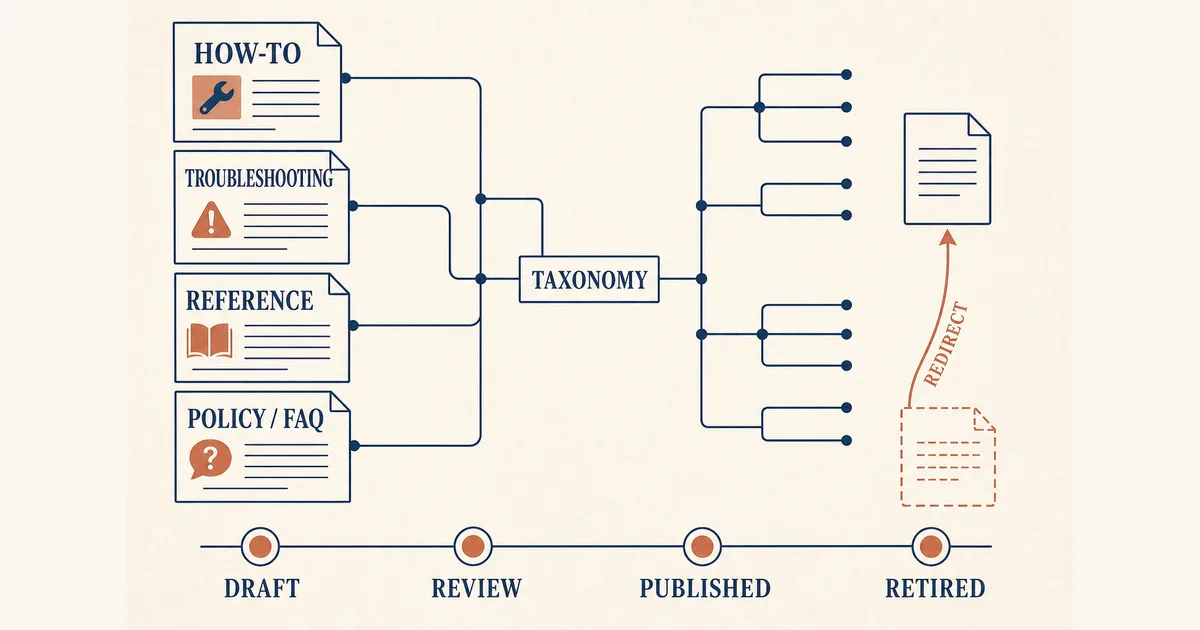
A knowledge base becomes difficult to maintain when every page uses a different structure, a URL acts as the only identity, review dates disappear, and retirement means deleting content without a redirect decision. A reusable template should expose those operating choices before prose hides them.
This original pack supplies four article worksheets, a fictional five-article example, a closed schema, three CSV registers, and a dependency-free validator with mutation tests. It governs article records and relationships. It does not provide a website theme, helpdesk, search engine, permission system, chatbot, or compliance result.
Design the article contract before filling the knowledge base
Treat the template as a governed record model, not a styling file. Each field should help a reader find the current article or help an owner explain why that article is current.
Choose article types by the reader job
Separate tasks, troubleshooting, reference, and policy or FAQ content because they answer different questions. KCS emphasizes simple, reusable article structure, while Microsoft documents templates that prepopulate consistent article fields and content structure. The pack supplies an original worksheet for each job without copying vendor prose.
Sources: [kcs-v6], [microsoft-article-templates], [knowledge-base-pack]
Give every article a stable identity and bounded audience
Assign a durable article ID separately from the canonical slug. Record the audience, owner, reviewer, taxonomy references, evidence sources, and article type before publication. A slug can then move through an explicit redirect without erasing the article record or pretending the URL is the source of truth.
Sources: [kcs-v6], [knowledge-base-pack]
Make review and freshness observable
Keep revision creation, last review, next review, and freshness state together. The deterministic example computes fresh, due-soon, expired, or not-applicable from one fixed as-of date. Human reviewers still judge accuracy, usefulness, and whether source evidence is current.
Sources: [kcs-v6], [knowledge-base-pack]
Structure content for navigation and adaptation
Use descriptive headings, meaningful link text, logical relationships, and text alternatives for non-text content in the published implementation. WCAG 2.2 provides the accessibility boundary; the pack records structure and links but does not make a conformance claim or test a rendered site.
Sources: [wcag-22], [microsoft-article-templates]
Validate lifecycle, links, retirement, and file parity
Use a closed Draft 2020-12 schema plus semantic checks for IDs, relationships, chronology, transitions, reciprocal links, retired-slug disposition, redirect targets, and cross-file projections. Rebuild the exact allowlisted archive twice and compare bytes before publishing the download.
Sources: [json-schema-2020-12], [knowledge-base-pack]
What this knowledge base template owns
Use this resource for the records and editorial rules that keep a set of articles reviewable. Keep product implementation and vendor-selection jobs with their separate owners.
Included
- Stable article identity, type, title, canonical slug, audience, owner, reviewer, revision, evidence, and review dates
- Taxonomy tree, article links, reciprocal backlinks, lifecycle history, freshness state, retirement disposition, and redirect records
- Original worksheets for how-to, troubleshooting, reference, and policy or FAQ articles
- Fictional Markdown, JSON, and CSV examples plus a closed schema, dependency-free validator, mutation tests, and reproducible ZIP
Not included
- Website themes, visual site templates, page implementation, hosting, or a packaged knowledge-base product
- Helpdesk tickets, inbox operations, vendor comparison, pricing, selection, procurement, or migration claims
- Search ranking or quality, authentication, permissions, private-content protection, analytics, or support-resolution proof
- RAG, embeddings, chatbot answers, native provider integrations, compliance certification, or legal and regulatory sufficiency
DOWNLOADABLE RESOURCE
Download the reproducible knowledge base template pack
Start with the Markdown worksheets, then review the fictional `Larkspur Field Guide` records and CSV projections. Replace every fictional value, keep private source material outside the public files, and test the actual publishing and access system separately.
Knowledge base template pack
An original article-governance pack for four article types, taxonomy, owners, audiences, review, freshness, lifecycle history, retirement, redirects, links, and evidence references.
Format: Markdown, JSON, closed JSON Schema, three CSV registers, and dependency-free validator/tests in one ZIP
Locally reproduced August 1, 2026. SHA-256: e6d96e11368340ea87a38748697327ed710d1be93fdfc6e778631b33491d561b
Included
- One Markdown template with four article-type worksheets and an explicit validation boundary
- One fictional five-article JSON example plus three matching CSV registers
- One closed Draft 2020-12 schema and dependency-free semantic validator
- Forty-nine deterministic tests for valid state, mutations, privacy, formula safety, and cross-file parity
Verification boundary
After extraction, run `node --test validate-knowledge-base.test.mjs` and `node validate-knowledge-base.mjs knowledge-base-example.json`. Rebuild from the reviewed page-local sources and compare the exact nine-file allowlist and ZIP SHA-256. These checks validate the fictional contract only, not article truth or a deployed knowledge base.
Four article patterns with different evidence jobs
Reuse the shared identity and governance fields, then change the article body to match the reader question. Each example remains fictional and needs source, subject-owner, accessibility, and publishing review before use.
Task how-to article
Use when: A reader has one bounded goal and needs an ordered, verifiable sequence.
State the goal, prerequisites, ordered actions, expected result, verification signal, and safe stop or recovery boundary. Keep each step observable instead of using generic instructions such as configure the system.
Structure
- Stable identity, audience, owner, source revision, prerequisites, steps, and verification
- Canonical slug, review date, freshness state, related troubleshooting and reference links
Watch for: A readable procedure does not prove that the action is authorized, safe for every environment, reversible, or currently correct.
Sources: [microsoft-article-templates], [wcag-22], [knowledge-base-pack]
Symptom-led troubleshooting article
Use when: A reader observes a specific failure and needs bounded diagnosis before escalation.
Lead with observable symptoms, then record environment checks, likely causes, resolution steps, verification, and the escalation boundary. Link to the controlled reference that defines status codes or known states.
Structure
- Symptoms, checks, causes, actions, verification, escalation, evidence, and review owner
- Reciprocal links to task and reference articles so readers can move without orphan paths
Watch for: Do not copy customer-specific details, credentials, private conversations, or unsupported diagnoses into a reusable public article.
Sources: [kcs-v6], [knowledge-base-pack]
Bounded reference article
Use when: Readers need stable definitions, fields, states, limits, and examples rather than a procedure.
Keep definitions and examples close to the source register, name exclusions, and expose related records. Review every consuming article when the reference changes instead of duplicating definitions in several pages.
Structure
- Summary, definitions, examples, limits, related records, evidence, owner, and revision
- Backlinks from every task or troubleshooting article that depends on the reference
Watch for: A reference describes the controlled contract. It does not prove implementation behavior, compatibility, or universal applicability.
Sources: [wcag-22], [json-schema-2020-12], [knowledge-base-pack]
Policy or FAQ article with retirement
Use when: Readers need one current rule plus bounded questions, exceptions, and an accountable review owner.
Record the policy statement, audience, exceptions, questions, evidence, effective date, and review owner. When the rule changes, preserve the old article record and choose a loop-free redirect or an explicit gone disposition.
Structure
- Policy statement, applicability, exceptions, questions, effective date, evidence, and review owner
- Retired revision, reason, disposition, target article, and matching redirect record when replaced
Watch for: A template is not legal advice, regulatory evidence, customer notice, or proof that a policy was approved or delivered.
Sources: [kcs-v6], [knowledge-base-pack]
Choose the next owner by the job, not the shared noun
Knowledge base can mean an article template, a custom application, a packaged tool, or an AI answer layer. Keep those decisions separate.
You need repeatable article fields, taxonomy, ownership, review dates, lifecycle records, and retirement rules.
Choose: Download and adapt this knowledge base template pack.
Tradeoff: The pack adds governance work and requires a named owner to keep records and CSV projections aligned.
You need a custom public or private article application with database records, permissions, publishing, search, export, and recovery.
Choose: Use the custom knowledge base builder owner.
Tradeoff: A custom build requires implementation, authorization, data, search, deployment, and operating tests beyond this template.
You are comparing packaged knowledge-base vendors, pricing meters, workflow, search, export, and operating fit.
Choose: Use the dated best knowledge base software comparison.
Tradeoff: A vendor shortlist saves build time but introduces plan limits, migration, portability, and product-change risk.
You need developer-facing API operations, schemas, authentication, examples, errors, compatibility, and changelog rules.
Choose: Use the API documentation template.
Tradeoff: API reference depth serves a different reader job and should not turn the general knowledge-base template into an engineering catch-all.
Original same-release resource
Start with the reviewed article contract
Download the exact pack, inspect the fictional records, run all forty-nine tests, and replace every example value before adapting it to a real knowledge base.
Download the template packThe same-release ZIP checksum is recorded in the verification panel above. Local reproduction is verified; the public download path still needs target-environment HTTP verification after release.
Compare packaged knowledge base softwareUse the dated comparison for vendor-selection intent rather than stretching this template into a product ranking.
What the template and validator cannot prove
Structural checks make contradictions visible. They do not replace subject-matter, security, privacy, accessibility, legal, or production review.
- The validator does not authenticate sources, judge article accuracy, measure usefulness, or prove a support outcome.
- The pack does not implement or test publishing, search, analytics, tickets, authentication, permissions, private files, or access control.
- The article structure does not establish WCAG conformance; test the rendered implementation with appropriate automated and human review.
- A passing schema does not prove safe content, authorized processing, regulatory sufficiency, certification, or legal validity.
- The fictional lifecycle and redirects do not prove provider behavior, production HTTP responses, crawler behavior, or migration safety.
- No chatbot, RAG, embeddings, model quality, citations, private-source isolation, or human support queue is included or tested.
Primary references and original pack evidence
These sources support bounded structure, maintenance, accessibility, and schema decisions. They do not endorse the pack or prove the adapted result.
[knowledge-base-pack] Playcode:Same-release knowledge base template pack
Checked August 1, 2026. Supports: The original fictional record model, worksheets, CSV projections, closed schema, validator behavior, deterministic tests, and exact archive hash.
[kcs-v6] Consortium for Service Innovation:KCS v6 Practices Guide
Checked August 1, 2026. Supports: Simple article structure, reuse and improvement, content health, article state, archival, linking, and accountable knowledge practice without claiming KCS conformance.
[microsoft-article-templates] Microsoft Learn:Create templates for knowledge articles
Checked August 1, 2026. Supports: Current first-party evidence that knowledge article templates can prepopulate consistent article fields and content structure for authors.
[wcag-22] World Wide Web Consortium:Web Content Accessibility Guidelines 2.2
Checked August 1, 2026. Supports: The accessibility boundary for headings, labels, link purpose, text alternatives, relationships, and rendered web content without implying conformance.
[json-schema-2020-12] JSON Schema:JSON Schema Draft 2020-12
Checked August 1, 2026. Supports: The vocabulary and metaschema version used by the closed machine-readable contract in the downloadable pack.
Knowledge base template questions
What is included in the knowledge base template pack?
The ZIP contains one Markdown file with four article worksheets, one completed fictional JSON example, one closed Draft 2020-12 schema, article, taxonomy and redirect, and source CSV registers, plus a dependency-free validator and forty-nine tests. It ships no theme, application, provider connector, credentials, or private data.
Which knowledge base article types should I use?
Use a how-to for one bounded task, troubleshooting for an observed symptom, reference for stable definitions or fields, and policy or FAQ for a current rule and recurring questions. Keep the shared identity, audience, owner, evidence, review, freshness, lifecycle, link, and retirement fields around every type.
How should I handle stale knowledge base articles?
Record the last review, next review, and computed freshness state. A due or expired article needs a human decision: review and republish, return it to review, or retire it. Do not silently refresh the date. Preserve the revision and evidence that explain what was reviewed.
Should a retired article redirect or return gone?
Redirect only when a current article honestly serves the same reader job. Record the retired article, target article, reason, timestamp, and loop-free redirect. Use an explicit gone disposition when no safe replacement exists. Test the production HTTP behavior separately because this pack validates records, not a deployed router.
Does this template prove knowledge base permissions or search?
No. The pack records audience and taxonomy intent but does not authenticate a reader, enforce permissions, protect private files, index content, rank results, or measure search quality. Those are implementation and production-test responsibilities for the actual knowledge-base application.
Can I use this template for an AI chatbot or RAG system?
The article records may help organize reviewed sources, but the pack does not implement retrieval, embeddings, model calls, citations, uncertainty, prompt-injection defenses, private-source isolation, action authorization, or human escalation. Treat an AI answer layer as a separate system with its own evidence and tests.
Need the application behind the articles?
Build the custom knowledge base your workflow needs
Describe the article records, audiences, permissions, review path, publishing, search, retirement, export, and recovery contract. Playcode can build the custom web app while this template remains the editorial source.
Build a custom knowledge baseThis informational article does not grant AI signup credits. The custom builder page owns the commercial build intent.