QUICK ANSWER
What should a software design document include?
A software design document should define the system boundary, architecture views, components, interface contracts, data ownership and lifecycle, deployment and rollback, trust assumptions, security controls, operations, alternatives, and unresolved questions. It should explain why each decision was made and how reviewers will verify it, without replacing requirements prioritization or a project schedule.
A useful software design document is a review surface, not a ceremonial essay. It makes the system boundary, architecture, interfaces, data ownership, deployment path, trust assumptions, operational responsibilities, and tradeoffs concrete enough for another engineer to challenge before implementation.
This guide includes an editable Markdown template, a machine-readable JSON record, a closed JSON Schema, a fictional completed example, and a deterministic validator. It deliberately stops at design ownership: requirements prioritization and the project schedule belong in adjacent documents.
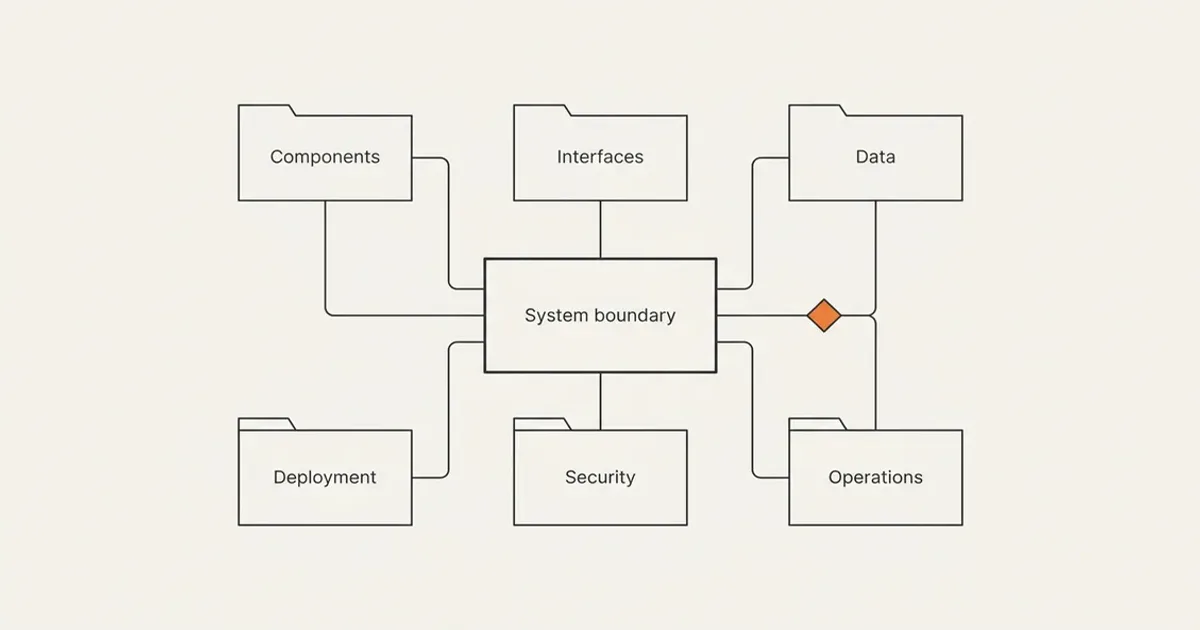
How this template was assembled
The template translates current architecture-description, secure-development, verification, and schema guidance into a compact review record. Source IDs connect every method step and example to the evidence below.
Frame the system and its views
State the system boundary, stakeholders, concerns, context, containers, and only the architecture views needed to explain the design. Treat the document as an architecture description, not as a prescribed drawing format.
Sources: [iso-42010], [c4-model]
Make contracts and data explicit
Describe components by responsibility, connect consumers and providers through named interfaces, record request, response, error, and compatibility behavior, then assign every data record an owner and lifecycle.
Sources: [microsoft-task-design], [c4-model], [json-schema-2020-12]
Review deployment and trust together
Connect deployment units to containers, define rollout and rollback evidence, identify trust-boundary threats, and map each control to a verification activity rather than claiming certification.
Sources: [nist-ssdf], [owasp-asvs]
Record alternatives and review status
Keep selected and rejected options beside the rationale and tradeoffs. A reviewed revision records design authority only; it does not approve requirements, funding, schedule, compliance, or production readiness.
Sources: [microsoft-task-design], [iso-42010]
What this document owns
Use this document for technical design decisions that reviewers need to understand and test. Link to requirement and planning records instead of copying their authority into the design.
Included
- System context, actors, boundary, constraints, assumptions, and architecture views
- Containers, components, responsibilities, dependencies, and interface contracts
- Data ownership, classification, lifecycle, retention boundary, and flows
- Deployment units, environments, migrations, rollout, rollback, and smoke checks
- Trust boundaries, threats, controls, verification, residual risk, operations, and decisions
Not included
- Requirement discovery, approval, prioritization, acceptance criteria, and backlog ownership
- Estimates, staffing, milestones, project schedule, delivery commitments, and roadmap priority
- Budget or procurement approval, legal advice, compliance certification, and security accreditation
- Automatic production approval or a guarantee of availability, performance, or implementation success
DOWNLOADABLE RESOURCE
Download the reproducible design-document pack
The archive contains editable and machine-readable forms of the same fictional design, plus a closed schema, dependency-free validator, contract tests, and deterministic archive builder. Inspect and adapt it before using it for a real system.
Software design document template pack
A reproducible starter pack for recording architecture, components, interfaces, data, deployment, trust, operations, decisions, and review boundaries.
Format: ZIP with Markdown, JSON, JSON Schema, and Node.js validation scripts
Locally reproduced August 1, 2026. SHA-256: 1899d012bd0a4566a06f5aa6799c6e3ec8aec55ab17a58be77d8984bfa76a17f
Included
- Editable Markdown template and fictional completed Markdown example
- Machine-readable JSON example and closed draft 2020-12 JSON Schema
- Dependency-free validator with mutation tests and cross-reference checks
- Deterministic allowlisted ZIP builder with fixed timestamps
Verification boundary
Run npm test and npm run validate after extraction. Rebuild with node build-pack.mjs and compare the resulting archive SHA-256 with this value.
Three ways to scale the template
Keep the same ownership boundary while changing the depth of each section. More diagrams or fields do not make a design stronger unless they expose a decision or verification point.
Internal request-routing service
Use when: A small service has a form, API, queue, worker, and operational ownership split.
The included Northstar example traces request submission through components, contracts, records, deployment units, trust controls, and a reviewed decision set.
Structure
- One system context with four containers and four components
- Three interfaces with compatibility and error contracts
- Two data records with explicit owners and lifecycle boundaries
- Threats, controls, verification checks, deployment, and rollback decisions
Watch for: The names, domains, people, and decisions are fictional. Replace every assumption and identifier after reviewing the real system.
Sources: [c4-model], [microsoft-task-design], [json-schema-2020-12]
Public API with asynchronous work
Use when: External consumers and background processing make compatibility and trust boundaries central.
Expand interface versions, authentication boundaries, replay behavior, queue failure modes, and verification evidence before discussing implementation readiness.
Structure
- Context and container views for external and internal boundaries
- Versioned request, response, error, event, and idempotency contracts
- Rollout, rollback, observability, and residual-risk review
Watch for: An application-security checklist supports review but does not by itself certify the system or resolve organization-specific threats.
Sources: [iso-42010], [nist-ssdf], [owasp-asvs]
Data-heavy reporting service
Use when: Several producers, classifications, retention rules, and derived records cross component boundaries.
Add data-flow views, lineage identifiers, owner components, deletion behavior, migration verification, and recovery checks while keeping product requirements in the PRD.
Structure
- Data records and flows linked to owning components
- Classification, retention boundary, deletion, backup, and restore behavior
- Schema validation and architecture decisions for compatibility changes
Watch for: The template can expose missing compliance decisions, but it is not a legal opinion or compliance approval.
Sources: [iso-42010], [json-schema-2020-12], [nist-ssdf]
Rules for a reviewable design
Apply these checks before marking a revision reviewed. Each rule favors traceability over document length.
A component cannot be tied to a single responsibility and container
Choose: Split or rename it until ownership and dependency direction are unambiguous.
Tradeoff: More components create more references to maintain, but vague boundaries hide coupling.
An interface lacks error, authentication, or compatibility behavior
Choose: Keep the design open and add the missing contract before implementation authority.
Tradeoff: Earlier contract work slows immediate coding but reduces incompatible assumptions.
A data record has no owner or lifecycle boundary
Choose: Assign an owner component and state creation, retention, deletion, and recovery behavior.
Tradeoff: Explicit lifecycle choices can expose unresolved policy work that needs another owner.
A trust control has no linked verification activity
Choose: Treat it as an unverified proposal, not an implemented or certified control.
Tradeoff: Verification adds review effort but prevents security language from becoming an unsupported claim.
Rollout changes storage, contracts, or trust boundaries without rollback evidence
Choose: Keep the revision open and define migration, smoke-check, and recovery evidence.
Tradeoff: Some changes are not directly reversible, so the design must record forward-recovery limits.
Editable artifact
Start with the reviewed structure
Download the pack, replace the fictional Northstar record, and run its validator before design review.
Download the template packThe validator checks structure and references. It cannot decide whether the design is safe or correct.
Separate requirements with the PRD templateThe PRD owns product requirements and prioritization; this document owns technical design decisions.
Limits of the template
A validated record proves internal consistency, not design quality. Reviewers still need system evidence, domain expertise, and authority appropriate to the change.
- The source map is a synthesis of guidance and standards, not a claim that any source mandates this exact template.
- The fictional example does not model every distributed-systems, privacy, safety, accessibility, or regulatory concern.
- Passing the validator does not approve requirements, schedule, budget, security, compliance, deployment, or production readiness.
- Architecture, technology, threat, and operations decisions must be re-reviewed when system or trust boundaries change.
- Standards and linked guidance can change after the checked date; review the current authoritative source before relying on it.
Authoritative source map
These primary sources were checked on August 1, 2026. Each entry states the limited fact it supports; none endorses this template or Playcode.
[microsoft-task-design] Microsoft Engineering Playbook:Task design review template
Checked August 1, 2026. Supports: A design proposal can cover the problem, goals, non-goals, options, technology choices, diagrams, pseudocode, interface contracts, open questions, and resources.
[iso-42010] International Organization for Standardization:ISO/IEC/IEEE 42010:2022
Checked August 1, 2026. Supports: The 2022 standard specifies requirements for the structure and expression of architecture descriptions, viewpoints, and model kinds without prescribing a particular medium or tool.
[c4-model] C4 model:C4 model diagrams
Checked August 1, 2026. Supports: Static structure can be described through system context, container, component, and code views, with deployment and dynamic diagrams used when they add useful information.
[nist-ssdf] National Institute of Standards and Technology:Secure Software Development Framework 1.1
Checked August 1, 2026. Supports: NIST SP 800-218 groups secure software development practices that can be integrated into an SDLC and supplies a common vocabulary for producers and acquirers.
[owasp-asvs] OWASP Foundation:Application Security Verification Standard 5.0.0
Checked August 1, 2026. Supports: ASVS provides requirements for verifying technical application-security controls and a basis for testing those controls; the current stable release listed is 5.0.0.
[json-schema-2020-12] JSON Schema:JSON Schema draft 2020-12
Checked August 1, 2026. Supports: Draft 2020-12 defines the current published JSON Schema vocabulary used to describe and validate the machine-readable record in the pack.
Software design document questions
What is the difference between a software design document and a PRD?
A PRD owns product requirements, outcomes, acceptance criteria, and prioritization. A software design document owns the technical boundary, architecture, contracts, data, deployment, trust, operations, and decision rationale used to implement reviewed requirements.
Does every design need every possible diagram?
No. Use only the views that reveal a decision, dependency, boundary, data flow, deployment shape, or runtime interaction reviewers need to understand. A diagram without a review purpose creates maintenance cost without useful evidence.
Can the JSON validator approve the architecture?
No. It checks required fields, closed shapes, identifiers, cross-references, review boundaries, and Markdown parity. Human reviewers must judge whether the decisions, threats, controls, tradeoffs, and evidence are appropriate for the real system.
When should the design document be updated?
Update it when a system boundary, component responsibility, interface contract, data lifecycle, deployment strategy, trust assumption, operational responsibility, or selected alternative changes. Record a new revision and repeat the affected review.
Does reviewed mean approved for production?
No. In this template, reviewed means the named technical reviewers recorded the design revision. Requirements approval, project schedule, funding, security certification, compliance approval, and production authorization remain separate decisions.
Does this article or download include AI credits?
No. This is an informational article with a downloadable template. It does not grant signup AI credits; product eligibility and plan limits are separate.
From design to implementation
Build the reviewed design in Playcode
Use Playcode after the system boundary and implementation authority are clear, then verify the result against the design record.
Open the AI app builderThis informational article does not grant signup AI credits. Product eligibility and plan limits are separate.